
XR Polarizer Market Report 2026
Global Outlook – By Type (Virtual Reality Polarizer, Augmented Reality Polarizer), By Polarizer Type (Linear Polarizing Films, Circular Polarizing Films, Advanced Optical Coatings), By Device Type (Head-Mounted Displays, Smart Glasses, Immersive Visualization Devices), By Application (Consumer Electronics, Automobile, Other Applications), By End-User (Consumer Electronics, Automotive, Healthcare, Gaming) – Market Size, Trends, Strategies, and Forecast to 2035
XR Polarizer Market Overview
• XR Polarizer market size has reached to $1.7 billion in 2025 • Expected to grow to $3.4 billion in 2030 at a compound annual growth rate (CAGR) of 15% • Growth Driver: Growing Adoption Of Consumer Electronics Driving The Growth Of The Market Due To Enhanced Display Demand And Rising Device Usage • Market Trend: Innovative Optical Engine Prototype Boosts Brightness And Efficiency For AR Glasses • Asia-Pacific was the largest region and fastest growing region.What Is Covered Under XR Polarizer Market?
Extended reality (XR) polarizers are optical components used in virtual, augmented, and mixed reality displays to control the polarization of light. They help reduce glare, improve contrast, and enhance image clarity within compact XR optical systems. These polarizers help to improve visual quality and viewing comfort in immersive XR devices. The main types of extended reality (XR) polarizers include virtual reality polarizers and augmented reality polarizers. Virtual reality polarizers refer to optical components that control light polarization in VR devices, enhancing image clarity, contrast, and visual comfort for immersive experiences. The polarizer types involved are linear polarizing films, circular polarizing films, and advanced optical coatings. The device types include head-mounted displays, smart glasses, and immersive visualization devices. The various applications involved include consumer electronics, automobile, and other applications, utilized across end users such as consumer electronics, automotive, healthcare, and gaming.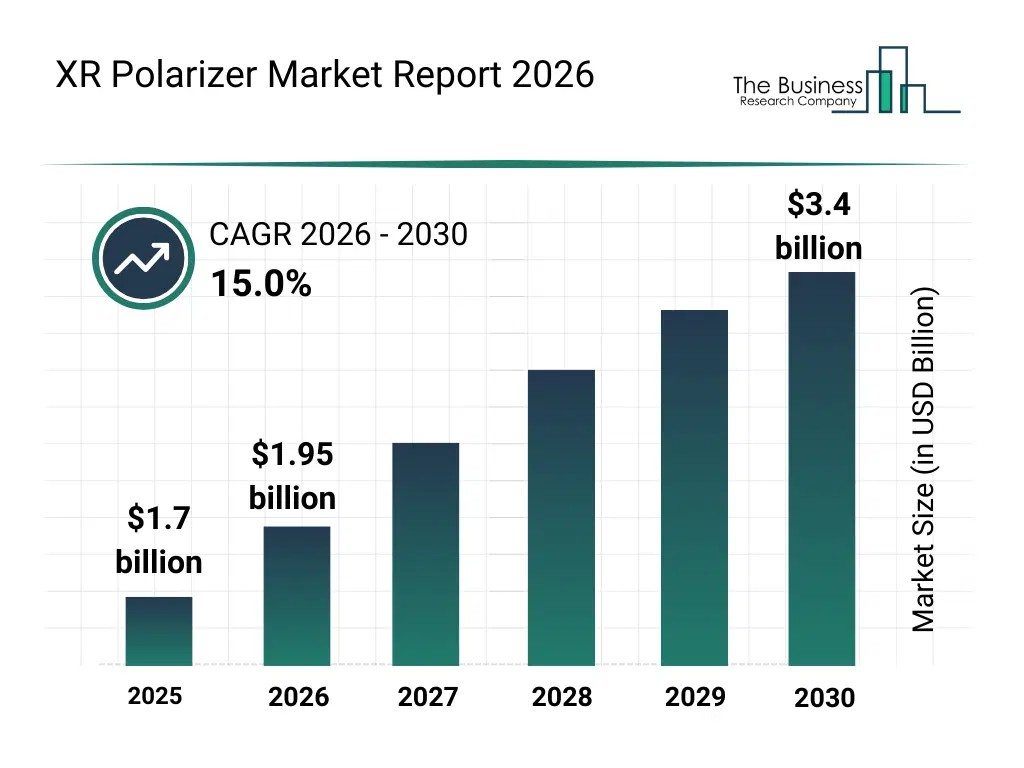
What Is The XR Polarizer Market Size and Share 2026?
The xr polarizer market size has grown rapidly in recent years. It will grow from $1.7 billion in 2025 to $1.95 billion in 2026 at a compound annual growth rate (CAGR) of 14.7%. The growth in the historic period can be attributed to growth in vr headset launches, expansion of ar device prototypes, rising demand for compact optics, historic display glare challenges, increased gaming headset adoption.What Is The XR Polarizer Market Growth Forecast?
The xr polarizer market size is expected to see rapid growth in the next few years. It will grow to $3.4 billion in 2030 at a compound annual growth rate (CAGR) of 15.0%. The growth in the forecast period can be attributed to expansion of ar smart glasses, rising enterprise xr usage, growth in immersive gaming, higher demand for lightweight optics, increasing xr display resolution needs. Major trends in the forecast period include high contrast xr optical polarizing films, ultra thin polarizer layers for headsets, Waveguide compatible polarizer designs, low reflection xr optical filters, laminated compact polarizer assemblies.
Global XR Polarizer Market Segmentation
1) By Type: Virtual Reality Polarizer; Augmented Reality Polarizer 2) By Polarizer Type: Linear Polarizing Films; Circular Polarizing Films; Advanced Optical Coatings 3) By Device Type: Head-Mounted Displays; Smart Glasses; Immersive Visualization Devices 4) By Application: Consumer Electronics; Automobile; Other Applications 5) By End-User: Consumer Electronics; Automotive; Healthcare; Gaming Subsegments: 1) By Virtual Reality Polarizer: Linear Polarization Films; Circular Polarization Films; High Contrast Polarizers; Low Reflection Polarizers 2) By Augmented Reality Polarizer: Transparent Polarization Films; Waveguide Compatible Polarizers; Anti Glare Polarizers; High Brightness PolarizersWhat Are The Drivers Of The XR Polarizer Market?
The growing adoption of consumer electronics is expected to propel the growth of the extra refractive (XR) polarizer market going forward. Consumer electronics refers to electronic devices designed for personal or household use, such as smartphones, laptops, and home appliances. The increase in consumer electronics is driven by rising digital connectivity and smartphone adoption, as more people rely on devices for communication, entertainment, and work, boosting demand for gadgets such as smartphones, tablets, and smart home products. An extra refractive (XR) polarizer helps consumer electronics by enhancing display visibility and clarity, especially in bright environments, by reducing glare and improving contrast, making screens on smartphones, tablets, TVs, and other devices easier to read and more visually appealing. For instance, in May 2023, according to the Japan Electronics and Information Technology Industries Association, a Japan-based trade association, Japan’s electronic equipment production totaled 771,457 million yen (approximately USD 5.6 billion), while consumer electronics output increased to 32,099 million yen (around USD 233 million) from 25,268 million yen (about USD 183 million) recorded in May 2022. Therefore, the growing adoption of consumer electronics is driving the growth of the extra refractive (XR) polarizer market. The growth in connected devices is expected to propel the growth of the extra refractive (XR) polarizer market going forward. Connected devices are gadgets or equipment that communicate over a network to share data and enable remote access or automation. The number of connected devices is increasing because rising demand for smart homes and cities is driving the adoption of devices that enable automation, energy efficiency, and real-time data monitoring. An Extra Refractive (XR) Polarizer enhances connected devices by improving display clarity and contrast, making screens easier to view in bright or outdoor environments and ensuring accurate visual performance for users. For instance, in July 2025, the European Commission, a Belgium-based governing body, reported that in 2023, the number of installed IoT-connected devices was around 40 billion and is projected to grow to 49 billion by 2026, representing an annual growth rate of 7%. Therefore, the growth in connected devices is driving the growth of the extra refractive (XR) polarizer market.Key Players In The Global XR Polarizer Market
Major companies operating in the xr polarizer market are 3M Company, Merck Group, Sumitomo Chemical Co. Ltd., Toppan Printing Co. Ltd, DAI Nippon Printing, Nitto Denko Corporation, Hoya Corporation, Zeon Corporation, Shenzhen O‑Film Tech Co., Ltd, Edmund Optics, Shenzhen Sunnypol Optoelectronics Co. Ltd., Pavonine Co. Ltd., Shenzhen SAPO Photoelectric Co. Ltd., Chimei Materials Technology Corporation, Schneider Kreuznach, AccuCoat Inc, American Polarizers Inc., CODIXX AG, Wave Polarizer LLC, Ningbo Shanshan Co. Ltd.Global XR Polarizer Market Trends and Insights
Major companies operating in the extra refractive (XR) polarizer market are focusing on developing innovative solutions, such as optical engine prototypes, to enhance brightness, efficiency, and miniaturization in AR and XR devices. An optical engine prototype is an early-stage version of a compact system that generates and projects images using components like lasers, lenses, and display panels, designed for devices such as AR or XR glasses. For instance, in January 2026, Appotronics Corporation Limited, a China-based laser display technology company, launched a Laser+LCoS optical engine prototype for AR glasses, showcasing a highly compact design with improved brightness and color accuracy. The new engine combines laser light sources with LCoS panels, eliminating bulky polarization conversion optics and enhancing power efficiency. This innovation positions Appotronics at the forefront of next-generation AR display solutions, enabling more wearable, high-performance augmented reality experiences.nan
Regional Insights
Asia-Pacific was the largest region in the XR polarizer market in 2025. Asia-Pacific is expected to be the fastest-growing region in the forecast period. The regions covered in this market report are Asia-Pacific, South East Asia, Western Europe, Eastern Europe, North America, South America, Middle East, Africa. The countries covered in this market report are Australia, Brazil, China, France, Germany, India, Indonesia, Japan, Taiwan, Russia, South Korea, UK, USA, Canada, Italy, Spain.What Defines the XR Polarizer Market?
The extended reality (XR) polarizer market consists of sales of optical polarizing films, reflective polarizers, wire grid polarizers, thin-film polarizer sheets, high-contrast optical filters, light management layers, laminated polarizer assemblies, and precision-engineered polarization components designed for advanced display systems. Values in this market are ‘factory gate’ values, that is, the value of goods sold by the manufacturers or creators of the goods, whether to other entities (including downstream manufacturers, wholesalers, distributors, and retailers) or directly to end customers. The value of goods in this market includes related services sold by the creators of the goods.How is Market Value Defined and Measured?
The market value is defined as the revenues that enterprises gain from the sale of goods and/or services within the specified market and geography through sales, grants, or donations in terms of the currency (in USD unless otherwise specified). The revenues for a specified geography are consumption values that are revenues generated by organizations in the specified geography within the market, irrespective of where they are produced. It does not include revenues from resales along the supply chain, either further along the supply chain or as part of other products.What Key Data and Analysis Are Included in the XR Polarizer Market Report 2026?
The xr polarizer market research report is one of a series of new reports from The Business Research Company that provides market statistics, including industry global market size, regional shares, competitors with the market share, detailed market segments, market trends and opportunities, and any further data you may need to thrive in the xr polarizer industry. The market research report delivers a complete perspective of everything you need, with an in-depth analysis of the current and future state of the industry.XR Polarizer Market Report Forecast Analysis
| Report Attribute | Details |
|---|---|
| Market Size Value In 2026 | $1.95 billion |
| Revenue Forecast In 2035 | $3.4 billion |
| Growth Rate | CAGR of 14.7% from 2026 to 2035 |
| Base Year For Estimation | 2025 |
| Actual Estimates/Historical Data | 2020-2025 |
| Forecast Period | 2026 - 2030 - 2035 |
| Market Representation | Revenue in USD Billion and CAGR from 2026 to 2035 |
| Segments Covered | Type, Polarizer Type, Device Type, Application, End-User |
| Regional Scope | Asia-Pacific, Western Europe, Eastern Europe, North America, South America, Middle East, Africa |
| Country Scope | The countries covered in the report are Australia, Brazil, China, France, Germany, India, ... |
| Key Companies Profiled | 3M Company, Merck Group, Sumitomo Chemical Co. Ltd., Toppan Printing Co. Ltd, DAI Nippon Printing, Nitto Denko Corporation, Hoya Corporation, Zeon Corporation, Shenzhen O‑Film Tech Co., Ltd, Edmund Optics, Shenzhen Sunnypol Optoelectronics Co. Ltd., Pavonine Co. Ltd., Shenzhen SAPO Photoelectric Co. Ltd., Chimei Materials Technology Corporation, Schneider Kreuznach, AccuCoat Inc, American Polarizers Inc., CODIXX AG, Wave Polarizer LLC, Ningbo Shanshan Co. Ltd. |
| Customization Scope | Request for Customization |
| Pricing And Purchase Options | Explore Purchase Options |