
Wireless Slicing Market Report 2026
Wireless Slicing Market Report 2026
Global Outlook – By Component (Network Slice Orchestration Software, Virtualized And Cloud-Native Network Functions (CNFs), Slicing-Enabled RAN And Core Network Hardware, Slice Lifecycle Management Platforms, Professional And Managed Services), By Technology (5G, 4G LTE, Wi-Fi 6, Satellite Communication), By Deployment Type (On-Premises, Cloud-Based, Hybrid), By Application (Telecommunications, Healthcare, Transportation, Smart Cities, Industrial Automation), By End Use (Enterprise, Government, Consumer) – Market Size, Trends, Strategies, and Forecast to 2035
Wireless Slicing Market Overview
• Wireless Slicing market size has reached to $6.35 billion in 2025 • Expected to grow to $16.2 billion in 2030 at a compound annual growth rate (CAGR) of 20.6% • Growth Driver: Rising Focus On Secure And Isolated Connectivity Fueling The Growth Of The Market Due To Increasing Cybersecurity Breaches And Need For Protected Network Operations • Market Trend: Advancements In Secure And Isolated Connectivity Driving Growth Through Mission-Critical 5G Network Slicing • North America was the largest region in 2025 and Asia-Pacific is the fastest growing region.

What Is Covered Under Wireless Slicing Market?
Wireless slicing is an advanced wireless networking technology that enables the creation of multiple virtualized, independent network slices over a shared physical Wireless Infrastructure, primarily within 5G and next-generation communication networks. Its primary objective is to deliver differentiated performance characteristics such as ultra-low latency, high reliability, enhanced security, and guaranteed bandwidth tailored to specific applications or user groups. Wireless slicing supports diverse use cases including enhanced mobile broadband, massive internet of things, and mission-critical communications, while optimizing spectrum utilization and network efficiency. It enables operators and enterprises to flexibly manage network resources, improve quality of service, and support scalable, future-ready digital connectivity. The main components of wireless slicing include network slice orchestration software, virtualized and cloud-native network functions (CNFs), slicing-enabled RAN and core network hardware, slice lifecycle management platforms, and professional and managed services. Network slice orchestration software refers to a platform that automates the creation, management, and optimization of multiple virtual network slices on a shared physical network, enabling customized connectivity and resource allocation for different services and applications. The technologies covered include 5G, 4G LTE, Wi-Fi?6, and satellite communication and are deployed through on-premises, cloud-based, and hybrid solutions. These network slicing solutions are applied across telecommunications, healthcare, transportation, smart cities, and industrial automation. They are utilized by end-users such as enterprises, government entities, and consumers.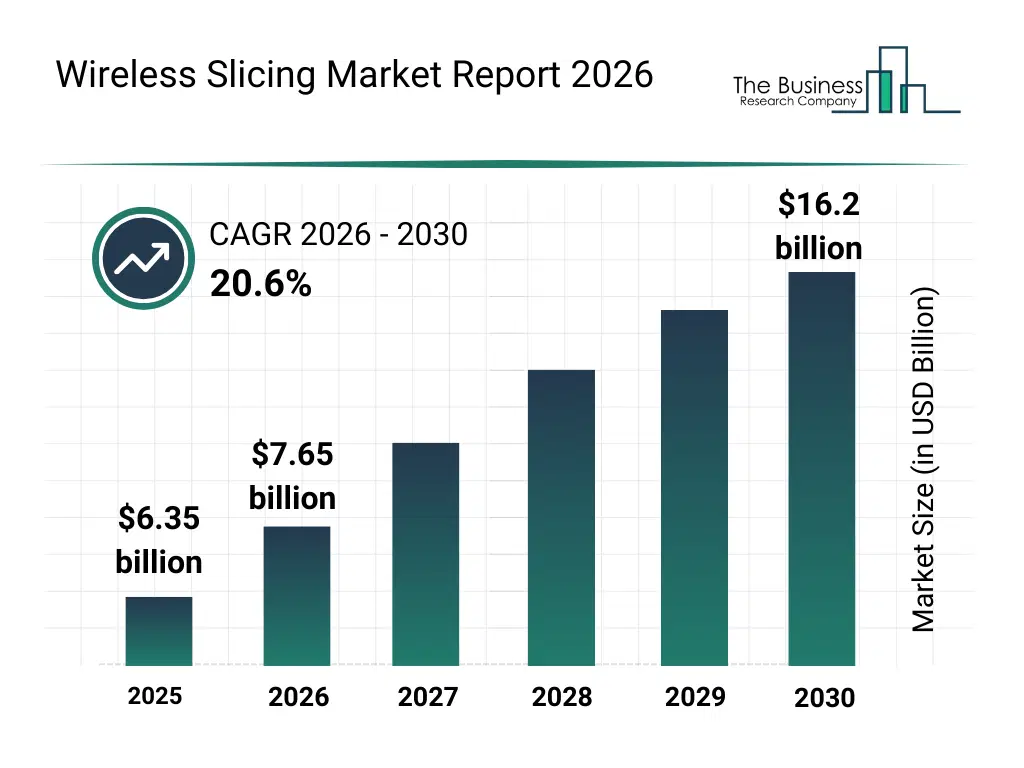
What Is The Wireless Slicing Market Size and Share 2026?
The wireless slicing market size has grown exponentially in recent years. It will grow from $6.35 billion in 2025 to $7.65 billion in 2026 at a compound annual growth rate (CAGR) of 20.4%. The growth in the historic period can be attributed to growing 5g network deployments, increasing demand for low-latency applications, adoption of virtualization in telecom networks, rising mobile broadband usage, expansion of cloud-based network services.What Is The Wireless Slicing Market Growth Forecast?
The wireless slicing market size is expected to see exponential growth in the next few years. It will grow to $16.2 billion in 2030 at a compound annual growth rate (CAGR) of 20.6%. The growth in the forecast period can be attributed to increasing deployment of 5g and beyond networks, growing adoption of ai-driven slice automation, rising demand for mission-critical iot applications, expansion of industrial automation connectivity, increasing focus on network security and performance optimization. Major trends in the forecast period include increasing adoption of cloud-based network slicing platforms, rising deployment of virtualized Radio Access Networks, growing focus on slice lifecycle monitoring and analytics, expansion of managed network operations services, rising demand for edge computing enabled network hardware.Global Wireless Slicing Market Segmentation
1) By Component: Network Slice Orchestration Software, Virtualized And Cloud-Native Network Functions (CNFs), Slicing-Enabled RAN And Core Network Hardware, Slice Lifecycle Management Platforms, Professional And Managed Services 2) By Technology: 5G, 4G LTE, Wi-Fi 6, Satellite Communication 3) By Deployment Type: On-Premises, Cloud-Based, Hybrid 4) By Application: Telecommunications, Healthcare, Transportation, Smart Cities, Industrial Automation 5) By End Use: Enterprise, Government, Consumer Subsegments: 1) By Network Slice Orchestration Software: Centralized Slice Orchestration Platforms, Policy Based Slice Control Software, Multi Domain Slice Coordination Software, Artificial Intelligence Driven Slice Automation Software 2) By Virtualized And Cloud-Native Network Functions: Virtualized Core Network Functions, Cloud Native Packet Processing Functions, Software Based Radio Access Functions, Distributed User Plane Functions 3) By Slicing-Enabled RAN And Core Network Hardware: 5G Radio Access Network Hardware, Core Network Processing Hardware, Edge Computing Network Hardware, High Performance Transport Hardware 4) By Slice Lifecycle Management Platforms: Slice Design And Provisioning Platforms, Slice Monitoring And Analytics Platforms, Slice Performance Optimization Platforms, Fault And Service Assurance Platforms 5) By Professional And Managed Services: Network Planning And Consulting Services, System Integration And Deployment Services, Managed Network Operations Services, Maintenance And Technical Support ServicesWhat Is The Driver Of The Wireless Slicing Market?
The rising focus on secure and isolated connectivity is expected to propel the growth of the wireless slicing market going forward. The rising focus on secure and isolated connectivity is driven by the need to prevent data breaches and service interference. Wireless slicing supports secure and isolated connectivity by enabling dedicated network slices with isolated resources and security policies, ensuring that critical services remain protected and unaffected by other network traffic. For instance, in January 2024, according to the Identity Theft Resource Center (ITRC), a US-based non-profit organization, there were 3,205 data breaches, exposures, leaks, and unspecified events, affecting approximately 353,027,892 victims, including those impacted by multiple incidents, reflecting a 78% increase from 2022. Therefore, the rising focus on secure and isolated connectivity is driving the growth of the wireless slicing industry.Key Players In The Global Wireless Slicing Market
Major companies operating in the wireless slicing market are Samsung Electronics Co. Ltd., Verizon Communications Inc., AT&T Inc., Deutsche Telekom AG, T-Mobile US Inc., Cisco Systems Inc., Intel Corporation, Telefónica S.A., Broadcom Inc., Hewlett Packard Enterprise, BT Group PLC, Ericsson AB, NEC Corporation, Nokia Corporation, ZTE Corporation, SK Telecom Co. Ltd., Keysight Technologies, NTT DOCOMO Inc., STL Tech Ltd., JMA Wireless, Parallel Wireless Inc., and Enea AB.Global Wireless Slicing Market Trends and Insights
Major companies operating in the wireless slicing market are focusing on advancements in security, such as end-to-end network slice isolation that ensures dedicated resources, guaranteed quality of service, and uninterrupted performance for critical applications even during network congestion. End-to-end network slice isolation means a network slice is fully separated across the radio, transport, and core network, ensuring dedicated resources, no interference, and guaranteed performance for critical applications. For instance, in April 2024, Verizon Communications Inc., a US-based telecommunications company, launched its frontline network slice nationwide. This 5G ultra-wideband virtual network slice is completely dedicated to public safety, providing first responders with reserved network capacity, optimized performance for critical applications, enhanced reliability during high congestion, and real-time scalable resources, ensuring uninterrupted mission-critical communications across all markets where Verizon offers 5G ultra-wideband service.What Are Latest Mergers And Acquisitions In The Wireless Slicing Market?
In February 2024, Telstra Corporation Limited, an Australia-based telecommunications company, partnered with Telefonaktiebolaget LM Ericsson to enhance technological capabilities and operationalize advanced 5G network slicing services for enterprises, enabling tailored service experiences and improved performance across use cases like fixed wireless access, broadcasting, automotive connectivity, and stadium or precinct services. Telefonaktiebolaget LM Ericsson, a Sweden-based telecommunications equipment and services company.Regional Insights
North America was the largest region in the wireless slicing market in 2025. Asia-Pacific is expected to be the fastest-growing region in the forecast period. The regions covered in this market report are Asia-Pacific, South East Asia, Western Europe, Eastern Europe, North America, South America, Middle East, Africa. The countries covered in this market report are Australia, Brazil, China, France, Germany, India, Indonesia, Japan, Taiwan, Russia, South Korea, UK, USA, Canada, Italy, Spain.What Defines the Wireless Slicing Market?
The wireless slicing market consists of revenues earned by entities by providing technologies and services such as network slicing orchestration, virtualized radio access networks, core network slicing platforms, spectrum management solutions, and slice lifecycle management. The market value includes the value of related software platforms, control systems, and slicing-enabled network equipment sold by the technology providers or included within service offerings. The wireless slicing market includes sales of slicing-capable hardware, software-defined networking components, and cloud-native network functions. Values in this market are “factory gate” values, representing the value of goods and services sold by the manufacturers or creators of the technology, whether to other entities such as telecom operators, system integrators, cloud service providers, enterprises, or directly to end users.How is Market Value Defined and Measured?
The market value is defined as the revenues that enterprises gain from the sale of goods and/or services within the specified market and geography through sales, grants, or donations in terms of the currency (in USD unless otherwise specified). The revenues for a specified geography are consumption values that are revenues generated by organizations in the specified geography within the market, irrespective of where they are produced. It does not include revenues from resales along the supply chain, either further along the supply chain or as part of other products.What Key Data and Analysis Are Included in the Wireless Slicing Market Report 2026?
The wireless slicing market research report is one of a series of new reports from The Business Research Company that provides wireless slicing market statistics, including wireless slicing industry global market size, regional shares, competitors with a wireless slicing market share, detailed wireless slicing market segments, market trends and opportunities, and any further data you may need to thrive in the wireless slicing industry. This wireless slicing market research report delivers a complete perspective of everything you need, with an in-depth analysis of the current and future scenario of the industry.Wireless Slicing Market Report Forecast Analysis
| Report Attribute | Details |
|---|---|
| Market Size Value In 2026 | $7.65 billion |
| Revenue Forecast In 2035 | $16.2 billion |
| Growth Rate | CAGR of 20.4% from 2026 to 2035 |
| Base Year For Estimation | 2025 |
| Actual Estimates/Historical Data | 2020-2025 |
| Forecast Period | 2026 - 2030 - 2035 |
| Market Representation | Revenue in USD Billion and CAGR from 2026 to 2035 |
| Segments Covered | Component, Technology, Deployment Type, Application, End Use |
| Regional Scope | Asia-Pacific, Western Europe, Eastern Europe, North America, South America, Middle East, Africa |
| Country Scope | The countries covered in the report are Australia, Brazil, China, France, Germany, India, ... |
| Key Companies Profiled | Samsung Electronics Co. Ltd., Verizon Communications Inc., AT&T Inc., Deutsche Telekom AG, T-Mobile US Inc., Cisco Systems Inc., Intel Corporation, Telefónica S.A., Broadcom Inc., Hewlett Packard Enterprise, BT Group PLC, Ericsson AB, NEC Corporation, Nokia Corporation, ZTE Corporation, SK Telecom Co. Ltd., Keysight Technologies, NTT DOCOMO Inc., STL Tech Ltd., JMA Wireless, Parallel Wireless Inc., and Enea AB. |
| Customization Scope | Request for Customization |
| Pricing And Purchase Options | Explore Purchase Options |
Frequently Asked Questions
The Wireless Slicing market was valued at $6.35 billion in 2025, increased to $7.65 billion in 2026, and is projected to reach $16.2 billion by 2030.
request a sample hereThe global Wireless Slicing market is expected to grow at a CAGR of 20.6% from 2026 to 2035 to reach $16.2 billion by 2035.
request a sample hereSome Key Players in the Wireless Slicing market Include, Samsung Electronics Co. Ltd., Verizon Communications Inc., AT&T Inc., Deutsche Telekom AG, T-Mobile US Inc., Cisco Systems Inc., Intel Corporation, Telefónica S.A., Broadcom Inc., Hewlett Packard Enterprise, BT Group PLC, Ericsson AB, NEC Corporation, Nokia Corporation, ZTE Corporation, SK Telecom Co. Ltd., Keysight Technologies, NTT DOCOMO Inc., STL Tech Ltd., JMA Wireless, Parallel Wireless Inc., and Enea AB..
request a sample hereMajor trend in this market includes: Advancements In Secure And Isolated Connectivity Driving Growth Through Mission-Critical 5G Network Slicing. For further insights on this market.
request a sample hereNorth America was the largest region in the wireless slicing market in 2025. Asia-Pacific is expected to be the fastest-growing region in the forecast period. The regions covered in the wireless slicing market report are Asia-Pacific, South East Asia, Western Europe, Eastern Europe, North America, South America, Middle East, Africa.
request a sample here