
Wireless Local Area Network (LAN) Card Market Report 2026
Wireless Local Area Network (LAN) Card Market Report 2026
Global Outlook – By Type (Peripheral Component Interconnect Express Wireless Local Area Network Cards, Universal Serial Bus Wireless Local Area Network Cards, M.2 Wireless Local Area Network Cards, Embedded Wireless Local Area Network Cards, Mini Peripheral Component Interconnect Express Wireless Local Area Network Cards), By Technology (Wi-Fi 4, Wi-Fi 5, Wi-Fi 6, Wi-Fi 6E), By Frequency Band (2.4 GHz, 5 GHz, Dual Band (2.4 GHz & 5 GHz)), By End User (Residential, Commercial, Industrial) – Market Size, Trends, Strategies, and Forecast to 2035
Wireless Local Area Network (LAN) Card Market Overview
• Wireless Local Area Network (LAN) Card market size has reached to $8.79 billion in 2025 • Expected to grow to $12.15 billion in 2030 at a compound annual growth rate (CAGR) of 6.7% • Growth Driver: Rise Of Hybrid Work Models Driving Growth Of The Market Due To Increasing Demand For Secure And Scalable Remote Access Infrastructure • Market Trend: Advancements In Wi-Fi 6E Wireless LAN Cards Boost High-Speed Connectivity And Network Performance • North America was the largest region in 2025 and Asia-Pacific is the fastest growing region.
%20Card%20Market%20Report%202026&content_id=fc60445d-945d-49e2-a259-3aa254bcb2d9&price=4490&discount=0&image=https%3A%2F%2Fd1lt5802h39cn9.cloudfront.net%2Fcoverimages%2Fwireless_local_area_network_lan_card_market_report.webp)
What Is Covered Under Wireless Local Area Network (LAN) Card Market?
A wireless local area network (LAN) card is a hardware component that enables a computer or other device to connect to a local area network without physical cables. It allows the device to send and receive data over a wireless local area network for internet or network access. The main types of wireless local area network (LAN) card include peripheral component interconnect express wireless local area network cards, universal serial bus wireless local area network cards, M.2 wireless local area network cards, embedded wireless local area network cards, and mini peripheral component interconnect express wireless local area network cards. Peripheral component interconnect express wireless local area network cards refer to internal expansion cards installed directly into a computer motherboard slot to enable high-speed and stable wireless network connectivity. The various technologies involved are Wi-Fi 4 and Wi-Fi 5 and Wi-Fi 6 and Wi-Fi 6E and operate across frequency bands such as 2.4 GHz and 5 GHz and dual band (2.4 GHz & 5 GHz). The end users include residential, commercial, and industrial.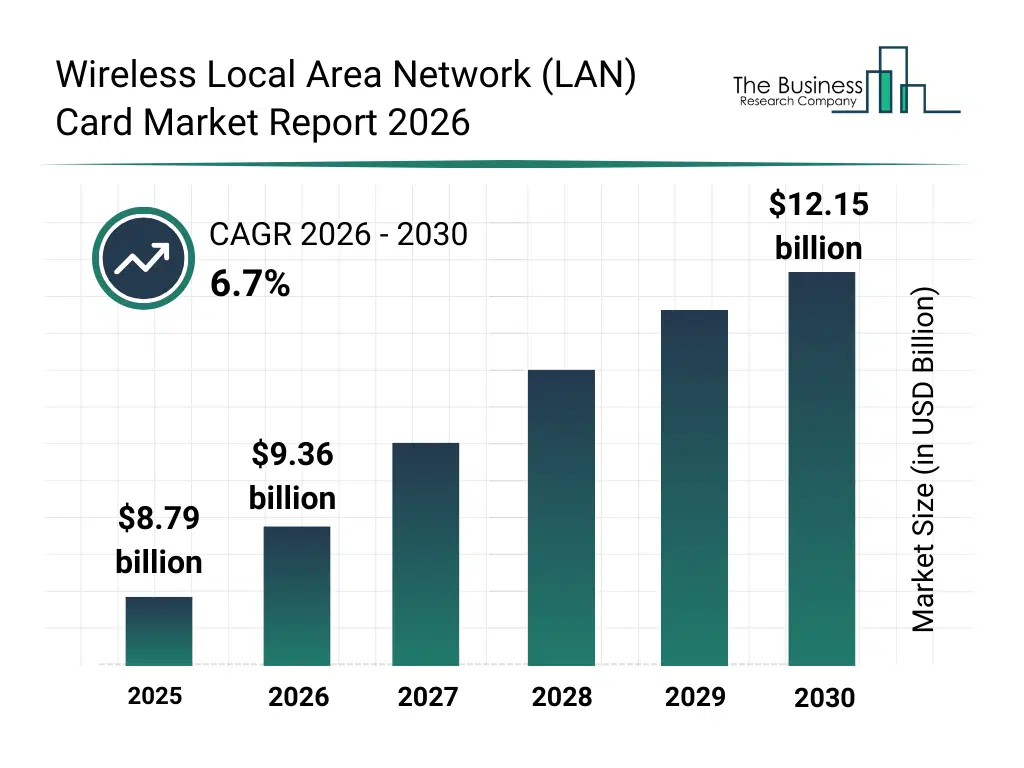
What Is The Wireless Local Area Network (LAN) Card Market Size and Share 2026?
The wireless local area network (lan) card market size has grown strongly in recent years. It will grow from $8.79 billion in 2025 to $9.36 billion in 2026 at a compound annual growth rate (CAGR) of 6.5%. The growth in the historic period can be attributed to increasing personal computer adoption, growing demand for Wireless Connectivity in residential and commercial spaces, rise in laptop and portable device shipments, expansion of enterprise Wi-Fi infrastructure, adoption of USB and PCIe wireless adapters.What Is The Wireless Local Area Network (LAN) Card Market Growth Forecast?
The wireless local area network (lan) card market size is expected to see strong growth in the next few years. It will grow to $12.15 billion in 2030 at a compound annual growth rate (CAGR) of 6.7%. The growth in the forecast period can be attributed to growing adoption of wi-fi 6 and wi-fi 6e technologies, rising deployment in industrial and commercial networks, increasing integration in iot and smart devices, expansion of dual band and tri band solutions, rising demand for high-performance embedded wireless lan cards. Major trends in the forecast period include rising adoption of wi-fi 6 and wi-fi 6e cards, growing demand for dual band and tri band wireless cards, increasing preference for portable and high-gain usb adapters, expansion of industrial grade wireless lan cards for enterprise networks, rising integration of wireless lan cards in embedded and mini pcie devices.Global Wireless Local Area Network (LAN) Card Market Segmentation
1) By Type: Peripheral Component Interconnect Express Wireless Local Area Network Cards, Universal Serial Bus Wireless Local Area Network Cards, M.2 Wireless Local Area Network Cards, Embedded Wireless Local Area Network Cards, Mini Peripheral Component Interconnect Express Wireless Local Area Network Cards 2) By Technology: Wi-Fi 4, Wi-Fi 5, Wi-Fi 6, Wi-Fi 6E 3) By Frequency Band: 2.4 GHz, 5 GHz, Dual Band (2.4 GHz & 5 GHz) 4) By End User: Residential, Commercial, Industrial Subsegments: 1) By Peripheral Component Interconnect Express Wireless Local Area Network Cards: Single Band, Dual Band, Tri Band, Industrial Grade, High Performance 2) By Universal Serial Bus Wireless Local Area Network Cards: Single Band, Dual Band, High Gain, Portable, Long Range 3) By M.2 Wireless Local Area Network Cards: Single Band, Dual Band, Tri Band, Low Power, High Performance 4) By Embedded Wireless Local Area Network Cards: Single Band, Dual Band, Industrial Grade, Low Power, High Performance 5) By Mini Peripheral Component Interconnect Express Wireless Local Area Network Cards: Single Band, Dual Band, Tri Band, Industrial Grade, Low PowerWhat Is The Driver Of The Wireless Local Area Network (LAN) Card Market?
The rise of hybrid work models is expected to support growth in the wireless local area network (LAN) card market going forward. Hybrid work models refer to flexible work arrangements that combine remote and in-office work, allowing employees to divide their time between home and the workplace based on organizational policies or individual preferences. Adoption of hybrid work is increasing due to growing demand for employee flexibility, as such arrangements improve work–life balance, enhance productivity, and aid talent retention. Wireless local area network (LAN) cards enable reliable wireless connectivity to corporate networks, supporting productivity and collaboration across both office and remote environments, particularly through device upgrades and demand for higher-performance wireless solutions. For instance, in March 2025, according to the Bureau of Labor Statistics, a US-based federal agency, approximately 35.5 million people in the US worked from home, including those in hybrid work arrangements, in the first quarter of 2024, an increase of 5.1 million compared to the first quarter of 2023, representing 22.9% of the employed workforce. Therefore, the rise of hybrid work models is driving the growth of the wireless local area network (LAN) card industry.Key Players In The Global Wireless Local Area Network (LAN) Card Market
Major companies operating in the wireless local area network (LAN) card market are Intel Corporation, Broadcom Inc., Qualcomm Technologies Inc., MediaTek Inc., TP-Link Systems Inc., Realtek Semiconductor Corp., Zebronics, Netgear Inc., Linksys Holdings Inc., Zyxel Communications Corp., D-Link Corporation, Edimax Technology Co. Ltd., TRENDnet Inc., Rosewill Inc., Mercusys, Shenzhen Bilian Electronic Limited, Tenda Technology Co. Ltd., BrosTrend, FENVI, and Shenzhen Anera Tech Company Limited.Global Wireless Local Area Network (LAN) Card Market Trends and Insights
Major companies operating in the wireless local area network (LAN) card market are focusing on advancements in high-speed wireless communication technologies, such as Wi-Fi 6E–enabled network adapters, to deliver faster data transfer rates, reduce network congestion, and support reliable connectivity across multiple devices. Wi-Fi 6E–enabled network adapters are wireless LAN cards that operate across the 2.4 GHz, 5 GHz, and extended 6 GHz spectrum, offering increased bandwidth, lower latency, and improved overall network performance for both consumer and enterprise applications. For instance, in March 2023, ALFA Network, a Taiwan-based networking hardware company, launched the AWUS036AXML Wi-Fi 6E USB adapter. The device supports tri-band connectivity across the 2.4 GHz, 5 GHz, and 6 GHz bands and delivers data transfer speeds of up to 3,000 Mbps. Powered by the MediaTek MT7921AU chipset and supporting Bluetooth 5.2, the adapter is compatible with Windows and Linux operating systems and is designed to support high-bandwidth, low-latency use cases such as streaming, gaming, and network monitoring. Such product launches highlight the industry’s focus on expanding high-performance wireless LAN card offerings to meet increasing demand for faster and more reliable wireless connectivity.What Are Latest Mergers And Acquisitions In The Wireless Local Area Network (LAN) Card Market?
In July 2025, Hewlett Packard Enterprise, a US-based information technology company, acquired Juniper Networks Inc. for $14 billion. With this acquisition Hewlett Packard Enterprise aims to strengthen its enterprise and hybrid-cloud networking portfolio by integrating Juniper’s AI-driven solutions to offer a comprehensive end-to-end networking platform. Juniper Networks Inc. is a US-based AI-native networking company that offers wireless LAN card solutions.Regional Insights
North America was the largest region in the wireless local area network (LAN) card market in 2025. Asia-Pacific is expected to be the fastest-growing region in the forecast period. The regions covered in this market report are Asia-Pacific, South East Asia, Western Europe, Eastern Europe, North America, South America, Middle East, Africa. The countries covered in this market report are Australia, Brazil, China, France, Germany, India, Indonesia, Japan, Taiwan, Russia, South Korea, UK, USA, Canada, Italy, Spain.What Defines the Wireless Local Area Network (LAN) Card Market?
The wireless local area network (LAN) card market consists of sales of USB Wi-Fi adapters, combo Wi-Fi + Bluetooth cards, and PCIe wireless cards. Values in this market are ‘factory gate’ values; that is, the value of goods sold by the manufacturers or creators of the goods, whether to other entities (including downstream manufacturers, wholesalers, distributors, and retailers) or directly to end customers. The value of goods in this market includes related services sold by the creators of the goods.How is Market Value Defined and Measured?
The market value is defined as the revenues that enterprises gain from the sale of goods and/or services within the specified market and geography through sales, grants, or donations in terms of the currency (in USD unless otherwise specified). The revenues for a specified geography are consumption values that are revenues generated by organizations in the specified geography within the market, irrespective of where they are produced. It does not include revenues from resales along the supply chain, either further along the supply chain or as part of other products.What Key Data and Analysis Are Included in the Wireless Local Area Network (LAN) Card Market Report 2026?
The wireless local area network (LAN) card market research report is one of a series of new reports from The Business Research Company that provides wireless local area network (LAN) card market statistics, including wireless local area network (LAN) card industry global market size, regional shares, competitors with a wireless local area network (LAN) card market share, detailed wireless local area network (LAN) card market segments, market trends and opportunities, and any further data you may need to thrive in the wireless local area network (LAN) card industry. This wireless local area network (LAN) card market research report delivers a complete perspective of everything you need, with an in-depth analysis of the current and future scenario of the industry.Wireless Local Area Network (LAN) Card Market Report Forecast Analysis
| Report Attribute | Details |
|---|---|
| Market Size Value In 2026 | $9.36 billion |
| Revenue Forecast In 2035 | $12.15 billion |
| Growth Rate | CAGR of 6.5% from 2026 to 2035 |
| Base Year For Estimation | 2025 |
| Actual Estimates/Historical Data | 2020-2025 |
| Forecast Period | 2026 - 2030 - 2035 |
| Market Representation | Revenue in USD Billion and CAGR from 2026 to 2035 |
| Segments Covered | Type, Technology, Frequency Band, End User |
| Regional Scope | Asia-Pacific, Western Europe, Eastern Europe, North America, South America, Middle East, Africa |
| Country Scope | The countries covered in the report are Australia, Brazil, China, France, Germany, India, ... |
| Key Companies Profiled | Intel Corporation, Broadcom Inc., Qualcomm Technologies Inc., MediaTek Inc., TP-Link Systems Inc., Realtek Semiconductor Corp., Zebronics, Netgear Inc., Linksys Holdings Inc., Zyxel Communications Corp., D-Link Corporation, Edimax Technology Co. Ltd., TRENDnet Inc., Rosewill Inc., Mercusys, Shenzhen Bilian Electronic Limited, Tenda Technology Co. Ltd., BrosTrend, FENVI, and Shenzhen Anera Tech Company Limited. |
| Customization Scope | Request for Customization |
| Pricing And Purchase Options | Explore Purchase Options |
Frequently Asked Questions
The Wireless Local Area Network (LAN) Card market was valued at $8.79 billion in 2025, increased to $9.36 billion in 2026, and is projected to reach $12.15 billion by 2030.
request a sample hereThe global Wireless Local Area Network (LAN) Card market is expected to grow at a CAGR of 6.7% from 2026 to 2035 to reach $12.15 billion by 2035.
request a sample hereSome Key Players in the Wireless Local Area Network (LAN) Card market Include, Intel Corporation, Broadcom Inc., Qualcomm Technologies Inc., MediaTek Inc., TP-Link Systems Inc., Realtek Semiconductor Corp., Zebronics, Netgear Inc., Linksys Holdings Inc., Zyxel Communications Corp., D-Link Corporation, Edimax Technology Co. Ltd., TRENDnet Inc., Rosewill Inc., Mercusys, Shenzhen Bilian Electronic Limited, Tenda Technology Co. Ltd., BrosTrend, FENVI, and Shenzhen Anera Tech Company Limited..
request a sample hereMajor trend in this market includes: Advancements In Wi-Fi 6E Wireless LAN Cards Boost High-Speed Connectivity And Network Performance. For further insights on this market.
request a sample hereNorth America was the largest region in the wireless local area network (LAN) card market in 2025. Asia-Pacific is expected to be the fastest-growing region in the forecast period. The regions covered in the wireless local area network (LAN) card market report are Asia-Pacific, South East Asia, Western Europe, Eastern Europe, North America, South America, Middle East, Africa.
request a sample here