
Wearable Neurotech Market Report 2026
Wearable Neurotech Market Report 2026
Global Outlook – By Product Type (Electroencephalography Headsets, Brain Computer Interface Devices, Neurostimulation Wearables, Neurofeedback Wearable Devices, Wearable Neural Sensors), By Technology (Electroencephalography Technology, Functional Near Infrared Spectroscopy Technology, Magnetoencephalography Technology, Transcranial Direct Current Stimulation Technology, Other Neural Sensing and Stimulation Technologies), By Distribution Channel (Online Stores, Specialty Retail Stores, Direct Sales, Other Distribution Channels), By Application (Healthcare, Consumer Electronics, Sports and Fitness, Other Applications), By End User (s and Fitness Centers, Academic and Educational Institutions) – Market Size, Trends, Strategies, and Forecast to 2035
Wearable Neurotech Market Overview
• Wearable Neurotech market size has reached to $2.18 billion in 2025 • Expected to grow to $5.34 billion in 2030 at a compound annual growth rate (CAGR) of 19.7% • Growth Driver: Surge In Neurological Disorders Fueling The Growth Of The Market Due To Aging Populations And Rising Disease Prevalence • Market Trend: Advancing Non-invasive Neurostimulation For Rehabilitation And Wellness • North America was the largest region in 2025 and Asia-Pacific is the fastest growing region.

What Is Covered Under Wearable Neurotech Market?
Wearable neurotech refers to portable electronic devices worn on the body that monitor, stimulate, or interact with the human nervous system to collect brain and neural data, enhance cognitive or physical performance, or support medical diagnosis and therapy. These devices typically use sensors, electrodes, and software algorithms to enable real-time brain–computer interaction, neurofeedback, and neurological health monitoring in everyday settings. The main product types of wearable neurotech include electroencephalography (EEG) headsets, brain computer interface (BCI) devices, neurostimulation wearables, neurofeedback wearable devices, and wearable neural sensors. Electroencephalography headsets refer to devices that monitor and record electrical activity of the brain for diagnostics, research, or neurofeedback applications. These devices utilize technologies such as electroencephalography technology, functional near infrared spectroscopy technology, magnetoencephalography technology, transcranial direct current stimulation technology, and other neural sensing and stimulation technologies. They are distributed through online stores, specialty retail stores, direct sales, and other distribution channels, and are applied in healthcare, consumer electronics, sports and fitness, and other applications, serving end users including hospitals and clinics, research institutes and laboratories, consumer end users, sports and fitness centers, and academic and educational institutions.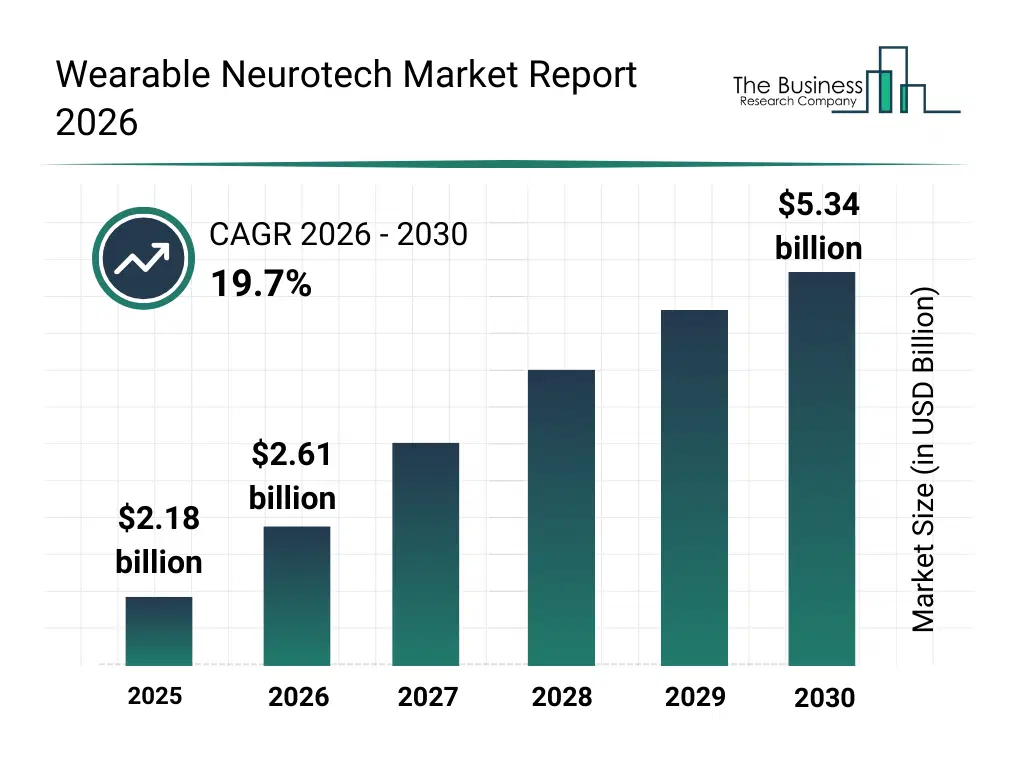
What Is The Wearable Neurotech Market Size and Share 2026?
The wearable neurotech market size has grown rapidly in recent years. It will grow from $2.18 billion in 2025 to $2.61 billion in 2026 at a compound annual growth rate (CAGR) of 19.4%. The growth in the historic period can be attributed to advances in eeg miniaturization, growth in digital health devices, expansion of brain computer interface research, rise in mental wellness tech, increase in wearable sensor adoption.What Is The Wearable Neurotech Market Growth Forecast?
The wearable neurotech market size is expected to see rapid growth in the next few years. It will grow to $5.34 billion in 2030 at a compound annual growth rate (CAGR) of 19.7%. The growth in the forecast period can be attributed to growth in remote neuro monitoring, rising demand for cognitive enhancement tools, expansion of neuro digital therapeutics, higher sports performance analytics use, increasing personalized brain health programs. Major trends in the forecast period include growth in consumer brain computer interfaces, rising adoption of neurofeedback wearables, expansion of portable eeg devices, integration of cognitive monitoring apps, increase in home use Neurostimulation Devices.Global Wearable Neurotech Market Segmentation
1) By Product Type: Electroencephalography Headsets; Brain Computer Interface Devices; Neurostimulation Wearables; Neurofeedback Wearable Devices; Wearable Neural Sensors 2) By Technology: Electroencephalography Technology; Functional Near Infrared Spectroscopy Technology; Magnetoencephalography Technology; Transcranial Direct Current Stimulation Technology; Other Neural Sensing and Stimulation Technologies 3) By Distribution Channel: Online Stores; Specialty Retail Stores; Direct Sales; Other Distribution Channels 4) By Application: Healthcare; Consumer Electronics; Sports and Fitness; Other Applications 5) By End User: Hospitals and Clinics; Research Institutes and Laboratories; Consumer End Users; Sports and Fitness Centers; Academic and Educational Institutions Subsegments: 1) By Electroencephalography Headsets: Portable Electroencephalography Headsets; Wireless Electroencephalography Headsets; Clinical Electroencephalography Headsets 2) By Brain Computer Interface Devices: Non Invasive Brain Computer Interface Devices; Invasive Brain Computer Interface Devices; Hybrid Brain Computer Interface Devices 3) By Neurostimulation Wearables: Transcranial Direct Current Stimulation Wearables; Transcranial Magnetic Stimulation Wearables; Vagus Nerve Stimulation Wearables 4) By Neurofeedback Wearable Devices: Real Time Neurofeedback Wearable Devices; Home Use Neurofeedback Wearable Devices; Clinical Neurofeedback Wearable Devices 5) By Wearable Neural Sensors: Electroencephalography Sensors; Functional Near-Infrared Spectroscopy Sensors; Magnetoencephalography Sensors; Electromyography Sensors; Cognitive Monitoring Sensors; Brain Computer Interface SensorsWhat Is The Driver Of The Wearable Neurotech Market?
The rising prevalence of neurological disorders is expected to propel the growth of the wearable neurotech market going forward. Neurological disorders refer to medical conditions that affect the brain, spinal cord, or nerves, impacting movement, sensation, cognition, or behavior. Neurological disorders are increasing due to the aging global population, which raises the prevalence of age-related neurological conditions. Wearable neurotech helps neurological disorders by continuously monitoring brain and nerve activity, enabling early detection, personalized treatment, and real-time management of symptoms. For instance, in March 2023, according to the Alzheimer's Association, a US-based nonprofit voluntary health organization reported that 6.7 million Americans aged 65+ have Alzheimer's, projected to rise to 13.8 million by 2060. Therefore, the rising prevalence of neurological disorders is driving the growth of the wearable neurotech industry.Key Players In The Global Wearable Neurotech Market
Major companies operating in the wearable neurotech market are Kernel Labs Inc., Nuro Corporation, NeuroSky Inc., BrainCo Inc., Emotiv Inc., Cognito Therapeutics Inc., Neuroelectrics Barcelona S.L.U, Q30 Innovations Inc., Halo Neuroscience, Thync, Neurable Inc., Neurovalens Ltd., Neurovalens Ltd., Bitbrain Technologies S.L., Muse (InteraXon), OpenBCI Inc., BrainBit, Nexstem Technologies Pvt. Ltd, Nalu Medical Inc., Alphabeats, Motif Neurotech.Global Wearable Neurotech Market Trends and Insights
Major companies operating in the wearable neurotech market are focusing on advancements in non-invasive neurostimulation technologies, such as wearable vagus nerve and electrical muscle stimulation devices, to support rehabilitation, wellness, or neural recovery. Wearable vagus nerve devices are non-invasive systems worn on the body that deliver electrical stimulation to the vagus nerve to support health, wellness, or therapeutic outcomes. For instance, in February 2025, Neuvotion Inc., a US medical device company, introduced NeuStim, a non-invasive, wearable neurostimulation system cleared by the FDA that precisely stimulates muscles to support hand movement recovery after stroke or spinal cord injury. The device features a lightweight, wrist-worn design, a clinician-friendly touchscreen for targeting stimulation, and customizable programs accessible via a mobile interface. Similarly, in 2025, Lithuania-based Pulsetto launched or expanded its wearable vagus nerve stimulation device aimed at stress reduction and sleep support. This neck-worn device delivers low-frequency transcutaneous stimulation, offers multiple preset programs through a companion app, and is designed for daily, drug-free use. Both devices highlight the growing trend of noninvasive, wearable neurotechnologies for health and rehabilitation.What Are Latest Mergers And Acquisitions In The Wearable Neurotech Market?
In December 2024, ElectroCore Inc., a US-based bioelectronic medicine and wellness company, acquired NeuroMetrix, Inc. for an undisclosed amount. Through this acquisition, electroCore aims to strengthen its position in non-invasive bioelectronic medicine by integrating NeuroMetrix’s Quell wearable neuromodulation platform and expanding its portfolio of therapies for chronic pain, fibromyalgia, and wellness applications. NeuroMetrix Inc. is a US-based company that develops the Quell platform, a wearable, app-enabled nerve stimulation device for pain management and symptom relief.Regional Insights
North America was the largest region in the wearable neurotech market in 2025. Asia-Pacific is expected to be the fastest-growing region in the forecast period. The regions covered in this market report are Asia-Pacific, South East Asia, Western Europe, Eastern Europe, North America, South America, Middle East, Africa. The countries covered in this market report are Australia, Brazil, China, France, Germany, India, Indonesia, Japan, Taiwan, Russia, South Korea, UK, USA, Canada, Italy, Spain.What Defines the Wearable Neurotech Market?
The wearable neurotech market consists of revenues earned by entities by providing services such as neural data monitoring services, brain signal analysis services, remote patient monitoring services, clinical assessment services, device calibration and maintenance services, and data interpretation services. The market value includes the value of related goods sold by the service provider or included within the service offering. The wearable neurotech market also includes sales of electroencephalography headsets, brain-computer interface headsets, neurostimulation wearables, transcranial electrical stimulation devices, wearable neural sensors, head-mounted neurofeedback devices, and smart neuro headbands. Values in this market are ‘factory gate’ values; that is, the value of goods sold by the manufacturers or creators of the goods, whether to other entities (including downstream manufacturers, wholesalers, distributors, and retailers) or directly to end customers. The value of goods in this market includes related services sold by the creators of the goods.How is Market Value Defined and Measured?
The market value is defined as the revenues that enterprises gain from the sale of goods and/or services within the specified market and geography through sales, grants, or donations in terms of the currency (in USD unless otherwise specified). The revenues for a specified geography are consumption values that are revenues generated by organizations in the specified geography within the market, irrespective of where they are produced. It does not include revenues from resales along the supply chain, either further along the supply chain or as part of other products.What Key Data and Analysis Are Included in the Wearable Neurotech Market Report 2026?
The wearable neurotech market research report is one of a series of new reports from The Business Research Company that provides market statistics, including industry global market size, regional shares, competitors with the market share, detailed market segments, market trends and opportunities, and any further data you may need to thrive in the wearable neurotech industry. The market research report delivers a complete perspective of everything you need, with an in-depth analysis of the current and future state of the industry.Wearable Neurotech Market Report Forecast Analysis
| Report Attribute | Details |
|---|---|
| Market Size Value In 2026 | $2.61 billion |
| Revenue Forecast In 2035 | $5.34 billion |
| Growth Rate | CAGR of 19.4% from 2026 to 2035 |
| Base Year For Estimation | 2025 |
| Actual Estimates/Historical Data | 2020-2025 |
| Forecast Period | 2026 - 2030 - 2035 |
| Market Representation | Revenue in USD Billion and CAGR from 2026 to 2035 |
| Segments Covered | Product Type, Technology, Distribution Channel, Application, End User |
| Regional Scope | Asia-Pacific, Western Europe, Eastern Europe, North America, South America, Middle East, Africa |
| Country Scope | The countries covered in the report are Australia, Brazil, China, France, Germany, India, ... |
| Key Companies Profiled | Kernel Labs Inc., Nuro Corporation, NeuroSky Inc., BrainCo Inc., Emotiv Inc., Cognito Therapeutics Inc., Neuroelectrics Barcelona S.L.U, Q30 Innovations Inc., Halo Neuroscience, Thync, Neurable Inc., Neurovalens Ltd., Neurovalens Ltd., Bitbrain Technologies S.L., Muse (InteraXon), OpenBCI Inc., BrainBit, Nexstem Technologies Pvt. Ltd, Nalu Medical Inc., Alphabeats, Motif Neurotech. |
| Customization Scope | Request for Customization |
| Pricing And Purchase Options | Explore Purchase Options |