
Visual-Inertial Odometry Systems Market Report 2026

Visual-Inertial Odometry Systems Market Report 2026
Global Outlook – By Component (Hardware, Software, Services), By Technology (Monocular, Stereo, RGB-D3By Application (Robotics, Drones, Autonomous Vehicles, Augmented Reality, Virtual Reality, Other Applications), By End-Users (Automotive, Aerospace and Defense, Consumer Electronics, Industrial, Healthcare) – Market Size, Trends, Strategies, and Forecast to 2035
Visual-Inertial Odometry Systems Market Overview
• Visual-Inertial Odometry Systems market size has reached to $1.32 billion in 2025 • Expected to grow to $3 billion in 2030 at a compound annual growth rate (CAGR) of 17.9% • Growth Driver: The Rising Deployment Of Unmanned Aerial Vehicles Driving The Growth Of The Market Due To Increasing Demand For Accurate Real-Time Navigation • Market Trend: Next-Generation Sensor-Fusion Technologies Driving Accurate Autonomous Navigation • North America was the largest region in 2025 and Asia-Pacific is the fastest growing region.

What Is Covered Under Visual-Inertial Odometry Systems Market?
Visual-Inertial odometry (VIO) system is a technique used to estimate the position and orientation of a moving device by combining camera images with inertial sensor data from accelerometers and gyroscopes. It enables reliable, real-time tracking of motion with improved accuracy and robustness compared to using vision or inertial sensors alone. The main component of visual-inertial odometry (VIO) systems include hardware, software, and services. Hardware refers to the physical components that capture and measure motion and environment data, enabling the system to estimate position and orientation. The main technologies include monocular, stereo, and RGB-D systems and find applications in robotics, drones, Autonomous Vehicles, augmented reality, virtual reality, and other applications, serving end users across automotive, aerospace and defense, consumer electronics, industrial, and healthcare sectors, providing precise navigation, positioning, and real-time motion tracking capabilities.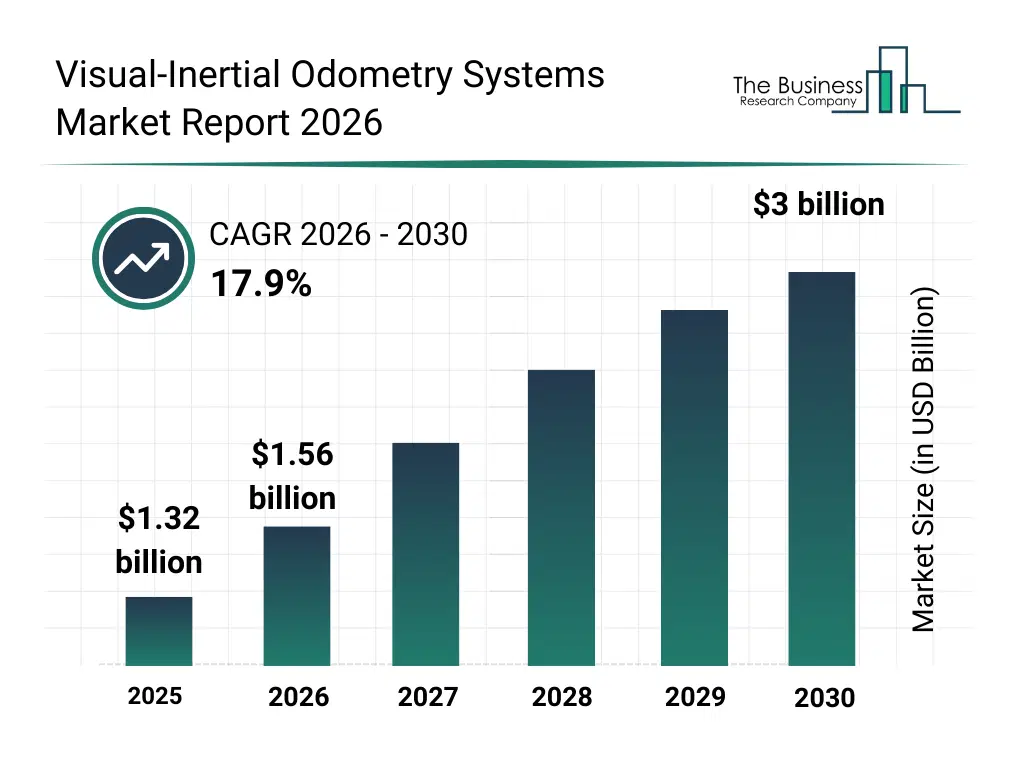
What Is The Visual-Inertial Odometry Systems Market Size and Share 2026?
The visual-inertial odometry systems market size has grown rapidly in recent years. It will grow from $1.32 billion in 2025 to $1.56 billion in 2026 at a compound annual growth rate (CAGR) of 17.6%. The growth in the historic period can be attributed to increasing use of monocular and stereo camera systems, growing adoption of IMUs and inertial sensors, rising robotics and drone deployment in industrial and commercial sectors, increasing demand for real-time navigation and tracking, adoption of VIO systems in early AR/VR applications.What Is The Visual-Inertial Odometry Systems Market Growth Forecast?
The visual-inertial odometry systems market size is expected to see rapid growth in the next few years. It will grow to $3 billion in 2030 at a compound annual growth rate (CAGR) of 17.9%. The growth in the forecast period can be attributed to growing deployment of autonomous vehicles and drones, increasing integration with AI-based motion estimation, rising adoption in industrial automation and warehouse robotics, expansion of AR/VR and mixed reality applications, growing demand for wearable motion capture devices and inspection robots. Major trends in the forecast period include increasing adoption of sensor fusion algorithms, rising demand for real-time motion estimation, growing integration of mapping and localization software, expansion of calibration and synchronization services, rising focus on wearable and robotics-based motion capture solutions.Global Visual-Inertial Odometry Systems Market Segmentation
1) By Component: Hardware, Software, Services 2) By Technology: Monocular, Stereo, RGB-D 3By Application: Robotics, Drones, Autonomous Vehicles, Augmented Reality, Virtual Reality, Other Applications 4) By End-Users: Automotive, Aerospace and Defense, Consumer Electronics, Industrial, Healthcare Subsegments: 1) By Hardware: Cameras, Inertial Measurement Sensors, Processing Units, Depth Sensors, Supporting Mounting Components 2) By Software: Sensor Fusion Algorithms, Motion Estimation Software, Mapping And Localization Software, Calibration And Synchronization Software, Visualization And Analytics Software 3) By Services: System Integration Services, Calibration And Testing Services, Maintenance And Support Services, Consulting And Customization Services, Training And Deployment ServicesWhat Is The Driver Of The Visual-Inertial Odometry Systems Market?
The rising deployment of unmanned aerial vehicles is expected to propel the growth of the visual-inertial odometry systems market going forward. Unmanned aerial vehicles are aircraft that operate without an onboard human pilot and are controlled either remotely by an operator or autonomously through onboard computers and sensors. The increasing deployment of unmanned aerial vehicles is driven by enhanced operational efficiency, as they can perform tasks such as surveillance, mapping, and delivery faster and more accurately than manual or manned methods. Visual-inertial odometry systems help unmanned aerial vehicles achieve accurate real-time navigation and stable flight by combining camera imagery and inertial sensor data to estimate position and motion even in GPS-denied environments. For instance, in June 2025, the UK Ministry of Defence announced a substantial increase in investment to expand drone deployment for military operations, aiming to increase the number from 10,000 in 2024 to 100,000. Therefore, the rising deployment of unmanned aerial vehicles is driving the growth of the visual-inertial odometry systems industry.Key Players In The Global Visual-Inertial Odometry Systems Market
Major companies operating in the visual-inertial odometry systems market are Apple Inc., Google LLC, Microsoft Corporation, Meta Platforms Inc, Huawei Technologies Co. Ltd., Bosch Sensortec GmbH, Sony Corporation, Intel Corporation, Continental AG, Qualcomm Technologies Inc., NVIDIA Corporation, STMicroelectronics N.V., Hexagon AB, SZ DJI Technology Co Ltd., Trimble Inc., Xiaomi Corporation, Leica Geosystems AG, Basler AG, Skydio Inc., SLAMcore Limited, Stereolabs Inc., and Fixposition AG.Global Visual-Inertial Odometry Systems Market Trends and Insights
Major companies operating in the visual-inertial odometry (VIO) systems market are focusing on developing innovative solutions such as sensor-fusion navigation systems to enhance real-time localization accuracy, autonomous mobility, and operational reliability in robotics and unmanned vehicles. Sensor-fusion navigation systems combine data from multiple sensors, including cameras, inertial measurement units (IMUs), LiDAR, and radar, to provide a more accurate and robust understanding of a vehicle’s or robot’s position and surroundings by compensating for the limitations of individual sensors. For instance, in November 2025, oToBrite Electronics, Inc., a Taiwan-based autonomous driving solutions company, announced the launch of a Vision-AI camera suite designed for applications in robotics, autonomous vehicles, and automotive safety. The suite includes automotive-grade GMSL cameras, a visual-inertial odometry (VIO) camera, and the oToSLAM multi-camera positioning system, which together enable accurate perception and localization in challenging outdoor environments. Additionally, the company introduced a GMSL camera developer kit for the NVIDIA Jetson platform, supporting developers and OEMs in building advanced AI-driven navigation and autonomous mobility solutions.What Are Latest Mergers And Acquisitions In The Visual-Inertial Odometry Systems Market?
In January 2025, VIAVI Solutions Inc., a US-based technology company, acquired Inertial Labs for an undisclosed amount. With this acquisition, VIAVI aimed to broaden its technological capabilities in positioning, navigation, and timing (PNT) solutions and expand its market footprint into high-growth aerospace, defense, and autonomous systems sectors. Inertial Labs Inc. is a US-based technology company that provides visual-inertial odometry (VIO) systems and visual-aided inertial navigation systems (VINS) designed for GNSS-denied or GPS-compromised environments.Regional Insights
North America was the largest region in the visual-inertial odometry systems market in 2025. Asia-Pacific is expected to be the fastest-growing region in the forecast period. The regions covered in this market report are Asia-Pacific, South East Asia, Western Europe, Eastern Europe, North America, South America, Middle East, Africa. The countries covered in this market report are Australia, Brazil, China, France, Germany, India, Indonesia, Japan, Taiwan, Russia, South Korea, UK, USA, Canada, Italy, Spain.What Defines the Visual-Inertial Odometry Systems Market?
The visual-inertial odometry systems market consists of revenues earned by entities by providing services such as navigation and localization services, robotics and autonomous systems integration, drone navigation and control services, surveying and mapping services, and inspection and monitoring solutions. The market value includes the value of related goods sold by the service provider or included within the service offering. The visual-inertial odometry systems market also includes sales of industrial automation and warehouse robotics, wearable motion capture devices, and inspection and mapping robots. Values in this market are ‘factory gate’ values; that is, the value of goods sold by the manufacturers or creators of the goods, whether to other entities (including downstream manufacturers, wholesalers, distributors, and retailers) or directly to end customers. The value of goods in this market includes related services sold by the creators of the goods.How is Market Value Defined and Measured?
The market value is defined as the revenues that enterprises gain from the sale of goods and/or services within the specified market and geography through sales, grants, or donations in terms of the currency (in USD unless otherwise specified). The revenues for a specified geography are consumption values that are revenues generated by organizations in the specified geography within the market, irrespective of where they are produced. It does not include revenues from resales along the supply chain, either further along the supply chain or as part of other products.What Key Data and Analysis Are Included in the Visual-Inertial Odometry Systems Market Report 2026?
The visual-inertial odometry systems market research report is one of a series of new reports from The Business Research Company that provides visual-inertial odometry systems market statistics, including visual-inertial odometry systems industry global market size, regional shares, competitors with a visual-inertial odometry systems market share, detailed visual-inertial odometry systems market segments, market trends and opportunities, and any further data you may need to thrive in the visual-inertial odometry systems industry. This visual-inertial odometry systems market research report delivers a complete perspective of everything you need, with an in-depth analysis of the current and future scenario of the industry.Visual-Inertial Odometry Systems Market Report Forecast Analysis
| Report Attribute | Details |
|---|---|
| Market Size Value In 2026 | $1.56 billion |
| Revenue Forecast In 2035 | $3 billion |
| Growth Rate | CAGR of 17.6% from 2026 to 2035 |
| Base Year For Estimation | 2025 |
| Actual Estimates/Historical Data | 2020-2025 |
| Forecast Period | 2026 - 2030 - 2035 |
| Market Representation | Revenue in USD Billion and CAGR from 2026 to 2035 |
| Segments Covered | Component, Technology, End-Users |
| Regional Scope | Asia-Pacific, Western Europe, Eastern Europe, North America, South America, Middle East, Africa |
| Country Scope | The countries covered in the report are Australia, Brazil, China, France, Germany, India, ... |
| Key Companies Profiled | Apple Inc., Google LLC, Microsoft Corporation, Meta Platforms Inc, Huawei Technologies Co. Ltd., Bosch Sensortec GmbH, Sony Corporation, Intel Corporation, Continental AG, Qualcomm Technologies Inc., NVIDIA Corporation, STMicroelectronics N.V., Hexagon AB, SZ DJI Technology Co Ltd., Trimble Inc., Xiaomi Corporation, Leica Geosystems AG, Basler AG, Skydio Inc., SLAMcore Limited, Stereolabs Inc., and Fixposition AG. |
| Customization Scope | Request for Customization |
| Pricing And Purchase Options | Explore Purchase Options |
Frequently Asked Questions
The Visual-Inertial Odometry Systems market was valued at $1.32 billion in 2025, increased to $1.56 billion in 2026, and is projected to reach $3 billion by 2030.
request a sample hereThe global Visual-Inertial Odometry Systems market is expected to grow at a CAGR of 17.9% from 2026 to 2035 to reach $3 billion by 2035.
request a sample hereSome Key Players in the Visual-Inertial Odometry Systems market Include, Apple Inc., Google LLC, Microsoft Corporation, Meta Platforms Inc, Huawei Technologies Co. Ltd., Bosch Sensortec GmbH, Sony Corporation, Intel Corporation, Continental AG, Qualcomm Technologies Inc., NVIDIA Corporation, STMicroelectronics N.V., Hexagon AB, SZ DJI Technology Co Ltd., Trimble Inc., Xiaomi Corporation, Leica Geosystems AG, Basler AG, Skydio Inc., SLAMcore Limited, Stereolabs Inc., and Fixposition AG..
request a sample hereMajor trend in this market includes: Next-Generation Sensor-Fusion Technologies Driving Accurate Autonomous Navigation. For further insights on this market.
request a sample hereNorth America was the largest region in the visual-inertial odometry systems market in 2025. Asia-Pacific is expected to be the fastest-growing region in the forecast period. The regions covered in the visual-inertial odometry systems market report are Asia-Pacific, South East Asia, Western Europe, Eastern Europe, North America, South America, Middle East, Africa.
request a sample here