
Virtual Ward Market Report 2026

Virtual Ward Market Report 2026
Global Outlook – By Component (Hardware, Software, Services), By Service Type (Chronic Disease Management, Post-Operative Care, Preventive Care, Acute Care at Home, Virtual Nursing Services, Care Coordination Services), By Patient Demographics (Children, Adults, Senior Citizens), By Application (Cardiology, Neurology, Pulmonology, Oncology, Orthopedics, General Medicine, Geriatric Care), By End User (Patients, Hospitals, Clinics, Home Healthcare Providers, Insurance Companies, Government Healthcare Agencies) – Market Size, Trends, Strategies, and Forecast to 2035
Virtual Ward Market Overview
• Virtual Ward market size has reached to $2.47 billion in 2025 • Expected to grow to $5 billion in 2030 at a compound annual growth rate (CAGR) of 15.2% • Growth Driver: Rising Hospital Capacity Constraints And Bed Shortages Driving Market Growth Due To Limited Hospital Resources And Increased Patient Demand • Market Trend: Advancement Of Digital Platforms To Enable Scalable Virtual Care Delivery • North America was the largest region in 2025 and Asia-Pacific is the fastest growing region.

What Is Covered Under Virtual Ward Market?
Virtual ward is a healthcare delivery model that uses digital health technologies, remote patient monitoring, and virtual clinical care to provide hospital-level treatment to patients in their homes or community settings. It integrates telehealth platforms, wearable and connected medical devices, electronic health records, and clinical decision support systems to enable continuous monitoring, timely interventions, and coordinated care. By replacing or shortening traditional hospital stays, it improves patient outcomes, enhances care accessibility, and reduces pressure on physical hospital infrastructure. The main components of virtual ward include hardware, software, and services. Hardware refers to devices and monitoring equipment that enable continuous patient tracking and remote healthcare delivery in a virtual ward setting. These services include chronic disease management, post-operative care, preventive care, acute care at home, virtual nursing services, and care coordination services. They cater to patient demographics including children, adults, and senior citizens. They are applied in cardiology, neurology, pulmonology, oncology, orthopedics, general medicine, and geriatric care, and are used by end users including patients, hospitals, clinics, home healthcare providers, insurance companies, and government healthcare agencies.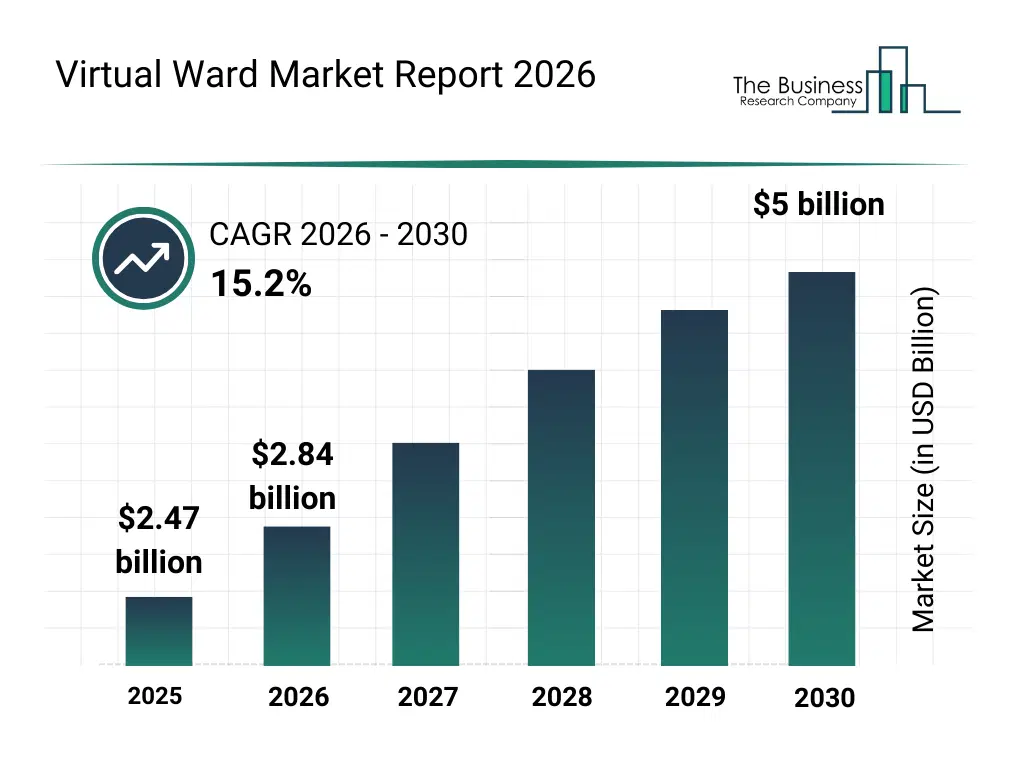
What Is The Virtual Ward Market Size and Share 2026?
The virtual ward market size has grown rapidly in recent years. It will grow from $2.47 billion in 2025 to $2.84 billion in 2026 at a compound annual growth rate (CAGR) of 14.9%. The growth in the historic period can be attributed to hospital capacity constraints, rise in remote monitoring pilots, growth in telehealth services, increase in chronic disease admissions, early home care digitization.What Is The Virtual Ward Market Growth Forecast?
The virtual ward market size is expected to see rapid growth in the next few years. It will grow to $5 billion in 2030 at a compound annual growth rate (CAGR) of 15.2%. The growth in the forecast period can be attributed to increasing healthcare cost pressure, rising aging population, expansion of reimbursement for home care, higher adoption of connected medical devices, growing government support for home treatment models. Major trends in the forecast period include growing adoption of hospital at home models, rising use of continuous remote patient monitoring, expansion of virtual nursing services, increasing integration of clinical decision support tools, higher deployment of home based acute care programs.Global Virtual Ward Market Segmentation
1) By Component: Hardware; Software; Services 2) By Service Type: Chronic Disease Management; Post-Operative Care; Preventive Care; Acute Care at Home; Virtual Nursing Services; Care Coordination Services 3) By Patient Demographics: Children; Adults; Senior Citizens 4) By Application: Cardiology; Neurology; Pulmonology; Oncology; Orthopedics; General Medicine; Geriatric Care 5) By End User: Patients; Hospitals; Clinics; Home Healthcare Providers; Insurance Companies; Government Healthcare Agencies Subsegments: 1) By Hardware: Remote Patient Monitoring Devices; Wearable Health Sensors; Vital Sign Monitoring Equipment; Mobile Medical Tablets; Home Diagnostic Devices 2) By Software: Virtual Ward Management Platforms; Remote Monitoring Software; Patient Data Management Systems; Clinical Decision Support Software; Telehealth Integration Software 3) By Services: Remote Patient Monitoring Services; Virtual Clinical Care Services; Technical Support Services; Data Management Services; Care Coordination ServicesWhat Is The Driver Of The Virtual Ward Market?
The rising hospital capacity constraints and bed shortages are expected to drive the growth of the virtual ward market in the coming years. Hospital capacity constraints occur when healthcare systems lack sufficient beds, workforce, or infrastructure to meet patient demand. These pressures are increasingly driven by an aging population, which requires longer hospital stays and more complex care, reducing bed turnover and intensifying demand for inpatient services. Virtual wards help alleviate these challenges by enabling patients to receive hospital-level care in their homes, thereby freeing up physical beds, improving patient flow, and reducing strain on hospital resources. For instance, in January 2026, according to the Australian Institute of Health and Welfare (AIHW), an Australian-based government agency, there were an average of 67,300 public hospital beds available in 2023–24, equating to 2.5 beds per 1,000 people. This relatively limited bed availability, combined with growing healthcare demand, highlights ongoing capacity pressures within the hospital system. Therefore, rising hospital capacity constraints And bed shortages are expected to drive the growth of the virtual ward industry.Key Players In The Global Virtual Ward Market
Major companies operating in the virtual ward market are Amazon.com Inc., UnitedHealth Group Incorporated, CVS Health Corporation, The Cigna Group Inc., Elevance Health Inc., Siemens AG, Roche Holding AG, HCA Healthcare Inc., Best Buy Co. Inc., Abbott Laboratories, Medtronic plc, Stryker Corporation, Koninklijke Philips N.V, GE Healthcare Technologies Inc., Boston Scientific Corporation, Baxter International Inc., ResMed Inc., DexCom Inc., Teladoc Health Inc., Masimo Corporation, iRhythm Technologies Inc.Global Virtual Ward Market Trends and Insights
Major companies operating in the virtual ward market are focusing on developing advanced products, such as digital platforms, to enhance remote patient monitoring, enable real-time clinical decision-making, improve care coordination across healthcare teams, and reduce hospital admissions by delivering continuous, hospital-level care in home-based settings. A digital platform is a technology-based system, typically delivered via the internet, that enables interactions, transactions, or the exchange of value between two or more interdependent groups, such as users, businesses, developers, or service providers. For instance, in June 2025, Medway NHS Foundation Trust, a UK-based public healthcare provider, launched a new digital platform in partnership with health tech firm Feebris to scale its virtual hospital and virtual ward services, expanding digital care beyond pilot programmes. The platform features configurable technology supporting virtual monitoring and hospital-at-home services across all clinical specialties, enables remote capture of patient data, and significantly reduces hospital bed days and costs by facilitating recovery at home, it also supports submission of pseudonymised data to national health data systems, helping drive broader adoption and evidence generation for virtual care models. This solution enhances traditional models by shifting care delivery out of physical wards into digitally enabled patient environments, improving efficiency and patient experience.What Are Latest Mergers And Acquisitions In The Virtual Ward Market?
In August 2023, Doccla Ltd, a UK-based provider of virtual ward solutions and remote patient monitoring technologies, acquired OpenTeleHealth A/S for an undisclosed amount. With this acquisition, Doccla Ltd aimed to strengthen its position as a leading virtual hospital provider in Europe by expanding its geographic footprint, enhancing its technology stack, and accelerating international growth across multiple healthcare systems. OpenTeleHealth A/S is a Denmark-based medtech company providing a medically certified cloud-based platform for remote patient monitoring, often integrated into virtual ward solutions.Regional Insights
North America was the largest region in the virtual ward market in 2025. Asia-Pacific is expected to be the fastest-growing region in the forecast period. The regions covered in this market report are Asia-Pacific, South East Asia, Western Europe, Eastern Europe, North America, South America, Middle East, Africa. The countries covered in this market report are Australia, Brazil, China, France, Germany, India, Indonesia, Japan, Taiwan, Russia, South Korea, UK, USA, Canada, Italy, Spain.What Defines the Virtual Ward Market?
The virtual ward market includes revenues earned by entities through remote patient monitoring services, virtual nursing services, telehealth and video consultation services, clinical care coordination services, virtual ward platform services, patient onboarding and engagement services, data analytics and reporting services, and home-based clinical support services. The market value includes the value of related goods sold by the service provider or included within the service offering. Only goods and services traded between entities or sold to end consumers are included.How is Market Value Defined and Measured?
The market value is defined as the revenues that enterprises gain from the sale of goods and/or services within the specified market and geography through sales, grants, or donations in terms of the currency (in USD unless otherwise specified). The revenues for a specified geography are consumption values that are revenues generated by organizations in the specified geography within the market, irrespective of where they are produced. It does not include revenues from resales along the supply chain, either further along the supply chain or as part of other products.What Key Data and Analysis Are Included in the Virtual Ward Market Report 2026?
The virtual ward market research report is one of a series of new reports from The Business Research Company that provides market statistics, including industry global market size, regional shares, competitors with the market share, detailed market segments, market trends and opportunities, and any further data you may need to thrive in the virtual ward industry. The market research report delivers a complete perspective of everything you need, with an in-depth analysis of the current and future state of the industry.Virtual Ward Market Report Forecast Analysis
| Report Attribute | Details |
|---|---|
| Market Size Value In 2026 | $2.84 billion |
| Revenue Forecast In 2035 | $5 billion |
| Growth Rate | CAGR of 14.9% from 2026 to 2035 |
| Base Year For Estimation | 2025 |
| Actual Estimates/Historical Data | 2020-2025 |
| Forecast Period | 2026 - 2030 - 2035 |
| Market Representation | Revenue in USD Billion and CAGR from 2026 to 2035 |
| Segments Covered | Component, Service Type, Patient Demographics, Application, End User |
| Regional Scope | Asia-Pacific, Western Europe, Eastern Europe, North America, South America, Middle East, Africa |
| Country Scope | The countries covered in the report are Australia, Brazil, China, France, Germany, India, ... |
| Key Companies Profiled | Amazon.com Inc., UnitedHealth Group Incorporated, CVS Health Corporation, The Cigna Group Inc., Elevance Health Inc., Siemens AG, Roche Holding AG, HCA Healthcare Inc., Best Buy Co. Inc., Abbott Laboratories, Medtronic plc, Stryker Corporation, Koninklijke Philips N.V, GE Healthcare Technologies Inc., Boston Scientific Corporation, Baxter International Inc., ResMed Inc., DexCom Inc., Teladoc Health Inc., Masimo Corporation, iRhythm Technologies Inc. |
| Customization Scope | Request for Customization |
| Pricing And Purchase Options | Explore Purchase Options |
Frequently Asked Questions
The Virtual Ward market was valued at $2.47 billion in 2025, increased to $2.84 billion in 2026, and is projected to reach $5 billion by 2030.
request a sample hereThe global Virtual Ward market is expected to grow at a CAGR of 15.2% from 2026 to 2035 to reach $5 billion by 2035.
request a sample hereSome Key Players in the Virtual Ward market Include, Amazon.com Inc., UnitedHealth Group Incorporated, CVS Health Corporation, The Cigna Group Inc., Elevance Health Inc., Siemens AG, Roche Holding AG, HCA Healthcare Inc., Best Buy Co. Inc., Abbott Laboratories, Medtronic plc, Stryker Corporation, Koninklijke Philips N.V, GE Healthcare Technologies Inc., Boston Scientific Corporation, Baxter International Inc., ResMed Inc., DexCom Inc., Teladoc Health Inc., Masimo Corporation, iRhythm Technologies Inc. .
request a sample hereMajor trend in this market includes: Advancement Of Digital Platforms To Enable Scalable Virtual Care Delivery. For further insights on this market.
request a sample hereNorth America was the largest region in the virtual ward market in 2025. Asia-Pacific is expected to be the fastest-growing region in the forecast period. The regions covered in the virtual ward market report are Asia-Pacific, South East Asia, Western Europe, Eastern Europe, North America, South America, Middle East, Africa.
request a sample here