

Triethylene Glycol (TEG) Dehydration Unit Market Report 2026
Global Outlook – By Type (Skid-Mounted, Trailer-Mounted, Other Types), By Capacity (Small, Medium, Large), By Application (Onshore, Offshore), By End-User (Oil And Gas, Petrochemical, Natural Gas Processing, Other End-Users) – Market Size, Trends, Strategies, and Forecast to 2035
Triethylene Glycol (TEG) Dehydration Unit Market Overview
• Triethylene Glycol (TEG) Dehydration Unit market size has reached to $1.31 billion in 2025 • Expected to grow to $1.74 billion in 2030 at a compound annual growth rate (CAGR) of 5.9% • Growth Driver: Increasing Natural Gas Production Activities Is Fueling The Growth Of The Market Due To Rising Demand For Gas Processing And Moisture Removal Systems • North America was the largest region in 2025 and Asia Pacific is the fastest growing region.What Is Covered Under Triethylene Glycol (TEG) Dehydration Unit Market?
Triethylene glycol (TEG) dehydration unit is an industrial system used in natural gas processing to remove water vapor from gas streams through an absorption process. In this unit, wet natural gas is brought into contact with liquid triethylene glycol, which selectively absorbs the water content, producing dry gas suitable for transportation and further processing. The water-rich glycol is then regenerated by heating to remove the absorbed moisture, allowing the glycol to be reused continuously. This process helps prevent pipeline corrosion, hydrate formation, and operational issues in gas handling systems. The main types of triethylene glycol (TEG) dehydration unit include skid-mounted, trailer-mounted, and other types. Skid-mounted refers to pre-engineered dehydration systems designed for removing water vapor from natural gas streams using triethylene glycol in a compact modular configuration. These systems are categorized by capacity including small, medium, and large. The various applications involved are onshore and offshore, and they are used by several end users such as oil and gas, petrochemical, natural gas processing, and others.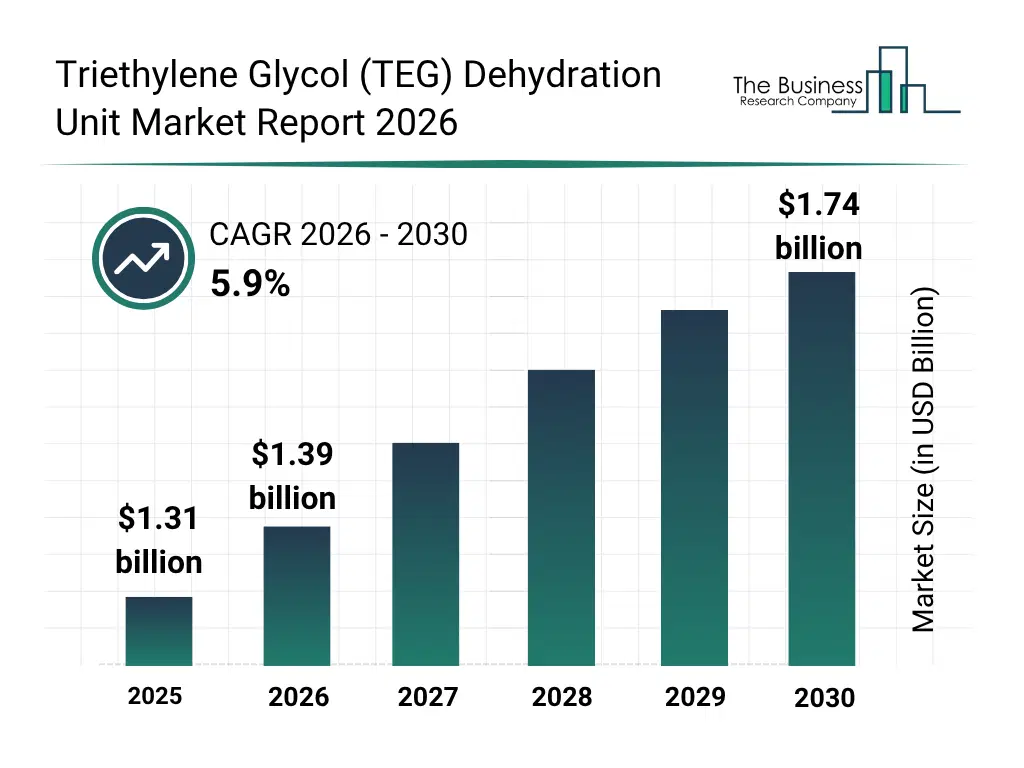
What Is The Triethylene Glycol (TEG) Dehydration Unit Market Size and Share 2026?
The triethylene glycol (TEG) dehydration unit market size has grown strongly in recent years.It will grow from $1.31 billion in 2025 to $1.39 billion in 2026 at a compound annual growth rate (CAGR) of 5.7%. The growth in the historic period can be attributed to expansion of global natural gas production, rising need for pipeline corrosion prevention, increasing adoption of gas processing infrastructure, growth in industrial-scale dehydration systems, development of conventional glycol based dehydration technology.What Is The Triethylene Glycol (TEG) Dehydration Unit Market Growth Forecast?
The triethylene glycol (TEG) dehydration unit market size is expected to see strong growth in the next few years.It will grow to $1.74 billion by 2030 at a compound annual growth rate (CAGR) of 5.9%. The growth in the forecast period can be attributed to rising demand for cleaner natural gas distribution networks, increasing automation in oil and gas processing plants, growth in remote offshore gas production facilities, expansion of energy infrastructure modernization projects, increasing focus on carbon reduction and process efficiency.Major trends in the forecast period include increasing adoption of energy efficient glycol regeneration systems, rising demand for modular gas dehydration skid units, growth in automated monitoring of gas processing parameters, expansion of remote operated natural gas processing facilities, increasing focus on emissions reduction in gas dehydration operations.
Global Triethylene Glycol (TEG) Dehydration Unit Market Segmentation
1) By Type: Skid-Mounted, Trailer-Mounted, Other Types 2) By Capacity: Small, Medium, Large 3) By Application: Onshore, Offshore 4) By End-User: Oil And Gas, Petrochemical, Natural Gas Processing, Other End-Users Subsegments: 1) By Skid-Mounted: Single Tower Units, Dual Tower Units, High Capacity Units, Low Capacity Units, Modular Skid Systems 2) By Trailer-Mounted: Mobile Field Deployment Units, Rapid Deployment Units, Compact Capacity Units, Heavy Duty Mobile Units, Remote Location Service Units 3) By Other Types: Fixed Installation Units, Containerized Units, Offshore Platform Units, Custom Engineered Units, Hybrid Mobility UnitsWhat Are The Drivers Of The Triethylene Glycol (TEG) Dehydration Unit Market?
The increasing natural gas production activities is expected to propel the growth of the triethylene glycol (TEG) dehydration unit industry going forward.Natural gas production activities refer to the exploration, extraction, and processing of natural gas resources.The rising adoption of natural gas is driven by growing global energy demand and the transition toward cleaner-burning fuels.TEG dehydration units play a critical role in natural gas processing by removing water vapor from the gas stream, thereby preventing pipeline corrosion and hydrate formation and ensuring that gas meets pipeline quality specifications.For instance, in November 2025,according to Enerdata, a France-based media company, global natural gas production rebounded by 2% in 2024 after a 0.6% increase in 2023, reflecting consistent year‑on‑year growth from 2022 levels when production rose modestly before accelerating again in 2024.Therefore, increasing natural gas production activities are driving the growth of the triethylene glycol (TEG) dehydration unit industry. The increasing use of corrosion-resistant materials is expected to support the growth of the triethylene glycol (TEG) dehydration unit industry going forward.Corrosion-resistant materials refer to metals or alloys specifically designed to withstand degradation caused by chemical reactions with environmental elements such as moisture, oxygen, and contaminants.Their use is rising due to greater exposure of industrial infrastructure to harsh operating environments, particularly in oil and gas processing systems.In such environments, TEG dehydration units play a critical role by removing water vapor from natural gas streams, thereby reducing moisture-induced corrosion and complementing the use of corrosion-resistant materials to extend equipment life and ensure operational reliability.For instance, in April 2023, according to the United States Geological Survey (USGS), a US-based government statistics source, global stainless steel production reached approximately 54.2 million metric tons, a 6.1% increase from 2022, reflecting growing demand for corrosion-resistant alloys across industrial applications.Therefore, the increasing use of corrosion-resistant materials is driving the growth of the triethylene glycol (TEG) dehydration unit industry. The increasing need for aging gas infrastructure upgrades and retrofits is expected to propel the growth of the triethylene glycol (TEG) dehydration unit industry going forward.Aging gas infrastructure upgrades and retrofits refer to the systematic replacement, refurbishment, or enhancement of outdated natural gas pipelines, processing equipment, and associated systems to improve safety, efficiency, and regulatory compliance.This need is driven by the growing number of decades-old pipelines and facilities requiring modernization to meet current operational and environmental standards.TEG dehydration units support these upgrades by removing water vapor from natural gas streams, thereby helping to maintain pipeline integrity, prevent corrosion, and ensure compliance with gas quality specifications in refurbished systems.For instance, in April 2026, according to the Pipeline and Hazardous Materials Safety Administration, a US-based pipeline safety regulator, funding for repairing and replacing aging natural gas pipelines reached $98 million in 2026, reflecting ongoing investment in infrastructure modernization despite fluctuations compared to previous years.Therefore, the increasing aging gas infrastructure upgrades & retrofits is driving the growth of the triethylene glycol (TEG) dehydration unit industry.Key Players In The Global Triethylene Glycol (TEG) Dehydration Unit Market
Major companies operating in the triethylene glycol (teg) dehydration unit market are Linde Engineering, Atlas Copco Gas & Process, Pall Corporation, Vanguard Process Solutions, Enerflex Ltd., Koch‑Glitsch LP, Spitzer Industries Inc., Propak Systems Ltd., Cimarron Energy Services, Axens S. A., TransTech Energy LLC, Sichuan Rongteng Automation Equipment Co. Ltd., QB Johnson Manufacturing Inc, ERGIL, Mar-Quinn Industries Ltd., Petro Gasgen Private Limited, NiGen International LLC, Croft Productions Systems, PSB Industries Inc., Excalibur Fiberglass Inc., Brilex Energy Solutions LLC, Triofab EngineeringRegional Insights
North America was the largest region in the triethylene glycol (TEG) dehydration unit market in 2025. Asia Pacific is expected to be the fastest-growing region in the forecast period. The regions covered in this market report are Asia-Pacific, South East Asia, Western Europe, Eastern Europe, North America, South America, Middle East and Africa. The countries covered in this market report are Australia, Brazil, China, France, Germany, India, Indonesia, Japan, Taiwan, Russia, South Korea, UK, USA, Canada, Italy, Spain.What Defines the Triethylene Glycol (TEG) Dehydration Unit Market?
The triethylene glycol (TEG) dehydration unit market consists of sales triethylene glycol, contactor column, glycol regeneration unit, reboiler, surge tank, flash tank, heat exchanger, glycol pump, gas filter separator, stripping column, glycol storage tank, level controllers, pressure regulators, temperature sensors. Values in this market are ‘factory gate’ values, that is, the value of goods sold by the manufacturers or creators of the goods, whether to other entities (including downstream manufacturers, wholesalers, distributors, and retailers) or directly to end customers. The value of goods in this market includes related services sold by the creators of the goods.What is the Market Assessment and Strategic Outlook for the Triethylene Glycol (TEG) Dehydration Unit Industry?
The triethylene glycol (teg) dehydration unit market research report is one of a series of new reports from The Business Research Company that provides market statistics, including industry global market size, regional shares, competitors with the market share, detailed market segments, market trends and opportunities, and any further data you may need to thrive in the triethylene glycol (teg) dehydration unit industry. The market research report delivers a complete perspective of everything you need, with an in-depth analysis of the current and future state of the industry.What is the Market Assessment and Strategic Outlook for the Triethylene Glycol (TEG) Dehydration Unit Market Report 2026?
The triethylene glycol (TEG) dehydration unit market research report is one of a series of new reports from The Business Research Company that provides triethylene glycol (TEG) dehydration unit market statistics, including triethylene glycol (TEG) dehydration unit industry global market size, regional shares, competitors with a triethylene glycol (TEG) dehydration unit market share, detailed triethylene glycol (TEG) dehydration unit market segments, market trends and opportunities, and any further data you may need to thrive in the triethylene glycol (TEG) dehydration unit industry. This triethylene glycol (TEG) dehydration unit market research report delivers a complete perspective of everything you need, with an in-depth analysis of the current and future scenario of the industry.Triethylene Glycol (TEG) Dehydration Unit Market Report Forecast Analysis
| Report Attribute | Details |
|---|---|
| Market Size Value In 2026 | $1.39 billion |
| Revenue Forecast In 2035 | $1.74 billion |
| Growth Rate | CAGR of 5.9% from 2026 to 2035 |
| Base Year For Estimation | 2025 |
| Actual Estimates/Historical Data | 2020-2025 |
| Forecast Period | 2026 - 2030 - 2035 |
| Market Representation | Revenue in USD Billion and CAGR from 2026 to 2035 |
| Segments Covered | Type, Capacity, Application, End-User |
| Regional Scope | Asia-Pacific, Western Europe, Eastern Europe, North America, South America, Middle East, Africa |
| Country Scope | The countries covered in the report are Australia, Brazil, China, France, Germany, India, Indonesia, Japan, Taiwan, Russia, South Korea, UK, USA, Canada, Italy, Spain. |
| Key Companies Profiled | Linde Engineering, Atlas Copco Gas & Process, Pall Corporation, Vanguard Process Solutions, Enerflex Ltd., Koch‑Glitsch LP, Spitzer Industries Inc., Propak Systems Ltd., Cimarron Energy Services, Axens S. A., TransTech Energy LLC, Sichuan Rongteng Automation Equipment Co. Ltd., QB Johnson Manufacturing Inc, ERGIL, Mar-Quinn Industries Ltd., Petro Gasgen Private Limited, NiGen International LLC, Croft Productions Systems, PSB Industries Inc., Excalibur Fiberglass Inc., Brilex Energy Solutions LLC, Triofab Engineering |
| Customization Scope | Request for Customization |
| Pricing And Purchase Options | Explore Purchase Options |