
Thyristor Market Report 2026
Thyristor Market Report 2026
Global Outlook – By Type (Unidirectional Thyristor, Bidirectional Thyristor, Other Types), By Device Type (Silicon-Controlled Rectifier (SCR), Gate Turn-Off Thyristor (GTO), Bidirectional Triac, Reverse Conducting Thyristor, Asymmetric Thyristor (ASCR)), By Voltage Rating (Rating Less than 500 MW, 500 - 1 000 MW, Above 1 000 MW), By Triggering Method (Electrical Gate Triggered, Light Triggered (LTT), Pulse Transformer Triggered), By End-use Industry (Industrial Drives and Motor Control, HVDC and FACTS (SVC, STATCOM), Renewable Power Conversion (Solar, Wind), Transportation (Rail Traction, Marine), Automotive (On-board Chargers, EV Powertrain), Consumer Electronics and Appliances, Aerospace And Defense) – Market Size, Trends, Strategies, and Forecast to 2035
Thyristor Market Overview
• Thyristor market size has reached to $1.7 billion in 2025 • Expected to grow to $2.21 billion in 2030 at a compound annual growth rate (CAGR) of 5.4% • Growth Driver: Surge In Demand For Renewable Energy Fueling The Growth Of The Market Due To Rising Investments In Solar, Wind, And Hydropower Systems • Market Trend: Advancing High-Performance Gate Driver Solutions For Compact And Energy-Efficient Appliance Architectures • North America was the largest region in 2025 and Asia-Pacific is the fastest growing region.

What Is Covered Under Thyristor Market?
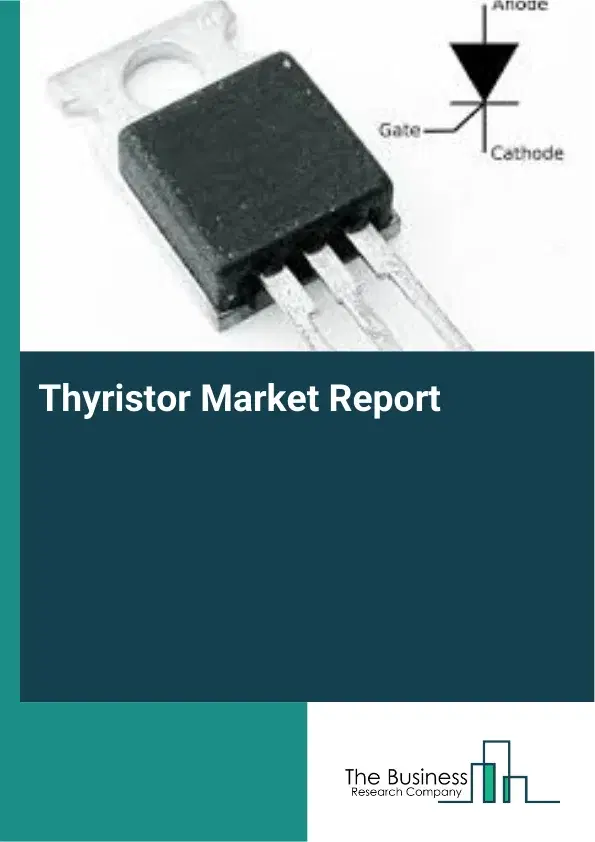
A thyristor is a solid-state semiconductor device that acts as a switch, controlling the flow of electrical current in a circuit. It has three or more layers of alternating P-type and N-type material, allowing it to remain in a conducting state once triggered until the current drops below a certain level. They are commonly used for controlling high-voltage and high-current power in electrical systems. The main types of thyristor are unidirectional thyristors, bidirectional thyristors, and other types, while the device types include silicon-controlled rectifiers (SCR), gate turn-off thyristors (GTO), bidirectional triacs, reverse conducting thyristors, and asymmetric thyristors (ASCR). Unidirectional thyristors refer to semiconductor devices that allow current to flow in only one direction when triggered by a gate signal. The voltage ratings are classified as less than 500?MW, 500–1,000?MW, and above 1,000?MW and the triggering methods include electrical gate triggered, light triggered (LTT), and pulse transformer triggered. These thyristor solutions are utilized across end-use industries such as industrial drives and motor control, HVDC and FACTS (SVC, STATCOM), renewable power conversion (solar, wind), transportation (rail traction, marine), automotive (on-board chargers, EV powertrain), consumer electronics and appliances, and Aerospace and Defense.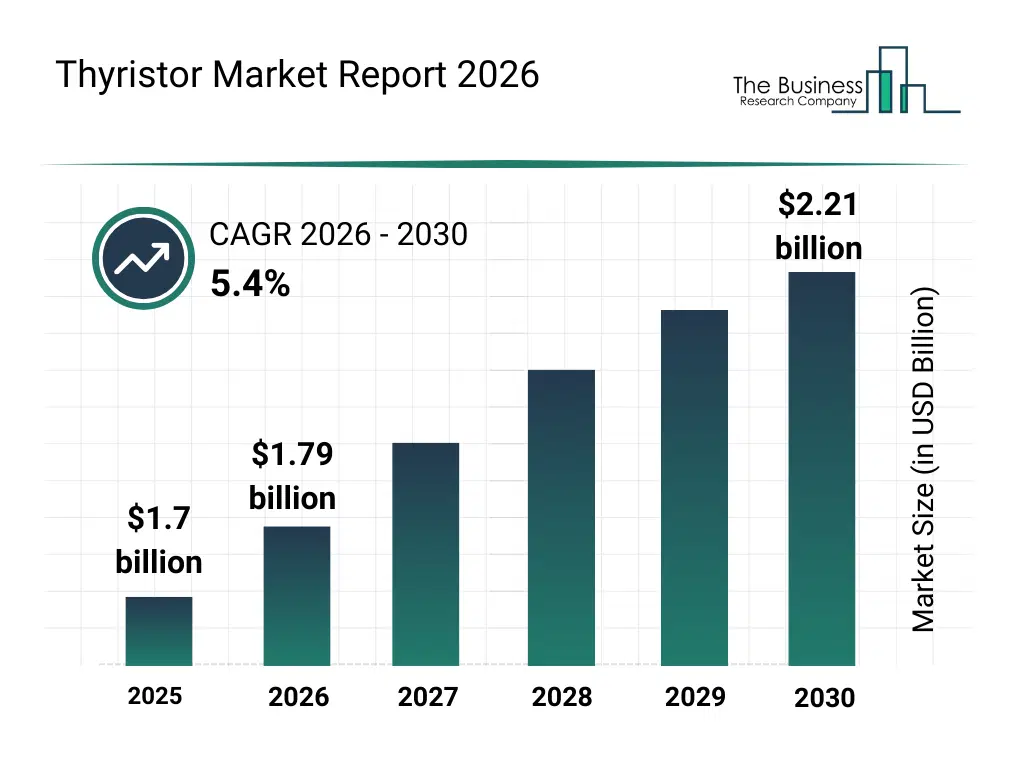
What Is The Thyristor Market Size and Share 2026?
The thyristor market size has grown strongly in recent years. It will grow from $1.7 billion in 2025 to $1.79 billion in 2026 at a compound annual growth rate (CAGR) of 5.2%. The growth in the historic period can be attributed to rising industrial automation, increasing deployment of hvdc systems, growing adoption of motor drives, expansion of renewable energy projects, rising demand for high-voltage power control.What Is The Thyristor Market Growth Forecast?
The thyristor market size is expected to see strong growth in the next few years. It will grow to $2.21 billion in 2030 at a compound annual growth rate (CAGR) of 5.4%. The growth in the forecast period can be attributed to growing electric mobility adoption, increasing deployment of smart grids, rising renewable power installations, expansion of rail traction and marine electrification, increasing adoption of ev onboard chargers and powertrains. Major trends in the forecast period include increasing adoption of high-power thyristors in hvdc and facts, rising demand for thyristor-based renewable power conversion systems, growing integration of light triggered thyristors (ltt), expansion of bidirectional thyristor applications in ac switching, rising focus on automotive and ev powertrain applications.Global Thyristor Market Segmentation
1) By Type: Unidirectional Thyristor, Bidirectional Thyristor, Other Types 2) By Device Type: Silicon-Controlled Rectifier (SCR), Gate Turn-Off Thyristor (GTO), Bidirectional Triac, Reverse Conducting Thyristor, Asymmetric Thyristor (ASCR) 3) By Voltage Rating: Rating Less than 500 MW, 500 - 1 000 MW, Above 1 000 MW 4) By Triggering Method: Electrical Gate Triggered, Light Triggered (LTT), Pulse Transformer Triggered 5) By End-use Industry: Industrial Drives and Motor Control, HVDC and FACTS (SVC, STATCOM), Renewable Power Conversion (Solar, Wind), Transportation (Rail Traction, Marine), Automotive (On-board Chargers, EV Powertrain), Consumer Electronics and Appliances, Aerospace And Defense Subsegments: 1) By Unidirectional Thyristor: Silicon Controlled Rectifier, Gate Turn Off Thyristor, Asymmetrical Silicon Controlled Rectifier, Reverse Conducting Thyristor, Light Activated Thyristor 2) By Bidirectional Thyristor: Bidirectional Triode For Alternating Current, Quadrac Device, Alternating Current Switch, Silicon Bilateral Switch 3) By Other Types: Static Induction Thyristor, Mos Controlled Thyristor, Integrated Gate Commutated Thyristor, Programmable Unijunction Transistor, Silicon Controlled SwitchWhat Is The Driver Of The Thyristor Market?
The rising demand for renewable energy is expected to propel the growth of the thyristor market going forward. Renewable energy refers to power generated from natural sources such as solar, wind, and hydropower that are replenished continuously and reduce dependence on fossil fuels while lowering carbon emissions. The demand for renewable energy is increasing as governments, industries, and consumers are focusing on sustainable power generation to address climate change, improve energy security, and meet environmental regulations. Thyristors support renewable energy systems by enabling efficient power control, voltage regulation, and high-capacity switching in converters and inverters used in solar panels and wind turbines. For instance, in March 2025, according to the International Renewable Energy Agency, a United Arab Emirates-based intergovernmental organization, renewable power capacity additions reached 585 GW in 2024, accounting for 92.5% of total power expansion and bringing total global capacity to 4,448 GW. Therefore, the rising demand for renewable energy is driving the growth of the thyristor industry.Key Players In The Global Thyristor Market
Major companies operating in the thyristor market are Siemens Aktiengesellschaft, Hitachi Ltd., Mitsubishi Electric Corporation, CRRC Corporation Limited, ABB Ltd., Eaton Corporation plc, Infineon Technologies AG, ON Semiconductor Corporation, Fuji Electric Co. Ltd., Vishay Intertechnology Inc., Bourns Inc., Littelfuse Inc., Sanken Electric Co. Ltd., Shindengen Electric Co. Ltd., Hind Rectifiers Limited, WeEn Semiconductors Co. Ltd., Dynex Semiconductor Limited, Central Semiconductor Corp., Powerex Inc., and SanRex Corporation.Global Thyristor Market Trends and Insights
Major companies operating in the thyristor market are focusing on developing innovative solutions, such as high-performance gate drivers, to enable more efficient and space-saving AC appliance designs. Ultra-compact thyristor gate drivers refer to devices that integrate isolation and control features in a small form factor, supporting high electrical isolation, noise immunity, and efficient triggering for household and industrial AC applications. For instance, in February 2026, STMicroelectronics, a Switzerland-based semiconductor company, launched its STSID140-12 ultra-compact thyristor gate driver, designed for space-constrained AC-powered appliances. This device features an integrated isolation transformer within a 5.35mm × 3.45mm DFN package, providing 1250V RMS insulation and high reliability while reducing board space. It supports zero-cross and phase-angle control modes, delivering up to 40mA output current to drive large thyristors, triacs, and solid-state relays, and is engineered to enhance safety with undervoltage lockout, high ESD robustness, and compact creepage distances. The solution enables manufacturers to design slimmer, more cost-effective AC appliances with simplified circuit layouts, automated assembly support, and minimal external components, ensuring dependable performance in compact and demanding electrical environments.What Are Latest Mergers And Acquisitions In The Thyristor Market?
In December 2025, ABB Ltd., a Switzerland-based electrification and automation technology company, acquired the power electronics business of Gamesa Electric from Siemens Gamesa for an undisclosed amount. Through this acquisition, the company aims to strengthen its position in renewable power conversion by expanding its portfolio of wind converters, battery energy storage systems, and utility-scale solar inverters while enhancing global service capabilities. Gamesa Electric is a Spain-based company that manufactures power electronic components incorporating thyristor technology for wind turbine converters, solar inverters, and energy storage systems.Regional Insights
North America was the largest region in the thyristor market in 2025. Asia-Pacific is expected to be the fastest-growing region in the forecast period. The regions covered in this market report are Asia-Pacific, South East Asia, Western Europe, Eastern Europe, North America, South America, Middle East, Africa. The countries covered in this market report are Australia, Brazil, China, France, Germany, India, Indonesia, Japan, Taiwan, Russia, South Korea, UK, USA, Canada, Italy, Spain.What Defines the Thyristor Market?
The thyristor market consists of sales of triacs, snubber circuits, thyristor power controllers, and diacs. Values in this market are ‘factory gate’ values, that is, the value of goods sold by the manufacturers or creators of the goods, whether to other entities (including downstream manufacturers, wholesalers, distributors, and retailers) or directly to end customers. The value of goods in this market includes related services sold by the creators of the goods.How is Market Value Defined and Measured?
The market value is defined as the revenues that enterprises gain from the sale of goods and/or services within the specified market and geography through sales, grants, or donations in terms of the currency (in USD unless otherwise specified). The revenues for a specified geography are consumption values that are revenues generated by organizations in the specified geography within the market, irrespective of where they are produced. It does not include revenues from resales along the supply chain, either further along the supply chain or as part of other products.What Key Data and Analysis Are Included in the Thyristor Market Report 2026?
The thyristor market research report is one of a series of new reports from The Business Research Company that provides thyristor market statistics, including thyristor industry global market size, regional shares, competitors with a thyristor market share, detailed thyristor market segments, market trends and opportunities, and any further data you may need to thrive in the thyristor industry. This thyristor market research report delivers a complete perspective of everything you need, with an in-depth analysis of the current and future scenario of the industry.Thyristor Market Report Forecast Analysis
| Report Attribute | Details |
|---|---|
| Market Size Value In 2026 | $1.79 billion |
| Revenue Forecast In 2035 | $2.21 billion |
| Growth Rate | CAGR of 5.2% from 2026 to 2035 |
| Base Year For Estimation | 2025 |
| Actual Estimates/Historical Data | 2020-2025 |
| Forecast Period | 2026 - 2030 - 2035 |
| Market Representation | Revenue in USD Billion and CAGR from 2026 to 2035 |
| Segments Covered | Type, Device Type, Voltage Rating, Triggering Method, End-use Industry |
| Regional Scope | Asia-Pacific, Western Europe, Eastern Europe, North America, South America, Middle East, Africa |
| Country Scope | The countries covered in the report are Australia, Brazil, China, France, Germany, India, ... |
| Key Companies Profiled | Siemens Aktiengesellschaft, Hitachi Ltd., Mitsubishi Electric Corporation, CRRC Corporation Limited, ABB Ltd., Eaton Corporation plc, Infineon Technologies AG, ON Semiconductor Corporation, Fuji Electric Co. Ltd., Vishay Intertechnology Inc., Bourns Inc., Littelfuse Inc., Sanken Electric Co. Ltd., Shindengen Electric Co. Ltd., Hind Rectifiers Limited, WeEn Semiconductors Co. Ltd., Dynex Semiconductor Limited, Central Semiconductor Corp., Powerex Inc., and SanRex Corporation. |
| Customization Scope | Request for Customization |
| Pricing And Purchase Options | Explore Purchase Options |