
Testing and simulation systems Market Report 2026
Testing and simulation systems Market Report 2026
Global Outlook – By Component (Hardware-In-The-Loop (HIL), Software-In-The-Loop (SIL), Model-In-The-Loop (MIL)), By Simulation Type (Real-time Simulation, Offline Simulation, Monte Carlo Simulation, Finite Element Analysis (FEA), Computational Fluid Dynamics (CFD)), By Deployment (On-premise, Cloud-Based, Hybrid), By Application (Aerospace And Defense, Automotive, Manufacturing, Healthcare, Other), By End Users (Original Equipment Manufacturers, Tier-1 And Tier-2 Suppliers, Research Institutions & Universities, Testing Laboratories, System Integrators) – Market Size, Trends, Strategies, and Forecast to 2035
Testing and simulation systems Market Overview
• Testing and simulation systems market size has reached to $17.59 billion in 2025 • Expected to grow to $30.47 billion in 2030 at a compound annual growth rate (CAGR) of 11.7% • Growth Driver: Rising Automotive Demand Driving Growth Of The Market Due To Growth In Electric And Autonomous Vehicles • Market Trend: Advancements In Precision Resistive Load Simulation Enhancing Electrical System Testing Accuracy • North America was the largest region in 2025 and Asia-Pacific is the fastest growing region.

What Is Covered Under Testing and simulation systems Market?
Testing and simulation systems refer to integrated hardware and software solutions used to evaluate and validate the performance, functionality, and reliability of products or systems under controlled conditions. These systems replicate real-world scenarios to identify defects, optimize designs, and ensure compliance before actual deployment. The main components of testing and simulation systems include hardware-in-the-loop (HIL), software-in-the-loop (SIL), and model-in-the-loop (MIL). Hardware-in-the-loop (HIL) refers to testing physical components within a simulated environment. The simulation types involved are real-time simulation, offline simulation, Monte Carlo simulation, finite element analysis (FEA), and computational fluid dynamics (CFD) and are deployed through on-premise, cloud-based, and hybrid modes. The applications involved are aerospace and defense, automotive, manufacturing, healthcare, and other sectors, and are utilized across end-users, including original equipment manufacturers, tier-1 and tier-2 suppliers, research institutions and universities, testing laboratories, and system integrators.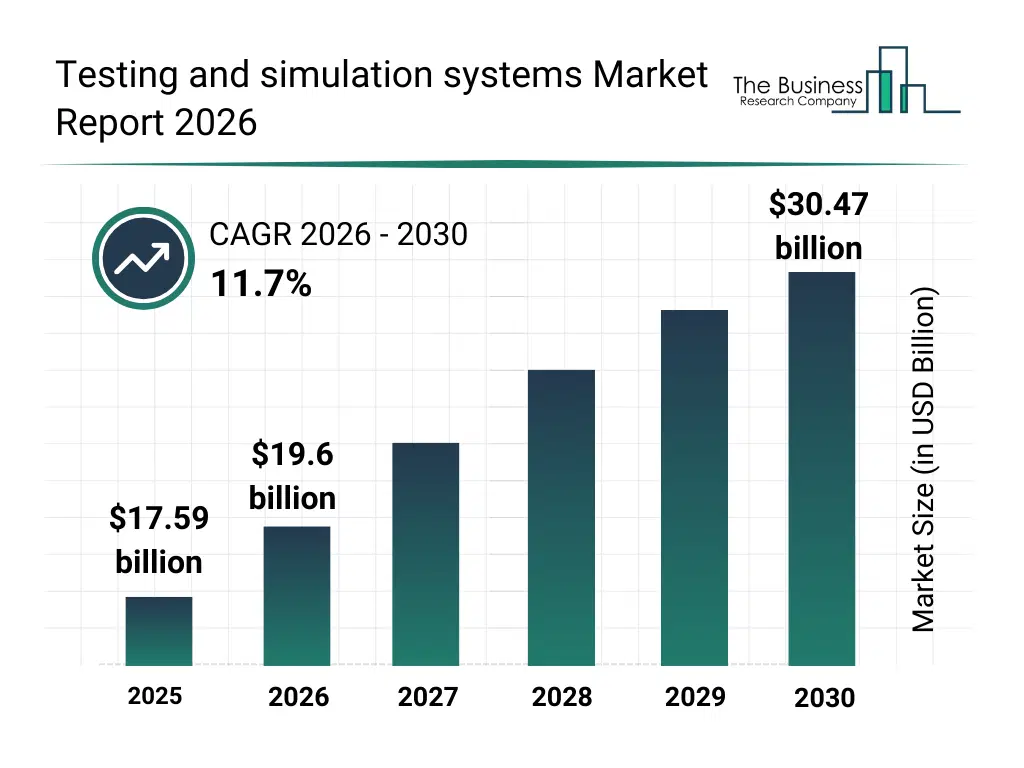
What Is The Testing and simulation systems Market Size and Share 2026?
The testing and simulation systems market size has grown rapidly in recent years. It will grow from $17.59 billion in 2025 to $19.6 billion in 2026 at a compound annual growth rate (CAGR) of 11.4%. The growth in the historic period can be attributed to increasing product complexity, growing adoption of advanced manufacturing processes, rising regulatory compliance requirements, increasing focus on product quality and safety, expansion of aerospace and automotive testing needs.What Is The Testing and simulation systems Market Growth Forecast?
The testing and simulation systems market size is expected to see rapid growth in the next few years. It will grow to $30.47 billion in 2030 at a compound annual growth rate (CAGR) of 11.7%. The growth in the forecast period can be attributed to growing deployment of AI-driven simulation tools, increasing adoption of cloud-based testing platforms, rising demand for multi-physics and multi-domain simulations, expansion of autonomous systems testing, increasing focus on digital twin technologies. Major trends in the forecast period include increasing adoption of cloud-based simulation platforms, rising demand for real-time data acquisition and reporting, growing focus on multi-scenario product testing, expansion of training and skill development solutions, rising integration of automation and control testing.Global Testing and simulation systems Market Segmentation
1) By Component: Hardware-In-The-Loop (HIL), Software-In-The-Loop (SIL), Model-In-The-Loop (MIL) 2) By Simulation Type: Real-time Simulation, Offline Simulation, Monte Carlo Simulation, Finite Element Analysis (FEA), Computational Fluid Dynamics (CFD) 3) By Deployment: On-premise, Cloud-Based, Hybrid 4) By Application: Aerospace And Defense, Automotive, Manufacturing, Healthcare, Other 5) By End Users: Original Equipment Manufacturers, Tier-1 And Tier-2 Suppliers, Research Institutions & Universities, Testing Laboratories, System Integrators Subsegments: 1) By Hardware-In-The-Loop (HIL): Sensor Or Actuator Simulators, Communication Interface Modules, HIL Simulation Platforms 2) By Software-In-The-Loop (SIL): Code Simulation Tools, Virtual Test Environments, Parameter Tuning And Debugging Tools 3) By Model-In-The-Loop (MIL): Model Development Tools, Logic Verification Tools, Algorithm Validation ToolsWhat Is The Driver Of The Testing and simulation systems Market?
The increasing demand for automotive is expected to propel the growth of the testing and simulation systems market going forward. Automotive refers to the industry and technologies associated with the development, production, operation, and servicing of motor vehicles used for the transportation of passengers and goods. The automotive industry is growing due to rising demand for electric vehicles, driven by stricter emission regulations and increasing consumer preference for sustainable and fuel-efficient transportation. Testing and simulation systems support the automotive industry by enabling manufacturers to virtually validate vehicle performance, safety, durability, and regulatory compliance, reducing development time, lowering costs, and accelerating time-to-market while improving product reliability. For instance, in January 2025, according to the Bureau of Infrastructure and Transport Research Economics (BITRE), an Australia-based government transport statistics agency, the total number of registered motor vehicles reached 22.3 million. Electrified vehicles saw substantial growth, with approximately 259,710 battery- and fuel-cell electric vehicles (BEVs & FCEVs) and 709,100 hybrid-electric vehicles (HEVs). Therefore, the increasing demand for automotive is driving the growth of the testing and simulation systems industry.Key Players In The Global Testing and simulation systems Market
Major companies operating in the testing and simulation systems market are Siemens Aktiengesellschaft, The Boeing Company, Lockheed Martin Corporation, General Dynamics Corporation, BAE Systems plc, Thales S.A., L3Harris Technologies Inc, Rheinmetall AG, Elbit Systems Ltd, Synopsys Inc, Saab AB, Kongsberg Gruppen ASA, The MathWorks Inc, FlightSafety International Inc, Altair Engineering Inc, dSPACE GmbH, Astronics Corporation, CAE Inc, COMSOL AB, and SIMTEC Systems GmbH.Global Testing and simulation systems Market Trends and Insights
Major companies operating in the testing and simulation systems market are focusing on developing technological advancements such as precision resistive load simulation to accurately replicate real-world electrical load conditions and improve the reliability and performance of power and electronic devices across diverse applications. Precision resistive load simulation is a testing method that uses highly accurate resistive loads to replicate real-world electrical conditions for evaluating the performance and reliability of power and electronic systems. For instance, in January 2026, TESCO Metering, a US-based manufacturing company, launched the 326P and 326X artificial resistive loads, portable and high-precision resistive load simulation devices featuring multi-tap and fixed high-current configurations to enable accurate meter testing and diagnostics, which are customizable for different testing scenarios and enhance safety and efficiency for both field and laboratory utility applications. It also offers lightweight construction and compatibility with a wide range of utility voltages by enabling technicians to perform repeatable and precise load simulations in both field and laboratory environments.What Are Latest Mergers And Acquisitions In The Testing and simulation systems Market?
In July 2025, Synopsys Inc., a US-based electronic design automation software company, acquired Ansys Inc. for $35 billion. Through this acquisition, Synopsys aims to expand its capabilities beyond chip design by integrating Ansys’s advanced simulation and analysis technologies, enabling a comprehensive silicon-to-systems engineering platform that supports virtual testing and validation of complex products. Ansys Inc. is a US-based software company that offers testing and simulation systems.Regional Insights
North America was the largest region in the testing and simulation systems market in 2025. Asia-Pacific is expected to be the fastest-growing region in the forecast period. The regions covered in this market report are Asia-Pacific, South East Asia, Western Europe, Eastern Europe, North America, South America, Middle East, Africa. The countries covered in this market report are Australia, Brazil, China, France, Germany, India, Indonesia, Japan, Taiwan, Russia, South Korea, UK, USA, Canada, Italy, Spain.What Defines the Testing and simulation systems Market?
The testing and simulation systems market consists of revenues earned by entities by providing services such as product testing and validation, training and skill development, automation and control testing, and data acquisition and reporting. The market value includes the value of related goods sold by the service provider or included within the service offering. The testing and simulation systems market also includes sales of test benches and rigs, flight simulators, data acquisition systems, and control and automation test systems. Values in this market are ‘factory gate’ values; that is, the value of goods sold by the manufacturers or creators of the goods, whether to other entities (including downstream manufacturers, wholesalers, distributors, and retailers) or directly to end customers. The value of goods in this market includes related services sold by the creators of the goods.How is Market Value Defined and Measured?
The market value is defined as the revenues that enterprises gain from the sale of goods and/or services within the specified market and geography through sales, grants, or donations in terms of the currency (in USD unless otherwise specified). The revenues for a specified geography are consumption values that are revenues generated by organizations in the specified geography within the market, irrespective of where they are produced. It does not include revenues from resales along the supply chain, either further along the supply chain or as part of other products.What Key Data and Analysis Are Included in the Testing and simulation systems Market Report 2026?
The testing and simulation systems market research report is one of a series of new reports from The Business Research Company that provides testing and simulation systems market statistics, including testing and simulation systems industry global market size, regional shares, competitors with a testing and simulation systems market share, detailed testing and simulation systems market segments, market trends and opportunities, and any further data you may need to thrive in the testing and simulation systems industry. This testing and simulation systems market research report delivers a complete perspective of everything you need, with an in-depth analysis of the current and future scenario of the industry.Testing and simulation systems Market Report Forecast Analysis
| Report Attribute | Details |
|---|---|
| Market Size Value In 2026 | $19.6 billion |
| Revenue Forecast In 2035 | $30.47 billion |
| Growth Rate | CAGR of 11.4% from 2026 to 2035 |
| Base Year For Estimation | 2025 |
| Actual Estimates/Historical Data | 2020-2025 |
| Forecast Period | 2026 - 2030 - 2035 |
| Market Representation | Revenue in USD Billion and CAGR from 2026 to 2035 |
| Segments Covered | Component, Simulation Type, Deployment, Application, End Users |
| Regional Scope | Asia-Pacific, Western Europe, Eastern Europe, North America, South America, Middle East, Africa |
| Country Scope | The countries covered in the report are Australia, Brazil, China, France, Germany, India, ... |
| Key Companies Profiled | Siemens Aktiengesellschaft, The Boeing Company, Lockheed Martin Corporation, General Dynamics Corporation, BAE Systems plc, Thales S.A., L3Harris Technologies Inc, Rheinmetall AG, Elbit Systems Ltd, Synopsys Inc, Saab AB, Kongsberg Gruppen ASA, The MathWorks Inc, FlightSafety International Inc, Altair Engineering Inc, dSPACE GmbH, Astronics Corporation, CAE Inc, COMSOL AB, and SIMTEC Systems GmbH. |
| Customization Scope | Request for Customization |
| Pricing And Purchase Options | Explore Purchase Options |
Frequently Asked Questions
The Testing and simulation systems market was valued at $17.59 billion in 2025, increased to $19.6 billion in 2026, and is projected to reach $30.47 billion by 2030.
request a sample hereThe global Testing and simulation systems market is expected to grow at a CAGR of 11.7% from 2026 to 2035 to reach $30.47 billion by 2035.
request a sample hereSome Key Players in the Testing and simulation systems market Include, Siemens Aktiengesellschaft, The Boeing Company, Lockheed Martin Corporation, General Dynamics Corporation, BAE Systems plc, Thales S.A., L3Harris Technologies Inc, Rheinmetall AG, Elbit Systems Ltd, Synopsys Inc, Saab AB, Kongsberg Gruppen ASA, The MathWorks Inc, FlightSafety International Inc, Altair Engineering Inc, dSPACE GmbH, Astronics Corporation, CAE Inc, COMSOL AB, and SIMTEC Systems GmbH..
request a sample hereMajor trend in this market includes: Advancements In Precision Resistive Load Simulation Enhancing Electrical System Testing Accuracy. For further insights on this market.
request a sample hereNorth America was the largest region in the testing and simulation systems market in 2025. Asia-Pacific is expected to be the fastest-growing region in the forecast period. The regions covered in the testing and simulation systems market report are Asia-Pacific, South East Asia, Western Europe, Eastern Europe, North America, South America, Middle East, Africa.
request a sample here