
Systemic Amyloidosis Therapeutic Market Report 2026
Systemic Amyloidosis Therapeutic Market Report 2026
Global Outlook – By Product Type (Small Molecule Drugs, Biologic Therapies, Monoclonal Antibodies, Chemotherapy Based Regimens, Targeted Therapies, Supportive Treatments), By Formulation (Tablets, Capsules, Injection), By Route of Administration (Oral, Intravenous, Subcutaneous), By Distribution Channel (Hospital Pharmacies, Retail Pharmacies, Online Pharmacies), By End User (Hospitals, Specialty Clinics, Specialty Pharmacies, Research and Academic Institutes, Other End Users) – Market Size, Trends, Strategies, and Forecast to 2035
Systemic Amyloidosis Therapeutic Market Overview
• Systemic Amyloidosis Therapeutic market size has reached to $5.67 billion in 2025 • Expected to grow to $8.88 billion in 2030 at a compound annual growth rate (CAGR) of 9.4% • Growth Driver: Increasing Demand For Targeted Therapeutic Solutions Is Fueling The Growth Of The Market Due To Rising Personalized Treatment Approvals • Market Trend: Advancements In Precision-Based Therapies Strengthen Treatment Outcomes For Rare Systemic Disorders • North America was the largest region in 2025 and Asia-Pacific is the fastest growing region.

What Is Covered Under Systemic Amyloidosis Therapeutic Market?
Systemic amyloidosis therapeutic refers to pharmaceutical and biologic treatments formulated to manage, slow, or treat systemic amyloidosis, a condition characterized by the abnormal accumulation of amyloid proteins in organs and tissues throughout the body. These therapies are designed to reduce amyloid production, stabilize misfolded proteins, or support organ function to alleviate symptoms and improve patient outcomes. It helps to slow or halt amyloid accumulation, preserve organ function, and improve survival and quality of life in patients with systemic amyloidosis. The main product types of systemic amyloidosis therapeutics include small molecule drugs, biologic therapies, monoclonal antibodies, chemotherapy-based regimens, targeted therapies, and supportive treatments. Small molecule drugs refer to low molecular weight compounds designed to target specific pathways involved in amyloidosis, reducing the accumulation of amyloid proteins. These therapeutics are available in formulations such as tablets, capsules, and injections, and are administered via oral, intravenous, or subcutaneous routes. They are distributed through hospital pharmacies, retail pharmacies, and online pharmacies, and are used by end users including hospitals, specialty clinics, specialty pharmacies, research and academic institutes, and other end users.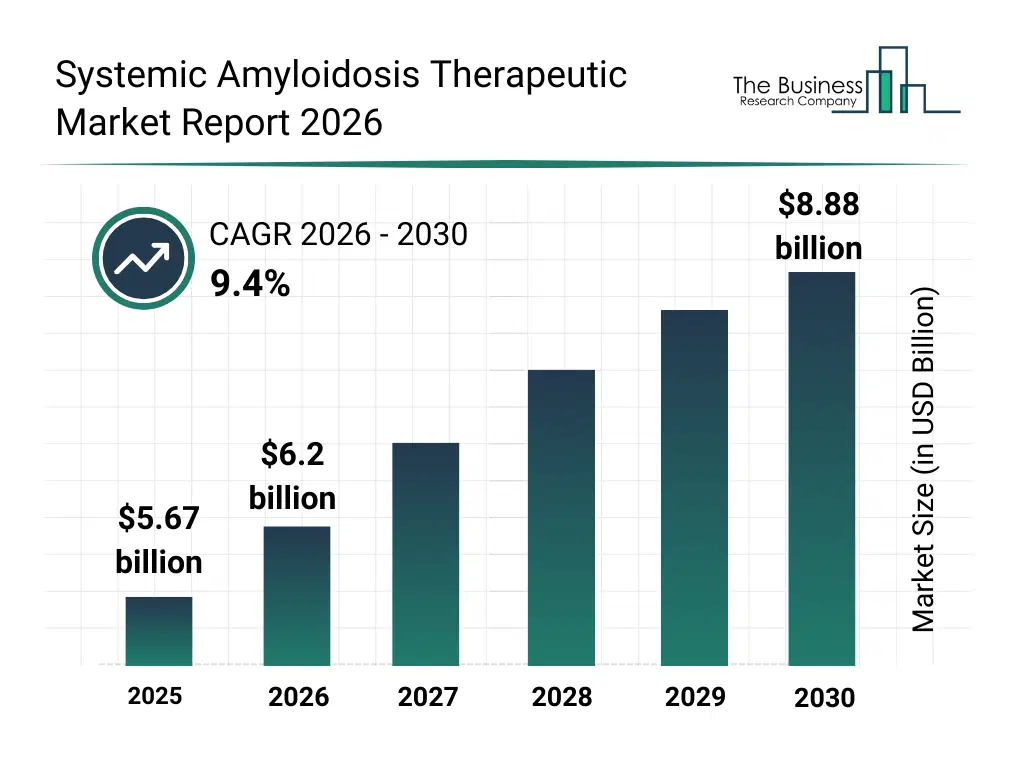
What Is The Systemic Amyloidosis Therapeutic Market Size and Share 2026?
The systemic amyloidosis therapeutic market size has grown strongly in recent years. It will grow from $5.67 billion in 2025 to $6.2 billion in 2026 at a compound annual growth rate (CAGR) of 9.2%. The growth in the historic period can be attributed to historical underdiagnosis of amyloidosis, reliance on chemotherapy regimens, growth in hematology treatment centers, increased rare disease awareness, early proteasome inhibitor adoption.What Is The Systemic Amyloidosis Therapeutic Market Growth Forecast?
The systemic amyloidosis therapeutic market size is expected to see strong growth in the next few years. It will grow to $8.88 billion in 2030 at a compound annual growth rate (CAGR) of 9.4%. The growth in the forecast period can be attributed to rising rare disease diagnosis rates, expansion of targeted biologic drugs, growing gene silencing therapy approvals, increased specialty clinic networks, stronger orphan drug incentives. Major trends in the forecast period include targeted amyloid protein stabilizer drugs, gene silencing amyloidosis therapies, monoclonal antibody based treatments, combination regimen treatment protocols, organ specific supportive drug strategies.Global Systemic Amyloidosis Therapeutic Market Segmentation
1) By Product Type: Small Molecule Drugs; Biologic Therapies; Monoclonal Antibodies; Chemotherapy Based Regimens; Targeted Therapies; Supportive Treatments 2) By Formulation: Tablets; Capsules; Injection 3) By Route of Administration: Oral; Intravenous; Subcutaneous 4) By Distribution Channel: Hospital Pharmacies; Retail Pharmacies; Online Pharmacies 5) By End User: Hospitals; Specialty Clinics; Specialty Pharmacies; Research and Academic Institutes; Other End Users Subsegments: 1) By Small Molecule Drugs: Proteasome Inhibitors; Stabilizers of Transthyretin Protein; Amyloid Fibril Disruptors; Immunomodulatory Small Molecules 2) By Biologic Therapies: Recombinant Protein Therapies; Gene Silencing Biologic Agents; Plasma Derived Biologic Products 3) By Monoclonal Antibodies: Anti Amyloid Fibril Antibodies; Anti Light Chain Antibodies; Targeted Clearance Antibodies 4) By Chemotherapy Based Regimens: Alkylating Agent Based Regimens; Proteasome Inhibitor Based Chemotherapy; Combination Chemotherapy Protocols 5) By Targeted Therapies: Targeted Light Chain Suppression Therapies; Targeted Transthyretin Reduction Therapies; Organ Specific Targeted Treatments 6) By Supportive Treatments: Cardiac Supportive Therapies; Renal Supportive Therapies; Neurological Symptom Management Therapies; Nutritional and Palliative Care TherapiesWhat Is The Driver Of The Systemic Amyloidosis Therapeutic Market?
The growing adoption of personalized medicine approaches is expected to propel the growth of the systemic amyloidosis therapeutic market going forward. Personalized medicine is a medical approach that customizes treatment and prevention strategies based on an individual’s genetic profile, biomarkers, and unique disease characteristics. The demand for personalized medicine is rising due to advances in genomic and biomarker technologies, which allow clinicians to precisely identify disease drivers and tailor treatments, improving efficacy and reducing adverse effects for individual patients. The adoption of personalized medicine increases demand for systemic amyloidosis therapeutics as patients with systemic amyloidosis have different amyloid subtypes (e.g., AL, ATTR) and genetic variations, so effective treatment requires therapies specifically designed to target the patient’s unique disease profile, ensuring maximum efficacy and minimal side effects. For instance, in April 2025, according to the Personalized Medicine Coalition (PMC), a US-based based nonprofit advocacy and educational organization, in 2023, FDA approved 16 new personalized treatments for rare disease patients, up from six in 2022. Therefore, the growing adoption of personalized medicine approaches is driving the growth of the systemic amyloidosis therapeutic industry.Key Players In The Global Systemic Amyloidosis Therapeutic Market
Major companies operating in the systemic amyloidosis therapeutic market are Johnson & Johnson Services Inc., Sanofi SA, Novartis Plc, AstraZeneca Plc, GSK Plc, Novo Nordisk A/S, Takeda Pharmaceutical Company Limited, Regeneron Pharmaceuticals Inc., Alnylam Pharmaceuticals Inc., Ionis Pharmaceuticals, Arcturus Therapeutics Inc, Prothena Biosciences, Fortress Biotech Inc., Intellia Therapeutics Inc., Zentalis Pharmaceuticals Inc., BridgeBio Pharma Inc., Neurimmune AG, HaemaLogix Pty Ltd., Attralus Inc., and Oncopeptides AB.Global Systemic Amyloidosis Therapeutic Market Trends and Insights
Major companies operating in the systemic amyloidosis therapeutic market are focusing on developing advanced targeted treatment approaches, such as RNA interference-based therapies, to address the underlying genetic causes of protein misfolding disorders, reduce disease progression, and improve long-term patient outcomes. RNA interference-based therapies work by selectively silencing disease-causing genes, thereby reducing the production of harmful proteins responsible for systemic organ damage. For instance, in March 2025, Alnylam Pharmaceuticals, a US-based biotechnology company, launched AMVUTTRA. AMVUTTRA offers a targeted, disease-modifying treatment for adults with transthyretin amyloidosis with cardiomyopathy (ATTR-CM). Developed by Alnylam Pharmaceuticals, it is the first RNAI therapeutic shown to reduce cardiovascular death, hospitalizations, and urgent heart failure visits in this patient population. AMVUTTRA works by rapidly suppressing transthyretin production at the source, addressing the underlying cause of amyloid deposition. It demonstrates consistent benefits across cardiovascular outcomes, functional capacity, and quality of life.What Are Latest Mergers And Acquisitions In The Systemic Amyloidosis Therapeutic Market?
In April 2025, Neurimmune, a Switzerland-based clinical-stage biopharmaceutical company focused on next-generation therapeutics for protein aggregation diseases, partnered with Alexion, AstraZeneca Rare Disease to develop and commercialize NI009 for light chain (AL) amyloidosis. Through this partnership, Neurimmune and Alexion aim to accelerate the development of a fibril-depleting monoclonal antibody therapy designed to target and remove lambda light chain amyloid deposits in patients with systemic AL amyloidosis. Alexion is a US-based global biopharmaceutical company specializing in late-stage development, manufacturing, and commercialization of therapies for serious systemic disorders, including amyloidosis.Regional Insights
North America was the largest region in the systemic amyloidosis therapeutic market in 2025. Asia-Pacific is expected to be the fastest-growing region in the forecast period. The regions covered in this market report are Asia-Pacific, South East Asia, Western Europe, Eastern Europe, North America, South America, Middle East, Africa. The countries covered in this market report are Australia, Brazil, China, France, Germany, India, Indonesia, Japan, Taiwan, Russia, South Korea, UK, USA, Canada, Italy, Spain.What Defines the Systemic Amyloidosis Therapeutic Market?
The systemic amyloidosis therapeutic market consists of sales of immunomodulatory drugs, proteasome inhibitors, alkylating agents, autophagy-modulating agents, cardiac supportive drugs, renal protective medications, and adjunctive symptomatic therapies. Values in this market are ‘factory gate’ values, that is, the value of goods sold by the manufacturers or developers of the therapeutics, whether to other entities (including wholesalers, distributors, hospitals, specialty pharmacies, and healthcare providers) or directly to end users. The value of goods in this market includes related services sold by the creators of the therapeutics.How is Market Value Defined and Measured?
The market value is defined as the revenues that enterprises gain from the sale of goods and/or services within the specified market and geography through sales, grants, or donations in terms of the currency (in USD unless otherwise specified). The revenues for a specified geography are consumption values that are revenues generated by organizations in the specified geography within the market, irrespective of where they are produced. It does not include revenues from resales along the supply chain, either further along the supply chain or as part of other products.What Key Data and Analysis Are Included in the Systemic Amyloidosis Therapeutic Market Report 2026?
The systemic amyloidosis therapeutic market research report is one of a series of new reports from The Business Research Company that provides market statistics, including industry global market size, regional shares, competitors with the market share, detailed market segments, market trends and opportunities, and any further data you may need to thrive in the systemic amyloidosis therapeutic industry. The market research report delivers a complete perspective of everything you need, with an in-depth analysis of the current and future state of the industry.Systemic Amyloidosis Therapeutic Market Report Forecast Analysis
| Report Attribute | Details |
|---|---|
| Market Size Value In 2026 | $6.2 billion |
| Revenue Forecast In 2035 | $8.88 billion |
| Growth Rate | CAGR of 9.2% from 2026 to 2035 |
| Base Year For Estimation | 2025 |
| Actual Estimates/Historical Data | 2020-2025 |
| Forecast Period | 2026 - 2030 - 2035 |
| Market Representation | Revenue in USD Billion and CAGR from 2026 to 2035 |
| Segments Covered | Product Type, Formulation, Route of Administration, Distribution Channel, End User |
| Regional Scope | Asia-Pacific, Western Europe, Eastern Europe, North America, South America, Middle East, Africa |
| Country Scope | The countries covered in the report are Australia, Brazil, China, France, Germany, India, ... |
| Key Companies Profiled | Johnson & Johnson Services Inc., Sanofi SA, Novartis Plc, AstraZeneca Plc, GSK Plc, Novo Nordisk A/S, Takeda Pharmaceutical Company Limited, Regeneron Pharmaceuticals Inc., Alnylam Pharmaceuticals Inc., Ionis Pharmaceuticals, Arcturus Therapeutics Inc, Prothena Biosciences, Fortress Biotech Inc., Intellia Therapeutics Inc., Zentalis Pharmaceuticals Inc., BridgeBio Pharma Inc., Neurimmune AG, HaemaLogix Pty Ltd., Attralus Inc., and Oncopeptides AB. |
| Customization Scope | Request for Customization |
| Pricing And Purchase Options | Explore Purchase Options |
Frequently Asked Questions
The Systemic Amyloidosis Therapeutic market was valued at $5.67 billion in 2025, increased to $6.2 billion in 2026, and is projected to reach $8.88 billion by 2030.
request a sample hereThe global Systemic Amyloidosis Therapeutic market is expected to grow at a CAGR of 9.4% from 2026 to 2035 to reach $8.88 billion by 2035.
request a sample hereSome Key Players in the Systemic Amyloidosis Therapeutic market Include, Johnson & Johnson Services Inc., Sanofi SA, Novartis Plc, AstraZeneca Plc, GSK Plc, Novo Nordisk A/S, Takeda Pharmaceutical Company Limited, Regeneron Pharmaceuticals Inc., Alnylam Pharmaceuticals Inc., Ionis Pharmaceuticals, Arcturus Therapeutics Inc, Prothena Biosciences, Fortress Biotech Inc., Intellia Therapeutics Inc., Zentalis Pharmaceuticals Inc., BridgeBio Pharma Inc., Neurimmune AG, HaemaLogix Pty Ltd., Attralus Inc., and Oncopeptides AB. .
request a sample hereMajor trend in this market includes: Advancements In Precision-Based Therapies Strengthen Treatment Outcomes For Rare Systemic Disorders. For further insights on this market.
request a sample hereNorth America was the largest region in the systemic amyloidosis therapeutic market in 2025. Asia-Pacific is expected to be the fastest-growing region in the forecast period. The regions covered in the systemic amyloidosis therapeutic market report are Asia-Pacific, South East Asia, Western Europe, Eastern Europe, North America, South America, Middle East, Africa.
request a sample here