
Spatial Computing In Robotics Market Report 2026
Global Outlook – By Component (Hardware, Software, Services), By Technology Type (Augmented Reality Technology, Virtual Reality Technology, Mixed Reality Technology), By Application (Space Exploration Robots, Industrial Robots, Service Robots, Collaborative Robots, Autonomous Mobile Robots, Other Applications), By End-User Industry (Aerospace And Defense, Manufacturing, Healthcare, Retail And E-commerce, Education And Training, Automotive, Information Technology And Telecommunications) – Market Size, Trends, Strategies, and Forecast to 2035
Spatial Computing In Robotics Market Overview
• Spatial Computing In Robotics market size has reached to $11.67 billion in 2025 • Expected to grow to $39.75 billion in 2030 at a compound annual growth rate (CAGR) of 27.7% • Growth Driver: Growing Demand For Digital Transformation Fueling The Growth Of The Market Due To Need For Operational Efficiency And Automation • Market Trend: Apple Unveils Vision Pro, Revolutionizing Spatial Computing In Robotics • North America was the largest region in 2025 and Asia-Pacific is the fastest growing region.What Is Covered Under Spatial Computing In Robotics Market?
Spatial computing in robotics refers to using digital technologies that enable robots to understand, interpret, and interact with physical space in real-time. It combines sensors, artificial intelligence, and 3D mapping to allow robots to perceive their environment, navigate accurately, recognize objects, and perform tasks with spatial awareness. The main components of spatial computing in robotics are hardware, software, and services. Hardware refers to the physical parts of a computer or electronic system, such as the monitor, keyboard, hard drive, and motherboard, that you can touch and see. The key technology types include augmented reality (AR), virtual reality (VR), and mixed reality (MR). This technology is applied across various robotic systems such as space exploration robots, industrial robots, service robots, collaborative robots, and autonomous mobile robots. It serves a wide range of end-user industries, including aerospace and defense, manufacturing, healthcare, retail and e-commerce, education and training, automotive, and information technology and telecommunications.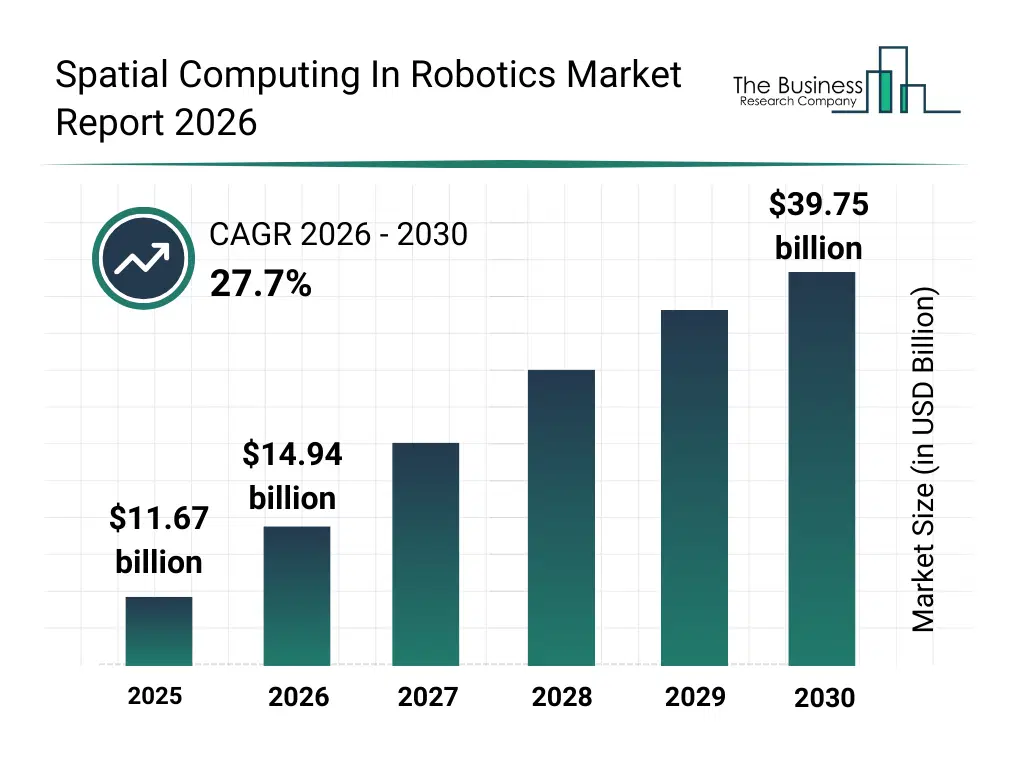
What Is The Spatial Computing In Robotics Market Size and Share 2026?
The spatial computing in robotics market size has grown exponentially in recent years. It will grow from $11.67 billion in 2025 to $14.94 billion in 2026 at a compound annual growth rate (CAGR) of 28.0%. The growth in the historic period can be attributed to growth of industrial robotics adoption, expansion of warehouse automation, advancement of sensor technologies, rising AI integration in robotics, demand for autonomous navigation systems.What Is The Spatial Computing In Robotics Market Growth Forecast?
The spatial computing in robotics market size is expected to see exponential growth in the next few years. It will grow to $39.75 billion in 2030 at a compound annual growth rate (CAGR) of 27.7%. The growth in the forecast period can be attributed to deployment of collaborative robots, expansion of autonomous mobile robots, adoption of digital twin platforms, integration of AI-based perception systems, growth of service robotics applications. Major trends in the forecast period include real-time robot navigation systems, 3D environment mapping integration, autonomous spatial perception models, human-robot interaction interfaces, digital twin robotics simulation.
Global Spatial Computing In Robotics Market Segmentation
1) By Component: Hardware, Software, Services 2) By Technology Type: Augmented Reality Technology, Virtual Reality Technology, Mixed Reality Technology 3) By Application: Space Exploration Robots, Industrial Robots, Service Robots, Collaborative Robots, Autonomous Mobile Robots, Other Applications 4) By End-User Industry: Aerospace And Defense, Manufacturing, Healthcare, Retail And E-commerce, Education And Training, Automotive, Information Technology And Telecommunications Subsegments: 1) By Hardware: Sensors, Cameras, Processing Units, Augmented Reality And Virtual Reality Headsets, Haptic Devices, Robotics Platforms 2) By Software: Mapping And Localization, Spatial Analytics And Artificial Intelligence Algorithms, Simulation And Modeling Tools, Three-Dimensional (3D) Reconstruction And Rendering Software, Augmented Reality And Virtual Reality Interfaces For Robotics Control, Middleware For Integration And Interoperability 3) By Services: System Integration Services, Consulting And Advisory Services, Support And Maintenance Services, Training And Education Services, Custom Application DevelopmentWhat Is The Driver Of The Spatial Computing In Robotics Market?
The growing demand for digital transformation is expected to propel the growth of the spatial computing in the robotics market going forward. Digital transformation refers to integrating digital technologies into all business areas, fundamentally changing how they operate and deliver value to customers. The demand for digital transformation is increasing due to the need for greater operational efficiency and automation as businesses aim to streamline processes, reduce costs, and enhance productivity through intelligent technologies. Spatial computing in robotics accelerates digital transformation by enabling real-time 3D perception and autonomous decision-making, making operations smarter and more efficient. It enhances productivity across industries by automating complex tasks and improving human-robot collaboration. For instance, in 2023, according to the European Investment Bank (EIB), a Luxembourg-based financial institution, the adoption of advanced digital technologies among EU firms increased from 69% in 2022 to approximately 70% in 2023, showing a modest year-on-year growth. Therefore, the growing demand for digital transformation is driving the growth of the spatial computing in the robotics market.Key Players In The Global Spatial Computing In Robotics Market
Major companies operating in the spatial computing in robotics market are Apple Inc., Google LLC, Microsoft Corporation, HyundAI Motor Group, Sony Group Corporation, Lenovo Group Limited, Midea Group, Qualcomm Technologies Inc., Nvidia Corporation, Rockwell Automation Inc., SICK AG, PTC Inc., Unity Software Inc., iRobot Corporation, ANYbotics AG, NavVis GmbH, Magic Leap Inc., RoboSense, XGrids Limited, Marxent Labs LLC, DAQRIGlobal Spatial Computing In Robotics Market Trends and Insights
Major companies operating in the spatial computing in robotics market are focusing on developing advanced products such as mixed reality headsets to enhance immersive interactions and improve robotic precision. Mixed reality (MR) headsets are wearable devices that blend real-world environments with computer-generated content, allowing users to simultaneously interact with physical and digital elements in a seamless and immersive experience. For instance, in June 2023, Apple Inc., a US-based technology company, launched Apple Vision Pro, a wearable mixed-reality headset that seamlessly blends digital content with the physical environment, creating a new spatial computing era. It offers intuitive control through eye, hand, and voice tracking, advanced spatial audio, and a sophisticated sensor array for immersive spatial computing experiences.What Are Latest Mergers And Acquisitions In The Spatial Computing In Robotics Market?
In January 2024, ABB Ltd, a Switzerland-based technology company, acquired Sevensense Robotics AG for an undisclosed amount. With this acquisition, ABB aims to strengthen its autonomous mobile robots with Sevensense’s Visual SLAM technology, boosting spatial computing and navigation capabilities. Sevensense Robotics AG is a Switzerland-based robotics company specializing in spatial computing in robotics.Regional Insights
North America was the largest region in the spatial computing in robotics market in 2025. Asia-Pacific is expected to be the fastest-growing region in the forecast period. The regions covered in this market report are Asia-Pacific, South East Asia, Western Europe, Eastern Europe, North America, South America, Middle East, Africa. The countries covered in this market report are Australia, Brazil, China, France, Germany, India, Indonesia, Japan, Taiwan, Russia, South Korea, UK, USA, Canada, Italy, Spain.What Defines the Spatial Computing In Robotics Market?
The spatial computing in robotics market consists of revenues earned by entities by providing services such as mapping and localization services, three-dimensional (3D) visualization and simulation, robot-assisted automation services and indoor navigation solutions. The market value includes the value of related goods sold by the service provider or included within the service offering. The spatial computing in robotics market also consists of sales of robotic perception systems, motion planning software, augmented reality systems, lidar sensors and inertial measurement units. Values in this market are ‘factory gate’ values, that is, the value of goods sold by the manufacturers or creators of the goods, whether to other entities (including downstream manufacturers, wholesalers, distributors, and retailers) or directly to end customers. The value of goods in this market includes related services sold by the creators of the goods.How is Market Value Defined and Measured?
The market value is defined as the revenues that enterprises gain from the sale of goods and/or services within the specified market and geography through sales, grants, or donations in terms of the currency (in USD unless otherwise specified). The revenues for a specified geography are consumption values that are revenues generated by organizations in the specified geography within the market, irrespective of where they are produced. It does not include revenues from resales along the supply chain, either further along the supply chain or as part of other products.What Key Data and Analysis Are Included in the Spatial Computing In Robotics Market Report 2026?
The spatial computing in robotics market research report is one of a series of new reports from The Business Research Company that provides market statistics, including industry global market size, regional shares, competitors with the market share, detailed market segments, market trends and opportunities, and any further data you may need to thrive in the spatial computing in robotics industry. The market research report delivers a complete perspective of everything you need, with an in-depth analysis of the current and future state of the industry.Spatial Computing In Robotics Market Report Forecast Analysis
| Report Attribute | Details |
|---|---|
| Market Size Value In 2026 | $14.94 billion |
| Revenue Forecast In 2035 | $39.75 billion |
| Growth Rate | CAGR of 28.0% from 2026 to 2035 |
| Base Year For Estimation | 2025 |
| Actual Estimates/Historical Data | 2020-2025 |
| Forecast Period | 2026 - 2030 - 2035 |
| Market Representation | Revenue in USD Billion and CAGR from 2026 to 2035 |
| Segments Covered | Component, Technology Type, Application, End-User Industry |
| Regional Scope | Asia-Pacific, Western Europe, Eastern Europe, North America, South America, Middle East, Africa |
| Country Scope | The countries covered in the report are Australia, Brazil, China, France, Germany, India, ... |
| Key Companies Profiled | Apple Inc., Google LLC, Microsoft Corporation, HyundAI Motor Group, Sony Group Corporation, Lenovo Group Limited, Midea Group, Qualcomm Technologies Inc., Nvidia Corporation, Rockwell Automation Inc., SICK AG, PTC Inc., Unity Software Inc., iRobot Corporation, ANYbotics AG, NavVis GmbH, Magic Leap Inc., RoboSense, XGrids Limited, Marxent Labs LLC, DAQRI |
| Customization Scope | Request for Customization |
| Pricing And Purchase Options | Explore Purchase Options |