
Space Medicine Market Report 2026
Global Outlook – By Type (Private Aerospace Service, Non-private Aerospace Service), By Technology (Telemedicine Solutions, Artificial Intelligence And Machine Learning In Health Monitoring, Remote Diagnostics), By Application (Regeneration Medicine, Neurobiology, Microbiology), By End-User (Commercial, Government, Military) – Market Size, Trends, Strategies, and Forecast to 2035
Space Medicine Market Overview
• Space Medicine market size has reached to $1.33 billion in 2025 • Expected to grow to $2.4 billion in 2030 at a compound annual growth rate (CAGR) of 12.5% • Growth Driver: Increasing Interest In Space Tourism Fueling The Growth Of The Market Due To Rising Need For Civilian Health And Safety In Space • Market Trend: Advancing Human Health Beyond Earth Through Innovations In Space-Based Regenerative Medicine • North America was the largest region in 2025 and Asia-Pacific is the fastest growing region.What Is Covered Under Space Medicine Market?
Space medicine is a specialized branch of medicine that focuses on the health and well-being of astronauts before, during, and after space missions. It studies how spaceflight conditions such as microgravity, radiation, isolation, and confinement affect human physiology and psychology. The main purpose of space medicine is to prevent, diagnose, and treat medical conditions in space, ensuring the safety and performance of crew members in extreme environments. The main types of space medicine are private aerospace service, and non-private aerospace service. Private aerospace service refers to space services provided by private companies, such as commercial space travel, astronaut training, and medical support for private space missions. It utilizes various technologies, including telemedicine solutions, artificial intelligence and machine learning in health monitoring, and remote diagnostics, and they are applied in oncology, regeneration medicine, neurobiology and microbiology, catering to several end users such as commercial, government and military.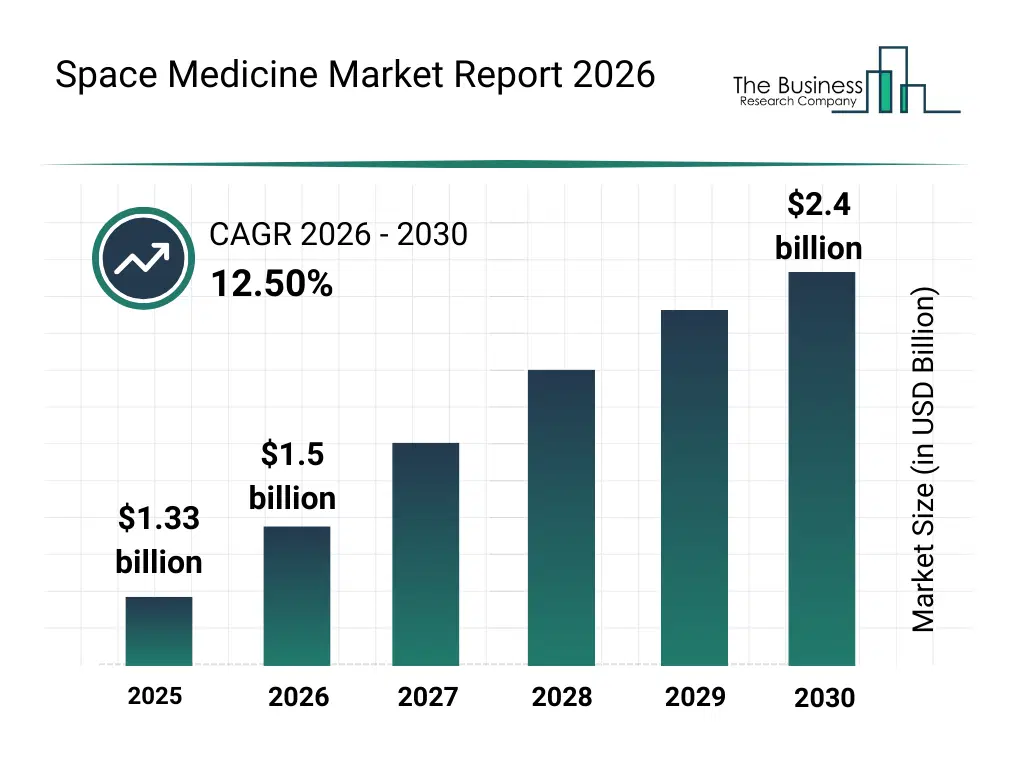
What Is The Space Medicine Market Size and Share 2026?
The space medicine market size has grown rapidly in recent years. It will grow from $1.33 billion in 2025 to $1.5 billion in 2026 at a compound annual growth rate (CAGR) of 12.8%. The growth in the historic period can be attributed to limited understanding of human physiology in microgravity, reliance on ground-based health monitoring, increasing number of government-funded space missions, rising investments in aerospace health research, development of early in-flight emergency care protocols.What Is The Space Medicine Market Growth Forecast?
The space medicine market size is expected to see rapid growth in the next few years. It will grow to $2.4 billion in 2030 at a compound annual growth rate (CAGR) of 12.5%. The growth in the forecast period can be attributed to growth of commercial spaceflight and space tourism, adoption of ai-based health monitoring systems, increasing military and government space missions, expansion of private astronaut training and health programs, development of advanced telemedicine and remote diagnostics. Major trends in the forecast period include increasing adoption of telemedicine solutions for space missions, rising focus on astronaut mental health and isolation management, growth in regenerative medicine and neurobiology applications in space, integration of remote diagnostics for in-flight health monitoring, expansion of space tourism medical support services.
Global Space Medicine Market Segmentation
1) By Type: Private Aerospace Service, Non-private Aerospace Service 2) By Technology: Telemedicine Solutions, Artificial Intelligence And Machine Learning In Health Monitoring, Remote Diagnostics 3) By Application: Regeneration Medicine, Neurobiology, Microbiology 4) By End-User: Commercial, Government, Military Subsegments: 1) By Private Aerospace Service: Space Tourism Medical Support, In-Flight Health Monitoring Systems, Commercial Spaceflight Emergency Care, Private Astronaut Training And Health Programs, Telemedicine Solutions For Private Missions 2) By Non-private Aerospace Service: Government-Funded Space Health Research, Astronaut Health Monitoring For National Missions, Military Space Medicine Programs, Space Agency Medical Facilities, Public-Sector Space Rehabilitation ProgramsWhat Is The Driver Of The Space Medicine Market?
The increasing interest in space tourism is expected to propel the growth of the space medicine market going forward. Space tourism refers to the commercial activity of sending private individuals into space for recreational, leisure, or adventure purposes, rather than for scientific or governmental missions. The demand for space tourism is increasing due to rising accessibility and affordability of commercial spaceflights as reusable launch technologies are significantly reducing the cost of space travel. Space medicine enhances space tourism by ensuring the health and safety of civilians in space through advanced medical monitoring and preventive care. It reduces health risks by addressing space-related physiological challenges, improving the overall experience for space travelers. For instance, in July 2023, according to a survey study among 10,329 U.S. adults from May 30 to June 4, 2023, by the Pew Research Center, a US-based research organization, 55% of Americans expect that space tourism will become routine by 2073, with 35% personally interested in going to space. Therefore, the increasing interest in space tourism is driving the growth of the space medicine industry.Key Players In The Global Space Medicine Market
Major companies operating in the space medicine market are The Boeing Company, Lockheed Martin Corporation, Novartis AG, Collins Aerospace, KBR Inc., Boryung Corp., Sierra Space Corporation, Redwire Corporation, Axiom Space Inc., Varda Space Industries Inc., Nanoracks LLC , RevBio Inc. , StemoniX Inc. , SpacePharma SA, Angiex Inc., Vaxxinity Inc., rHEALTH Inc., Delta Biosciences LLC, Virgin Galactic Holdings Inc., Level Ex Inc.Global Space Medicine Market Trends and Insights
Major companies operating in the space medicine market are focusing on developing innovative formulations, such as space-based regenerative medicine, to enhance tissue repair, stem cell functionality, and overall human health during long-duration space missions. Space-based regenerative medicine refers to using microgravity environments to study and enhance tissue repair, stem cell growth, and organ regeneration. For instance, in May 2025, according to Cedars-Sinai, a US-based healthcare organization, launched the Center for Space Medicine Research to advance studies on how the human body and stem cells behave in space. It also offers educational programs in space biomedicine as part of its regenerative medicine curriculum. This initiative leads advancements in space medicine by connecting space science with clinical research, aiming to improve astronaut care and foster medical breakthroughs for use on Earth.What Are Latest Mergers And Acquisitions In The Space Medicine Market?
In April 2025, the Indian Space Research Organisation, an Indian-based organization, partnered with the Sree Chitra Tirunal Institute for Medical Sciences & Technology to develop space medicine solutions for astronaut health and Gaganyaan missions. This partnership aims to advance research in astronaut physiology, telemedicine, radiation protection, and mental health support and to develop medical kits and protocols for human spaceflight. Sree Chitra Tirunal Institute for Medical Sciences & Technology is an Indian medical institute aiding space medicine via astronaut health, telemedicine, and space medical tech research.Regional Insights
North America was the largest region in the space medicine market in 2025. Asia-Pacific is expected to be the fastest-growing region in the forecast period. The regions covered in this market report are Asia-Pacific, South East Asia, Western Europe, Eastern Europe, North America, South America, Middle East, Africa. The countries covered in this market report are Australia, Brazil, China, France, Germany, India, Indonesia, Japan, Taiwan, Russia, South Korea, UK, USA, Canada, Italy, Spain.What Defines the Space Medicine Market?
The space medicine market consists of revenues earned by entities by providing services such as pre-flight medical screening, in-flight health monitoring, telemedicine consultations, development of countermeasures for microgravity effects, space-based surgical support, radiation protection solutions, psychological support for astronauts, post-mission rehabilitation, and space health data analytics. The market value includes the value of related goods sold by the service provider or included within the service offering. The space medicine market also includes sales of space-adapted medical devices, wearable health monitors, radiation protection equipment, space-grade pharmaceuticals, and diagnostic tools. Values in this market are ‘factory gate’ values, that is the value of goods sold by the manufacturers or creators of the goods, whether to other entities (including downstream manufacturers, wholesalers, distributors and retailers) or directly to end customers. The value of goods in this market includes related services sold by the creators of the goods.How is Market Value Defined and Measured?
The market value is defined as the revenues that enterprises gain from the sale of goods and/or services within the specified market and geography through sales, grants, or donations in terms of the currency (in USD unless otherwise specified). The revenues for a specified geography are consumption values that are revenues generated by organizations in the specified geography within the market, irrespective of where they are produced. It does not include revenues from resales along the supply chain, either further along the supply chain or as part of other products.What Key Data and Analysis Are Included in the Space Medicine Market Report 2026?
The space medicine market research report is one of a series of new reports from The Business Research Company that provides market statistics, including industry global market size, regional shares, competitors with the market share, detailed market segments, market trends and opportunities, and any further data you may need to thrive in the space medicine industry. The market research report delivers a complete perspective of everything you need, with an in-depth analysis of the current and future state of the industry.Space Medicine Market Report Forecast Analysis
| Report Attribute | Details |
|---|---|
| Market Size Value In 2026 | $1.5 billion |
| Revenue Forecast In 2035 | $2.4 billion |
| Growth Rate | CAGR of 12.8% from 2026 to 2035 |
| Base Year For Estimation | 2025 |
| Actual Estimates/Historical Data | 2020-2025 |
| Forecast Period | 2026 - 2030 - 2035 |
| Market Representation | Revenue in USD Billion and CAGR from 2026 to 2035 |
| Segments Covered | Type, Technology, Application, End-User |
| Regional Scope | Asia-Pacific, Western Europe, Eastern Europe, North America, South America, Middle East, Africa |
| Country Scope | The countries covered in the report are Australia, Brazil, China, France, Germany, India, ... |
| Key Companies Profiled | The Boeing Company, Lockheed Martin Corporation, Novartis AG, Collins Aerospace, KBR Inc., Boryung Corp., Sierra Space Corporation, Redwire Corporation, Axiom Space Inc., Varda Space Industries Inc., Nanoracks LLC , RevBio Inc. , StemoniX Inc. , SpacePharma SA, Angiex Inc., Vaxxinity Inc., rHEALTH Inc., Delta Biosciences LLC, Virgin Galactic Holdings Inc., Level Ex Inc. |
| Customization Scope | Request for Customization |
| Pricing And Purchase Options | Explore Purchase Options |