
Space-Based Laser Communication Market Report 2026
Space-Based Laser Communication Market Report 2026
Global Outlook – By Component (Optical Head, Laser Receiver And Transmitter, Modulator And Demodulator, Pointing Mechanism, Other Components), By Solution (Space-To-Space, Space-To-Ground Station, Space-To-Other Application), By Laser Type (Solid-State Laser, Fiber Laser, Free-Space Quantum Key Distribution (QKD) Laser ), By Application (Satellite Communication, Earth Observation, Space Exploration, Surveillance And Reconnaissance, Other Applications), By End-User (Commercial, Government, Military) – Market Size, Trends, Strategies, and Forecast to 2035
Space-Based Laser Communication Market Overview
• Space-Based Laser Communication market size has reached to $2.19 billion in 2025 • Expected to grow to $7.42 billion in 2030 at a compound annual growth rate (CAGR) of 27.6% • Growth Driver: Rise In Space Exploration Activities Fueling The Growth Of The Market Due To Increasing Demand For High-Speed, Long-Distance Data Transmission • Market Trend: Market Expansion Strategies and General Atomics’ Launch of the Optical Communication Terminal • North America was the largest region in 2025 and Europe is the fastest growing region.

What Is Covered Under Space-Based Laser Communication Market?
Space-based laser communication is a technology that enables the transmission of data between satellites or from satellites to ground stations using laser beams instead of traditional radio frequency signals. This method leverages the high frequency and narrow beam of lasers to achieve significantly higher data rates and greater security. The main components of space-based laser communication include an optical head, laser receiver and transmitter, modulator and demodulator, pointing mechanism, and others. The optical head is a device that collects and directs laser beams in a communication system. It offers various solutions such as space-to-space, space-to-ground station, and space-to-other application and uses various laser types, including solid-state laser, fiber laser, and free-space quantum key distribution (QKD) laser. It is applied for satellite communication, earth observation, space exploration, surveillance and reconnaissance, and others by several end-users, including commercial, government, and military.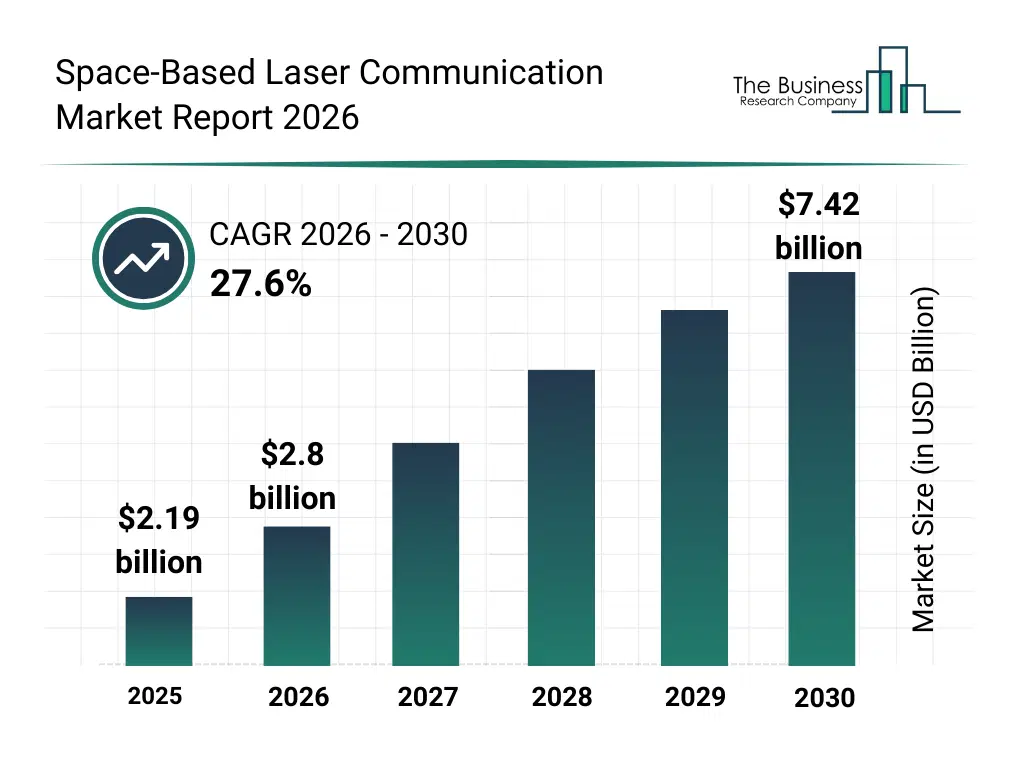
What Is The Space-Based Laser Communication Market Size and Share 2026?
The space-based laser communication market size has grown exponentially in recent years. It will grow from $2.19 billion in 2025 to $2.8 billion in 2026 at a compound annual growth rate (CAGR) of 27.9%. The growth in the historic period can be attributed to early development of optical communication technologies for space, deployment of prototype laser communication satellites, advancements in high-precision beam alignment systems, government and institutional funding for laser-based data transmission research, integration of optical amplifiers and switches in satellite communication systems.What Is The Space-Based Laser Communication Market Growth Forecast?
The space-based laser communication market size is expected to see exponential growth in the next few years. It will grow to $7.42 billion in 2030 at a compound annual growth rate (CAGR) of 27.6%. The growth in the forecast period can be attributed to rising demand for high-speed satellite-to-satellite and satellite-to-ground data links, expansion of global optical satellite networks, adoption of secure and encrypted laser communication systems, development of advanced beam expander and optical coupling technologies, increased collaboration between aerospace and telecommunication companies for space-based laser communication. Major trends in the forecast period include enhanced data security in space communication, miniaturization and integration of optical components, demand for high-bandwidth satellite communication, growth of space-to-ground and inter-satellite links, advances in quantum key distribution (qkd) for secure communication.Global Space-Based Laser Communication Market Segmentation
1) By Component: Optical Head, Laser Receiver And Transmitter, Modulator And Demodulator, Pointing Mechanism, Other Components 2) By Solution: Space-To-Space, Space-To-Ground Station, Space-To-Other Application 3) By Laser Type: Solid-State Laser, Fiber Laser, Free-Space Quantum Key Distribution (QKD) Laser 4) By Application: Satellite Communication, Earth Observation, Space Exploration, Surveillance And Reconnaissance, Other Applications 5) By End-User: Commercial, Government, Military Subsegments: 1) By Optical Head: Transmitter Optical Head, Receiver Optical Head, Transceiver Optical Head, Beam Steering Unit, Optical Aperture 2) By Laser Receiver And Transmitter: High-Power Laser Transmitter, Low-Power Laser Transmitter, Avalanche Photodiode (APD) Receiver, PIN Photodiode Receiver, Erbium-Doped Fiber Amplifier (EDFA) Transmitter, Semiconductor Laser Transmitter 3) By Modulator And Demodulator: Electro-Optic Modulator, Acousto-Optic Modulator, Mach-Zehnder Modulator, Direct Modulator, Coherent Demodulator, Incoherent Demodulator 4) By Pointing Mechanism: Fine Pointing Mechanism, Coarse Pointing Mechanism, Tracking Mechanism, Stabilization Mechanism, Gimbal Mechanism 5) By Other Components: Optical Amplifiers, Signal Processing Units, Control Electronics, Thermal Management Systems, Power Supply UnitsWhat Is Driver Of The Space-Based Laser Communication Market?
The rise in space exploration activities is anticipated to fuel the growth of the space-based laser communication market in the coming years. Space exploration is studying outer space using astronomy, spacecraft, and advanced technologies to expand knowledge beyond Earth's atmosphere. Space exploration activities are rising due to growing interest in commercial opportunities, as private enterprises and governments invest in areas such as satellite deployment, space tourism, and extraterrestrial resource extraction to secure economic and strategic benefits. The growing efforts in space exploration are driving the need for reliable long-range communication technologies. Space-based laser systems address this need by enabling fast and efficient data transmission between spacecraft and Earth. For instance, in April 2024, according to a report published by the World Economic Forum, a Switzerland-based non-governmental organization, the space economy is forecasted to reach $1.8 trillion by 2035, up from $630 billion in 2023, with a 9% yearly growth rate that far exceeds global gross domestic product (GDP) growth. Therefore, the rise in space exploration activities boosts the growth of the space-based laser communication industry.Key Players In The Global Space-Based Laser Communication Market
Major companies operating in the space-based laser communication market are Boeing Co., Airbus SE, Northrop Grumman Corp., Honeywell International Inc., Thales Group, Ball Corporation, Mynaric AG, General Atomics, Hensoldt AG, Lumentum, Telesat, Tesat-Spacecom GmbH & Co., York Space Systems LLC, AAC Clyde Space AB, SKYLOOM Global Corp., Kepler Communications Inc., Odysseus Space SA, Archangel Lightworks, X-lumin Corp., Laser Light Communications Inc., BridgeComm Inc., AalyriaGlobal Space-Based Laser Communication Market Trends and Insights
Major companies operating in the space-based laser communication market are focusing on expanding market presence to help diversify risk by entering new markets and reducing dependence on a single customer base or region. Expansion of market presence is a company’s strategic effort to increase its visibility, customer base, and sales reach within existing or new markets. For instance, in September 2025, General Atomics Electromagnetic Systems, a US-based defense and aerospace company, introduced the Optical Communication Terminal (OCT) for air-to-space applications in the space-based laser communication market. The terminal features a 10-watt laser capable of transmitting data over 3,417 miles, a maximum data rate of 2.5 Gbps, and robust multi-vendor interoperability for establishing secure, high-speed links between airborne and satellite assets. This launch represents a significant advancement in building resilient space communication architectures.What Are Latest Mergers And Acquisitions In The Space-Based Laser Communication Market? AeroVironment Acquires BlueHalo to Expand Defense and Space Technology Capabilities
In November 2024, AeroVironment, a US-based provider of unmanned aircraft systems, drones, and defense technologies, acquired BlueHalo for $4.1 billion. With this acquisition, AeroVironment aims to diversify its product portfolio, expand into advanced space and counter-uncrewed aircraft systems, and enhance technological capabilities across defense domains. BlueHalo is a US-based provider of drone swarm technologies, counter-UAS solutions, space technologies, electronic warfare systems, and cyber capabilities.Regional Insights
North America was the largest region in the space-based laser communication market in 2025. Western Europe is expected to be the fastest-growing region in the forecast period. The regions covered in this market report are Asia-Pacific, South East Asia, Western Europe, Eastern Europe, North America, South America, Middle East, Africa. The countries covered in this market report are Australia, Brazil, China, France, Germany, India, Indonesia, Japan, Taiwan, Russia, South Korea, UK, USA, Canada, Italy, SpainWhat Defines the Space-Based Laser Communication Market?
The space-based laser communication market consists of revenues earned by entities by providing services such as high-speed data transmission, network integration, data encryption, system design, and validation services. The market value includes the value of related goods sold by the service provider or included within the service offering. The space-based laser communication market also includes sales of optical amplifiers, beam expander units, optical fiber couplers, and optical switches. Values in this market are ‘factory gate’ values, that is the value of goods sold by the manufacturers or creators of the goods, whether to other entities (including downstream manufacturers, wholesalers, distributors and retailers) or directly to end customers. The value of goods in this market includes related services sold by the creators of the goods.How is Market Value Defined and Measured?
The market value is defined as the revenues that enterprises gain from the sale of goods and/or services within the specified market and geography through sales, grants, or donations in terms of the currency (in USD unless otherwise specified). The revenues for a specified geography are consumption values that are revenues generated by organizations in the specified geography within the market, irrespective of where they are produced. It does not include revenues from resales along the supply chain, either further along the supply chain or as part of other products.What Key Data and Analysis Are Included in the Space-Based Laser Communication Market Report 2026?
The space-based laser communication market research report is one of a series of new reports from The Business Research Company that provides market statistics, including industry global market size, regional shares, competitors with the market share, detailed market segments, market trends and opportunities, and any further data you may need to thrive in the space-based laser communication industry. The market research report delivers a complete perspective of everything you need, with an in-depth analysis of the current and future state of the industry.Space-Based Laser Communication Market Report Forecast Analysis
| Report Attribute | Details |
|---|---|
| Market Size Value In 2026 | $2.8 billion |
| Revenue Forecast In 2035 | $7.42 billion |
| Growth Rate | CAGR of 27.9% from 2026 to 2035 |
| Base Year For Estimation | 2025 |
| Actual Estimates/Historical Data | 2020-2025 |
| Forecast Period | 2026 - 2030 - 2035 |
| Market Representation | Revenue in USD Billion and CAGR from 2026 to 2035 |
| Segments Covered | Component, Solution, Laser Type, Application, End-User |
| Regional Scope | Asia-Pacific, Western Europe, Eastern Europe, North America, South America, Middle East, Africa |
| Country Scope | The countries covered in the report are Australia, Brazil, China, France, Germany, India, ... |
| Key Companies Profiled | Boeing Co., Airbus SE, Northrop Grumman Corp., Honeywell International Inc., Thales Group, Ball Corporation, Mynaric AG, General Atomics, Hensoldt AG, Lumentum, Telesat, Tesat-Spacecom GmbH & Co., York Space Systems LLC, AAC Clyde Space AB, SKYLOOM Global Corp., Kepler Communications Inc., Odysseus Space SA, Archangel Lightworks, X-lumin Corp., Laser Light Communications Inc., BridgeComm Inc., Aalyria |
| Customization Scope | Request for Customization |
| Pricing And Purchase Options | Explore Purchase Options |
Frequently Asked Questions
The Space-Based Laser Communication Market Report 2026 market was valued at $2.19 billion in 2025, increased to $2.19 billion in 2026, and is projected to reach $7.42 billion by 2030.
request a sample hereThe expected CAGR for the Space-Based Laser Communication Market Report 2026 market during the forecast period 2025–2030 is 27.6%.
request a sample hereMajor growth driver of the market includes: Rise In Space Exploration Activities Fueling The Growth Of The Market Due To Increasing Demand For High-Speed, Long-Distance Data Transmission in the Space-Based Laser Communication Market Report 2026 market. For further insights on this market,
request a sample hereThe space-based laser communication market covered in this report is segmented –
1) By Component: Optical Head, Laser Receiver And Transmitter, Modulator And Demodulator, Pointing Mechanism, Other Components
2) By Solution: Space-To-Space, Space-To-Ground Station, Space-To-Other Application
3) By Laser Type: Solid-State Laser, Fiber Laser, Free-Space Quantum Key Distribution (QKD) Laser
4) By Application: Satellite Communication, Earth Observation, Space Exploration, Surveillance And Reconnaissance, Other Applications
5) By End-User: Commercial, Government, Military Subsegments:
1) By Optical Head: Transmitter Optical Head, Receiver Optical Head, Transceiver Optical Head, Beam Steering Unit, Optical Aperture
2) By Laser Receiver And Transmitter: High-Power Laser Transmitter, Low-Power Laser Transmitter, Avalanche Photodiode (APD) Receiver, PIN Photodiode Receiver, Erbium-Doped Fiber Amplifier (EDFA) Transmitter, Semiconductor Laser Transmitter
3) By Modulator And Demodulator: Electro-Optic Modulator, Acousto-Optic Modulator, Mach-Zehnder Modulator, Direct Modulator, Coherent Demodulator, Incoherent Demodulator
4) By Pointing Mechanism: Fine Pointing Mechanism, Coarse Pointing Mechanism, Tracking Mechanism, Stabilization Mechanism, Gimbal Mechanism
5) By Other Components: Optical Amplifiers, Signal Processing Units, Control Electronics, Thermal Management Systems, Power Supply Units
request a sample here1) By Component: Optical Head, Laser Receiver And Transmitter, Modulator And Demodulator, Pointing Mechanism, Other Components
2) By Solution: Space-To-Space, Space-To-Ground Station, Space-To-Other Application
3) By Laser Type: Solid-State Laser, Fiber Laser, Free-Space Quantum Key Distribution (QKD) Laser
4) By Application: Satellite Communication, Earth Observation, Space Exploration, Surveillance And Reconnaissance, Other Applications
5) By End-User: Commercial, Government, Military Subsegments:
1) By Optical Head: Transmitter Optical Head, Receiver Optical Head, Transceiver Optical Head, Beam Steering Unit, Optical Aperture
2) By Laser Receiver And Transmitter: High-Power Laser Transmitter, Low-Power Laser Transmitter, Avalanche Photodiode (APD) Receiver, PIN Photodiode Receiver, Erbium-Doped Fiber Amplifier (EDFA) Transmitter, Semiconductor Laser Transmitter
3) By Modulator And Demodulator: Electro-Optic Modulator, Acousto-Optic Modulator, Mach-Zehnder Modulator, Direct Modulator, Coherent Demodulator, Incoherent Demodulator
4) By Pointing Mechanism: Fine Pointing Mechanism, Coarse Pointing Mechanism, Tracking Mechanism, Stabilization Mechanism, Gimbal Mechanism
5) By Other Components: Optical Amplifiers, Signal Processing Units, Control Electronics, Thermal Management Systems, Power Supply Units
Major trend in this market includes: Market Expansion Strategies and General Atomics’ Launch of the Optical Communication Terminal For further insights on this market,
request a sample hereMajor companies operating in the Space-Based Laser Communication Market Report 2026 market are Major companies operating in the space-based laser communication market are Boeing Co., Airbus SE, Northrop Grumman Corp., Honeywell International Inc., Thales Group, Ball Corporation, Mynaric AG, General Atomics, Hensoldt AG, Lumentum, Telesat, Tesat-Spacecom GmbH & Co., York Space Systems LLC, AAC Clyde Space AB, SKYLOOM Global Corp., Kepler Communications Inc., Odysseus Space SA, Archangel Lightworks, X-lumin Corp., Laser Light Communications Inc., BridgeComm Inc., Aalyria
request a sample hereNorth America was the largest region in the space-based laser communication market in 2025. Western Europe is expected to be the fastest-growing region in the forecast period. The regions covered in the space-based laser communication market report are Asia-Pacific, South East Asia, Western Europe, Eastern Europe, North America, South America, Middle East, Africa.
request a sample here