
Smart Waste Management Market 2026
Smart Waste Management Market 2026
By Type (Smart Collection, Smart Processing, Smart Disposal, Smart Energy Recovery), By Waste Type (Solid Waste, Special Waste, Electronic Waste (E-Waste)), By Application (Residential And Municipality, Industrial, Commercial, Construction And Demolition, Energy And Water Supply, Sewage Treatment), And By Region, Opportunities And Strategies – Global Forecast To 2035
Smart Waste Management Market Definition
Smart waste management refers to the use of advanced technologies such as IoT (Internet of Things), artificial intelligence, data analytics and automation to optimize the entire waste management lifecycle, from collection to disposal and energy recovery. It is used by municipal governments, residential communities, commercial and industrial establishments and utility operators to improve the efficiency, cost-effectiveness and sustainability of waste handling processes. The smart waste management market consists of sales, by entities (organizations, sole traders, or partnerships), of smart waste management solutions that are used on an ongoing basis, with continuous data collection and automated decision-making to support daily operations, although they can also be deployed for specific events or seasonal adjustments.

Smart Waste Management Market Size
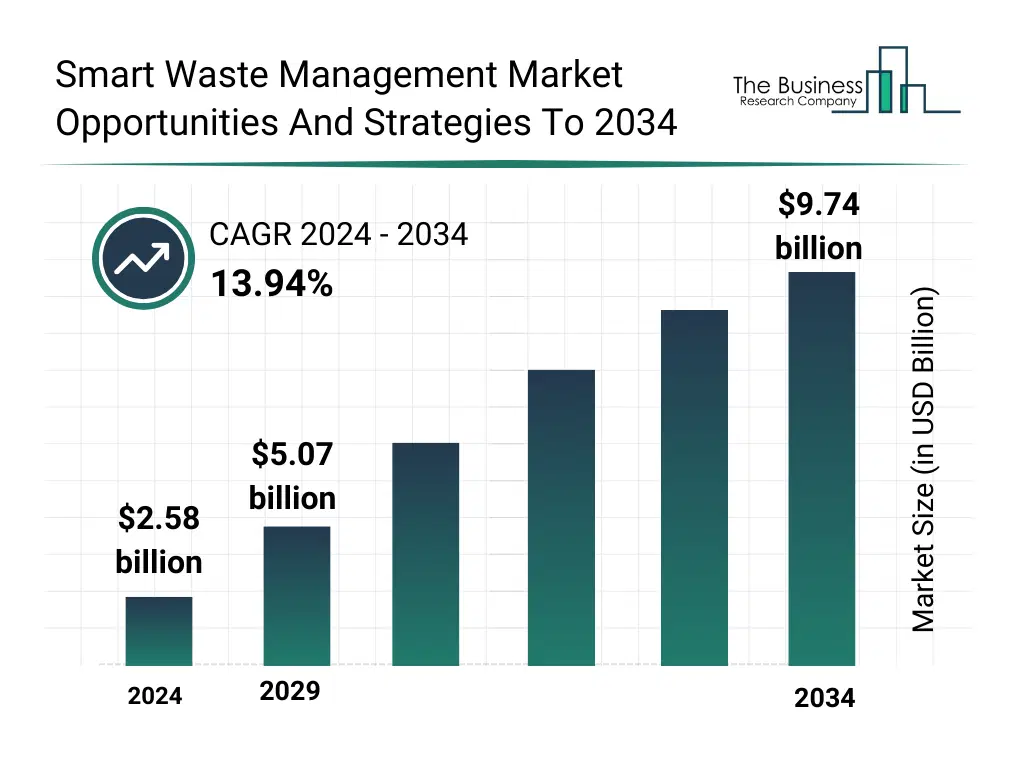
The global smart waste management market reached a value of nearly $2,581.56 million in 2024, having grown at a compound annual growth rate (CAGR) of 11.27% since 2019. The market is expected to grow from $2,581.56 million in 2024 to $5,072.17 million in 2029 at a rate of 14.46%. The market is then expected to grow at a CAGR of 13.94% from 2029 and reach $9,741.45 million in 2034. Growth in the historic period resulted from the rise of smart cities, rising environmental concerns, stringent environmental regulations and rising public health concerns. Factors that negatively affected growth in the historic period were high initial implementation and maintenance costs and data privacy and security concerns in connected systems. Going forward, the expansion of circular economy initiatives, increased municipal budget allocations for waste management, growing consumer demand for sustainability and expansion of commercial and industrial activities will drive the growth. Factors that could hinder the growth of the smart waste management market in the future include lack of skilled workforce and technical expertise limited infrastructure and interoperability challenges and impact of trade war and tariff.Smart Waste Management Market Drivers
The key drivers of the smart waste management market include: Expansion Of Circular Economy Initiatives Expansion of circular economy initiatives is expected to be a key driver of the growth of the smart waste management market in the forecast period. The growing global emphasis on circular economy principles will drive investments in smart waste technologies that enable recycling, resource recovery and waste minimization. Governments and private sector organizations are collaborating to create closed-loop systems that prioritize waste reduction and material reuse. This shift will encourage the adoption of IoT (internet of things)-based waste tracking and digital sorting solutions to ensure better efficiency and accountability across the waste value chain. The expansion of circular economy initiatives contribution during the forecast period in 2024 is 2.25%.Smart Waste Management Market Restraints
The key restraints on the smart waste management market include: Lack Of A Skilled Workforce And Technical Expertise Lack of a skilled workforce and technical expertise is restricting the growth of the smart waste management market during the forecast period. Deploying, integrating and operating these technologies require a technically proficient workforce capable of managing hardware, communication systems and data-driven decision platforms. In many municipalities and developing economies, the lack of such expertise leads to inefficient use of installed systems, increased reliance on external consultants and operational delays. This skill gap reduces confidence among decision-makers, increases implementation risks and often results in underperforming projects or technology abandonment, slowing down overall market growth. Growth affected by lack of a skilled workforce and technical expertise during the forecast period in 2024 is -2.50%.Smart Waste Management Market Trends
Major trends shaping the smart waste management market include: AI-Driven Waste Intelligence Platforms Advancing Circular Economy Major companies in the smart waste management market are developing advanced AI-driven platforms to enhance transparency, traceability and accountability across the recycling value chain. These innovations aim to empower producers, recyclers and regulators with actionable insights to improve circularity, optimize packaging design and reduce environmental and financial risks. For instance, in June 2025, Greyparrot, a London-based technology company specializing in artificial intelligence (AI) and computer vision systems for waste management and recycling, launched Deepnest, a world-first AI waste intelligence platform designed to give brands direct access to detailed data about their recyclable waste. Deepnest addresses a major knowledge gap in understanding what happens to products, especially packaging, after they become waste by providing real-world insights into packaging performance in waste and recycling systems. The platform tracks packaging by brand, material, product type and region, showing what is sorted, recycled, or lost, enabling brands to optimize packaging design and reduce regulatory and financial risks related to waste. Integration Of Artificial Intelligence And Machine Learning In Waste Management Operations Major companies in the smart waste management market are increasingly deploying AI (artificial intelligence) and ML (machine learning) technologies to enhance decision-making, optimize operations and improve sustainability metrics. These technologies enable automated waste identification, predictive maintenance of collection vehicles and optimization of recycling streams to reduce human error and operational costs. For example, in May 2025, Samsara, a US-based company that specializes in providing IoT (internet of things) and cloud platforms, partnered with WasteVision AI to integrate AI capabilities into its IoT platform. Features include real-time detection of overflowing or contaminated waste containers and automated service verification using photo and video analysis to boost collection efficiency and safety. WasteVision AI is a US-based company that specializes in AI-powered solutions for waste management.Opportunities And Recommendations In The Smart Waste Management Market
Opportunities – The top opportunities in the smart waste management markets segmented by type will arise in the smart collection segment, which will gain $1,215.10 million of global annual sales by 2029. The top opportunities in the smart waste management markets segmented by waste type will arise in the solid waste segment, which will gain $1,475.38 million of global annual sales by 2029. The top opportunities in the smart waste management markets segmented by application will arise in the residential and municipality segment, which will gain $1,324.51 million of global annual sales by 2029. The smart waste management market size will gain the most in the USA at $771.25 million. Recommendations- To take advantage of the opportunities, The Business Research Company recommends the smart waste management companies to focus on AI-driven transparency and circularity, focus on AI and ML for operational efficiency, focus on integrated AI and IoT platforms, focus on AI and ML for automated compliance and data accuracy, focus on AI-driven robotic sortation, focus on consumer-centric digital E-waste solutions, focus on intelligent municipal waste collection, focus on smart processing for growth, focus on electronic waste (E-Waste) management, focus on expanding distribution channels, focus on optimizing pricing strategies, focus on strengthening awareness campaigns, focus on driving adoption through incentives and focus on residential and municipality waste management.Smart Waste Management Market Segmentation
The smart waste management market is segmented by type, by waste type and by application.By Type –
The smart waste management market is segmented by type into:
- a) Smart Collection
- b) Smart Processing
- c) Smart Disposal
- d) Smart Energy Recovery
By Waste Type –
The smart waste management market is segmented by waste type into:
- a) Solid Waste
- b) Special Waste
- c) Electronic Waste (E-Waste)
By Application –
The smart waste management market is segmented by application into:
- a) Residential And Municipality
- b) Industrial
- c) Commercial
- d) Construction And Demolition
- e) Energy
- f) Water Supply And Sewage Treatment
By Geography - The smart waste management market is segmented by geography into:
- • China
- • India
- • Japan
- • Australia
- • Indonesia
- • South Korea
- • USA
- • Canada
- • Brazil
- • France
- • Germany
- • UK
- • Italy
- • Spain
- • Russia
-
o Asia Pacific
o Africa