
Smart Manufacturing Market 2026
Smart Manufacturing Market 2026
By Component (Hardware, Software, Services), By Technology (Machine Execution Systems (MES), Programmable Logic Controller (PLC), Enterprise Resource Planning (ERP), SCADA, Discrete Control Systems (DCS), Machine Vision, 3D Printing, Other Technologies), By End-User (Automotive, Aerospace And Defense, Chemicals And Materials, Healthcare, Industrial Equipment, Electronics, Food And Agriculture, Oil And Gas, Other End-Users), And By Region, Opportunities And Strategies – Global Forecast To 2035
Smart Manufacturing Market Definition
Smart manufacturing refers to the use of interconnected technologies and intelligent systems to automate and optimize production processes in manufacturing environments. It integrates advanced hardware, software and services to enable real-time decision-making, efficient operations, predictive maintenance and end-to-end visibility across the manufacturing value chain. The smart manufacturing market consists of sales, by entities (organizations, sole traders or partnerships) that are used is used by manufacturers in diverse sectors such as automotive, aerospace, healthcare, chemicals, electronics, food processing and industrial equipment to enhance productivity, flexibility and responsiveness to market demands.

Smart Manufacturing Market Size
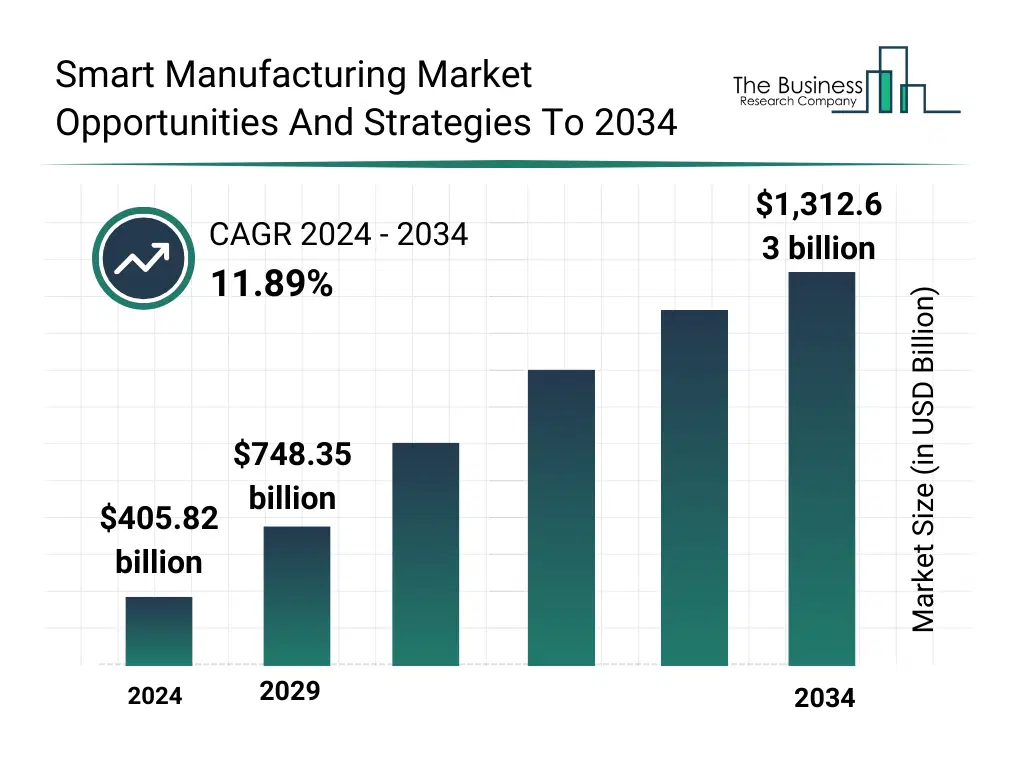
The global smart manufacturing market reached a value of nearly $405,817.99 million in 2024, having grown at a compound annual growth rate (CAGR) of 13.72% since 2019. The market is expected to grow from $405,817.99 million in 2024 to $748,351.65 million in 2029 at a rate of 13.02%. The market is then expected to grow at a CAGR of 11.89% from 2029 and reach $1,312,634.05 million in 2034. Growth in the historic period resulted from the growing use of collaborative robotics (Cobots), industrial automation and robotics deployment, utilization of big data and analytics and expansion of smart factories. Factors that negatively affected growth in the historic period were lack of skilled workforce and data security and privacy concerns. Going forward, the rising investments in industry 4.0, demand for condition monitoring and predictive maintenance, government support for digital transformation initiatives and growing adoption of connected devices will drive the growth. Factors that could hinder the growth of the smart manufacturing market in the future include high initial investment costs, integration challenges with legacy systems and impact of trade war and tariff.Smart Manufacturing Market Drivers
The key drivers of the smart manufacturing market include: Rising Investments In Industry 4.0 Rising investments in industry 4.0 is expected to be a key driver of the growth of the smart manufacturing market in the forecast period. As manufacturers invest more in cyber-physical systems, intelligent automation, IoT (internet of things) connectivity, cloud platforms, digital twins and advanced analytics, factories become increasingly capable of self-optimization and real-time decision-making. These investments establish the technological foundation needed for automated operations, seamless human-machine collaboration and interconnected production environments. With higher investment levels, companies can modernize legacy equipment, integrate end-to-end data flows and upgrade plant-level architectures to support smarter, faster and more resilient manufacturing. This steady capital infusion drives the transition toward highly automated, digitally orchestrated factories, positioning smart manufacturing as a core pillar of long-term industrial competitiveness. The rising investments in industry 4.0 growth contribution during the forecast period in 2024 is 1.50%.Smart Manufacturing Market Restraints
The key restraints on the smart manufacturing market include: High Initial Investment Costs High initial investment costs are restricting the growth of the smart manufacturing market during the forecast period. Beyond equipment, companies must invest in manufacturing software platforms such as MES (manufacturing execution system), ERP (enterprise resource planning), SCADA (supervisory control and data acquisition), PLM (product lifecycle management) and predictive analytics systems, all of which demand substantial capital outlays. These expenses become even higher when considering integration services, cybersecurity layers, cloud migration, digital-twin development, workforce training and facility redesigns required to support connected manufacturing environments. For many manufacturers, especially small and medium-sized enterprises, these combined costs create financial barriers that delay or scale down digital transformation initiatives. As a result, adoption occurs more slowly, limiting the speed at which the smart manufacturing market can expand. Growth affected by high initial investment costs across regions during the forecast period in 2024 is -2.10%.Smart Manufacturing Market Trends
Major trends shaping the smart manufacturing market include: Integration Of AI-Driven Automation To Enhance Real-Time Manufacturing Intelligence Major companies in the smart manufacturing market are focusing on integrating AI (artificial intelligence)-driven automation across production systems to enable real-time decision-making, adaptive process control and continuous improvement of manufacturing intelligence. These efforts are designed to enable machines and systems to learn from manufacturing data, act autonomously or semi-autonomously, reduce downtime, improve yield and accelerate responsiveness to quality or supply-chain deviations. For example, in March 2025, Hitachi Ltd., a Japan-based multinational conglomerate known for its industrial systems, information technology, launched its new AI Center of Excellence, which in early 2024 began piloting integrated solutions that embed advanced AI across physical production systems including robotics, sensors and automation in its industrial and mobility divisions. The initiative enables predictive controls, real-time analytics from factory floor data and tighter coupling between automation hardware and AI models, with the goal of increasing efficiency, reducing waste and driving smarter manufacturing at scale. Advancement Of Smart Sensor And Robotics Integration For High-Precision Manufacturing Major companies in the smart manufacturing market are focusing on advancing the integration of smart sensors, robotics and automation into manufacturing hardware to deliver high-precision, flexible production systems capable of real-time adaptation and minimal downtime. These innovations aim to combine sensing, actuation and control within robot cells and production lines to improve accuracy, reduce manual intervention and support rapid changeovers. For example, in February 2025, Delta Electronics, a Taiwan-based electronics manufacturing company, launched its D-Bot Series Collaborative Robots (Cobots) at ELECRAMA 2025 in India, offering 6-axis cobots with payloads up to 30 kg, speeds of up to 200°/s (degrees per second) and seamless integration with machine-vision systems and sensor networks for pick-and-place, materials handling and welding tasks, designed explicitly for smart factory deployment in electronics and packaging. ELECRAMA is an India-based standalone exhibition of electrical and allied industries.Opportunities And Recommendations In The Smart Manufacturing Market
Opportunities – The top opportunities in the smart manufacturing markets segmented by component will arise in the software segment, which will gain $241,680.66 million of global annual sales by 2029. The top opportunities in the smart manufacturing markets segmented by technology will arise in the machine execution systems (MES) segment, which will gain $79,533.40 million of global annual sales by 2029. The top opportunities in the smart manufacturing markets segmented by end user will arise in the automotive segment, which will gain $93,635.29 million of global annual sales by 2029. The smart manufacturing market size will gain the most in China at $91,997.50 million. Recommendations- To take advantage of the opportunities, The Business Research Company recommends the smart manufacturing companies to focus on AI-driven automation for real-time and adaptive manufacturing, focus on sensor-integrated robotics for flexible and high-precision manufacturing, focus on cloud-based MES and ERP platforms for scalable smart manufacturing, focus on end-to-end IIoT connectivity to build integrated smart factories, focus on portable segment to capitalize on fastest growth in military power solutions, focus on digital twin adoption for predictive and efficient manufacturing operations, focus on scalable smart manufacturing software, focus on high-growth 3D printing adoption, expand in emerging markets, focus on integrated and scalable distribution networks, focus on outcome-based and modular pricing discipline, promotion strategy built on measurable operational value, account-based and partner-led promotion framework, focus on high-growth electronics manufacturing.Smart Manufacturing Market Segmentation
The smart manufacturing market is segmented by component, by technology and end user.By Component –
The smart manufacturing market is segmented by component into:
- a) Hardware
- b) Software
- b) Services
By Technology–
The smart manufacturing market is segmented by technology into:
- a) Machine Execution Systems (MES)
- b) Programmable Logic Controller (PLC)
- c) Enterprise Resource Planning (ERP)
- d) SCADA
- e) Discrete Control Systems (DCS)
- f) Machine Vision
- g) 3D Printing
- h) Other Technologies
By End User–
The smart manufacturing market is segmented by end user into:
- a) Automotive
- b) Aerospace And Defense
- c) Chemicals And Materials
- d) Healthcare
- e) Industrial Equipment
- f) Electronics
- g) Food And Agriculture
- h) Oil And Gas
- i) Other End-Users
By Geography - The smart manufacturing market is segmented by geography into:
- • China
- • India
- • Japan
- • Australia
- • Indonesia
- • South Korea
- • USA
- • Canada
- • Brazil
- • France
- • Germany
- • UK
- • Italy
- • Spain
- • Russia
-
o Asia Pacific
o Africa