
Smart Glasses Microdisplay Market Report 2026
Global Outlook – By Display Technology (Organic Light-Emitting Diode (OLED), Liquid Crystal Display (LCD), Liquid Crystal On Silicon (LCoS), Digital Light Processing (DLP), Micro Light-Emitting Diode (MicroLED), Other Display Technologies), By Application (Consumer Electronics, Healthcare, Industrial, Military And Defense, Sports And Fitness, Other Applications), By Distribution Channel (Online, Offline), By End-User (Enterprises, Individuals, Other End-Users) – Market Size, Trends, Strategies, and Forecast to 2035
Smart Glasses Microdisplay Market Overview
• Smart Glasses Microdisplay market size has reached to $1.79 billion in 2025 • Expected to grow to $5.48 billion in 2030 at a compound annual growth rate (CAGR) of 25.2% • Growth Driver: Rising Adoption of Immersive AR Systems Fueling Market Growth Due To Expanded Government Use Cases • Market Trend: Advancements In Microdisplay Technology Accelerate Performance And Adoption Of Smart Glasses • North America was the largest region in 2025 and Asia-Pacific is the fastest growing region.What Is Covered Under Smart Glasses Microdisplay Market?
A smart glasses microdisplay is a miniature display component designed to project visual information directly into the user’s field of view. It enables high-resolution imagery in a compact form factor suitable for wearable devices. These displays are optimized for low power consumption, brightness, and clarity to support extended use. They play a critical role in delivering immersive and hands-free visual experiences. The main display technologies of smart glasses microdisplay include organic light-emitting diode, liquid crystal display, liquid crystal on silicon, digital light processing, micro light-emitting diode, and other display technologies. Organic light-emitting diode displays refer to high-resolution, energy-efficient displays integrated into smart glasses for enhanced visual experiences. These solutions are adopted across applications such as consumer electronics, healthcare, industrial, military and defense, sports and fitness, and other applications and they are distributed through online and offline channels. The multiple end users include enterprises, individual users, and others.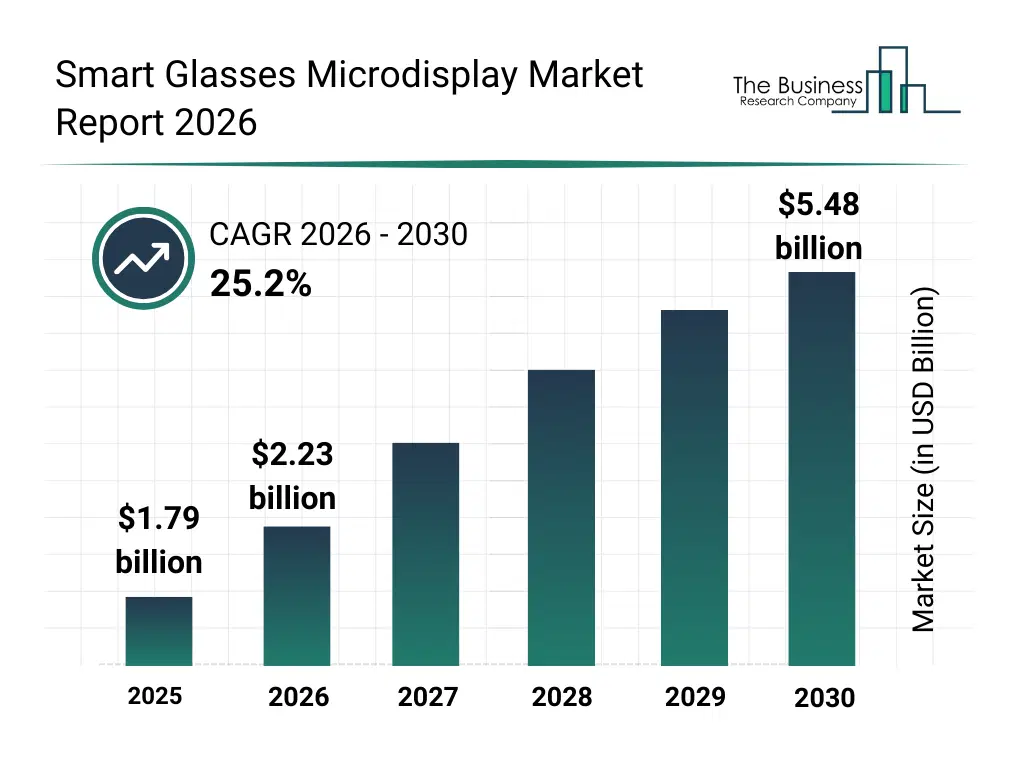
What Is The Smart Glasses Microdisplay Market Size and Share 2026?
The smart glasses microdisplay market size has grown exponentially in recent years. It will grow from $1.79 billion in 2025 to $2.23 billion in 2026 at a compound annual growth rate (CAGR) of 24.9%. The growth in the historic period can be attributed to growth in AR wearable devices, early smart glasses launches, miniaturization of display components, defense head mounted display demand, enterprise wearable pilots.What Is The Smart Glasses Microdisplay Market Growth Forecast?
The smart glasses microdisplay market size is expected to see exponential growth in the next few years. It will grow to $5.48 billion in 2030 at a compound annual growth rate (CAGR) of 25.2%. The growth in the forecast period can be attributed to consumer AR glasses adoption, enterprise field service wearables, microled commercialization, immersive interface demand, lightweight optics innovation. Major trends in the forecast period include ultra high brightness microdisplays, low power consumption display engines, waveguide optimized microdisplay modules, microled based smart glass displays, compact optical engine integration.
Global Smart Glasses Microdisplay Market Segmentation
1) By Display Technology: Organic Light-Emitting Diode (OLED); Liquid Crystal Display (LCD); Liquid Crystal On Silicon (LCoS); Digital Light Processing (DLP); Micro Light-Emitting Diode (MicroLED); Other Display Technologies 2) By Application: Consumer Electronics; Healthcare; Industrial; Military And Defense; Sports And Fitness; Other Applications 3) By Distribution Channel: Online; Offline 4) By End-User: Enterprises; Individuals; Other End-Users Subsegments: 1) By Organic Light-Emitting Diode (OLED): Active Matrix; Passive Matrix 2) By Liquid Crystal Display (LCD): Twisted Nematic; In-Plane Switching; Advanced Fringe Field Switching 3) By Liquid Crystal On Silicon (LCoS): Ferroelectric; Nematic 4) By Digital Light Processing (DLP): Single Panel; Three Panel 5) By Micro Light-Emitting Diode (MicroLED): Direct View; Quantum Dot Enhanced 6) By Other Display Technologies: Laser Beam Scanning; Virtual Retinal Display; Electrowetting DisplayWhat Is The Driver Of The Smart Glasses Microdisplay Market?
The rising adoption of immersive AR systems is expected to propel the growth of the smart glasses microdisplay market going forward. Immersive AR technologies refer to lightweight, head-worn devices that overlay digital content onto the physical environment, enabling hands-free visualization and interaction across training, operations, and training scenarios. The adoption of immersive AR systems is increasing due to expanded use cases in public sector training and operational workflows that mirror broader metaverse and wearable ecosystem demands. Smart-glasses microdisplays deliver sharp digital imagery directly within the user’s line of sight, seamlessly overlaying virtual content onto the real environment. High brightness and low latency allow accurate object alignment, enhancing realism and immersion in AR experiences. For instance, in August 2024, according to the United States Government Accountability Office (GAO), a US-based federal agency, 17 of 23 U.S. federal civilian agencies reported activities involving immersive technologies (including AR and VR) in fiscal years 2022–2023, with 16 agencies planning to expand their use through 2028, demonstrating growing governmental reliance on wearable AR systems for real-world applications. Therefore, the rising adoption of immersive AR technologies is driving the growth of the smart glasses microdisplay industry.Key Players In The Global Smart Glasses Microdisplay Market
Major companies operating in the smart glasses microdisplay market are Hon HAI Precision Industry Co. Ltd., Sony Group Corporation, LG Corporation, BOE Technology Group Co. Ltd., Texas Instruments Incorporated, Goertek Inc., Seiko Epson Corporation, Innolux Corporation, Samsung Display Co. Ltd., MicroOLED S.A., OMNIVISION Technologies Inc., Magic Leap Inc., Himax Technologies Inc., Jade Bird Display, SeeYA Technology Co. Ltd., Kopin Corporation, FRAMOS GmbH, MICLEDI Microdisplays B.V., RAONTECH Inc., MicroVision Inc., and Vuzix Corporation.Global Smart Glasses Microdisplay Market Trends and Insights
Major companies operating in the smart glasses microdisplay market are focusing on developing advanced display solutions, such as ultra-low-power single-chip full-color microdisplay panels, to improve visual performance, reduce power consumption, and lower manufacturing complexity and costs. Ultra-low-power single-chip microdisplay panels refer to integrated display technologies that combine the display array, driver circuitry, and memory into a single compact chip, enabling higher resolution and wider fields of view while minimizing energy usage and easing system integration for smart glasses manufacturers. For instance, in December 2025, OmniVision, a US-based semiconductor and imaging technology company, launched the OP03021 liquid crystal on silicon (LCOS) microdisplay panel, an industry-leading single-chip solution. The panel delivers a resolution of 1632 × 1536 at a 90 Hz refresh rate within a compact 0.26-inch optical format, integrates the display array, driver, and memory on a single die, and supports advanced smart glasses designs by improving image quality and field of view while lowering power consumption and overall component costs.What Are Latest Mergers And Acquisitions In The Smart Glasses Microdisplay Market?
In October 2023, Samsung Display Co., Ltd., a South Korea-based provider of advanced display technologies, acquired eMagin Corporation for an undisclosed amount. Through this acquisition, Samsung Display aims to strengthen its position in high-resolution microdisplay technology by integrating eMagin’s OLED-on-silicon microdisplay solutions to expand its offerings for smart glasses, augmented reality (AR), and extended reality (XR) devices. eMagin Corporation is a US-based developer and manufacturer of OLED microdisplays and imaging components for near-eye applications.Regional Insights
North America was the largest region in the smart glasses microdisplay market in 2025. Asia-Pacific is expected to be the fastest-growing region in the forecast period. The regions covered in this market report are Asia-Pacific, South East Asia, Western Europe, Eastern Europe, North America, South America, Middle East, Africa. The countries covered in this market report are Australia, Brazil, China, France, Germany, India, Indonesia, Japan, Taiwan, Russia, South Korea, UK, USA, Canada, Italy, Spain.What Defines the Smart Glasses Microdisplay Market?
The smart glasses microdisplay market consists of sales of microdisplay panels, waveguide-compatible display modules, optical engine components, projection display units, and integrated microdisplay assemblies. Values in this market are ‘factory gate’ values, that is, the value of goods sold by the manufacturers or creators of the goods, whether to other entities (including downstream manufacturers, wholesalers, distributors, and retailers) or directly to end customers. The value of goods in this market includes related services sold by the creators of the goods.How is Market Value Defined and Measured?
The market value is defined as the revenues that enterprises gain from the sale of goods and/or services within the specified market and geography through sales, grants, or donations in terms of the currency (in USD unless otherwise specified). The revenues for a specified geography are consumption values that are revenues generated by organizations in the specified geography within the market, irrespective of where they are produced. It does not include revenues from resales along the supply chain, either further along the supply chain or as part of other products.What Key Data and Analysis Are Included in the Smart Glasses Microdisplay Market Report 2026?
The smart glasses microdisplay market research report is one of a series of new reports from The Business Research Company that provides market statistics, including industry global market size, regional shares, competitors with the market share, detailed market segments, market trends and opportunities, and any further data you may need to thrive in the smart glasses microdisplay industry. The market research report delivers a complete perspective of everything you need, with an in-depth analysis of the current and future state of the industry.Smart Glasses Microdisplay Market Report Forecast Analysis
| Report Attribute | Details |
|---|---|
| Market Size Value In 2026 | $2.23 billion |
| Revenue Forecast In 2035 | $5.48 billion |
| Growth Rate | CAGR of 24.9% from 2026 to 2035 |
| Base Year For Estimation | 2025 |
| Actual Estimates/Historical Data | 2020-2025 |
| Forecast Period | 2026 - 2030 - 2035 |
| Market Representation | Revenue in USD Billion and CAGR from 2026 to 2035 |
| Segments Covered | Display Technology, Application, Distribution Channel, End-User |
| Regional Scope | Asia-Pacific, Western Europe, Eastern Europe, North America, South America, Middle East, Africa |
| Country Scope | The countries covered in the report are Australia, Brazil, China, France, Germany, India, ... |
| Key Companies Profiled | Hon HAI Precision Industry Co. Ltd., Sony Group Corporation, LG Corporation, BOE Technology Group Co. Ltd., Texas Instruments Incorporated, Goertek Inc., Seiko Epson Corporation, Innolux Corporation, Samsung Display Co. Ltd., MicroOLED S.A., OMNIVISION Technologies Inc., Magic Leap Inc., Himax Technologies Inc., Jade Bird Display, SeeYA Technology Co. Ltd., Kopin Corporation, FRAMOS GmbH, MICLEDI Microdisplays B.V., RAONTECH Inc., MicroVision Inc., and Vuzix Corporation. |
| Customization Scope | Request for Customization |
| Pricing And Purchase Options | Explore Purchase Options |