
Service Level Management Market Report 2026
Service Level Management Market Report 2026
Global Outlook – By Component (Software, Services), By Functionality (Service Level Agreement Definition And Tracking, Performance Monitoring And Reporting, Availability And Uptime Management, Capacity And Demand Management, Incident And Escalation Management, Compliance And Audit Management), By Deployment Model (On Premises Deployment, Cloud Based Deployment, Hybrid Deployment), By Organization Size (Small And Medium Enterprises, Large Enterprises), By End-User (Banking, Financial Services And Insurance, Telecommunications, Information Technology And Services, Healthcare And Life Sciences, Retail And Consumer Goods, Government And Public Sector, Manufacturing, Energy And Utilities, Transportation And Logistics, Education And Research) – Market Size, Trends, Strategies, and Forecast to 2035
Service Level Management Market Overview
• Service Level Management market size has reached to $6.03 billion in 2025 • Expected to grow to $10.96 billion in 2030 at a compound annual growth rate (CAGR) of 12.7% • Growth Driver: Hybrid Work Adoption Driving Growth In The Market Due To Increasing Demand For Flexible And Reliable Digital Work Environments • Market Trend: AI-Driven Employee Service Orchestration Enhancing SLA Compliance And Enterprise Service Efficiency • North America was the largest region in 2025 and Asia-Pacific is the fastest growing region.

What Is Covered Under Service Level Management Market?
Service level management is a process and software framework used by organizations to define, monitor, and manage service quality through formal agreements, known as service level agreements (SLAs), with customers or internal stakeholders. It helps to ensure that IT Services meet agreed-upon performance, availability, and response targets. It is used in tracking service performance, identifying gaps, improving customer satisfaction, and enabling continuous improvement of service delivery. The main components of service level management include software and services. Software refers to platforms that help organizations monitor, manage, and optimize IT infrastructure. The various functionalities involved are service level agreement definition and tracking, performance monitoring and reporting, availability and uptime management, capacity and demand management, incident and escalation management, and compliance and audit management. The various deployment models involved are on-premises deployment, cloud-based deployment, and hybrid deployment. The solutions cater to organizations of all sizes, including small and medium enterprises and large enterprises. The various applications involved are infrastructure monitoring, performance optimization, incident management, and compliance tracking and are distributed across several end users such as banking, financial services and insurance, telecommunications, information technology and services, healthcare and life sciences, retail and consumer goods, government and public sector, manufacturing, energy and utilities, transportation and logistics, and education and research.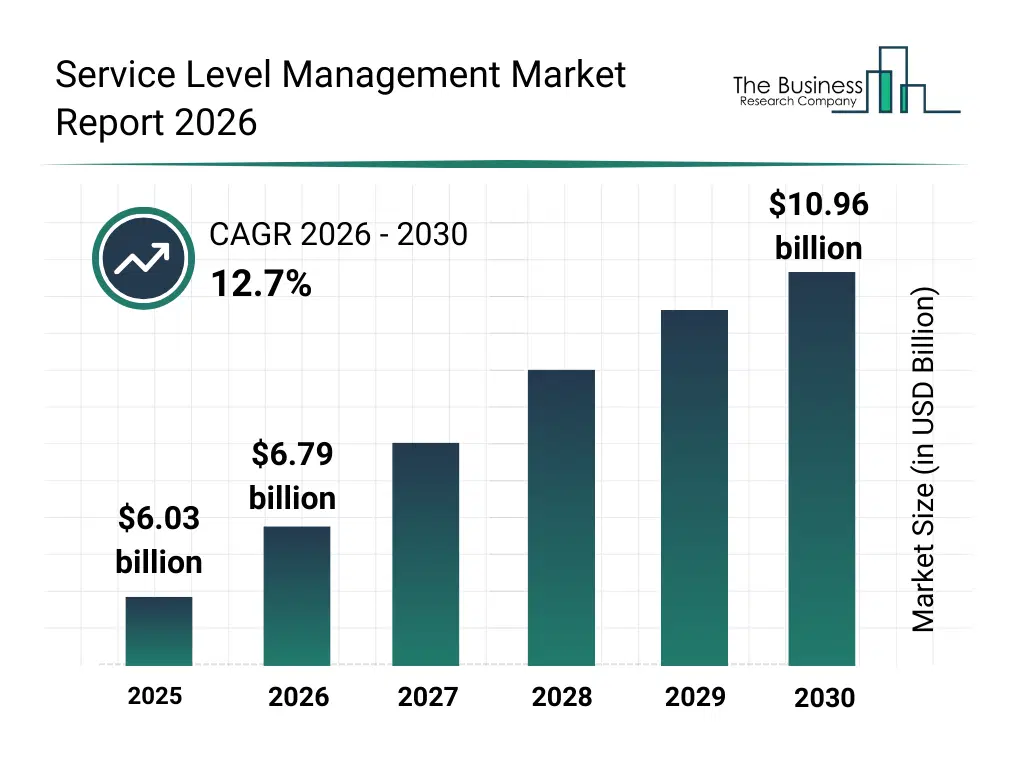
What Is The Service Level Management Market Size and Share 2026?
The service level management market size has grown rapidly in recent years. It will grow from $6.03 billion in 2025 to $6.79 billion in 2026 at a compound annual growth rate (CAGR) of 12.5%. The growth in the historic period can be attributed to increasing adoption of service management frameworks, rising demand for IT service quality, growing implementation of SLA agreements, increasing focus on customer satisfaction, adoption of performance monitoring tools.What Is The Service Level Management Market Growth Forecast?
The service level management market size is expected to see rapid growth in the next few years. It will grow to $10.96 billion in 2030 at a compound annual growth rate (CAGR) of 12.7%. The growth in the forecast period can be attributed to growing deployment of cloud-based sla management, increasing integration with ai and analytics, rising demand for automated incident and escalation management, expansion of hybrid deployment models, increasing focus on regulatory compliance and audit services. Major trends in the forecast period include increasing adoption of cloud-based service level management solutions, rising demand for performance monitoring and reporting tools, growing focus on sla compliance and audit management, expansion of managed service level management services, rising use of training and certification programs for sla governance.Global Service Level Management Market Segmentation
1) By Component: Software, Services 2) By Functionality: Service Level Agreement Definition And Tracking, Performance Monitoring And Reporting, Availability And Uptime Management, Capacity And Demand Management, Incident And Escalation Management, Compliance And Audit Management 3) By Deployment Model: On Premises Deployment, Cloud Based Deployment, Hybrid Deployment 4) By Organization Size: Small And Medium Enterprises, Large Enterprises 5) By End-User: Banking, Financial Services And Insurance, Telecommunications, Information Technology And Services, Healthcare And Life Sciences, Retail And Consumer Goods, Government And Public Sector, Manufacturing, Energy And Utilities, Transportation And Logistics, Education And Research Subsegments: 1) By Software: Service Level Agreement Management Software, Performance Monitoring And Analytics Software, Availability And Uptime Monitoring Software, Capacity And Demand Planning Software, Incident And Escalation Management Software, Service Reporting And Dashboard Software, Compliance And Audit Tracking Software, Service Catalog Management Software 2) By Services: Consulting And Advisory Services, Implementation And Integration Services, Managed Service Level Management Services, Training And Certification Services, Support And Maintenance Services, Process Optimization Services, Audit And Compliance Support ServicesWhat Is The Driver Of The Service Level Management Market?
The growing adoption of hybrid work models is expected to propel the growth of the service level management market going forward. Hybrid work models refer to a flexible approach where employees divide their time between remote work and on-site office work. Hybrid work models are increasing due to employee demand for flexibility, as workers seek better work-life balance and the ability to reduce commuting time while maintaining productivity. Service level management enables hybrid work by guaranteeing consistent performance and availability of digital tools across all work locations. For instance, in June 2025, according to the Office for National Statistics, a UK-based government department, more than a quarter (28%) of working adults in Great Britain worked in a hybrid model between January and March 2025, with the share of hybrid workers steadily increasing since March 2022. Therefore, the growing adoption of hybrid work models is driving the growth of the service level management industry.Key Players In The Global Service Level Management Market
Major companies operating in the service level management market are IBM Corporation, Oracle Corporation, SAP SE, ServiceNow Inc., Atlassian Corporation Plc., Zoho Corporation, Datadog Inc., ManageEngine, EasyVista Inc., Kaseya Limited, Freshworks Inc., Ivanti Inc., Freshworks, NinjaOne LLC, PagerDuty Inc., TeamDynamix Solutions LLC, Lakeside Software LLC, Halo Service Solutions Ltd., and SysAid Technologies Ltd.Global Service Level Management Market Trends and Insights
Major companies operating in the service level management market are focusing on developing innovative solutions such as the Intelligent Employee Service Orchestration Platform to automate SLA tracking, streamline cross-department service workflows, enhance real-time performance visibility, and improve overall service delivery efficiency across enterprise environments. Intelligent Employee Service Orchestration Platform refers to an AI-driven platform that automates, coordinates, and monitors employee service requests across departments while ensuring SLA compliance and optimized service delivery. For instance, in November 2025, Freshworks Inc., an India-based SaaS company, launched AI-powered capabilities to elevate the employee experience and turn complexity into growth. Its features include enhanced Freddy AI agents for self-service and proactive issue prevention via device health insights, intelligent ticket routing for faster resolutions, and conversational analytics to spot service patterns. These updates help IT leaders reduce complexity, prevent burnout, and drive business growth, as highlighted in Freshworks' Cost of Complexity report.What Are Latest Mergers And Acquisitions In The Service Level Management Market?
In December 2025, ServiceNow Inc., a US-based technology company, acquired Moveworks Inc. for an undisclosed amount. With this acquisition, ServiceNow aimed to strengthen its artificial intelligence-driven automation capabilities by embedding conversational and generative artificial intelligence into service-level management and information technology service management workflows, thereby improving service resolution speed, operational efficiency, and end-user experience across enterprise environments. Moveworks Inc. is a US-based technology company that offers service level management solutions.Regional Insights
North America was the largest region in the service level management market in 2025. Asia-Pacific is expected to be the fastest-growing region in the forecast period. The regions covered in this market report are Asia-Pacific, South East Asia, Western Europe, Eastern Europe, North America, South America, Middle East, Africa. The countries covered in this market report are Australia, Brazil, China, France, Germany, India, Indonesia, Japan, Taiwan, Russia, South Korea, UK, USA, Canada, Italy, Spain.What Defines the Service Level Management Market?
The service level management market includes revenues earned by entities through performance reporting, service improvement planning, service auditing, training and education on SLA compliance, and advisory services. The market value includes the value of related goods sold by the service provider or included within the service offering. Only goods and services traded between entities or sold to end consumers are included.How is Market Value Defined and Measured?
The market value is defined as the revenues that enterprises gain from the sale of goods and/or services within the specified market and geography through sales, grants, or donations in terms of the currency (in USD unless otherwise specified). The revenues for a specified geography are consumption values that are revenues generated by organizations in the specified geography within the market, irrespective of where they are produced. It does not include revenues from resales along the supply chain, either further along the supply chain or as part of other products.What Key Data and Analysis Are Included in the Service Level Management Market Report 2026?
The service level management market research report is one of a series of new reports from The Business Research Company that provides service level management market statistics, including service level management industry global market size, regional shares, competitors with a service level management market share, detailed service level management market segments, market trends and opportunities, and any further data you may need to thrive in the service level management industry. This service level management market research report delivers a complete perspective of everything you need, with an in-depth analysis of the current and future scenario of the industry.Service Level Management Market Report Forecast Analysis
| Report Attribute | Details |
|---|---|
| Market Size Value In 2026 | $6.79 billion |
| Revenue Forecast In 2035 | $10.96 billion |
| Growth Rate | CAGR of 12.5% from 2026 to 2035 |
| Base Year For Estimation | 2025 |
| Actual Estimates/Historical Data | 2020-2025 |
| Forecast Period | 2026 - 2030 - 2035 |
| Market Representation | Revenue in USD Billion and CAGR from 2026 to 2035 |
| Segments Covered | Component, Functionality, Deployment Model, Organization Size, End-User |
| Regional Scope | Asia-Pacific, Western Europe, Eastern Europe, North America, South America, Middle East, Africa |
| Country Scope | The countries covered in the report are Australia, Brazil, China, France, Germany, India, ... |
| Key Companies Profiled | IBM Corporation, Oracle Corporation, SAP SE, ServiceNow Inc., Atlassian Corporation Plc., Zoho Corporation, Datadog Inc., ManageEngine, EasyVista Inc., Kaseya Limited, Freshworks Inc., Ivanti Inc., Freshworks, NinjaOne LLC, PagerDuty Inc., TeamDynamix Solutions LLC, Lakeside Software LLC, Halo Service Solutions Ltd., and SysAid Technologies Ltd. |
| Customization Scope | Request for Customization |
| Pricing And Purchase Options | Explore Purchase Options |