
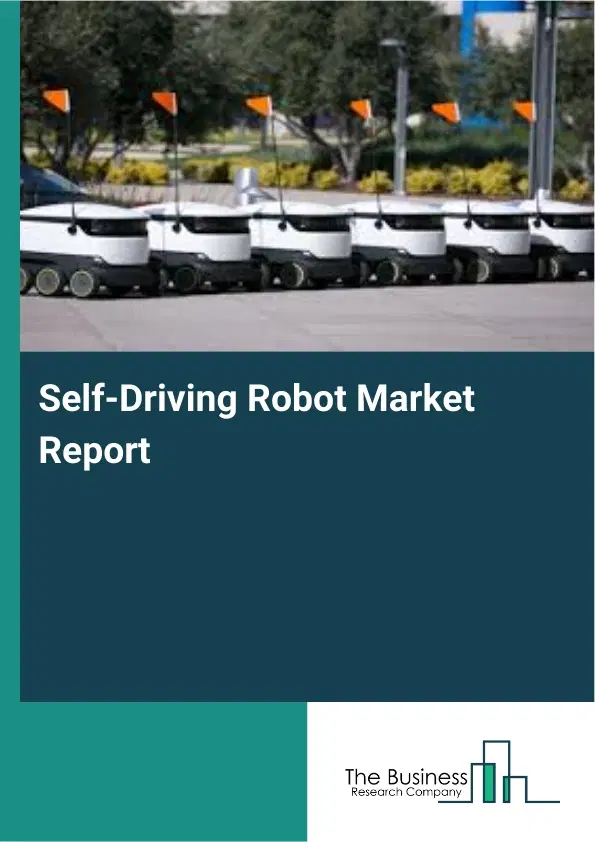
Self-Driving Robot Market Report 2026
Global Outlook – By Component (Hardware, Software, Services), By Navigation Type (Light Detection And Ranging (LiDAR), Global Positioning System (GPS), Camera, Ultrasonic Sensors, Other Navigation Types), By Application (Mail And Packages Delivery, Food Delivery, Material Transportation, Retail Delivery And Transportation, Military Uses), By End-User (Industrial, Commercial, Residential) – Market Size, Trends, Strategies, and Forecast to 2035
Self-Driving Robot Market Overview
• Self-Driving Robot market size has reached to $3.26 billion in 2025 • Expected to grow to $8.24 billion in 2030 at a compound annual growth rate (CAGR) of 20.3% • Growth Driver: Rising Automation Demand Fueling The Growth Of The Self-Driving Robot Market Due To Increasing Efficiency And Cost Reduction Needs • Market Trend: Innovative Autonomous Robots Driving Efficiency And Transformation In The Market • North America was the largest region in 2025 and Asia-Pacific is the fastest growing region.What Is Covered Under Self-Driving Robot Market?
A self-driving robot is an autonomous machine capable of navigating and performing tasks in its environment without direct human control. It uses sensors, cameras, artificial intelligence (AI), and control systems to perceive its surroundings, make decisions, and move safely and efficiently. These robots can detect obstacles, plan routes, and adjust their actions in real-time to achieve specific goals. The main components of a self-driving robot are hardware, software, and services. Hardware refers to the tangible physical parts that enable the robot to perceive, move, and interact with its environment. The types of navigation systems used include light detection and ranging (LiDAR), global positioning system (GPS), cameras, ultrasonic sensors, and other navigation technologies. These have various applications such as mail and package delivery, food delivery, material transportation, retail delivery, and military uses. They serve multiple end-users across industrial, commercial, and residential sectors.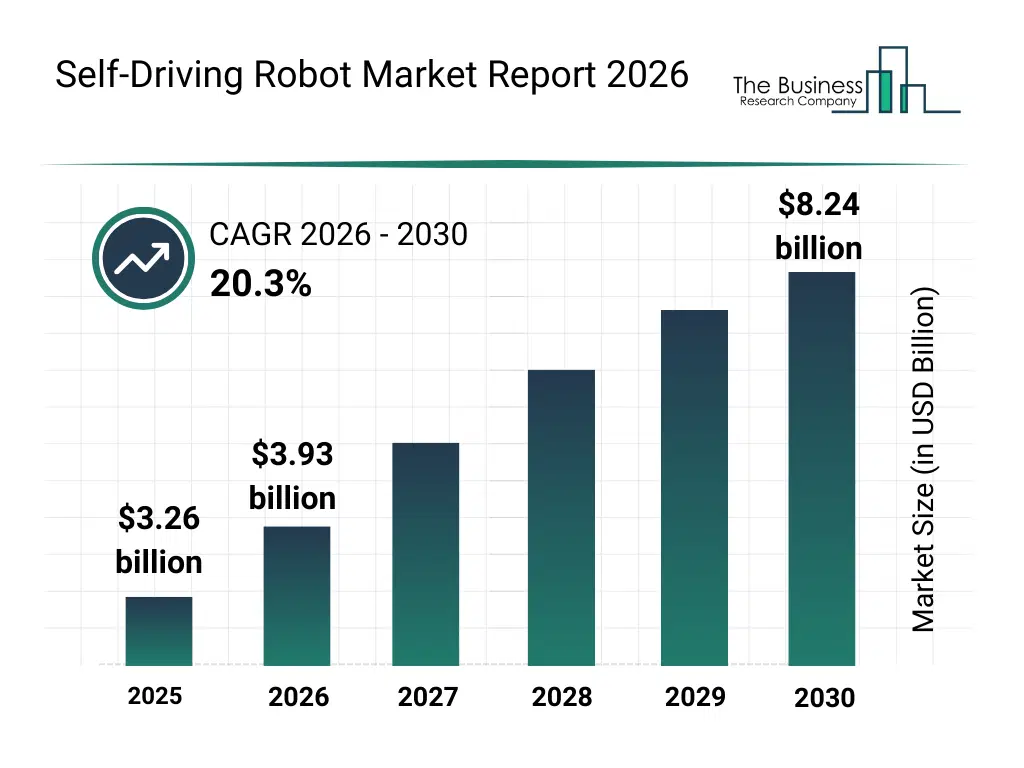
What Is The Self-Driving Robot Market Size and Share 2026?
The self-driving robot market size has grown exponentially in recent years. It will grow from $3.26 billion in 2025 to $3.93 billion in 2026 at a compound annual growth rate (CAGR) of 20.6%. The growth in the historic period can be attributed to industrial automation adoption, labor shortage challenges, advancements in robotics sensors, growth of warehouse automation, declining hardware costs.What Is The Self-Driving Robot Market Growth Forecast?
The self-driving robot market size is expected to see exponential growth in the next few years. It will grow to $8.24 billion in 2030 at a compound annual growth rate (CAGR) of 20.3%. The growth in the forecast period can be attributed to integration of AI perception models, expansion of delivery robotics demand, adoption of smart factories, growth of service robotics, investment in autonomous mobility platform. Major trends in the forecast period include autonomous navigation optimization, multi-sensor fusion systems, fleet management automation, edge AI processing integration, human-robot collaboration.
Global Self-Driving Robot Market Segmentation
1) By Component: Hardware, Software, Services 2) By Navigation Type: Light Detection And Ranging (LiDAR), Global Positioning System (GPS), Camera, Ultrasonic Sensors, Other Navigation Types 3) By Application: Mail And Packages Delivery, Food Delivery, Material Transportation, Retail Delivery And Transportation, Military Uses 4) By End-User: Industrial, Commercial, Residential Subsegments: 1) By Hardware: Sensors, Actuators, Control Systems, Power Supply Units, Communication Modules, Chassis And Frame 2) By Software: Navigation And Mapping Software, Perception Software, Localization Software, Path Planning And Obstacle Avoidance, Fleet Management Software, Artificial Intelligence (AI) And Machine Learning Algorithms 3) By Services: Integration And Deployment Services, Maintenance And Support Services, Consulting And Training Services, Remote Monitoring Services, Upgrades And Customization ServicesWhat Is The Driver Of The Self-Driving Robot Market?
The increasing demand for automation is expected to propel the growth of the self-driving robot market going forward. Automation is the use of technology to perform tasks with minimal or no human intervention. It involves the application of machines, control systems, and software to automatically operate equipment, processes, or systems. The increasing demand for automation is due to the need for greater efficiency, cost reduction, improved productivity, and consistent quality in various industries. Self-driving robots enhance automation by independently performing complex tasks precisely, reducing human intervention and increasing operational efficiency across industries. For instance, in April 2024, according to the International Federation of Robotics (IFR), a Germany-based non-profit organization, total installations of industrial robots in U.S. manufacturing companies reached 44,303 units in 2023, up from 40,000 in 2022, an increase of 12%. Therefore, the increasing demand for automation is driving the growth of the self-driving robot industry.Global Self-Driving Robot Market Trends and Insights
Major companies operating in the self-driving robot market are focusing on developing innovative products such as autonomous robots to enhance operational efficiency, address complex logistics challenges, and meet the growing demand for automation across various industries. An autonomous robot is a machine that can perform tasks and make decisions independently without human intervention. It uses sensors, actuators, control systems, and artificial intelligence to perceive its environment, process information, and act accordingly. For instance, in April 2025, Cartken, a US-based AI-powered robotics company, launched the Cartken Hauler, an advanced autonomous robot designed for material handling in complex indoor and outdoor industrial environments. With a 660 lb payload capacity, all-terrain capability, 24/7 operation in all weather, and integration with existing infrastructure (elevators, doors, software), the Hauler addresses a critical gap in logistics automation. It outperforms traditional AGVs and AMRs by offering greater flexibility, faster deployment (within 7 days), and robust performance without requiring special infrastructure.Key Players In The Global Self-Driving Robot Market
Major companies operating in the self-driving robot market are Tesla Inc., Nissan Motor Co. Ltd., Baidu Inc., FANUC Corporation, Waymo LLC, ShanghAI Keenon Robotics Co. Ltd., Locus Robotics Corp., Starship Technologies Inc., PlusAI Inc., ANYbotics AG, Pony.AI Inc., Aurora Innovation Inc., Bear Robotics Inc., Vecna Robotics Inc., Aethon Inc., AutoX Inc., Udelv Inc., Nuro Inc., Cartken Inc., Robomart Inc.What Are Latest Mergers And Acquisitions In The Self-Driving Robot Market?
In October 2023, Rockwell Automation Inc., a US-based industrial automation and digital transformation company, acquired Clearpath Robotics for an undisclosed amount. With this acquisition, Rockwell Automation aims to provide end-to-end autonomous production logistics solutions, simplifying and transforming material handling within manufacturing plants to optimize operations and accelerate digital transformation. Clearpath Robotics Inc. is a Canada-based self-driving vehicle technology and services company that provides self-driving robots.Regional Insights
North America was the largest region in the self-driving robot market in 2025. Asia-Pacific is expected to be the fastest-growing region in the forecast period. The regions covered in this market report are Asia-Pacific, South East Asia, Western Europe, Eastern Europe, North America, South America, Middle East, Africa. The countries covered in this market report are Australia, Brazil, China, France, Germany, India, Indonesia, Japan, Taiwan, Russia, South Korea, UK, USA, Canada, Italy, Spain.What Defines the Self-Driving Robot Market?
The self-driving robot market consists of revenues earned by companies providing services such as autonomous delivery, cleaning, security patrolling, warehouse transport, and hospital supply movement. The market value includes the value of related goods sold by the service providers or included within the robot service offering. The self-driving robot market also includes sales of spare parts, software subscriptions, charging stations, sensors, and upgrade kits. Values in this market are ‘factory gate’ values, that is, the value of goods sold by the manufacturers or creators of the goods, whether to other entities (including downstream manufacturers, wholesalers, distributors, and retailers) or directly to end customers. The value of goods in this market includes related services sold by the creators of the goods.How is Market Value Defined and Measured?
The market value is defined as the revenues that enterprises gain from the sale of goods and/or services within the specified market and geography through sales, grants, or donations in terms of the currency (in USD unless otherwise specified). The revenues for a specified geography are consumption values that are revenues generated by organizations in the specified geography within the market, irrespective of where they are produced. It does not include revenues from resales along the supply chain, either further along the supply chain or as part of other products.What Key Data and Analysis Are Included in the Self-Driving Robot Market Report 2026?
The self-driving robot market research report is one of a series of new reports from The Business Research Company that provides market statistics, including industry global market size, regional shares, competitors with the market share, detailed market segments, market trends and opportunities, and any further data you may need to thrive in the self-driving robot industry. The market research report delivers a complete perspective of everything you need, with an in-depth analysis of the current and future state of the industry.Self-Driving Robot Market Report Forecast Analysis
| Report Attribute | Details |
|---|---|
| Market Size Value In 2026 | $3.93 billion |
| Revenue Forecast In 2035 | $8.24 billion |
| Growth Rate | CAGR of 20.6% from 2026 to 2035 |
| Base Year For Estimation | 2025 |
| Actual Estimates/Historical Data | 2020-2025 |
| Forecast Period | 2026 - 2030 - 2035 |
| Market Representation | Revenue in USD Billion and CAGR from 2026 to 2035 |
| Segments Covered | Component, Navigation Type, Application, End-User |
| Regional Scope | Asia-Pacific, Western Europe, Eastern Europe, North America, South America, Middle East, Africa |
| Country Scope | The countries covered in the report are Australia, Brazil, China, France, Germany, India, ... |
| Key Companies Profiled | Tesla Inc., Nissan Motor Co. Ltd., Baidu Inc., FANUC Corporation, Waymo LLC, ShanghAI Keenon Robotics Co. Ltd., Locus Robotics Corp., Starship Technologies Inc., PlusAI Inc., ANYbotics AG, Pony.AI Inc., Aurora Innovation Inc., Bear Robotics Inc., Vecna Robotics Inc., Aethon Inc., AutoX Inc., Udelv Inc., Nuro Inc., Cartken Inc., Robomart Inc. |
| Customization Scope | Request for Customization |
| Pricing And Purchase Options | Explore Purchase Options |