
Robotic Assisted Endovascular Systems Market Report 2026
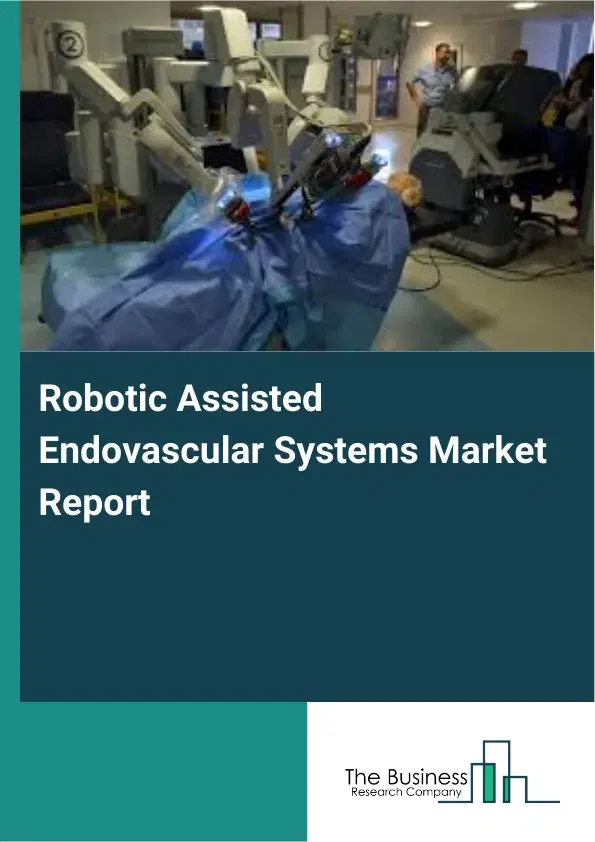
Robotic Assisted Endovascular Systems Market Report 2026
Global Outlook – By Component (Hardware, Software, Services), By Product (Robotic Catheter Systems, Robotic Guidewire Systems, Robotic Angioplasty Systems, Other Products), By Technology (Robotic Catheter Systems, AI-Assisted Navigation Systems, Imaging-Guided Robotic Platforms, Haptic Feedback Systems, Autonomous Robotic Systems), By Application (Coronary Interventions, Peripheral Vascular Interventions, Neurovascular Interventions, Other Applications), By End-User (Hospitals, Specialty Clinics, Ambulatory Surgical Centers, Research And Academic Institutes, Other End-Users) – Market Size, Trends, Strategies, and Forecast to 2035
Robotic Assisted Endovascular Systems Market Overview
• Robotic Assisted Endovascular Systems market size has reached to $32.01 billion in 2025 • Expected to grow to $48.94 billion in 2030 at a compound annual growth rate (CAGR) of 8.9% • Growth Driver: Rising Prevalence Of Cardiovascular And Neurovascular Diseases Fueling The Growth Of The Market Due To Increased Demand For Minimally Invasive Vascular Interventions • Market Trend: Integration Of Robotics With Advanced Imaging And Navigation Systems Drives Precision And Adoption • Europe was the largest region in 2025 and Asia-Pacific is the fastest growing region.

What Is Covered Under Robotic Assisted Endovascular Systems Market?
Robotic assisted endovascular systems are advanced medical technologies designed to support and enhance endovascular procedures through precision-guided robotic mechanisms. These systems integrate Robotic Arms, imaging technologies, navigation modules, and control consoles to assist surgeons in performing minimally invasive vascular interventions with improved accuracy and stability. These systems help reduce surgical complexity, improve procedural safety, and enhance clinical outcomes. The main components of robotic assisted endovascular systems are hardware, software, and services. Hardware refers to the physical robotic devices and instruments used in endovascular procedures, including catheters, guidewires, and angioplasty systems, designed to enhance precision, control, and safety. These systems include various products, such as robotic catheter systems, robotic guidewire systems, robotic angioplasty systems, and other products, and leverage multiple technologies, including robotic catheter systems, AI-assisted navigation systems, imaging-guided robotic platforms, haptic feedback systems, and autonomous robotic systems. They are used across different applications, such as coronary interventions, peripheral vascular interventions, neurovascular interventions, and other applications, and cater to multiple end-users, including hospitals, specialty clinics, ambulatory surgical centers, research and academic institutes, and other end-users.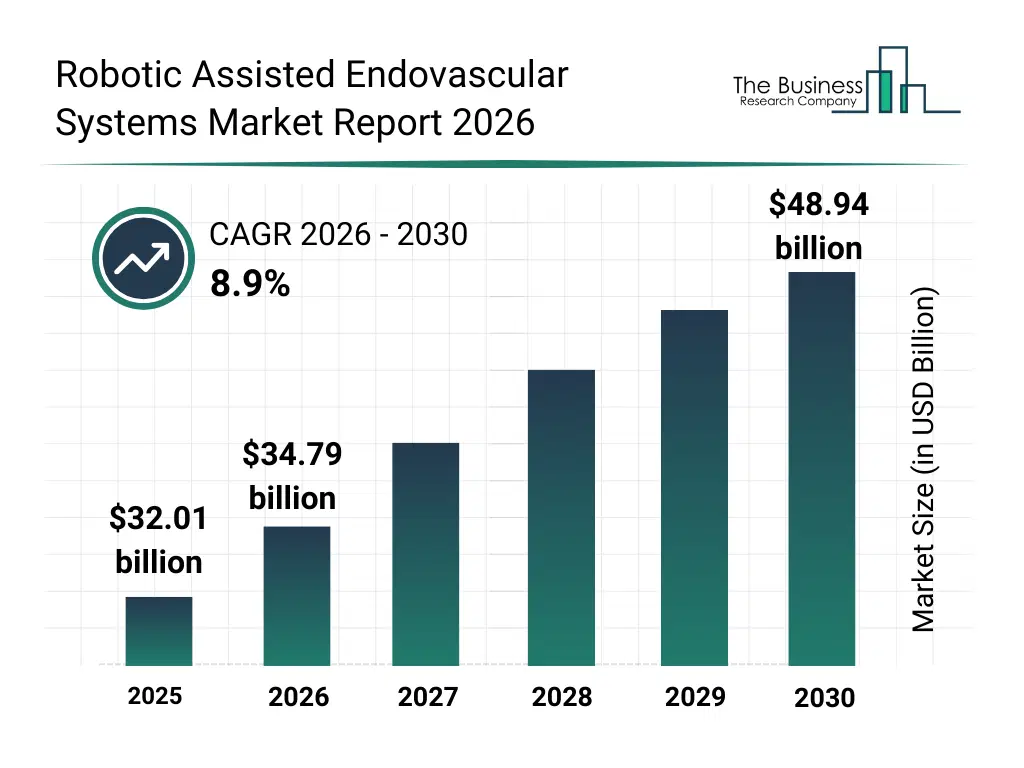
What Is The Robotic Assisted Endovascular Systems Market Size and Share 2026?
The robotic assisted endovascular systems market size has grown strongly in recent years. It will grow from $32.01 billion in 2025 to $34.79 billion in 2026 at a compound annual growth rate (CAGR) of 8.7%. The growth in the historic period can be attributed to increase in cardiovascular disease cases, growth in catheter based interventions, expansion of interventional radiology units, rising preference for minimally invasive surgery, improvements in vascular imaging.What Is The Robotic Assisted Endovascular Systems Market Growth Forecast?
The robotic assisted endovascular systems market size is expected to see strong growth in the next few years. It will grow to $48.94 billion in 2030 at a compound annual growth rate (CAGR) of 8.9%. The growth in the forecast period can be attributed to growth in robotic vascular labs, rising demand for precision guided interventions, expansion of neurovascular robotic procedures, increasing remote surgery capabilities, higher hospital investment in robotic suites. Major trends in the forecast period include growth in robotic catheter navigation, rising adoption in minimally invasive vascular procedures, expansion of imaging guided robotic platforms, increasing use of remote robotic intervention, integration of precision vascular control systems.Global Robotic Assisted Endovascular Systems Market Segmentation
1) By Component: Hardware; Software; Services 2) By Product: Robotic Catheter Systems; Robotic Guidewire Systems; Robotic Angioplasty Systems; Other Products 3) By Technology: Robotic Catheter Systems; AI-Assisted Navigation Systems; Imaging-Guided Robotic Platforms; Haptic Feedback Systems; Autonomous Robotic Systems 4) By Application: Coronary Interventions; Peripheral Vascular Interventions; Neurovascular Interventions; Other Applications 5) By End-User: Hospitals; Specialty Clinics; Ambulatory Surgical Centers; Research And Academic Institutes; Other End-Users Subsegments: 1) By Hardware: Robotic Control Units; Robotic Catheter Systems; Navigation Consoles; Imaging Integration Modules; Surgical Instrument Arms 2) By Software: Navigation Software Platforms; Imaging Processing Software; Procedure Planning Software; Data Management Software; Clinical Decision Support Software 3) By Services: Installation Services; Maintenance And Repair Services; Training And Education Services; System Upgradation ServicesWhat Is The Driver Of The Robotic Assisted Endovascular Systems Market?
The rising prevalence of cardiovascular and neurovascular diseases is expected to propel the growth of the robotic-assisted endovascular systems market going forward. Cardiovascular and neurovascular diseases are conditions that affect the heart, blood vessels, and brain circulation, including coronary artery disease, stroke, and cerebral aneurysms, and they represent a leading cause of mortality and long-term disability worldwide. Cardiovascular and neurovascular diseases are increasing due to aging populations combined with higher prevalence of lifestyle-related risk factors such as obesity, hypertension, and physical inactivity. Robotic-assisted endovascular systems help manage cardiovascular and neurovascular diseases by enabling highly precise, minimally invasive navigation of blood vessels, improving treatment accuracy, safety, and clinical outcomes for complex vascular interventions. For instance, in January 2024, according to the American Heart Association, a US-based non-profit organization, the age-adjusted death rate from cardiovascular disease increased to 233.3 per 100,000 in 2024, up 4.0% from 224.4 per 100,000 in 2023. Therefore, the rising prevalence of cardiovascular and neurovascular diseases is driving the growth of the robotic assisted endovascular systems industry.Key Players In The Global Robotic Assisted Endovascular Systems Market
Major companies operating in the robotic assisted endovascular systems market are Johnson & Johnson, Siemens Healthineers AG, Corindus Vascular Robotics Inc., Cordis Corporation, MicroPort Scientific Corporation, Hansen Medical Inc., Robocath S.A.S., Magnetecs Corporation, Cathbot Robot Co. Ltd., EKOS Corporation, Stereotaxis Inc., Imperative Care Inc., WeMed Medical Technology Co. Ltd., Lombard Medical Limited, Endovascular Robotics Inc., SS Innovations International Inc., Visionary Medicare Co. Ltd., Vantis Vascular Inc., Microbot Medical Inc., Sentante Ltd.Global Robotic Assisted Endovascular Systems Market Trends and Insights
Major companies operating in the robotic assisted endovascular systems market are focusing on integrating robotics with advanced imaging and navigation systems, such as fully remote endovascular robotic platforms, to improve procedural precision, enable complex vascular navigation, and expand access to specialist care. Fully remote endovascular robotic platforms refer to robotic systems that combine real-time fluoroscopic imaging with preoperative CT and MRI data to guide robotic manipulation of catheters and guidewires during endovascular procedures while allowing clinicians to operate from a remote console. For instance, in October 2025, Remedy Robotics, a US-based medical technology company, introduced the Remedy N1 System, an endovascular surgical robotic platform designed to support fully remote neurointerventional procedures. It is designed to enhance accuracy and clinical workflow, the system integrates automated CT and MRI image preprocessing with live fluoroscopic imaging for real-time navigation, enables simultaneous robotic control of up to four endovascular devices, and includes a portable operator console with secure audiovisual connectivity to support remote procedural execution.What Are Latest Mergers And Acquisitions In The Robotic Assisted Endovascular Systems Market?
In October 2025, Remedy Robotics Inc., a US-based healthcare technology company specializing in robotic-assisted endovascular systems, partnered with the Australian Stroke Alliance to jointly deploy and implement robotic endovascular systems across hospitals nationwide, enhancing access to minimally invasive stroke and cardiovascular interventions. With this partnership, Remedy Robotics aims to expand access to advanced endovascular robotic interventions across Australia by integrating its robotic systems into the Stroke Alliance’s national clinical network and hospital infrastructure, improving procedural efficiency, precision, and patient outcomes in stroke and cardiovascular care. The Australian Stroke Alliance is an Australia-based healthcare collaboration of clinicians, researchers, and industry stakeholders focused on improving stroke care nationwide.Regional Insights
Europe was the largest region in the robotic assisted endovascular systems market in 2025. Asia-Pacific is expected to be the fastest-growing region in the forecast period. The regions covered in this market report are Asia-Pacific, South East Asia, Western Europe, Eastern Europe, North America, South America, Middle East, Africa. The countries covered in this market report are Australia, Brazil, China, France, Germany, India, Indonesia, Japan, Taiwan, Russia, South Korea, UK, USA, Canada, Italy, Spain.What Defines the Robotic Assisted Endovascular Systems Market?
The robotic assisted endovascular systems market consists of sales of robotic arms and positioning mechanisms, imaging and navigation modules, control and operating software licenses, sensors and actuators, and disposable and reusable endovascular instruments. Values in this market are ‘factory gate’ values, that is, the value of goods sold by the manufacturers or creators of the goods, whether to other entities (including downstream manufacturers, wholesalers, distributors, and retailers) or directly to end customers. The value of goods in this market includes related services sold by the creators of the goods.How is Market Value Defined and Measured?
The market value is defined as the revenues that enterprises gain from the sale of goods and/or services within the specified market and geography through sales, grants, or donations in terms of the currency (in USD unless otherwise specified). The revenues for a specified geography are consumption values that are revenues generated by organizations in the specified geography within the market, irrespective of where they are produced. It does not include revenues from resales along the supply chain, either further along the supply chain or as part of other products.What Key Data and Analysis Are Included in the Robotic Assisted Endovascular Systems Market Report 2026?
The robotic assisted endovascular systems market research report is one of a series of new reports from The Business Research Company that provides market statistics, including industry global market size, regional shares, competitors with the market share, detailed market segments, market trends and opportunities, and any further data you may need to thrive in the robotic assisted endovascular systems industry. The market research report delivers a complete perspective of everything you need, with an in-depth analysis of the current and future state of the industry.Robotic Assisted Endovascular Systems Market Report Forecast Analysis
| Report Attribute | Details |
|---|---|
| Market Size Value In 2026 | $34.79 billion |
| Revenue Forecast In 2035 | $48.94 billion |
| Growth Rate | CAGR of 8.7% from 2026 to 2035 |
| Base Year For Estimation | 2025 |
| Actual Estimates/Historical Data | 2020-2025 |
| Forecast Period | 2026 - 2030 - 2035 |
| Market Representation | Revenue in USD Billion and CAGR from 2026 to 2035 |
| Segments Covered | Component, Product, Technology, Application, End-User |
| Regional Scope | Asia-Pacific, Western Europe, Eastern Europe, North America, South America, Middle East, Africa |
| Country Scope | The countries covered in the report are Australia, Brazil, China, France, Germany, India, ... |
| Key Companies Profiled | Johnson & Johnson, Siemens Healthineers AG, Corindus Vascular Robotics Inc., Cordis Corporation, MicroPort Scientific Corporation, Hansen Medical Inc., Robocath S.A.S., Magnetecs Corporation, Cathbot Robot Co. Ltd., EKOS Corporation, Stereotaxis Inc., Imperative Care Inc., WeMed Medical Technology Co. Ltd., Lombard Medical Limited, Endovascular Robotics Inc., SS Innovations International Inc., Visionary Medicare Co. Ltd., Vantis Vascular Inc., Microbot Medical Inc., Sentante Ltd. |
| Customization Scope | Request for Customization |
| Pricing And Purchase Options | Explore Purchase Options |
Frequently Asked Questions
The Robotic Assisted Endovascular Systems market was valued at $32.01 billion in 2025, increased to $34.79 billion in 2026, and is projected to reach $48.94 billion by 2030.
request a sample hereThe global Robotic Assisted Endovascular Systems market is expected to grow at a CAGR of 8.9% from 2026 to 2035 to reach $48.94 billion by 2035.
request a sample hereSome Key Players in the Robotic Assisted Endovascular Systems market Include, Johnson & Johnson, Siemens Healthineers AG, Corindus Vascular Robotics Inc., Cordis Corporation, MicroPort Scientific Corporation, Hansen Medical Inc., Robocath S.A.S., Magnetecs Corporation, Cathbot Robot Co. Ltd., EKOS Corporation, Stereotaxis Inc., Imperative Care Inc., WeMed Medical Technology Co. Ltd., Lombard Medical Limited, Endovascular Robotics Inc., SS Innovations International Inc., Visionary Medicare Co. Ltd., Vantis Vascular Inc., Microbot Medical Inc., Sentante Ltd. .
request a sample hereMajor trend in this market includes: Integration Of Robotics With Advanced Imaging And Navigation Systems Drives Precision And Adoption. For further insights on this market.
request a sample hereEurope was the largest region in the robotic assisted endovascular systems market in 2025. Asia-Pacific is expected to be the fastest-growing region in the forecast period. The regions covered in the robotic assisted endovascular systems market report are Asia-Pacific, South East Asia, Western Europe, Eastern Europe, North America, South America, Middle East, Africa.
request a sample here