
Rare Earth Magnet Market 2026
Rare Earth Magnet Market 2026
By Product Type (Sintered Neodymium-Iron-Boron, Bonded Neodymium-Iron-Boron, Samarium-Cobalt, Praseodymium-Neodymium-Iron-Boron, Dysprosium-Neodymium-Iron-Boron – By Grade (High-Performance, Mid-Performance, Low-Performance), By End User (Automotive, Consumer Electronics, Energy, Healthcare, Industrial Equipment, Other End Users), And By Region, Opportunities And Strategies – Global Forecast To 2035
Rare Earth Magnet Market Definition
A rare earth magnet is a powerful permanent magnet made from alloys of rare earth elements, primarily neodymium (Nd-Fe-B) or samarium-cobalt (SmCo). These magnets exhibit powerful magnetic fields, high resistance to demagnetization and excellent performance even in compact sizes. A rare earth magnet is a powerful permanent magnet made from alloys of rare earth elements, primarily neodymium (Nd-Fe-B) or samarium-cobalt (SmCo). These magnets exhibit powerful magnetic fields, high resistance to demagnetization and excellent performance even in compact sizes. and. The rare earth magnet market consists of sales, by entities (organizations, sole traders, or partnerships), of high‑strength permanent magnets made from alloys of rare earth elements, primarily from the lanthanide series. These magnets, such as neodymium‑iron‑boron and samarium‑cobalt types, are significantly stronger than ferrite or alnico magnets of similar size and enable compact, high‑efficiency motor and generator designs.

Rare Earth Magnet Market Size
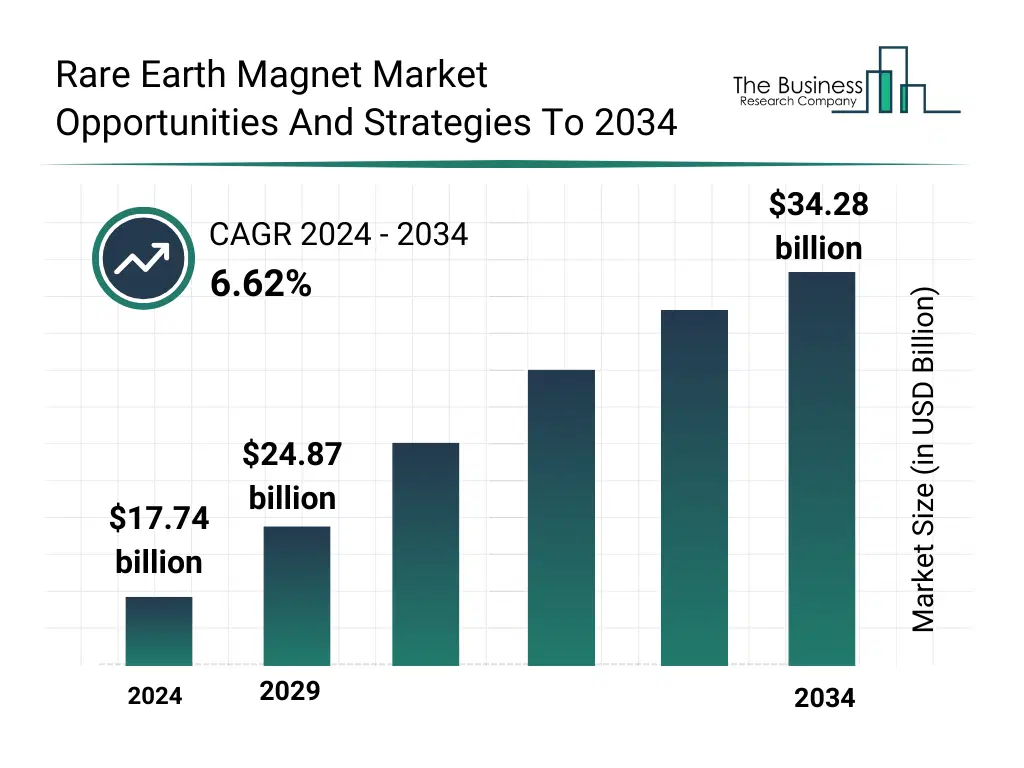
The global rare earth magnet market reached a value of nearly $17,743.34 million in 2024, having grown at a compound annual growth rate (CAGR) of 4.33% since 2019. The market is expected to grow from $17,743.34 million in 2024 to $24,872.20 million in 2029 at a rate of 6.99%. The market is then expected to grow at a CAGR of 6.62% from 2029 and reach $34,276.02 million in 2034. Growth in the historic period resulted from increasing adoption of electric vehicles, expansion of consumer electronics, increasing industrial automation and increased investment in aerospace and defense. Factors that negatively affected growth in the historic period were the price fluctuations of rare-earth metals and heavy-rare‐earth (HRE) element scarcity. Going forward, expansion in renewable energy sectors, increasing deployment of wind turbines, increasing consumer preference for energy-efficient appliances and expanding robotics sector will drive growth. Factor that could hinder the growth of the rare earth magnet market in the future include were limited clinical validation, competition from substitute products and impact of trade war and tariff.Rare Earth Magnet Market Drivers
The key drivers of the rare earth magnet market include: Expansion In Renewable Energy Sectors During the forecast period, expansion in renewable energy sectors will propel the growth of the rare earth magnet market. Rapid global deployment of wind turbines, solar power infrastructure and grid-modernization systems is increasing the need for high-performance magnetic materials that ensure efficient energy conversion and long-term operational stability. Rare earth magnets play a critical role in enabling high-torque, compact and energy-efficient generator designs, which are essential for modern wind power systems and advanced clean-energy technologies. Moreover, as countries intensify efforts to meet climate targets, renewable energy installations are accelerating at record levels, creating sustained demand for technologically reliable components that support continuous, large-scale power generation. With renewable power becoming a central pillar of global energy strategies, the requirement for durable, high-efficiency magnet solutions is expected to rise substantially, thereby driving the overall growth of the rare earth magnet market. The expansion in renewable energy sectors during the forecast period in 2024 is 2.00%.Rare Earth Magnet Market Restraints
The key restraints on the rare earth magnet market include: Low Recycling Rates During the forecast period, low recycling rates will restrict the growth of the rare earth magnet market. Rare earth magnets rely heavily on elements such as neodymium, dysprosium and terbium, yet the rates at which end-of-life magnet materials are collected, processed and recycled remain extremely limited, hampering the development of a reliable secondary supply. This is particularly crucial in the context of soaring demand for rare earth magnet in applications like electric vehicle motors, wind turbines and high-performance electronics, where supply security is as important as cost and environmental performance. Moreover, most recycling systems for critical minerals are not yet established at scale, especially for rare earth elements from end-use products. Therefore, low recycling rates will restrict the rare earth magnet market growth. Growth affected by low recycling rates during the forecast period in 2024 is -1.50%.Rare Earth Magnet Market Trends
Major trends shaping the rare earth magnet market include: Development Of Heavy-Rare-Earth-Free Neodymium Sintered Magnets To Meet High-Performance EV Motor Requirements Major companies in the rare earth magnet market are focusing on the development of heavy-rare-earth-free neodymium sintered magnets designed to address the increasing performance demands of electric vehicle (EV) driving motors. These innovations aim to deliver high magnetic output, improved thermal stability and reduced resource dependency, while supporting the industry’s shift toward more efficient and sustainable motor technologies. For instance, in July 2025, Proterial Ltd., a Japan-based materials manufacturer specializing in advanced magnetic products, introduced a new generation of heavy-rare-earth-free neodymium sintered magnets under the NMX™ series, engineered to achieve high residual flux density and high coercive force without relying on heavy rare earth elements. These magnets feature improved temperature performance and enhanced design flexibility, offering a more efficient and environmentally aligned solution for next-generation EV motors. By applying proprietary manufacturing techniques and extensive R&D expertise, the company aims to provide magnet solutions that combine durability, resource efficiency and high performance to meet the evolving needs of global EV and industrial markets. Growth Of Indigenous Rare Earth Magnet Manufacturing To Reduce Import Dependence Major companies in the rare earth magnet market are focusing on the growth of indigenous manufacturing capabilities to reduce reliance on imported magnet materials and strengthen domestic supply chains. These initiatives aim to support national self-sufficiency, improve access to critical materials and meet rising demand from sectors such as electric mobility, renewable energy, electronics and industrial machinery. For instance, in May 2024, the Technology Development Board (TDB) under India’s Department of Science and Technology announced financial support for Midwest Advanced Materials Private Limited (MAM), a Hyderabad-based company, to establish a commercial-scale rare earth permanent magnet manufacturing facility using oxide feedstock sourced domestically. The project incorporates a modified molten salt electrolysis (MSE) method developed by the Non-Ferrous Materials Technology Development Centre (NFTDC), enabling the production of high-performance NdFeB magnets at scale. By combining indigenous technology development with locally sourced raw materials, the initiative aims to deliver magnet solutions that enhance supply-chain resilience, reduce import dependence and address the evolving requirements of India’s EV, electronics and clean-energy industries.Opportunities And Recommendations In The Rare Earth Magnet Market
Opportunities – The top opportunities in the rare earth magnet market segmented by product type will arise in the sintered neodymium-iron-boron segment, which will gain $3,409.13 million of global annual sales by 2029. The top opportunities in the rare earth magnet market segmented by grade will arise in the high-performance segment, which will gain $3,821.44 million of global annual sales by 2029. The top opportunities in the rare earth magnet market segmented by end-user will arise in the automotive segment, which will gain $2,546.59 million of global annual sales by 2029. The rare earth magnet market size will gain the most in China at $3,446.62 million. Recommendations- To take advantage of the opportunities, The Business Research Company recommends the rare earth magnet companies to focus on developing heavy-rare-earth-free magnet solutions, focus on strengthening indigenous magnet manufacturing, focus on expanding closed-loop magnet recycling, focus on scaling continuous rare earth recycling, focus on commercial-scale recycled magnet production, focus on bonded neodymium-iron-boron magnets for growth, focus on mid-performance NdFeB magnets for rapid growth, expand in emerging markets, continue to focus on developed markets, focus on value-based and competitive pricing for rare earth magnets, focus on targeted b2b promotion for rare earth magnets, focus on relationship-based marketing and thought leadership and focus on energy sector for rare earth magnet expansion.Rare Earth Magnet Market Segmentation
The rare earth magnet market is segmented by product type, by grade and end user.By Product Type –
The rare earth magnet market is segmented by product type into:
- a) Sintered Neodymium-Iron-Boron
- b) Bonded Neodymium-Iron-Boron
- c) Samarium-Cobalt
- d) Praseodymium-Neodymium-Iron-Boron
- e) Dysprosium-Neodymium-Iron-Boron
By Grade –
The rare earth magnet market is segmented by grade into:
- a) High-Performance
- b) Mid-Performance
- c) Low-Performance
By End User –
The rare earth magnet market is segmented by end user into:
- a) Automotive
- b) Consumer electronics
- c) Energy
- d) Healthcare
- e) Industrial equipment
- f) Other end users
By Geography - The rare earth magnet market is segmented by geography into:
- • China
- • India
- • Japan
- • Australia
- • Indonesia
- • South Korea
- • USA
- • Canada
- • Brazil
- • France
- • Germany
- • UK
- • Italy
- • Spain
- • Russia
-
o Asia Pacific
o Africa