
Quantum Materials Market Report 2026
Quantum Materials Market Report 2026
Global Outlook – By Material (Topological Insulators, Graphene And 2D Materials, Weyl Semimetals, Quantum Dots, High-Temperature Superconductors, Photonic Quantum Materials, Other Materials), By Application (Quantum Computing, Quantum Sensing And Metrology, Optoelectronics, Medical And Life Sciences, Other Applications), By End-User (Information Technology And Telecommunications, Healthcare And Life Sciences, Aerospace And Defense, Automotive And Transportation, Electronics And Semiconductors, Energy And Power, Other End-Users) – Market Size, Trends, Strategies, and Forecast to 2035
Quantum Materials Market Overview
• Quantum Materials market size has reached to $10.45 billion in 2025 • Expected to grow to $37.15 billion in 2030 at a compound annual growth rate (CAGR) of 28.9% • Growth Driver: The Rising Demand For Next-Generation Semiconductors Driving The Growth Of The Market Due To The Expansion Of 5g Networks And Advanced Telecommunications Infrastructure • Market Trend: Innovative Carbon Platforms Pave The Way For Scalable, Energy-Efficient Quantum Technologies • North America was the largest region in 2025 and Asia-Pacific is the fastest growing region.

What Is Covered Under Quantum Materials Market?
Quantum materials are materials whose electronic, magnetic, or optical properties are governed by quantum-mechanical effects such as electron entanglement, topological states, or strong electron correlations. These materials exhibit unusual phenomena such as superconductivity, topological insulation, and quantum magnetism that enable advanced applications in quantum computing, sensing, and next-generation electronics. The main materials of quantum materials include topological insulators, graphene and 2D materials, Weyl semimetals, quantum dots, high-temperature superconductors, photonic quantum materials, and other materials. Topological insulators refer to Advanced Materials that conduct electricity on the surface while remaining insulating in the bulk, enabling unique quantum mechanical properties for next-generation technologies. The various applications involved are quantum computing, quantum sensing and metrology, optoelectronics, medical and life sciences, and others and are utilized across several end-users such as information technology and telecommunications, healthcare and life sciences, aerospace and defense, automotive and transportation, electronics and semiconductors, energy and power, and other end-users.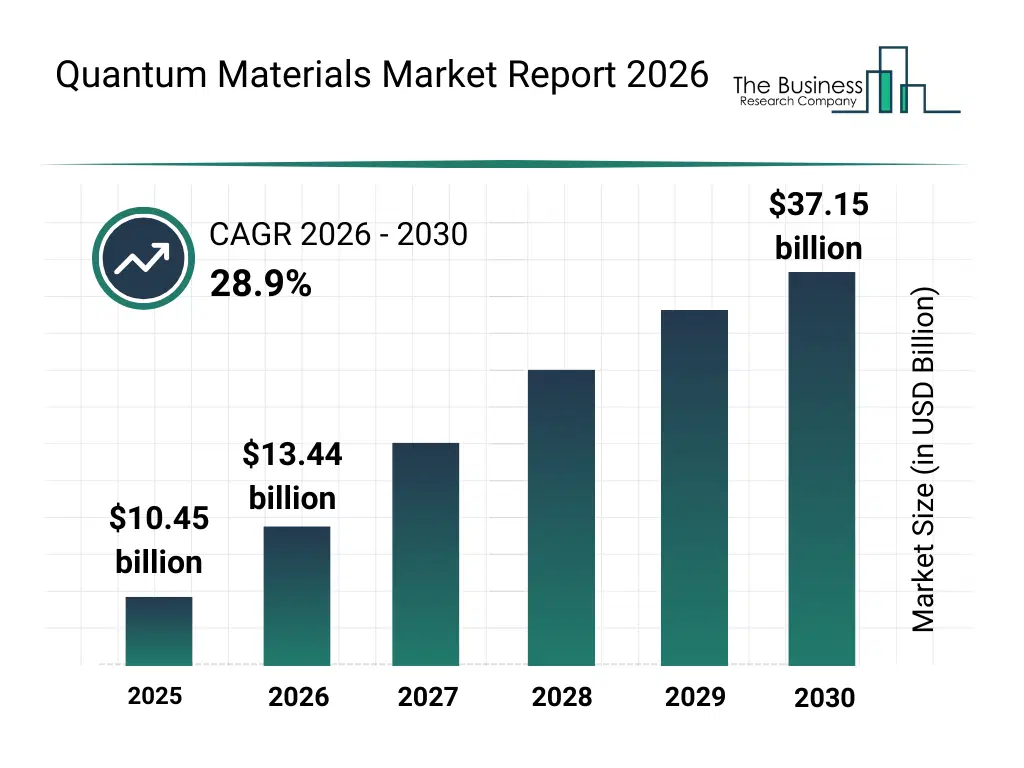
What Is The Quantum Materials Market Size and Share 2026?
The quantum materials market size has grown exponentially in recent years. It will grow from $10.45 billion in 2025 to $13.44 billion in 2026 at a compound annual growth rate (CAGR) of 28.7%. The growth in the historic period can be attributed to increasing research funding in quantum physics, development of advanced fabrication techniques, rising adoption of nanomaterials, growing demand from electronics and semiconductor industries, increasing collaboration between academia and industry.What Is The Quantum Materials Market Growth Forecast?
The quantum materials market size is expected to see exponential growth in the next few years. It will grow to $37.15 billion in 2030 at a compound annual growth rate (CAGR) of 28.9%. The growth in the forecast period can be attributed to growing deployment of quantum computing technologies, increasing demand in quantum sensing and metrology, expansion of optoelectronics applications, rising adoption in medical and life sciences, growing interest in next-generation communication systems. Major trends in the forecast period include increasing adoption of topological insulator materials, rising demand for high-temperature superconductors, growing development of quantum dots and nanocrystals, expansion of photonic quantum materials applications, rising focus on spintronic and excitonic materials.Global Quantum Materials Market Segmentation
1) By Material: Topological Insulators, Graphene And 2D Materials, Weyl Semimetals, Quantum Dots, High-Temperature Superconductors, Photonic Quantum Materials, Other Materials 2) By Application: Quantum Computing, Quantum Sensing And Metrology, Optoelectronics, Medical And Life Sciences, Other Applications 3) By End-User: Information Technology And Telecommunications, Healthcare And Life Sciences, Aerospace And Defense, Automotive And Transportation, Electronics And Semiconductors, Energy And Power, Other End-Users Subsegments: 1) By Topological Insulators: Bismuth Selenide, Bismuth Telluride, Antimony Telluride, Tin Telluride 2) By Graphene And 2D Materials: Monolayer Graphene, Bilayer Graphene, Transition Metal Dichalcogenides, Hexagonal Boron Nitride 3) By Weyl Semimetals: Type One Weyl Semimetals, Type Two Weyl Semimetals, Magnetic Weyl Semimetals 4) By Quantum Dots: Cadmium Selenide Quantum Dots, Lead Sulfide Quantum Dots, Perovskite Quantum Dots, Carbon Quantum Dots 5) By High-Temperature Superconductors: Copper Oxide Superconductors, Iron-Based Superconductors, Rare Earth Superconductors 6) By Photonic Quantum Materials: Nonlinear Optical Materials, Photonic Crystals, Topological Photonic Materials 7) By Other Materials: Spintronic Materials, Excitonic Materials, Majorana MaterialsWhat Is The Driver Of The Quantum Materials Market?
The rising demand for next-generation semiconductors is expected to support the growth of the quantum materials market going forward. Next-generation semiconductors refer to advanced semiconductor materials, devices, and manufacturing technologies designed to deliver higher performance, lower power consumption, greater efficiency, and enhanced functionality compared with conventional silicon-based technologies. This demand is being driven by the expansion of 5G networks, artificial intelligence workloads, data centers, and advanced telecommunications infrastructure, all of which require faster processing speeds, higher bandwidth, and improved energy-efficient chips to enable large-scale data transmission and connectivity. Quantum materials can enable certain next-generation semiconductor technologies by offering novel electronic, magnetic, and topological properties that support faster operation, improved energy efficiency, and device miniaturization beyond the practical limits of traditional silicon-based approaches. For instance, in February 2025, according to the Semiconductor Industry Association (SIA), a US-based voice of the semiconductor industry, in 2024, global semiconductor sales reached $627.6 billion, representing a 19.1% increase compared with the $526.8 billion recorded in 2023. Therefore, the rising demand for next-generation semiconductors is driving the growth of the quantum materials industry.Key Players In The Global Quantum Materials Market
Major companies operating in the quantum materials market are Samsung Display Company Limited, Dow Incorporated, Linde Public Limited Company, BOE Technology Group Company Limited, TCL Corporation, Merck Kommanditgesellschaft auf Aktien, Dainippon Ink and Chemicals Corporation, Kurt J. Lesker Company, Stanford Advanced Materials, Materials And Services Engineering Supplies Limited Liability Company, Nanoco Group Public Limited Company, Quantum Solutions Limited Liability Company, American Elements Inc., Nanosys Incorporated, Qlight Nanotechnology, Ubiquitous Quantum Dots Incorporated, Headquarters Graphene Besloten Vennootschap, Ocean Nanotechnology Limited Liability Company, Ossila Limited, Quantum Dot Laser Incorporated, and Solterra Renewable Technologies Inc.Global Quantum Materials Market Trends and Insights
Major companies operating in the quantum materials market are focusing on developing innovative solutions, such as carbon-based material platforms to enable scalable, energy-efficient, and high-performance quantum computing, sensing, and communication devices. A carbon-based material platform is a system built from carbon nanostructures such as graphene or nanographene designed to harness their unique electronic and quantum properties for applications in computing, sensing, or communication. For instance, in January 2025, Empa, a Switzerland‑based research institution and materials science organization, launched the CarboQuant Lab to explore carbon‑based quantum materials. The lab focuses on atomically precise nanographenes and graphene nanoribbons to study and manipulate quantum effects at the nanoscale. Researchers aim to develop spin‑based quantum devices that could operate at room temperature, reducing reliance on extreme cryogenic cooling. Supported by the Werner Siemens Foundation and the Swiss National Science Foundation, the initiative targets scalable and sustainable quantum‑materials technologies.What Are Latest Mergers And Acquisitions In The Quantum Materials Market?
In January 2024, PsiQuantum Corp., a US-based quantum computing company, partnered with Mitsubishi UFJ Financial Group (MUFG) and Mitsubishi Chemical to design energy-efficient materials using PsiQuantum’s fault-tolerant quantum computer. This partnership aims to accelerate the development of advanced materials for sustainability and energy efficiency by combining PsiQuantum’s expertise in fault-tolerant quantum computing with Mitsubishi Chemical’s materials science capabilities and MUFG’s support in sustainable innovation. Mitsubishi Chemical Group Corporation is a Japan-based materials and chemical company specializing in high-performance and functional materials, and Mitsubishi UFJ Financial Group Inc. is a Japan-based financial group supporting innovation and sustainable technologies.Regional Insights
North America was the largest region in the quantum materials market in 2025. Asia-Pacific is expected to be the fastest-growing region in the forecast period. The regions covered in this market report are Asia-Pacific, South East Asia, Western Europe, Eastern Europe, North America, South America, Middle East, Africa. The countries covered in this market report are Australia, Brazil, China, France, Germany, India, Indonesia, Japan, Taiwan, Russia, South Korea, UK, USA, Canada, Italy, Spain.What Defines the Quantum Materials Market?
The quantum materials market consists of sales of topological insulator materials, superconducting materials, quantum dots and nanocrystals, single-photon emitter materials, and spintronic materials. Values in this market are ‘factory gate’ values, that is, the value of goods sold by the manufacturers or creators of the goods, whether to other entities (including downstream manufacturers, wholesalers, distributors, and retailers) or directly to end customers. The value of goods in this market includes related services sold by the creators of the goods.How is Market Value Defined and Measured?
The market value is defined as the revenues that enterprises gain from the sale of goods and/or services within the specified market and geography through sales, grants, or donations in terms of the currency (in USD unless otherwise specified). The revenues for a specified geography are consumption values that are revenues generated by organizations in the specified geography within the market, irrespective of where they are produced. It does not include revenues from resales along the supply chain, either further along the supply chain or as part of other products.What Key Data and Analysis Are Included in the Quantum Materials Market Report 2026?
The quantum materials market research report is one of a series of new reports from The Business Research Company that provides quantum materials market statistics, including quantum materials industry global market size, regional shares, competitors with a quantum materials market share, detailed quantum materials market segments, market trends and opportunities, and any further data you may need to thrive in the quantum materials industry. This quantum materials market research report delivers a complete perspective of everything you need, with an in-depth analysis of the current and future scenario of the industry.Quantum Materials Market Report Forecast Analysis
| Report Attribute | Details |
|---|---|
| Market Size Value In 2026 | $13.44 billion |
| Revenue Forecast In 2035 | $37.15 billion |
| Growth Rate | CAGR of 28.7% from 2026 to 2035 |
| Base Year For Estimation | 2025 |
| Actual Estimates/Historical Data | 2020-2025 |
| Forecast Period | 2026 - 2030 - 2035 |
| Market Representation | Revenue in USD Billion and CAGR from 2026 to 2035 |
| Segments Covered | Material, Application, End-User |
| Regional Scope | Asia-Pacific, Western Europe, Eastern Europe, North America, South America, Middle East, Africa |
| Country Scope | The countries covered in the report are Australia, Brazil, China, France, Germany, India, ... |
| Key Companies Profiled | Samsung Display Company Limited, Dow Incorporated, Linde Public Limited Company, BOE Technology Group Company Limited, TCL Corporation, Merck Kommanditgesellschaft auf Aktien, Dainippon Ink and Chemicals Corporation, Kurt J. Lesker Company, Stanford Advanced Materials, Materials And Services Engineering Supplies Limited Liability Company, Nanoco Group Public Limited Company, Quantum Solutions Limited Liability Company, American Elements Inc., Nanosys Incorporated, Qlight Nanotechnology, Ubiquitous Quantum Dots Incorporated, Headquarters Graphene Besloten Vennootschap, Ocean Nanotechnology Limited Liability Company, Ossila Limited, Quantum Dot Laser Incorporated, and Solterra Renewable Technologies Inc. |
| Customization Scope | Request for Customization |
| Pricing And Purchase Options | Explore Purchase Options |
Frequently Asked Questions
The Quantum Materials market was valued at $10.45 billion in 2025, increased to $13.44 billion in 2026, and is projected to reach $37.15 billion by 2030.
request a sample hereThe global Quantum Materials market is expected to grow at a CAGR of 28.9% from 2026 to 2035 to reach $37.15 billion by 2035.
request a sample hereSome Key Players in the Quantum Materials market Include, Samsung Display Company Limited, Dow Incorporated, Linde Public Limited Company, BOE Technology Group Company Limited, TCL Corporation, Merck Kommanditgesellschaft auf Aktien, Dainippon Ink and Chemicals Corporation, Kurt J. Lesker Company, Stanford Advanced Materials, Materials And Services Engineering Supplies Limited Liability Company, Nanoco Group Public Limited Company, Quantum Solutions Limited Liability Company, American Elements Inc., Nanosys Incorporated, Qlight Nanotechnology, Ubiquitous Quantum Dots Incorporated, Headquarters Graphene Besloten Vennootschap, Ocean Nanotechnology Limited Liability Company, Ossila Limited, Quantum Dot Laser Incorporated, and Solterra Renewable Technologies Inc..
request a sample hereMajor trend in this market includes: Innovative Carbon Platforms Pave The Way For Scalable, Energy-Efficient Quantum Technologies. For further insights on this market.
request a sample hereNorth America was the largest region in the quantum materials market in 2025. Asia-Pacific is expected to be the fastest-growing region in the forecast period. The regions covered in the quantum materials market report are Asia-Pacific, South East Asia, Western Europe, Eastern Europe, North America, South America, Middle East, Africa.
request a sample here