
Quantitative Brain Function Imaging Device Market Report 2026
Quantitative Brain Function Imaging Device Market Report 2026
Global Outlook – By Component (Imaging Hardware, Electrodes And Sensors, Data Acquisition Systems, Software Platforms, Accessories And Consumables, Maintenance And Service Kits), By Device Type (Functional Magnetic Resonance Imaging (fMRI), Positron Emission Tomography (PET), Electroencephalography (EEG), Magnetoencephalography (MEG), Near Infrared Spectroscopy (NIRS)), By Modality (Single Modal Imaging, Multi-Modal Imaging), By Application (Neurological Research, Psychiatric Research, Clinical Diagnostics, Brain-Computer Interface (BCI), Cognitive Neuroscience), By End-User (Hospitals, Research Laboratories, Academic Institutes, Diagnostic Centers, Pharmaceutical And Biotechnology Companies) – Market Size, Trends, Strategies, and Forecast to 2035
Quantitative Brain Function Imaging Device Market Overview
• Quantitative Brain Function Imaging Device market size has reached to $6.09 billion in 2025 • Expected to grow to $9.3 billion in 2030 at a compound annual growth rate (CAGR) of 8.9% • Growth Driver: Rising Prevalence Of Neurological Disorders Fueling The Growth Of The Market Due To Increasing Need For Early Diagnosis And Objective Brain • Market Trend: Advanced Head-Focused MRI Systems Enhance Precision And Supply Efficiency • North America was the largest region in 2025 and Asia-Pacific is the fastest growing region.

What Is Covered Under Quantitative Brain Function Imaging Device Market?
A quantitative brain function imaging device refers to a medical diagnostic system that measures and analyzes brain activity in objective, numerical form rather than relying only on visual imaging, enabling precise evaluation of functional brain performance. It uses advanced technologies such as functional MRI (fMRI), PET, SPECT, EEG, and near-infrared spectroscopy (fNIRS) to quantify blood flow, oxygen metabolism, electrical activity, and neural connectivity for diagnosing, monitoring, and researching neurological and psychiatric disorders. The main components of quantitative brain function imaging devices are imaging hardware, electrodes and sensors, data acquisition systems, software platforms, accessories and consumables, and maintenance and service kits. Imaging hardware refers to the core equipment used to capture and record brain activity, including scanners, sensors, and measurement instruments. These devices are available in various device types, such as functional magnetic resonance imaging (fMRI), positron emission tomography (PET), electroencephalography (EEG), magnetoencephalography (MEG), and near infrared spectroscopy (NIRS), and can operate in single-modal imaging or multi-modal imaging modes. They are utilized across multiple applications, including neurological research, psychiatric research, clinical diagnostics, brain-computer interface (BCI), and cognitive neuroscience, and are deployed by diverse end-users, such as hospitals, research laboratories, academic institutes, diagnostic centers, and pharmaceutical and biotechnology companies.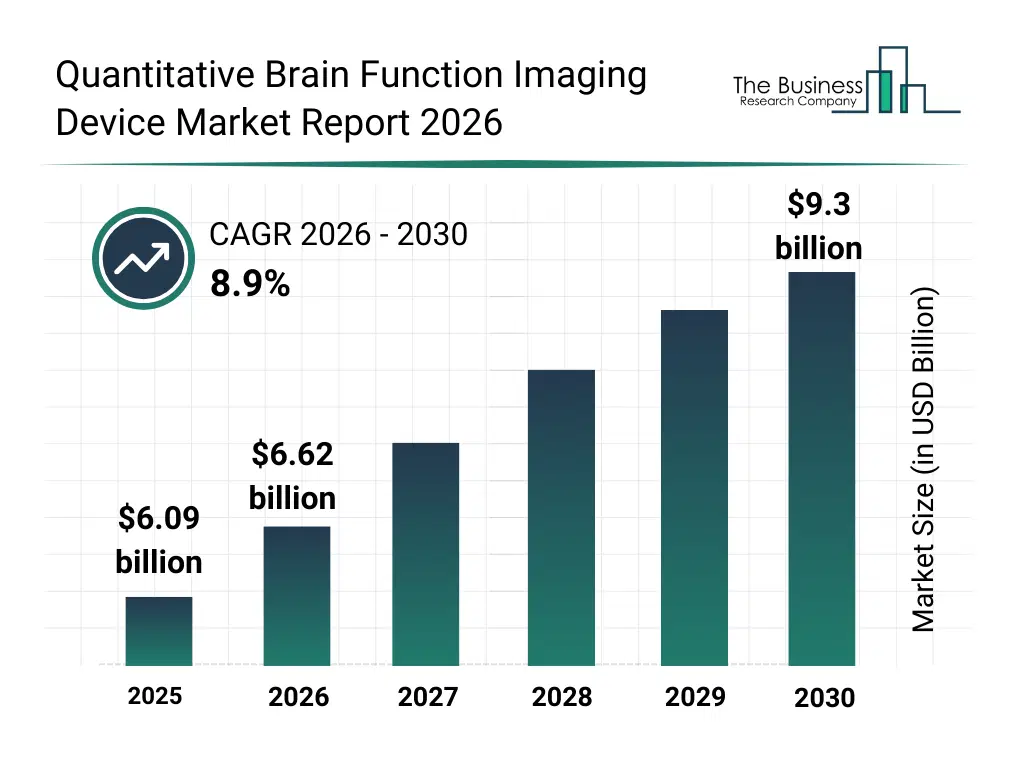
What Is The Quantitative Brain Function Imaging Device Market Size and Share 2026?
The quantitative brain function imaging device market size has grown strongly in recent years. It will grow from $6.09 billion in 2025 to $6.62 billion in 2026 at a compound annual growth rate (CAGR) of 8.7%. The growth in the historic period can be attributed to growth in neurological disorder prevalence, expansion of neuroscience research funding, rising hospital imaging infrastructure, increased use of eeg and pet systems, development of brain mapping techniques.What Is The Quantitative Brain Function Imaging Device Market Growth Forecast?
The quantitative brain function imaging device market size is expected to see strong growth in the next few years. It will grow to $9.3 billion in 2030 at a compound annual growth rate (CAGR) of 8.9%. The growth in the forecast period can be attributed to increasing demand for quantitative diagnostics, growth in precision neurology, expansion of Brain Computer Interface research, rising mental health diagnostics demand, higher investment in neurotechnology platforms. Major trends in the forecast period include multi modal brain imaging adoption, growth in functional brain mapping, integration of advanced neuro signal software, rising use in psychiatric diagnostics, expansion of portable Brain Monitoring systems.Global Quantitative Brain Function Imaging Device Market Segmentation
1) By Component: Imaging Hardware; Electrodes And Sensors; Data Acquisition Systems; Software Platforms; Accessories And Consumables; Maintenance And Service Kits 2) By Device Type: Functional Magnetic Resonance Imaging (fMRI); Positron Emission Tomography (PET); Electroencephalography (EEG); Magnetoencephalography (MEG); Near Infrared Spectroscopy (NIRS) 3) By Modality: Single Modal Imaging; Multi-Modal Imaging 4) By Application: Neurological Research; Psychiatric Research; Clinical Diagnostics; Brain-Computer Interface (BCI); Cognitive Neuroscience 5) By End-User: Hospitals; Research Laboratories; Academic Institutes; Diagnostic Centers; Pharmaceutical And Biotechnology Companies Subsegments: 1) By Imaging Hardware: Functional Magnetic Resonance Imaging Systems; Quantitative Electroencephalography Systems; Magnetoencephalography Systems; Functional Near Infrared Spectroscopy Systems 2) By Electrodes And Sensors: Electroencephalography Electrodes; Magnetoencephalography Sensors; Functional Near Infrared Spectroscopy Optodes; Multimodal Neural Sensors 3) By Data Acquisition Systems: Signal Amplifiers; Analog To Digital Converters; Neural Signal Recorders; Synchronization And Timing Modules 4) By Software Platforms: Brain Signal Processing Software; Quantitative Analysis And Visualization Software; Image Reconstruction Software; Data Management And Integration Software 5) By Accessories And Consumables: Electrode Caps And Headgear; Conductive Gels And Pastes; Cables And Connectors; Disposable Sensors 6) By Maintenance And Service Kits: Calibration Kits; System Diagnostics Tools; Replacement Parts And Spares; Software Updates And Technical Support ServicesWhat Is The Driver Of The Quantitative Brain Function Imaging Device Market?
The increasing prevalence of neurological disorders is expected to propel the growth of the quantitative brain function imaging device market going forward. Neurological disorders refer to medical conditions that affect the brain, spinal cord, or nerves, leading to impairments in movement, sensation, cognition, or other bodily functions. The increasing prevalence of neurological disorders is driven by aging populations, which raise the risk of conditions like Alzheimer’s and Parkinson’s and contribute to a growing global healthcare burden. A quantitative brain function imaging device helps neurological disorders by providing objective, data-driven measurements of brain activity that enable earlier diagnosis, precise disease monitoring, and personalized treatment planning. For instance, in March 2023, according to the Alzheimer's Association, a US-based nonprofit voluntary health organization, reported that 6.7 million Americans aged 65+ have Alzheimer's, projected to rise to 13.8 million by 2060. Therefore, the increasing prevalence of neurological disorders is driving the growth of the quantitative brain function imaging device industry.Key Players In The Global Quantitative Brain Function Imaging Device Market
Major companies operating in the quantitative brain function imaging device market are NeuroPace Inc., NeuroSky Inc, BrainsWay Ltd., Compumedics Limited, Brain Products GmbH, Emotiv Inc., Aspect Imaging Ltd., ANT Neuro/ANT North America Inc., Neuroelectrics Barcelona S.L.U., MR Solutions Ltd., Advanced Brain Monitoring Inc, Cerca Magnetics Limited, Cortech Solutions Inc., FieldLine Inc., Gowerlabs Ltd., Mitsar Co. Ltd, Mind Media B.V., Wearable Sensing LLC, Brain Vision LLC, CereHealth Corp.Global Quantitative Brain Function Imaging Device Market Trends and Insights
Major companies operating in the quantitative brain function imaging device market are focusing on technological advancements, such as AI-based quantitative neuroimaging and imaging biomarkers, to gain more accurate diagnoses, improve clinical decision-making, and support precision neurology through objective, reproducible brain metrics. AI-based quantitative neuroimaging and imaging biomarkers refer to the use of artificial intelligence algorithms to automatically extract, measure, and analyze objective, numerical indicators from brain imaging data. For instance, in December 2023, Quibim, a Spain-based healthtech company, launched QP-Brain, an AI-based quantitative brain imaging software that enables automated measurement of brain atrophy and lesion burden to support early detection and monitoring of neurological diseases. It enables early identification of subtle brain changes associated with neurodegenerative and neurological disorders. The software provides objective, reproducible imaging biomarkers that support earlier and more accurate diagnosis. By integrating directly into existing PACS workflows, it streamlines radiological reporting and reduces reliance on subjective visual assessment.What Are Latest Mergers And Acquisitions In The Quantitative Brain Function Imaging Device Market?
In February 2024, Philips Healthcare, a Netherlands-based company that provides medical imaging solutions, partnered with Synthetic MR to integrate quantitative MRI software that enables faster, standardized measurement of brain tissue properties for neurological assessment. Through this collaboration, Philips integrates Synthetic MR’s SyMRI NEURO 3D software with its SmartSpeed AI-enabled MRI scanners to deliver Smart Quant Neuro 3D, a quantitative brain function imaging device that provides rapid 3D measurements of brain tissue volumes, including myelin, white matter, and gray matter. SyntheticMR AB is a Sweden-based company that provides a quantitative brain imaging device enabling objective assessment of brain tissue properties, rather than relying solely on subjective, contrast-based imaging.Regional Insights
North America was the largest region in the quantitative brain function dmaging device market in 2025. Asia-Pacific is expected to be the fastest-growing region in the forecast period. The regions covered in this market report are Asia-Pacific, South East Asia, Western Europe, Eastern Europe, North America, South America, Middle East, Africa. The countries covered in this market report are Australia, Brazil, China, France, Germany, India, Indonesia, Japan, Taiwan, Russia, South Korea, UK, USA, Canada, Italy, Spain.What Defines the Quantitative Brain Function Imaging Device Market?
The quantitative brain function imaging device market includes sales of brain function imaging devices, neuroimaging scanners, functional brain mapping systems, brain activity analysis units, imaging software platforms, signal acquisition modules, data processing workstations, and visualization display systems. Values in this market are ‘factory gate’ values, that is the value of goods sold by the manufacturers or creators of the goods, whether to other entities (including downstream manufacturers, wholesalers, distributors, and retailers) or directly to end customers. The value of goods in this market includes related services sold by the creators of the goods.How is Market Value Defined and Measured?
The market value is defined as the revenues that enterprises gain from the sale of goods and/or services within the specified market and geography through sales, grants, or donations in terms of the currency (in USD unless otherwise specified). The revenues for a specified geography are consumption values that are revenues generated by organizations in the specified geography within the market, irrespective of where they are produced. It does not include revenues from resales along the supply chain, either further along the supply chain or as part of other products.What Key Data and Analysis Are Included in the Quantitative Brain Function Imaging Device Market Report 2026?
The quantitative brain function imaging device market research report is one of a series of new reports from The Business Research Company that provides market statistics, including industry global market size, regional shares, competitors with the market share, detailed market segments, market trends and opportunities, and any further data you may need to thrive in the quantitative brain function imaging device industry. The market research report delivers a complete perspective of everything you need, with an in-depth analysis of the current and future state of the industry.Quantitative Brain Function Imaging Device Market Report Forecast Analysis
| Report Attribute | Details |
|---|---|
| Market Size Value In 2026 | $6.62 billion |
| Revenue Forecast In 2035 | $9.3 billion |
| Growth Rate | CAGR of 8.7% from 2026 to 2035 |
| Base Year For Estimation | 2025 |
| Actual Estimates/Historical Data | 2020-2025 |
| Forecast Period | 2026 - 2030 - 2035 |
| Market Representation | Revenue in USD Billion and CAGR from 2026 to 2035 |
| Segments Covered | Component, Device Type, Modality, Application, End-User |
| Regional Scope | Asia-Pacific, Western Europe, Eastern Europe, North America, South America, Middle East, Africa |
| Country Scope | The countries covered in the report are Australia, Brazil, China, France, Germany, India, ... |
| Key Companies Profiled | NeuroPace Inc., NeuroSky Inc, BrainsWay Ltd., Compumedics Limited, Brain Products GmbH, Emotiv Inc., Aspect Imaging Ltd., ANT Neuro/ANT North America Inc., Neuroelectrics Barcelona S.L.U., MR Solutions Ltd., Advanced Brain Monitoring Inc, Cerca Magnetics Limited, Cortech Solutions Inc., FieldLine Inc., Gowerlabs Ltd., Mitsar Co. Ltd, Mind Media B.V., Wearable Sensing LLC, Brain Vision LLC, CereHealth Corp. |
| Customization Scope | Request for Customization |
| Pricing And Purchase Options | Explore Purchase Options |