
Property Condition Assessment Market 2026
Property Condition Assessment Market 2026
By Component (Software, Services), By Property Type (Residential Properties, Commercial Properties, Industrial Properties, Institutional Properties, Mixed-Use Properties), By Assessment Type (Physical Assessment, Operational Assessment, Maintenance Assessment, Environmental Assessment, Financial Assessment), By Technology Utilized (Traditional Assessment Methods, Digital And Automated Assessment Tools, Mobile And Cloud-Based Applications, Drone Inspections, Building Information Modeling (BIM)), By End-Use Sector (Real Estate Investment, Property Management Firms, Insurance Companies, Banks And Financial Institutions, Government Entities), And By Region, Opportunities And Strategies – Global Forecast To 2035
Property Condition Assessment Market Definition
Property condition assessment (PCA) refers to the process of evaluating the state and performance of real estate assets, typically involving an inspection of the building’s physical structure, mechanical systems and operational components, as well as a review of environmental and financial considerations. The property condition assessment market consists of sales by entities (organizations, sole traders and partnerships) that are used by a wide range of stakeholders, including property owners, real estate investors, asset managers, banks and financial institutions, insurance companies and government entities, primarily during property acquisitions, refinancing, maintenance planning, or risk assessment exercises.

Property Condition Assessment Market Size
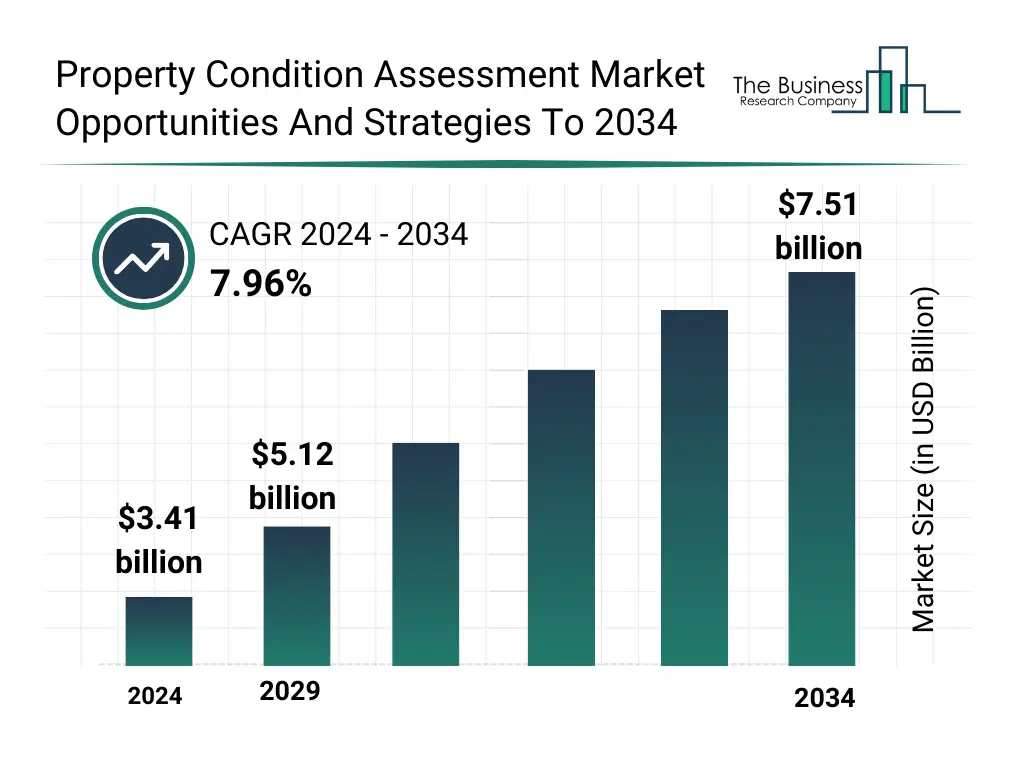
The global property condition assessment market reached a value of nearly $3,411.07 million in 2024, having grown at a compound annual growth rate (CAGR) of 6.30% since 2019. The market is expected to grow from $3,411.07 million in 2024 to $5,121.95 million in 2029 at a rate of 8.47%. The market is then expected to grow at a CAGR of 7.96% from 2029 and reach $7,510.46 million in 2034. Growth in the historic period resulted from growth in real estate sector, rising infrastructure investments, regulatory and code compliance and aging building infrastructure. Factors that negatively affected growth in the historic period were the high cost of property assessments and inadequate access to historical building documentation. Going forward, natural hazard and climate-exposure risks, rising insurance premiums and tighter risk selection, integration of digital and automated tools and rising green building initiatives will drive growth. Factors that could hinder the growth of the property condition assessment market in the future include lack of standardized global assessment protocols, shortage of certified inspectors / skilled workforce and impact of trade war and tariff.Property Condition Assessment Market Drivers
The key drivers of the property condition assessment market include: Natural Hazard And Climate-Exposure Risks During the forecast period, the elevated risks from natural hazards and climate-exposure will propel the growth of the property condition assessment market. As extreme weather, rising sea-levels and climate-driven asset vulnerability become more prevalent, property owners, investors and lenders are increasingly seeking assessments that evaluate not just standard structural integrity but hazard exposure, resilience measures and regulatory compliance. The growing recognition that assets must withstand flood zones, wildfires, wind events and other climate threats is driving demand for condition assessments that integrate environmental risk analytics and mitigation readiness. Consequently, the property condition assessment market will be stimulated by the confluence of escalating climate hazards, the need for proactive risk-management and evolving exposure-driven assessment standard. The elevated risks from natural hazards and climate-exposure during the forecast period in 2024 is 1.75%.Property Condition Assessment Market Restraints
The key restraints on the property condition assessment market include: Lack Of Standardized Global Assessment Protocols In the forecast period, lack of standardized global assessment protocols is restricting the growth of the property condition assessment market. Differences in inspection criteria, reporting formats and evaluation methods across regions have created uncertainty for property owners, investors and insurers who depend on consistent and comparable information. These inconsistencies make it harder to evaluate building performance, verify compliance with sustainability expectations and integrate assessment results across diverse portfolios. With growing emphasis on transparency, carbon-aligned decision-making and harmonized building practices, the absence of common assessment frameworks has made property evaluations more complex and less efficient. This has led many stakeholders to delay assessments or rely on fragmented local practices, reducing the scalability and reliability of condition-assessment activities. Consequently, these protocol gaps are influencing how assessments are conducted and slowing expansion of the property condition assessment market, particularly in markets where multi-level building governance and data harmonization remain limited. Growth affected by lack of standardized global assessment protocols during the forecast period in 2024 is -2.07%.Property Condition Assessment Market Trends
Major trends shaping the property condition assessment market include: Expansion of AI-Driven Condition Analytics to Strengthen Property Assessment Accuracy Major companies in the property condition assessment market are focusing on the expansion of AI-driven condition analytics designed to enhance property inspections, improve valuation accuracy and support more data-driven decision-making. These innovations emphasize automated condition scoring, repair-cost estimation and rapid photo-based analysis, while also offering accessible digital tools that cater to real-estate professionals and homeowners. For instance, in September 2025, Homesage.ai, a US-based provider of AI-powered real estate analytics, introduced an upgraded suite of condition-analysis models that incorporate property condition as a core input for valuation, enabling users to generate condition scores and estimated repair costs within seconds. These tools analyze multiple property images using advanced computer-vision technology to identify visible wear, defects and key structural indicators. By utilizing AI-enabled visualization and comprehensive property-data processing, the company aims to deliver faster, more transparent and more accurate condition assessments that meet the evolving needs of appraisers, investors and real-estate stakeholders. Integration of Advanced Image Analytics to Improve Property Condition Evaluation Companies in the property condition assessment market are focusing on integrating image analytics to enhance property evaluation accuracy and streamline condition-scoring processes. These innovations emphasize automated image interpretation, room and scene classification and improved quality assessment, while also offering scalable solutions that support large-volume property workflows. For instance, in August 2024, FoxyAI, a US-based PropTech company specializing in property-intelligence and computer-vision solutions, partnered with Auction.com to integrate its suite of AI models, including Condition Score, Quality Score, Image Quality Score, Room Classification and Scene Classification, into Auction.com’s real estate analytics platform. This integration enables more precise condition scoring and enhanced listing accuracy by automatically analyzing property photos uploaded to the platform. By utilizing advanced computer vision technology and years of domain expertise, the company aims to deliver faster, more reliable and data-rich property condition assessments that meet the evolving needs of both residential investors and online real estate marketplaces. Additionally in June 2024, ACI, a US-based provider of valuation workflow software and appraisal technology, integrated Restb.ai’s computer-vision system into its ACI Sky® platform to automate the review of property photos, identifying inconsistencies, compliance gaps and condition-related anomalies before reports are finalized. This integration helps appraisers reduce manual review time and ensures higher levels of accuracy across submitted appraisal files. By utilizing advanced computer-vision algorithms and workflow automation capabilities, the company aims to deliver faster, more consistent and compliance-ready property condition assessments that meet the evolving expectations of lenders, appraisal managers and real-estate professionals.Opportunities And Recommendations In The Property Condition Assessment Market
Opportunities – The top opportunities in the property condition assessment market segmented by component will arise in the software segment, which will gain $1,044.65 million of global annual sales by 2029. The top opportunities in the property condition assessment market segmented by property type will arise in the residential properties segment, which will gain $702.89 million of global annual sales by 2029. The top opportunities in the property condition assessment market segmented by assessment type will arise in the physical assessment segment, which will gain $609.25 million of global annual sales by 2029. The top opportunities in the property condition assessment market segmented by technology utilized will arise in the digital and automated assessment tools segment, which will gain $639.03 million of global annual sales by 2029. The top opportunities in the property condition assessment market segmented by end-use sector will arise in the real estate investment segment, which will gain $691.29 million of global annual sales by 2029. The property condition assessment market size will gain the most in the USA at $514.36 million. Recommendations- To take advantage of the opportunities, The Business Research Company recommends the property condition assessment companies to focus on AI-driven property condition analytics to improve speed and accuracy, focus on image analytics integration for scalable and consistent property assessments, focus on generative AI to accelerate commercial property assessments, focus on mobile photo-based applications to improve verification and speed, focus on automated image analysis linked with centralized property data, focus on services-led property condition assessment, focus on industrial properties for accelerated growth, focus on scaling maintenance assessment services, focus on digital and automated assessment tools, expand in emerging markets, focus on structured channel expansion and regional coverage, focus on value-based and tiered pricing discipline, promotion strategy centered on trust and decision enablement, account-driven and partnership-led promotion framework and focus on real estate investment applications.Property Condition Assessment Market Segmentation
The property condition assessment market is segmented by component, by property type, by assessment type, by technology utilized, and by end-use sector.By Component –
The property condition assessment market is segmented by component into:
- a) Software
- b) Services
By Property Type –
The property condition assessment market is segmented by property type into:
- a) Residential Properties
- b) Commercial Properties
- c) Industrial Properties
- d) Institutional Properties
- e) Mixed-Use Properties
By Assessment Type –
The property condition assessment market is segmented by assessment type into:
- a) Physical Assessment
- b) Operational Assessment
- c) Maintenance Assessment
- d) Environmental Assessment
- e) Financial Assessment
By Technology Utilized –
The property condition assessment market is segmented by technology utilized into:
- a) Traditional Assessment Methods
- b) Digital And Automated Assessment Tools
- c) Mobile And Cloud-Based Applications
- d) Drone Inspections
- e) Building Information Modeling (BIM)
By End-Use Sector –
The property condition assessment market is segmented by end-use sector into:
- a) Real Estate Investment
- b) Property Management Firms
- c) Insurance Companies
- d) Banks And Financial Institutions
- e) Government Entities
By Geography - The property condition assessment market is segmented by geography into:
- • China
- • India
- • Japan
- • Australia
- • Indonesia
- • South Korea
- • USA
- • Canada
- • Brazil
- • France
- • Germany
- • UK
- • Italy
- • Spain
- • Russia
-
o Asia Pacific
o Africa