
Polycythemia Market Report 2026

Polycythemia Market Report 2026
Global Outlook – By Type (Primary polycythemia, Secondary polycythemia, Pseudopolycythemia), By Drug Class (Antimetabolites, Janus Kinase 2 Inhibitors, Myelosuppressive Agents, Selective Serotonin Reuptake Inhibitors, Folic Acid, Other Drug Classes), By Route Of Administration (Oral, Intravenous, Intramuscular), By End Users (Hospital Pharmacies, Retail Pharmacies, Online Pharmacies) – Market Size, Trends, Strategies, and Forecast to 2035
Polycythemia Market Overview
• Polycythemia market size has reached to $4.68 billion in 2025 • Expected to grow to $6.53 billion in 2030 at a compound annual growth rate (CAGR) of 7% • Growth Driver: The Rising Prevalence Of Myeloproliferative Diseases Driving Market Growth Due to Aging-Related Hematological Abnormalities • Market Trend: Innovations in Polycythemia focus on first-in-class therapies that reduce phlebotomy dependence and enhance patient outcomes • North America was the largest region in 2025 and Asia-Pacific is the fastest growing region.

What Is Covered Under Polycythemia Market?
Polycythemia refers to a blood disorder in which the body produces an abnormally high number of red blood cells, resulting in increased blood thickness and reduced blood flow efficiency. This condition can lead to complications such as blood clots, stroke, and heart problems, and it may occur as a primary bone marrow disease or as a secondary response to low oxygen levels or other underlying medical conditions. The main types of polycythemia are primary polycythemia, secondary polycythemia, and pseudopolycythemia. Primary polycythemia refers to a type of blood disorder characterized by the overproduction of red blood cells due to intrinsic abnormalities in the bone marrow. Treatments are classified by drug class, including antimetabolites, Janus kinase 2 inhibitors, myelosuppressive agents, selective serotonin reuptake inhibitors, folic acid, and other drug classes, and are administered through various routes, such as oral, intravenous, and intramuscular. The serves different end users, including hospital pharmacies, retail pharmacies, and online pharmacies.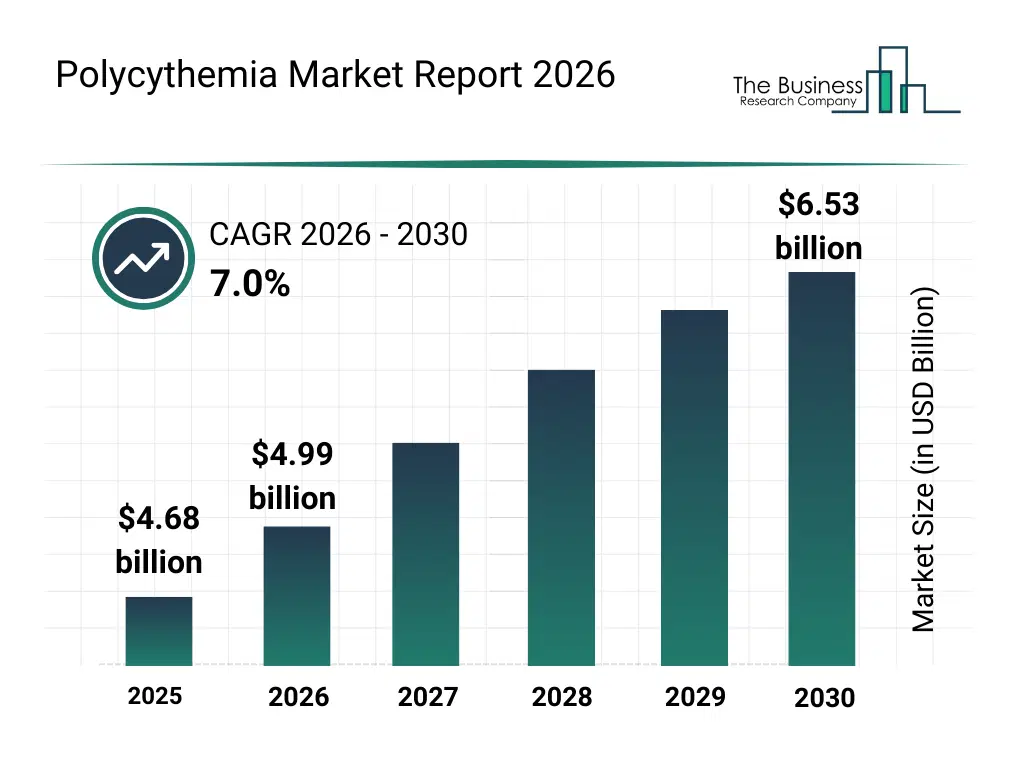
What Is The Polycythemia Market Size and Share 2026?
The polycythemia market size has grown strongly in recent years. It will grow from $4.68 billion in 2025 to $4.99 billion in 2026 at a compound annual growth rate (CAGR) of 6.7%. The growth in the historic period can be attributed to rising prevalence of myeloproliferative disorders, increasing awareness of rare blood diseases, expansion of specialty hematology centers, higher diagnostic testing rates, growth in use of cytoreductive drugs.What Is The Polycythemia Market Growth Forecast?
The polycythemia market size is expected to see strong growth in the next few years. It will grow to $6.53 billion in 2030 at a compound annual growth rate (CAGR) of 7.0%. The growth in the forecast period can be attributed to advancements in targeted JAK2 therapies, increasing genetic screening adoption, rising demand for personalized treatment plans, expanding access to specialty biologics, growing elderly population base. Major trends in the forecast period include growing adoption of janus kinase inhibitors, rising use of interferon based injectable therapies, increasing preference for therapeutic phlebotomy procedures, expansion of hematocrit monitoring diagnostics, shift toward combination drug therapy approaches.Global Polycythemia Market Segmentation
1) By Type: Primary polycythemia; Secondary polycythemia; Pseudopolycythemia 2) By Drug Class: Antimetabolites; Janus Kinase 2 Inhibitors; Myelosuppressive Agents; Selective Serotonin Reuptake Inhibitors; Folic Acid; Other Drug Classes 3) By Route Of Administration: Oral; Intravenous; Intramuscular 4) By End Users: Hospital Pharmacies; Retail Pharmacies; Online Pharmacies Subsegments: 1) By Primary Polycythemia: Polycythemia Vera; Familial Primary Polycythemia 2) By Secondary Polycythemia: Hypoxia Induced Polycythemia; Tumor Associated Polycythemia; Drug Induced Polycythemia; Hormone Induced Polycythemia 3) By Pseudopolycythemia: Stress Related Polycythemia; Dehydration Related Polycythemia; Plasma Volume Contraction Related PolycythemiaWhat Is The Driver Of The Polycythemia Market?
The rising incidence of myeloproliferative diseases is expected to propel the growth of the polycythemia market going forward. Myeloproliferative diseases are a group of rare blood disorders characterized by the abnormal overproduction of blood cells in the bone marrow, resulting in impaired blood function and circulation. The growing prevalence of age-related hematological abnormalities is a key factor contributing to the increasing occurrence of these disorders, as aging populations are more susceptible to bone marrow dysfunction. Polycythemia, as a major subtype of myeloproliferative diseases involving excessive red blood cell production, plays a significant role in enhancing clinical awareness, diagnosis, and ongoing monitoring of these conditions, thereby supporting market expansion. For instance, in September 2024, according to Blood Cancer United, a US-based nonprofit dedicated to curing blood cancers, over 120,000 people in the United States were estimated to be living with or in remission from myeloproliferative neoplasms (MPNs) in 2023, showing an increased prevalence of these chronic hematologic disorders. Therefore, the rising incidence of myeloproliferative diseases is driving the growth of the polycythemia industry.Key Players In The Global Polycythemia Market
Major companies operating in the polycythemia market are Bristol Myers Squibb Company, Roche Holding AG, Merck And Company Inc., Bayer AG, Novartis AG, Takeda Pharmaceutical Company, Gilead Sciences Inc., Teva Pharmaceutical Industries Ltd., Incyte Corporation, Ionis Pharmaceuticals Inc., CTI BioPharma Corp., AOP Orphan Pharmaceuticals AG, Silence Therapeutics Plc, Italfarmaco S.p.A., PharmaEssentia Corporation, Karyopharm Therapeutics Inc., Protagonist Therapeutics Inc., Kartos Therapeutics Inc., Geron Corporation, and Perseus Proteomics Inc.Global Polycythemia Market Trends and Insights
Major companies operating in the polycythemia market are focusing on advanced innovations such as rusfertide, a first-in-class hepcidin mimetic peptide, which significantly reduces the need for frequent phlebotomies while improving hematocrit control and patient quality of life. A hepcidin mimetic is a drug or compound designed to act like hepcidin, the body’s main hormone that regulates iron balance. For instance, in March 2025, Takeda Pharmaceutical Company Limited, a Japan-based biopharmaceutical company, announced positive topline results from the Phase 3 VERIFY study of rusfertide in patients with polycythemia vera, demonstrating significant reduction in phlebotomy dependence, improved hematocrit control, and meaningful patient-reported outcomes, while maintaining a favorable safety profile.What Are Latest Mergers And Acquisitions In The Polycythemia Market?
In March 2025, Ono Pharmaceutical, a Japan-based pharmaceutical company, partnered with Ionis Pharmaceuticals to advance the development, regulatory approval, and global commercialization of sapablursen, a novel RNA-targeted therapy for polycythemia vera, leveraging Ionis Pharmaceuticals’ expertise to address unmet needs in rare blood disorders. Ionis Pharmaceuticals is a US-based company specializing in RNA-targeted therapies for rare blood disorders, including treatments for polycythemia.Regional Insights
North America was the largest region in the polycythemia market in 2025. Asia-Pacific is expected to be the fastest-growing region in the forecast period. The regions covered in this market report are Asia-Pacific, South East Asia, Western Europe, Eastern Europe, North America, South America, Middle East, Africa. The countries covered in this market report are Australia, Brazil, China, France, Germany, India, Indonesia, Japan, Taiwan, Russia, South Korea, UK, USA, Canada, Italy, Spain.What Defines the Polycythemia Market?
The polycythemia market consists of sales of therapeutic phlebotomy kits, cytoreductive drug formulations, antiplatelet medication products, janus kinase inhibitor drugs, interferon-based injectable products, and hematocrit monitoring test kits. Values in this market are ‘factory gate’ values, that is, the value of goods sold by the manufacturers or creators of the goods, whether to other entities (including downstream manufacturers, wholesalers, distributors, and retailers) or directly to end customers. The value of goods in this market includes related services sold by the creators of the goods.How is Market Value Defined and Measured?
The market value is defined as the revenues that enterprises gain from the sale of goods and/or services within the specified market and geography through sales, grants, or donations in terms of the currency (in USD unless otherwise specified). The revenues for a specified geography are consumption values that are revenues generated by organizations in the specified geography within the market, irrespective of where they are produced. It does not include revenues from resales along the supply chain, either further along the supply chain or as part of other products.What Key Data and Analysis Are Included in the Polycythemia Market Report 2026?
The polycythemia market research report is one of a series of new reports from The Business Research Company that provides market statistics, including industry global market size, regional shares, competitors with the market share, detailed market segments, market trends and opportunities, and any further data you may need to thrive in the polycythemia industry. The market research report delivers a complete perspective of everything you need, with an in-depth analysis of the current and future state of the industry.Polycythemia Market Report Forecast Analysis
| Report Attribute | Details |
|---|---|
| Market Size Value In 2026 | $4.99 billion |
| Revenue Forecast In 2035 | $6.53 billion |
| Growth Rate | CAGR of 6.7% from 2026 to 2035 |
| Base Year For Estimation | 2025 |
| Actual Estimates/Historical Data | 2020-2025 |
| Forecast Period | 2026 - 2030 - 2035 |
| Market Representation | Revenue in USD Billion and CAGR from 2026 to 2035 |
| Segments Covered | Type, Drug Class, Route Of Administration, End Users |
| Regional Scope | Asia-Pacific, Western Europe, Eastern Europe, North America, South America, Middle East, Africa |
| Country Scope | The countries covered in the report are Australia, Brazil, China, France, Germany, India, ... |
| Key Companies Profiled | Bristol Myers Squibb Company, Roche Holding AG, Merck And Company Inc., Bayer AG, Novartis AG, Takeda Pharmaceutical Company, Gilead Sciences Inc., Teva Pharmaceutical Industries Ltd., Incyte Corporation, Ionis Pharmaceuticals Inc., CTI BioPharma Corp., AOP Orphan Pharmaceuticals AG, Silence Therapeutics Plc, Italfarmaco S.p.A., PharmaEssentia Corporation, Karyopharm Therapeutics Inc., Protagonist Therapeutics Inc., Kartos Therapeutics Inc., Geron Corporation, and Perseus Proteomics Inc. |
| Customization Scope | Request for Customization |
| Pricing And Purchase Options | Explore Purchase Options |
Frequently Asked Questions
The Polycythemia market was valued at $4.68 billion in 2025, increased to $4.99 billion in 2026, and is projected to reach $6.53 billion by 2030.
request a sample hereThe global Polycythemia market is expected to grow at a CAGR of 7.0% from 2026 to 2035 to reach $6.53 billion by 2035.
request a sample hereSome Key Players in the Polycythemia market Include, Bristol Myers Squibb Company, Roche Holding AG, Merck And Company Inc., Bayer AG, Novartis AG, Takeda Pharmaceutical Company, Gilead Sciences Inc., Teva Pharmaceutical Industries Ltd., Incyte Corporation, Ionis Pharmaceuticals Inc., CTI BioPharma Corp., AOP Orphan Pharmaceuticals AG, Silence Therapeutics Plc, Italfarmaco S.p.A., PharmaEssentia Corporation, Karyopharm Therapeutics Inc., Protagonist Therapeutics Inc., Kartos Therapeutics Inc., Geron Corporation, and Perseus Proteomics Inc. .
request a sample hereMajor trend in this market includes: Innovations in Polycythemia focus on first-in-class therapies that reduce phlebotomy dependence and enhance patient outcomes. For further insights on this market.
request a sample hereNorth America was the largest region in the polycythemia market in 2025. Asia-Pacific is expected to be the fastest-growing region in the forecast period. The regions covered in the polycythemia market report are Asia-Pacific, South East Asia, Western Europe, Eastern Europe, North America, South America, Middle East, Africa.
request a sample here