
Palmoplantar Keratoderma Market Report 2026
Palmoplantar Keratoderma Market Report 2026
Global Outlook – By Treatment Type (Topical Treatments, Systemic Treatments, Phototherapy, Surgical Interventions), By Type (Non Lamellar Keratoderma, Lamellar Keratoderma, Epidermolytic Keratoderma, Palmoplantar Keratoderma With Systemic Involvement), By Diagnosis Method (Clinical Examination, Histopathological Examination, Genetic Testing), By Patient Type (Pediatric, Adult), By Distribution Channel (Hospital Pharmacies, Retail Pharmacies, Online Pharmacies) – Market Size, Trends, Strategies, and Forecast to 2035
Palmoplantar Keratoderma Market Overview
• Palmoplantar Keratoderma market size has reached to $0.88 billion in 2025 • Expected to grow to $1.13 billion in 2030 at a compound annual growth rate (CAGR) of 5.2% • Growth Driver: Escalating Prevalence Of Genetic Mutations Driving The Market Growth Due To Rising Identification Of Hereditary Skin Disorders • Market Trend: Innovative Topical And Oral TRPV3 Inhibitors Show Promise In Treating Rare Keratoderma Disorders • North America was the largest region in 2025 and Asia-Pacific is the fastest growing region.

What Is Covered Under Palmoplantar Keratoderma Market?
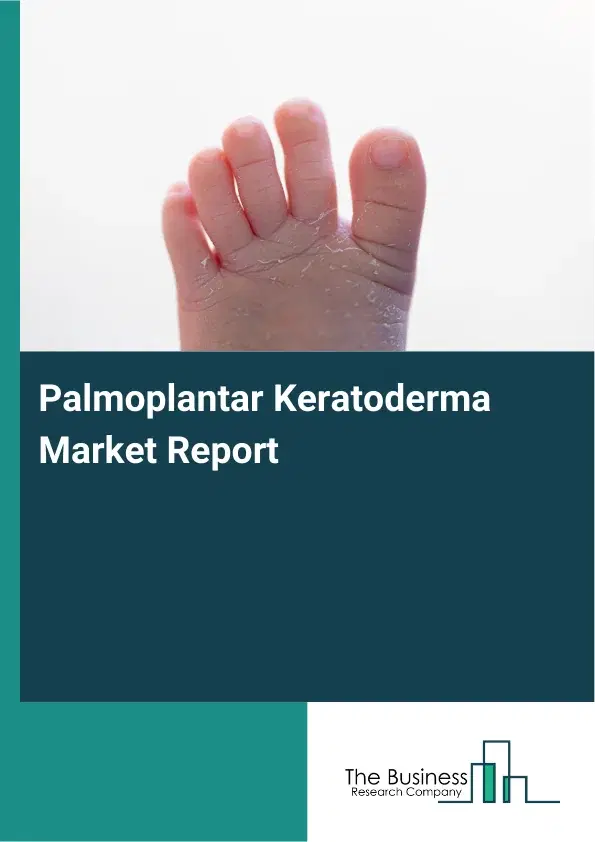
Palmoplantar keratoderma (PPK) refers to a group of rare skin disorders characterized by thickening of the skin on the palms of the hands and the soles of the feet. The condition may be hereditary or acquired and often requires long-term management through topical treatments, systemic therapies, or biologic drugs to reduce skin thickening, inflammation, and associated discomfort. The main types of palmoplantar keratoderma include topical treatments, systemic treatments, phototherapy, and surgical interventions. Topical treatments refer to medications and therapeutic creams applied directly to the skin to manage hyperkeratosis, reduce scaling, and alleviate symptoms. These conditions are classified by type including non-lamellar keratoderma, lamellar keratoderma, epidermolytic keratoderma, and palmoplantar keratoderma with systemic involvement. Diagnosis methods include clinical examination, histopathological examination, and genetic testing. They are applied across patient types including pediatric and adult populations and are distributed through hospital pharmacies, retail pharmacies, and online pharmacies.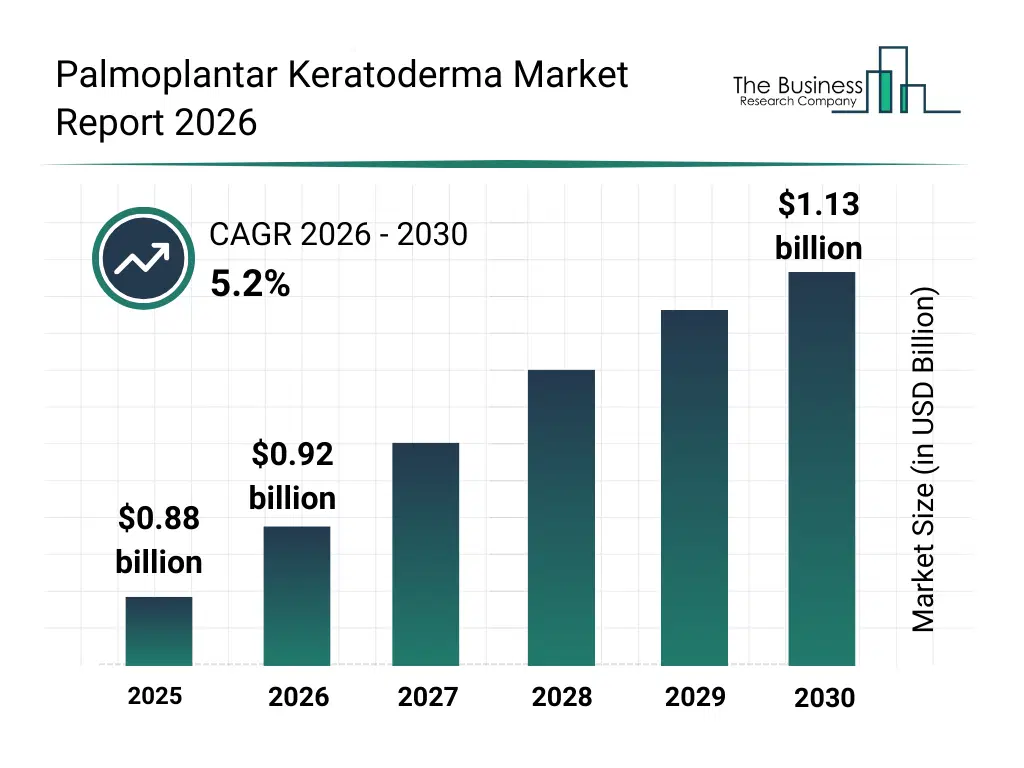
What Is The Palmoplantar Keratoderma Market Size and Share 2026?
The palmoplantar keratoderma market size has grown steadily in recent years. It will grow from $0.88 billion in 2025 to $0.92 billion in 2026 at a compound annual growth rate (CAGR) of 4.9%. The growth in the historic period can be attributed to increase in rare dermatological disorder diagnosis, growth in dermatology specialty clinics, expansion of retinoid therapies, rising patient awareness of genetic skin diseases, improved dermatopathology testing.What Is The Palmoplantar Keratoderma Market Growth Forecast?
The palmoplantar keratoderma market size is expected to see strong growth in the next few years. It will grow to $1.13 billion in 2030 at a compound annual growth rate (CAGR) of 5.2%. The growth in the forecast period can be attributed to growth in targeted dermatology drugs, expansion of genetic screening access, rising biologic therapy adoption, increase in specialty dermatology pipelines, broader orphan disease support programs. Major trends in the forecast period include targeted biologic skin therapies, advanced genetic diagnostic panels, long acting topical formulations, combination retinoid treatment protocols, home based phototherapy adoption.Global Palmoplantar Keratoderma Market Segmentation
1) By Treatment Type: Topical Treatments; Systemic Treatments; Phototherapy; Surgical Interventions 2) By Type: Non Lamellar Keratoderma; Lamellar Keratoderma; Epidermolytic Keratoderma; Palmoplantar Keratoderma With Systemic Involvement 3) By Diagnosis Method: Clinical Examination; Histopathological Examination; Genetic Testing 4) By Patient Type: Pediatric; Adult 5) By Distribution Channel: Hospital Pharmacies; Retail Pharmacies; Online Pharmacies Subsegments: 1) By Topical Treatments: Salicylic Acid Preparations; Urea Creams; Emollients; Retinoid Creams; Corticosteroid Creams 2) By Systemic Treatments: Oral Retinoids; Oral Vitamin D Analogues; Oral Corticosteroids; Oral Immunosuppressants 3) By Phototherapy: Ultraviolet A Therapy; Ultraviolet B Therapy; Psoralen Plus Ultraviolet A Therapy 4) By Surgical Interventions: Excision Surgery; Laser Therapy; Dermabrasion; Skin GraftingWhat Are The Drivers Of The Palmoplantar Keratoderma Market?
The escalating prevalence of genetic mutations is expected to propel the growth of the palmoplantar keratoderma market going forward. Genetic mutations are changes or variations in DNA sequences that can increase susceptibility to hereditary conditions and dermatological disorders. The prevalence of genetic mutations is rising due to advances in genomic sequencing and widespread genetic testing, which are enabling the detection and identification of a growing number of previously unrecognized DNA variations across populations. Rising genetic mutations contribute to palmoplantar keratoderma by increasing the population with inherited skin-gene alterations, which in turn results in earlier detection and a greater need for targeted management. For instance, in January 2023, according to the report published by the National Center for Biotechnology Information (NCBI), a division of the US-based National Library of Medicine (NLM), with approximately 140 million babies born each year, roughly 9.8 billion new human mutations are introduced into the gene pool annually. Therefore, the escalating prevalence of genetic mutations is driving the growth of the palmoplantar keratoderma industry. The increasing healthcare expenditure is expected to propel the growth of the palmoplantar keratoderma market going forward. Healthcare expenditure refers to the total amount of financial resources allocated toward health services, including medical treatments, diagnostic procedures, medications, and preventive care. Healthcare expenditure is rising due to population aging because older populations have higher rates of chronic diseases, require more frequent medical care, and often need long-term treatments, driving overall healthcare costs upward. Increasing healthcare expenditure supports palmoplantar keratoderma by improving access to specialized care, funding advanced diagnostics and therapies, and enabling timely, personalized treatment for patients. For instance, in January 2026, according to the Centers for Medicare & Medicaid Services, a US-based government agency, in 2024, national health expenditure (NHE) increased by 7.2% to $5.3 trillion, averaging $15,474 per person and representing 18.0% of GDP, while Medicare spending rose by 7.8% to $1,118.0 billion, accounting for 21% of total NHE. Therefore, increasing healthcare expenditure is driving the growth of the palmoplantar keratoderma industry.Key Players In The Global Palmoplantar Keratoderma Market
Major companies operating in the palmoplantar keratoderma market are LEO Pharma, Krystal Biotech Inc., and Kamari Pharma.Global Palmoplantar Keratoderma Market Trends and Insights
Major companies operating in the palmoplantar keratoderma market are focusing on conducting clinical trials to develop innovative drugs such as TRPV3 inhibitors to provide targeted, disease-modifying treatments that go beyond symptomatic relief. TRPV3 inhibitors are drugs that block the TRPV3 ion channel, helping to normalize skin cell growth, strengthen the skin barrier, and reduce pain and thickening associated with palmoplantar keratoderma. For instance, in June 2024, Kamari Pharma Ltd., a clinical-stage biotechnology company, launched KM-001, a topical TRPV3 inhibitor, following promising Phase 1b clinical results. KM-001 is formulated as a cream applied twice daily and has demonstrated high safety with no severe adverse events, along with an overall responder rate of 87% in patients with pachyonychia congenita and punctate palmoplantar keratoderma type 1. Its unique mechanism helps normalize skin cell proliferation, enhance epidermal barrier formation, and reduce pain in affected patients, offering a disease-modifying alternative to conventional treatments. Kamari Pharma plans to advance KM-001 into Phase 2 trials while also developing KM-023, an oral TRPV3 inhibitor, for broader keratoderma indications.nan
Regional Insights
North America was the largest region in the palmoplantar keratoderma market in 2025. Asia - Pacific is expected to be the fastest-growing region in the forecast period. The regions covered in this market report are Asia-Pacific, South East Asia, Western Europe, Eastern Europe, North America, South America, Middle East, Africa. The countries covered in this market report are Australia, Brazil, China, France, Germany, India, Indonesia, Japan, Taiwan, Russia, South Korea, UK, USA, Canada, Italy, Spain.What Defines the Palmoplantar Keratoderma Market?
The palmoplantar keratoderma market consists of revenues earned by entities by providing services such as clinical consultations and dermatological assessments, genetic and diagnostic testing, prescription management, phototherapy sessions, and surgical evaluation and interventions. The market value includes the value of related goods sold by the service provider or included within the service offering. The palmoplantar keratoderma market also includes sales of oral retinoids, keratolytic agents, immunomodulators, corticosteroids, and adjunctive systemic therapies. Values in this market are ‘factory gate’ values, that is the value of goods sold by the manufacturers or creators of the goods, whether to other entities (including downstream manufacturers, wholesalers, distributors and retailers) or directly to end customers. The value of goods in this market includes related services sold by the creators of the goods.How is Market Value Defined and Measured?
The market value is defined as the revenues that enterprises gain from the sale of goods and/or services within the specified market and geography through sales, grants, or donations in terms of the currency (in USD unless otherwise specified). The revenues for a specified geography are consumption values that are revenues generated by organizations in the specified geography within the market, irrespective of where they are produced. It does not include revenues from resales along the supply chain, either further along the supply chain or as part of other products.What Key Data and Analysis Are Included in the Palmoplantar Keratoderma Market Report 2026?
The palmoplantar keratoderma market research report is one of a series of new reports from The Business Research Company that provides market statistics, including industry global market size, regional shares, competitors with the market share, detailed market segments, market trends and opportunities, and any further data you may need to thrive in the palmoplantar keratoderma industry. The market research report delivers a complete perspective of everything you need, with an in-depth analysis of the current and future state of the industry.Palmoplantar Keratoderma Market Report Forecast Analysis
| Report Attribute | Details |
|---|---|
| Market Size Value In 2026 | $0.92 billion |
| Revenue Forecast In 2035 | $1.13 billion |
| Growth Rate | CAGR of 4.9% from 2026 to 2035 |
| Base Year For Estimation | 2025 |
| Actual Estimates/Historical Data | 2020-2025 |
| Forecast Period | 2026 - 2030 - 2035 |
| Market Representation | Revenue in USD Billion and CAGR from 2026 to 2035 |
| Segments Covered | Treatment Type, Type, Diagnosis Method, Patient Type, Distribution Channel |
| Regional Scope | Asia-Pacific, Western Europe, Eastern Europe, North America, South America, Middle East, Africa |
| Country Scope | The countries covered in the report are Australia, Brazil, China, France, Germany, India, ... |
| Key Companies Profiled | LEO Pharma, Krystal Biotech Inc., and Kamari Pharma. |
| Customization Scope | Request for Customization |
| Pricing And Purchase Options | Explore Purchase Options |
Frequently Asked Questions
The Palmoplantar Keratoderma market was valued at $0.88 billion in 2025, increased to $0.92 billion in 2026, and is projected to reach $1.13 billion by 2030.
request a sample hereThe global Palmoplantar Keratoderma market is expected to grow at a CAGR of 5.2% from 2026 to 2035 to reach $1.13 billion by 2035.
request a sample hereSome Key Players in the Palmoplantar Keratoderma market Include, LEO Pharma, Krystal Biotech Inc., and Kamari Pharma. .
request a sample hereMajor trend in this market includes: Innovative Topical And Oral TRPV3 Inhibitors Show Promise In Treating Rare Keratoderma Disorders. For further insights on this market.
request a sample hereNorth America was the largest region in the palmoplantar keratoderma market in 2025. Asia - Pacific is expected to be the fastest-growing region in the forecast period. The regions covered in the palmoplantar keratoderma market report are Asia-Pacific, South East Asia, Western Europe, Eastern Europe, North America, South America, Middle East, Africa.
request a sample here