
Packet Core Market Report 2026

Packet Core Market Report 2026
Global Outlook – By Component (Hardware, Software, Services), By Technology (Traditional Packet Core, Virtualized Evolved Packet Core, Cloud Native Packet Core), By Deployment (Cloud-Based, On-Premise, Hybrid), By Application (Internet Of Things (IoT) And Machine-To-Machine (M2M) Market, Mobile Private Networks (MPN) And Mobile Virtual Network Operator (MVNO), Broadband Wireless Access (BWA), Long-Term Evolution (LTE) Or Voice Over LTE (VoLTE) Or Voice Over Wi-Fi (VoWiFi), 5G Non-Standalone (NSA) Core, 5G Standalone (SA) Core), By End User (Telecom Operators, Enterprises And Industrial Verticals, Government And Public Safety, Cloud Service Providers, Mobile Virtual Network Enabler (MVNE) Or Mobile Virtual Network Operators (MVNOs)) – Market Size, Trends, Strategies, and Forecast to 2035
Packet Core Market Overview
• Packet Core market size has reached to $13.08 billion in 2025 • Expected to grow to $19.67 billion in 2030 at a compound annual growth rate (CAGR) of 8.6% • Growth Driver: Increasing Adoption Of 5G Networks Is Fueling The Growth Of The Market Due To Rising Demand For High-speed, Low-latency, And Reliable Connectivity • Market Trend: Cloud-Native Packet Core Solutions With Automated Lifecycle Management • North America was the largest region in 2025 and Asia-Pacific is the fastest growing region.

What Is Covered Under Packet Core Market?
Packet Core refers to the central part of a mobile telecommunications network that is responsible for managing data traffic, subscriber sessions, authentication, mobility, and connectivity between radio access networks and external networks. It enables voice, data, and multimedia services to be delivered over mobile networks and supports technologies such as 4G, 5G, and beyond. The main components of packet core include hardware, software, and services. Hardware refers to the physical equipment that supports the core network functions responsible for handling and routing data packets. The technologies involved are traditional packet core, virtualized evolved packet core, and cloud-native packet core. The deployment modes include cloud-based, on-premise, and hybrid solutions and are applied across Internet of Things (IoT) and machine-to-machine (M2M) networks, mobile private networks (MPN) and mobile virtual network operators (MVNO), broadband wireless access (BWA), LTE or Voice over LTE (VoLTE) or Voice over Wi-Fi (VoWiFi), 5G non-standalone (NSA) core, and 5G standalone (SA) core. They are utilized by end-users such as telecom operators, enterprises and industrial verticals, government and public safety, cloud service providers, and mobile virtual network enablers (MVNE) or MVNOs.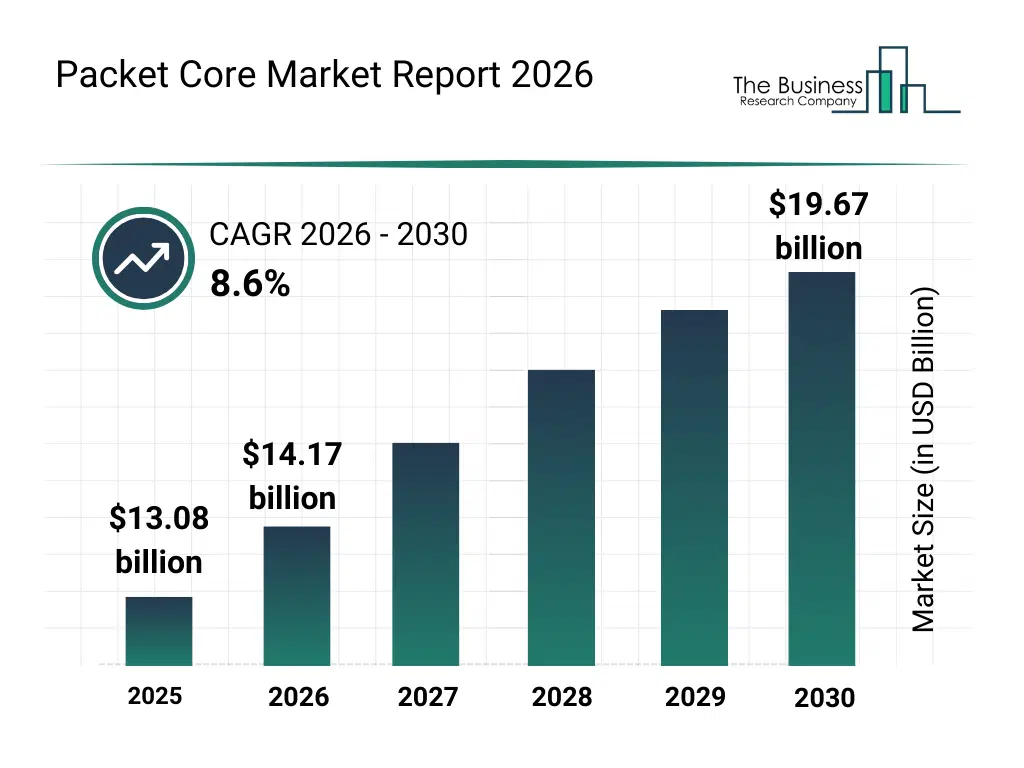
What Is The Packet Core Market Size and Share 2026?
The packet core market size has grown strongly in recent years. It will grow from $13.08 billion in 2025 to $14.17 billion in 2026 at a compound annual growth rate (CAGR) of 8.3%. The growth in the historic period can be attributed to growing adoption of 4g and lte networks, increasing mobile data traffic, expansion of telecom infrastructure, rising demand for high-speed mobile connectivity, and development of core network hardware and software solutions.What Is The Packet Core Market Growth Forecast?
The packet core market size is expected to see strong growth in the next few years. It will grow to $19.67 billion in 2030 at a compound annual growth rate (CAGR) of 8.6%. The growth in the forecast period can be attributed to rapid rollout of 5g networks, increasing virtualization and cloud adoption in telecom, growing demand for iot and m2m connectivity, rising deployment of mobile private networks and mvnos, and increasing adoption of sa and nsa 5g core. Major trends in the forecast period include rising adoption of cloud-native packet core solutions, increasing deployment of virtualized evolved packet core (vepc), growing focus on network function virtualization (nfv) and sdn integration, expansion of 5g standalone (sa) and non-standalone (nsa) core networks, increasing demand for managed core network services.Global Packet Core Market Segmentation
1) By Component: Hardware, Software, Services 2) By Technology: Traditional Packet Core, Virtualized Evolved Packet Core, Cloud Native Packet Core 3) By Deployment: Cloud-Based, On-Premise, Hybrid 4) By Application: Internet Of Things (IoT) And Machine-To-Machine (M2M) Market, Mobile Private Networks (MPN) And Mobile Virtual Network Operator (MVNO), Broadband Wireless Access (BWA), Long-Term Evolution (LTE) Or Voice Over LTE (VoLTE) Or Voice Over Wi-Fi (VoWiFi), 5G Non-Standalone (NSA) Core, 5G Standalone (SA) Core 5) By End User: Telecom Operators, Enterprises And Industrial Verticals, Government And Public Safety, Cloud Service Providers, Mobile Virtual Network Enabler (MVNE) Or Mobile Virtual Network Operators (MVNOs) Subsegments: 1) By Hardware: Core Network Routers, Packet Gateways, Network Switches, Network Servers, Traffic Management Appliances 2) By Software: Core Network Management Software, Subscriber Data Management Software, Network Virtualization Software, Policy Control And Charging Software, Traffic Analysis And Monitoring Software 3) By Services: Managed Core Network Services, Network Integration And Deployment Services, Maintenance And Support Services, Network Optimization Services, Consulting And Professional ServicesWhat Is The Driver Of The Packet Core Market?
The increasing adoption of 5G networks is expected to propel the growth of the packet core market going forward. 5G networks are fifth-generation wireless systems that offer high-speed data, low latency, and reliable connectivity to support advanced applications like the internet of things (IoT), autonomous systems, and immersive media. 5G networks are increasing due to growing demand for faster data speeds, low-latency communication, and enhanced connectivity to support emerging technologies and data-intensive applications. Packet core supports 5G networks by managing data traffic, routing connections, and ensuring seamless communication between devices and applications while enabling network slicing, low latency, and high-speed data transfer. For instance, in December 2024, according to the trade association 5G Americas, a US-based telecommunications industry group, global 5G connections surpassed 2 billion by the third quarter of 2024, representing a 48% year-on-year increase. Therefore, increasing adoption of 5G networks is driving the growth of the packet core industry.Key Players In The Global Packet Core Market
Major companies operating in the packet core market are Samsung Electronics Co. Ltd., Huawei Technologies Co. Ltd., IBM Corporation, Cisco Systems Inc., Intel Corporation, Ericsson AB, NEC Corporation, Nokia Corporation, ZTE Corporation, Tech Mahindra Limited, Mavenir Systems Inc., Parallel Wireless Inc., Casa Systems Inc., Affirmed Networks Inc., Telrad Networks Ltd., Tecore Networks, Druid Software Ltd., IPLOOK Technologies Co. Ltd., Cumucore Oy, and Athonet S.p.A.Global Packet Core Market Trends and Insights
Major companies operating in the packet core market are focusing on developing compact and cloud-native packet core solutions, such as pre-configured lifecycle automation to simplify software upgrades, to enhance reliability, and to support 5G Standalone deployments. Pre-configured lifecycle automation refers to a system capability that allows operators to automatically install, configure, and upgrade core network software with minimal manual intervention, reducing operational complexity and downtime. For instance, in December 2024, Telefonaktiebolaget LM Ericsson, a Sweden-based telecommunications equipment company, launched Compact Packet Core, which integrates control plane functions (MME, SGW-C, PGW-C, AMF, SMF) and user plane functions (UPF, PGW, SGW, TDF) with preset parameters and automation tools. Designed to improve operational simplicity, scalability, and core network performance, the solution allows operators to deploy 5G SA, increase capacity in regional or user plane locations, and manage software upgrades centrally, helping service providers maintain telco-grade reliability while accelerating their cloud-native core transformation.What Are Latest Mergers And Acquisitions In The Packet Core Market?
In March 2025, Telefonaktiebolaget LM Ericsson, a Sweden-based telecommunications company, partnered with Econet Wireless Zimbabwe Limited to support the deployment of 5G Standalone, expand core network capacity, and enable service exposure functionality. Through this partnership, Ericsson and Econet aim to upgrade and modernize Econet’s mobile core network by deploying Ericsson’s 5G Packet Core, enhancing scalability, operational efficiency, and enabling new service and revenue opportunities via application processing interface (API) exposure. Econet Wireless Zimbabwe Limited is a Zimbabwe-based mobile network operator that operates and manages packet core networks to provide 4G and 5G services to its subscribers.Regional Insights
North America was the largest region in the packet core market in 2025. Asia-Pacific is expected to be the fastest-growing region in the forecast period. The regions covered in this market report are Asia-Pacific, South East Asia, Western Europe, Eastern Europe, North America, South America, Middle East, Africa. The countries covered in this market report are Australia, Brazil, China, France, Germany, India, Indonesia, Japan, Taiwan, Russia, South Korea, UK, USA, Canada, Italy, Spain.What Defines the Packet Core Market?
The packet core market consists of revenues earned by entities by providing services such as mobile data management, network traffic routing, subscriber session management, and core network virtualization services. The market value includes the value of related goods sold by the service provider or included within the service offering. The packet core market also includes sales of products, including core network routers, gateways, packet gateways, and network function virtualization (NFV) tools. Values in this market are ‘factory gate’ values, that is, the value of goods sold by the manufacturers or creators of the goods, whether to other entities (including downstream manufacturers, wholesalers, distributors, and retailers) or directly to end customers. The value of goods in this market includes related services sold by the creators of the goods.How is Market Value Defined and Measured?
The market value is defined as the revenues that enterprises gain from the sale of goods and/or services within the specified market and geography through sales, grants, or donations in terms of the currency (in USD unless otherwise specified). The revenues for a specified geography are consumption values that are revenues generated by organizations in the specified geography within the market, irrespective of where they are produced. It does not include revenues from resales along the supply chain, either further along the supply chain or as part of other products.What Key Data and Analysis Are Included in the Packet Core Market Report 2026?
The packet core market research report is one of a series of new reports from The Business Research Company that provides packet core market statistics, including packet core industry global market size, regional shares, competitors with a packet core market share, detailed packet core market segments, market trends and opportunities, and any further data you may need to thrive in the packet core industry. This packet core market research report delivers a complete perspective of everything you need, with an in-depth analysis of the current and future scenario of the industry.Packet Core Market Report Forecast Analysis
| Report Attribute | Details |
|---|---|
| Market Size Value In 2026 | $14.17 billion |
| Revenue Forecast In 2035 | $19.67 billion |
| Growth Rate | CAGR of 8.3% from 2026 to 2035 |
| Base Year For Estimation | 2025 |
| Actual Estimates/Historical Data | 2020-2025 |
| Forecast Period | 2026 - 2030 - 2035 |
| Market Representation | Revenue in USD Billion and CAGR from 2026 to 2035 |
| Segments Covered | Component, Technology, Deployment, Application, End User |
| Regional Scope | Asia-Pacific, Western Europe, Eastern Europe, North America, South America, Middle East, Africa |
| Country Scope | The countries covered in the report are Australia, Brazil, China, France, Germany, India, ... |
| Key Companies Profiled | Samsung Electronics Co. Ltd., Huawei Technologies Co. Ltd., IBM Corporation, Cisco Systems Inc., Intel Corporation, Ericsson AB, NEC Corporation, Nokia Corporation, ZTE Corporation, Tech Mahindra Limited, Mavenir Systems Inc., Parallel Wireless Inc., Casa Systems Inc., Affirmed Networks Inc., Telrad Networks Ltd., Tecore Networks, Druid Software Ltd., IPLOOK Technologies Co. Ltd., Cumucore Oy, and Athonet S.p.A. |
| Customization Scope | Request for Customization |
| Pricing And Purchase Options | Explore Purchase Options |