
Organoids Market 2026
Organoids Market 2026
By Product (Hepatic Organoid, Colorectal Organoid, Intestinal Organoid, Other Organoid), By Source (Pluripotent Stem Cells, Organ-Specific Adult Stem Cells), By Application (Developmental Biology, Disease Pathology Of Infectious Disease, Regenerative Medicine, Drug Toxicity And Efficacy Testing, Drug Discovery And Personalized Medicine, Other Applications), By End-User (Hospitals And Diagnostic Centers, Biotechnology And Pharmaceutical Companies, Other End-Users), And By Region, Opportunities And Strategies – Global Forecast To 2035
Organoids Market Definition
Organoids are three-dimensional (3D) miniaturized and self-organizing tissue structures grown from stem cells that mimic key structural and functional features of real organs. They reproduce complex cellular interactions, architecture and biological behavior, making them more physiologically relevant than traditional 2D cell cultures. The primary purpose of organoids is to provide realistic biological models for disease research, drug discovery, toxicology testing and personalized medicine. The organoids market consists of sales, by entities (organizations, sole traders, or partnerships), of organoids products that are miniaturized and simplified three-dimensional versions of organs produced in vitro. These structures are derived from stem cells or tissue cells and exhibit realistic microanatomy with self-renewal and differentiation capacities.

Organoids Market Size
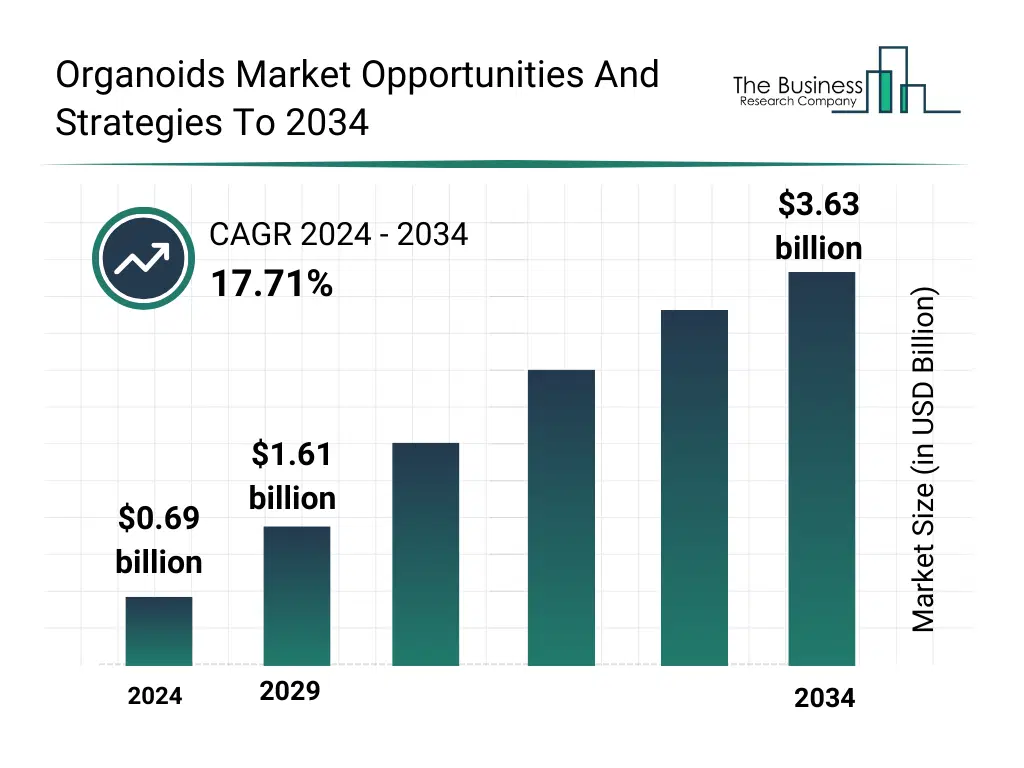
The global organoids market reached a value of nearly $690.06 million in 2024, having grown at a compound annual growth rate (CAGR) of 21.03% since 2019. The market is expected to grow from $690.06 million in 2024 to $1,605.46 million in 2029 at a rate of 18.40%. The market is then expected to grow at a CAGR of 17.71% from 2029 and reach $3,627.43 million in 2034. Growth in the historic period resulted from the growing demand for personalized medicine, rise in investments in pharmaceutical and biotechnology companies, increasing prevalence of infectious diseases and rising demand for tissue engineering and organ transplantation. Factors that negatively affected growth in the historic period were high cost of organoid development and maintenance and limited standardization across organoid models. Going forward, increasing prevalence of chronic diseases, increasing use in modeling and cancer drug screening, rising development of biobanking and patient-derived models and growing demand for drug discovery and development will drive the growth. Factors that could hinder the growth of the organoids market in the future include shortage of skilled healthcare professionals, scalability issues in large-scale production and impact of trade war and tariff.Organoids Market Drivers
The key drivers of the organoids market include: Increasing Prevalence Of Chronic Diseases Increasing prevalence of chronic diseases is expected to be a key driver of the growth of the organoids market in the forecast period. Chronic illnesses such as cardiovascular disorders, liver diseases, metabolic syndromes, and neurodegenerative conditions cannot be accurately studied using conventional 2D (two-dimensional) cell cultures or animal models. Organoids offer a more realistic representation of human tissue architecture and disease progression, enabling deeper insights into mechanisms behind long-term, progressive disorders. As chronic diseases continue to burden populations worldwide, research institutions, pharmaceutical companies, and clinicians will increasingly rely on organoids to design predictive models, assess therapeutic strategies, and identify early biomarkers. This shift toward more precise and efficient disease research will expand the application scope of organoids, leading to sustained market growth. The increasing prevalence of chronic diseases growth contribution during the forecast period in 2024 is 1.82%.Organoids Market Restraints
The key restraints on the organoids market include: Scalability Issues In Large-Scale Production Scalability issues in large-scale production is restricting the growth of the organoids market during the forecast period. Organoid growth is still largely dependent on manual processes and precise biological conditions that are difficult to automate. Producing large batches while maintaining uniform quality, morphology, and functional characteristics is challenging. These constraints limit the ability of companies to supply organoids for high-throughput screening, widespread clinical research, or large-scale therapeutic development. Scalability issues also increase production timelines and costs, making it difficult to transition organoids from the laboratory stage to industrial-level manufacturing. This inability to reliably scale slows adoption in pharmaceutical pipelines and reduces the market’s potential growth. Growth affected by scalability issues in large-scale production across regions during the forecast period in 2024 is -2.00%.Organoids Market Trends
Major trends shaping the organoids market include: Focus On Vascularized And Functionally Mature Organoid Models Companies operating in the organoids market are focusing on vascularized and functionally mature organoid models that better replicate human tissue architecture and physiological responses, enabling advancements in disease modeling, regenerative therapies, and drug testing applications. For instance, in June 2025, Cincinnati Children's Hospital Medical Center, a US-based hospital, engineered a liver organoid capable of forming its own organ-specific blood vessels, marking a significant advancement in tissue engineering. Using a multilayer gel technique, liver sinusoidal progenitor cells were guided to migrate, sprout, and integrate with surrounding liver cells to form functional sinusoid-like vasculature. These vascularized organoids also produced critical coagulation factors, including Factor VIII, and were able to correct bleeding in hemophilia-model mice. The approach helps overcome the long-standing limitation of organoids lacking internal vasculature, and may pave the way for transplantable liver tissue, enhanced disease models, and novel therapies for coagulation disorders. Development Of Scalable, Long-Lasting Functional Organoid Models Leading companies in the organoids market are focusing on developing scalable, long-lasting functional organoid models derived from human cells to advance disease modeling, drug discovery, and regenerative medicine. These efforts aim to overcome key challenges such as organ donor shortages and limited tissue functionality. For example, in April 2025, Keio University School of Medicine, a Japan-based medical institute, developed a long-lasting, functional human liver organoids from frozen hepatocytes. Using the signaling protein oncostatin M, enabled a million-fold proliferation of liver organoids, maintaining functionality for up to six months a breakthrough for disease modeling and regenerative medicine. These organoids produced key liver compounds such as albumin, glucose, and bile acids, and successfully restored liver function in mice with damaged livers. The innovation offers a scalable solution to overcome organ donor shortages, providing powerful new tools for drug testing, genetic disease modeling, and future liver regeneration therapies, marking a transformative step in organoid science.Opportunities And Recommendations In The Organoids Market
Opportunities – The top opportunities in the organoids market segmented by product will arise in the intestinal organoid segment, which will gain $389.90 million of global annual sales by 2029. The top opportunities in the organoids market segmented by source will arise in the pluripotent stem cells segment, which will gain $695.91 million of global annual sales by 2029. The top opportunities in the organoids market segmented by application will arise in the developmental biology segment, which will gain $261.61 million of global annual sales by 2029. The top opportunities in the organoids market segmented by end-user will arise in the other end-users segment, which will gain $436.32 million of global annual sales by 2029. The organoids market size will gain the most in the USA at $317.54 million. Recommendations- To take advantage of the opportunities, The Business Research Company recommends the organoids companies to focus on vascularized and functionally mature organoid development, focus on scalable and durable human-derived organoid platforms, focus on integrated organoid solutions for biotherapeutic research, focus on specialized 3d organoid platforms for advanced life science research, focus on cardiac organoid kits for drug safety testing, focus on intestinal organoids for growth and market leadership, focus on pluripotent stem cells for strategic expansion, expand in emerging markets, continue to focus on developed markets, focus on value-based and tiered pricing for organoid products, focus on targeted scientific outreach and educational campaigns, focus on multi-channel engagement and strategic partnerships, focus on regenerative medicine for accelerated growth, focus on other end-users to capture fastest growth.Organoids Market Segmentation
The organoids market is segmented by product, by source, by application and end user.By Product–
The organoids market is segmented by product into:
- a) Hepatic Organoid
- b) Colorectal Organoid
- b) Intestinal Organoid
- b) Other Organoid
By Source–
The organoids market is segmented by source into:
- a) Pluripotent Stem Cells
- b) Organ-Specific Adult Stem Cells
By Application–
The organoids market is segmented by application into:
- a) Developmental Biology
- b) Disease Pathology Of Infectious Disease
- c) Regenerative Medicine
- c) Drug Toxicity And Efficacy Testing
- c) Drug Discovery And Personalized Medicine
- c) Other Applications
By End-User–
The organoids market is segmented by end-user into:
- a) Hospitals And Diagnostic Centers
- b) Biotechnology And Pharmaceutical Companies
- c) Other End-Users
By Geography - The organoids market is segmented by geography into:
- • China
- • India
- • Japan
- • Australia
- • Indonesia
- • South Korea
- • USA
- • Canada
- • Brazil
- • France
- • Germany
- • UK
- • Italy
- • Spain
- • Russia
-
o Asia Pacific
o Africa