
On-Orbit Refueling Market Report 2026
Global Outlook – By Component (Hardware, Software, Services), By Refueling Technology (Docking Based Refueling Systems, Robotic Refueling Systems, Cryogenic Fluid Transfer Systems, Autonomous Refueling Systems, Standardized Fuel Adapter Systems), By Application (Communication Satellites, Earth Observation Satellites, Military And Defense, Scientific Satellites, Other Applications), By End User (Commercial Satellite Operators, Government Space Agencies, Defense Organizations, Space Infrastructure And Logistics Companies) – Market Size, Trends, Strategies, and Forecast to 2035
On-Orbit Refueling Market Overview
• On-Orbit Refueling market size has reached to $1.11 billion in 2025 • Expected to grow to $2.29 billion in 2030 at a compound annual growth rate (CAGR) of 15.6% • Growth Driver: The Increasing Demand For Satellite Deployment Is Fueling The Market Growth Due To Rising Earth Observation Needs • Market Trend: Advancing Autonomous Docking And In-Space Fuel Transfer Technologies For Sustainable Satellite Servicing • North America was the largest region in 2025 and Asia-Pacific is the fastest growing region.What Is Covered Under On-Orbit Refueling Market?
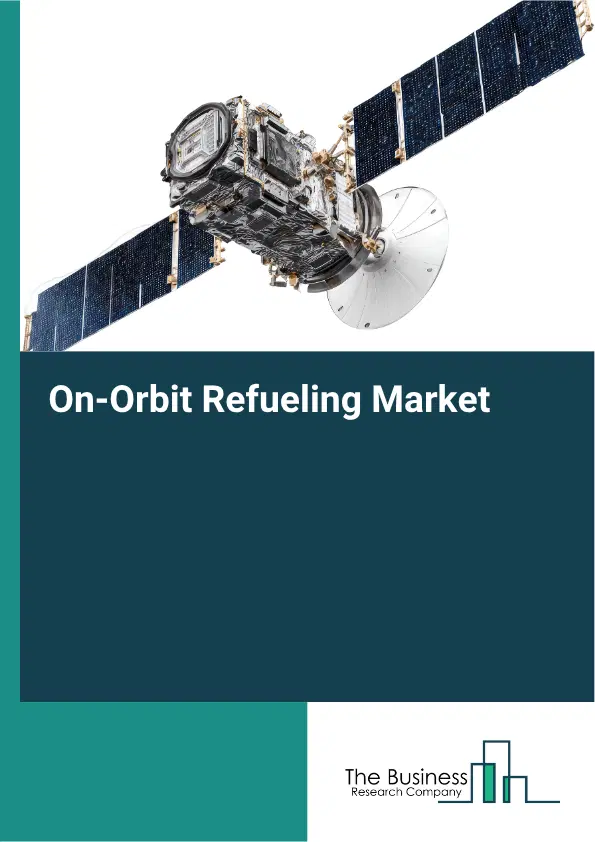
On-orbit refueling refers to the process of transferring propellant between spacecraft while they are already in space, typically in earth orbit. It enables satellites or spacecraft to extend their operational life by replenishing fuel without returning to Earth. This capability improves mission flexibility, reduces launch costs, and supports long-duration space operations such as deep space exploration and satellite servicing. The main components of on-orbit refueling include hardware, software, and services. Hardware refers to physical space systems and equipment used to transfer propellants between spacecraft while maintaining orbital stability and safety. They utilize refueling technologies include docking based refueling systems, robotic refueling systems, cryogenic fluid transfer systems, autonomous refueling systems, and standardized fuel adapter systems. The various applications involved are communication satellites, earth observation satellites, military and defense, scientific satellites, and other applications, and they are used by several end users such as commercial satellite operators, government space agencies, defense organizations, and space infrastructure and logistics companies.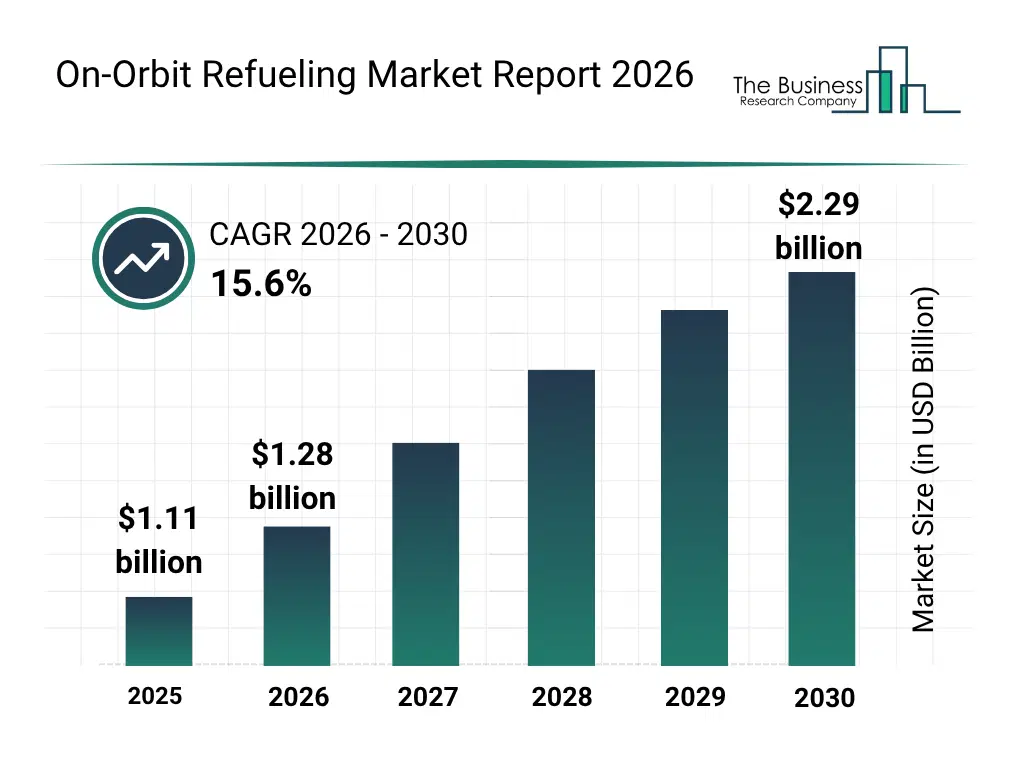
What Is The On-Orbit Refueling Market Size and Share 2026?
The on-orbit refueling market size has grown rapidly in recent years.It will grow from $1.11 billion in 2025 to $1.28 billion in 2026 at a compound annual growth rate (CAGR) of 15.3%. The growth in the historic period can be attributed to increasing satellite launch activities, growth in communication and earth observation satellite deployments, rising dependence on chemical propulsion systems, early development of satellite servicing concepts, expansion of government space exploration programs.What Is The On-Orbit Refueling Market Growth Forecast?
The on-orbit refueling market size is expected to see rapid growth in the next few years.It will grow to $2.29 billion by 2030 at a compound annual growth rate (CAGR) of 15.6%. The growth in the forecast period can be attributed to rising demand for long-duration satellite missions, increasing adoption of reusable spacecraft systems, growing investment in deep space exploration missions, expansion of commercial satellite servicing industry, increasing focus on cost-efficient orbital operations and mission sustainability.Major trends in the forecast period include increasing development of autonomous robotic spacecraft docking systems for on-orbit refueling operations, growing adoption of ai-based orbital mission planning and fuel optimization algorithms, rising deployment of standardized refueling interfaces to enable interoperability between satellites, expansion of reusable spacecraft architectures to support multiple refueling cycles, increasing integration of digital twin technology for in-orbit fuel transfer simulation and mission risk assessment.
Global On-Orbit Refueling Market Segmentation
1) By Component: Hardware, Software, Services 2) By Refueling Technology: Docking Based Refueling Systems, Robotic Refueling Systems, Cryogenic Fluid Transfer Systems, Autonomous Refueling Systems, Standardized Fuel Adapter Systems 3) By Application: Communication Satellites, Earth Observation Satellites, Military And Defense, Scientific Satellites, Other Applications 4) By End User: Commercial Satellite Operators, Government Space Agencies, Defense Organizations, Space Infrastructure And Logistics Companies Subsegments: 1) By Hardware: Refueling Interfaces, Fluid Transfer Systems, Propellant Storage Tanks, Docking And Capture Mechanisms 2) By Software: Mission Planning Software, Autonomous Docking Software, Fuel Transfer Control Software, Telemetry And Monitoring Software 3) By Services: On Orbit Refueling Operations Services, Mission Integration Services, Maintenance And Support Services, Training And Simulation ServicesWhat Is The Driver Of The On-Orbit Refueling Market?
The increasing demand for satellite deployment is expected to propel the growth of the on-orbit refueling industry going forward.Satellite deployment refers to the process of placing a satellite into its designated orbit in space using a launch vehicle or deployment mechanism.The increasing demand for satellite deployment is primarily due to the rising need for earth observation, which supports applications such as climate monitoring, disaster management, agricultural planning, and urban development through real-time data and high-resolution imagery.On-orbit refueling enhances satellite deployment capabilities by enabling satellites and spacecraft to replenish propellant in space, thereby extending mission duration, increasing operational flexibility, reducing launch mass constraints, and supporting the deployment of larger and more complex satellite constellations.For instance, in January 2024, according to the Space Foundation, a US-based nonprofit space advocacy organization, more than 2,800 satellites were deployed into orbit in 2023, representing a 23% increase compared to 2022.Therefore, the increasing demand for satellite deployment is driving the growth of on-orbit refueling industry.Key Players In The Global On-Orbit Refueling Market
Major companies operating in the on-orbit refueling market are Airbus Defence and Space GmbH, Northrop Grumman Corporation, Space Exploration Technologies Corp., Blue Origin Enterprises L. P., Thales Alenia Space S. A., MDA Space Ltd., Sierra Space Corporation, Redwire Corporation, Firefly Aerospace Inc., Astroscale Holdings Inc., Impulse Space Inc., D-Orbit S. p. A., Dawn Aerospace Limited, Bellatrix Aerospace Private Limited, ClearSpace SA, Starfish Space Inc., Orbit Fab Inc., Infinite Orbits SAS, Portal Space Systems Inc., TransAstra Corporation, Eta Space LLC, OrbitAID Aerospace Private LimitedGlobal On-Orbit Refueling Market Trends and Insights
Major companies operating in the on-orbit refueling market are focusing on developing technologically advanced solutions, such as autonomous satellite docking and propellant transfer systems, to extend spacecraft lifespan, reduce mission costs, and enable sustainable in-space servicing operations. Autonomous satellite docking and propellant transfer systems are space technologies that enable satellites to automatically navigate, connect with each other in orbit, and safely transfer fuel without human intervention. For instance, in January 2026, Orbitaid Aerospace Private Limited, an India-based space technology company, launched AayulSAT, a technology demonstration mini tanker satellite to test on-orbit refueling and autonomous docking capabilities using the company’s proprietary standard interface for docking and refueling port (SIDRP). The platform is engineered to facilitate propellant, power, and data transfer in microgravity environments and incorporates dual-docking redundancy to improve spacecraft coupling safety and reliability. This platform also supports bubble-free fuel transfer experiments, autonomous proximity maneuvers, and in-orbit satellite servicing validation, contributing to the advancement of orbital fuel station infrastructure and commercial space logistics networks. The mission further aims to validate fuel transfer across different orbital conditions and create a scalable framework for future chaser-and-tanker satellite operations, helping extend satellite lifespan and reduce reliance on replacement satellite launches.What Are Latest Mergers And Acquisitions In The On-Orbit Refueling Market?
In January 2024, Orbit Fab Inc., a US-based satellite refueling services company, partnered with ClearSpace to develop an in-space refueling service for satellites and spacecraft. This partnership aims to advance on-orbit refueling capabilities by combining Orbit Fab’s fuel depot and refueling infrastructure with ClearSpace’s autonomous rendezvous, docking, and in-orbit servicing technologies to extend satellite operational life and support sustainable space operations. ClearSpace SA is a Switzerland-based space technology company specializing in active debris removal and in-orbit servicing solutions.Regional Insights
North America was the largest region in the on-orbit refueling market in 2025. Asia-Pacific is expected to be the fastest-growing region in the forecast period. The regions covered in this market report are Asia-Pacific, South East Asia, Western Europe, Eastern Europe, North America, South America, Middle East and Africa. The countries covered in this market report are Australia, Brazil, China, France, Germany, India, Indonesia, Japan, Taiwan, Russia, South Korea, UK, USA, Canada, Italy, Spain.What Defines the On-Orbit Refueling Market?
The on-orbit refueling market consists of revenues earned by entities by providing services such as on-orbit fuel transfer services, satellite refueling services, mission planning and integration services, autonomous docking support services, propellant storage and management services, spacecraft servicing, and in-space logistics consulting services. The market value includes the value of related goods sold by the service provider or included within the service offering. The on-orbit refueling market also includes sales of propellant transfer systems, docking and berthing systems, cryogenic fluid management systems, and standardized fuel adapters. Values in this market are ‘factory gate’ values, that is, the value of goods sold by the manufacturers or creators of the goods, whether to other entities (including downstream manufacturers, wholesalers, distributors, and retailers) or directly to end customers. The value of goods in this market includes related services sold by the creators of the goods.What is the Market Assessment and Strategic Outlook for the On-Orbit Refueling Industry?
The on-orbit refueling market research report is one of a series of new reports from The Business Research Company that provides market statistics, including industry global market size, regional shares, competitors with the market share, detailed market segments, market trends and opportunities, and any further data you may need to thrive in the on-orbit refueling industry. The market research report delivers a complete perspective of everything you need, with an in-depth analysis of the current and future state of the industry.What is the Market Assessment and Strategic Outlook for the On-Orbit Refueling Market Report 2026?
The on-orbit refueling market research report is one of a series of new reports from The Business Research Company that provides on-orbit refueling market statistics, including on-orbit refueling industry global market size, regional shares, competitors with a on-orbit refueling market share, detailed on-orbit refueling market segments, market trends and opportunities, and any further data you may need to thrive in the on-orbit refueling industry. This on-orbit refueling market research report delivers a complete perspective of everything you need, with an in-depth analysis of the current and future scenario of the industry.On-Orbit Refueling Market Report Forecast Analysis
| Report Attribute | Details |
|---|---|
| Market Size Value In 2026 | $1.28 billion |
| Revenue Forecast In 2035 | $2.29 billion |
| Growth Rate | CAGR of 15.6% from 2026 to 2035 |
| Base Year For Estimation | 2025 |
| Actual Estimates/Historical Data | 2020-2025 |
| Forecast Period | 2026 - 2030 - 2035 |
| Market Representation | Revenue in USD Billion and CAGR from 2026 to 2035 |
| Segments Covered | Component, Refueling Technology, Application, End User |
| Regional Scope | Asia-Pacific, Western Europe, Eastern Europe, North America, South America, Middle East, Africa |
| Country Scope | The countries covered in the report are Australia, Brazil, China, France, Germany, India, Indonesia, Japan, Taiwan, Russia, South Korea, UK, USA, Canada, Italy, Spain. |
| Key Companies Profiled | Airbus Defence and Space GmbH, Northrop Grumman Corporation, Space Exploration Technologies Corp., Blue Origin Enterprises L. P., Thales Alenia Space S. A., MDA Space Ltd., Sierra Space Corporation, Redwire Corporation, Firefly Aerospace Inc., Astroscale Holdings Inc., Impulse Space Inc., D-Orbit S. p. A., Dawn Aerospace Limited, Bellatrix Aerospace Private Limited, ClearSpace SA, Starfish Space Inc., Orbit Fab Inc., Infinite Orbits SAS, Portal Space Systems Inc., TransAstra Corporation, Eta Space LLC, OrbitAID Aerospace Private Limited |
| Customization Scope | Request for Customization |
| Pricing And Purchase Options | Explore Purchase Options |