
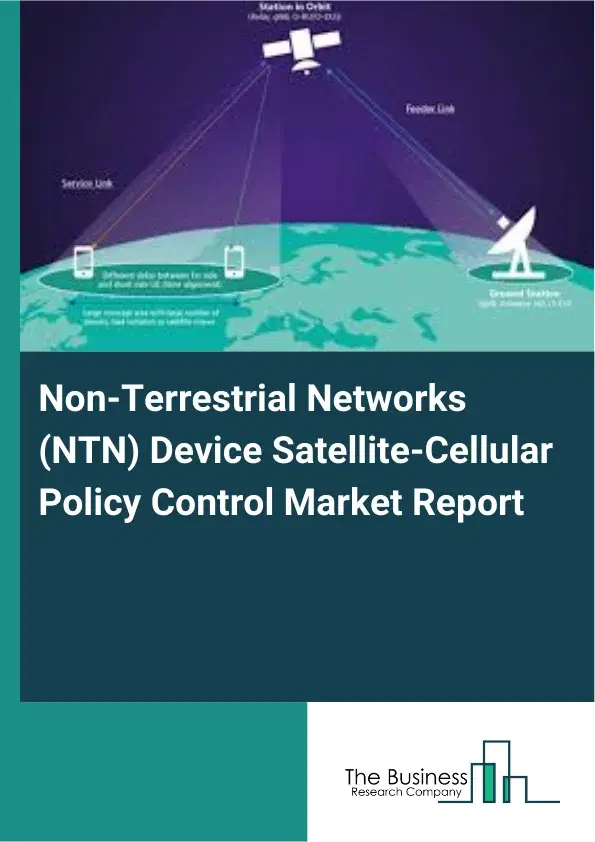
Non-Terrestrial Networks (NTN) Device Satellite-Cellular Policy Control Market Report 2026
Global Outlook – By Component (Hardware, Software, Services), By Device Type (Smartphones, Internet Of Things (IOT) Devices, Wearables, Other Device Types), By Connectivity (Satellite, Cellular, Hybrid), By Application (Telecommunications, Automotive, Industrial, Consumer Electronics, Defense, Other Applications), By End-Users (Enterprises, Government, Consumers, Other End Users) – Market Size, Trends, Strategies, and Forecast to 2035
Non-Terrestrial Networks (NTN) Device Satellite-Cellular Policy Control Market Overview
• Non-Terrestrial Networks (NTN) Device Satellite-Cellular Policy Control market size has reached to $2.35 billion in 2025 • Expected to grow to $5.49 billion in 2030 at a compound annual growth rate (CAGR) of 18.6% • Growth Driver: Rising Global Data Traffic Driving The Growth Of The Market Due To Increasing Internet Usage And Connectivity Demands • Market Trend: Technology Advancements in Satellite-Cellular Network Integration Trend in the Non-Terrestrial Networks (NTN) Device Satellite-Cellular Policy Control • North America was the largest region in 2025 and Asia-Pacific is the fastest growing region.What Is Covered Under Non-Terrestrial Networks (NTN) Device Satellite-Cellular Policy Control Market?
Non-terrestrial networks (NTN) device satellite-cellular policy control is a technology framework that manages how devices dynamically select, prioritize, and switch between satellite and terrestrial cellular networks. It defines policies for access control, roaming, traffic prioritization, latency management, and service continuity between satellite and cellular links. It helps to ensure seamless, secure, and efficient connectivity by optimizing network usage, service quality, and continuity across hybrid satellite-cellular environments. The main types of non-terrestrial networks device satellite-cellular policy control include hardware, software, and services. Hardware refers to the physical devices and network equipment that enable communication between user terminals and terrestrial or space-based networks. These solutions support smartphones, Internet of Things devices, wearables, and other device categories, operating through satellite, cellular, or hybrid connectivity models. They are applied across telecommunications, automotive systems, industrial operations, consumer electronics, defense, and other applications. They are used by several end users such as enterprises, government organizations, consumers, and other end users.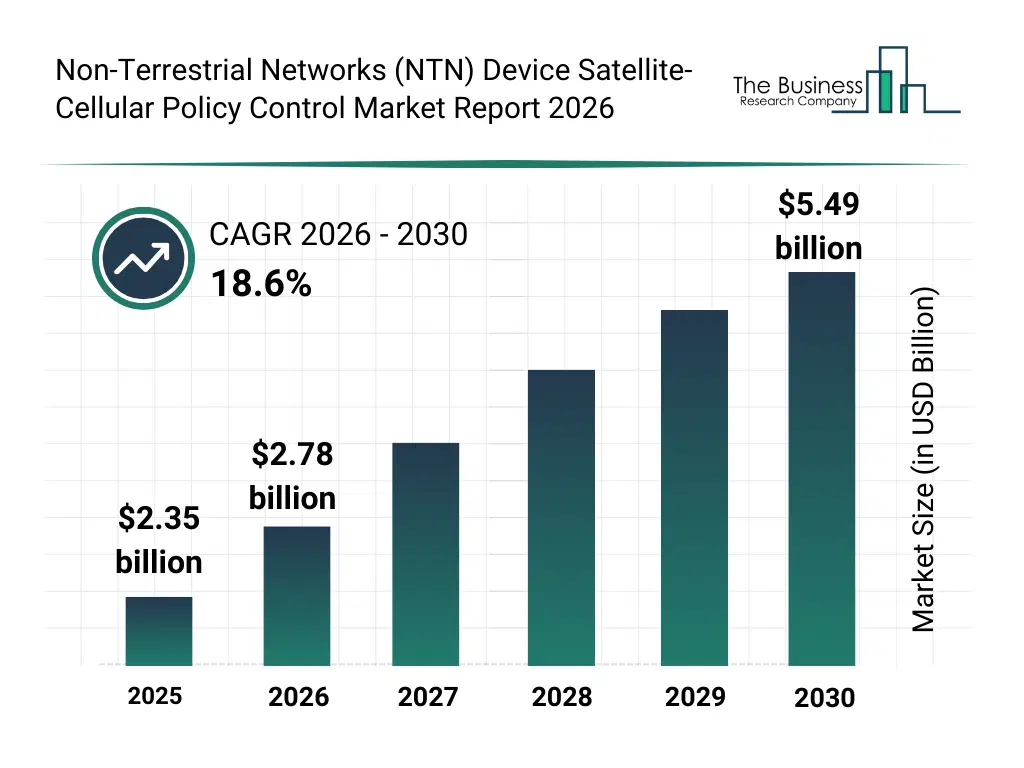
What Is The Non-Terrestrial Networks (NTN) Device Satellite-Cellular Policy Control Market Size and Share 2026?
The non-terrestrial networks (ntn) device satellite-cellular policy control market size has grown rapidly in recent years. It will grow from $2.35 billion in 2025 to $2.78 billion in 2026 at a compound annual growth rate (CAGR) of 18.4%. The growth in the historic period can be attributed to growth in satellite communication deployments, expansion of cellular coverage in remote areas, rise in connected iot devices, demand for uninterrupted roaming services, defense and maritime reliance on hybrid connectivity.What Is The Non-Terrestrial Networks (NTN) Device Satellite-Cellular Policy Control Market Growth Forecast?
The non-terrestrial networks (ntn) device satellite-cellular policy control market size is expected to see rapid growth in the next few years. It will grow to $5.49 billion in 2030 at a compound annual growth rate (CAGR) of 18.6%. The growth in the forecast period can be attributed to proliferation of direct-to-device satellite services, increasing adoption of autonomous vehicles and drones, growth of private 5g and ntn integration, rising demand for resilient disaster recovery networks, advancements in multi-orbit satellite constellations. Major trends in the forecast period include dynamic satellite-cellular network switching policies, edge-based policy control for low latency ntn connectivity, standardization of ntn policy frameworks under 3gpp releases, secure cross-network authentication and access governance, device-level traffic prioritization for mission-critical applications.
Global Non-Terrestrial Networks (NTN) Device Satellite-Cellular Policy Control Market Segmentation
1) By Component: Hardware, Software, Services 2) By Device Type: Smartphones, Internet Of Things (IOT) Devices, Wearables, Other Device Types 3) By Connectivity: Satellite, Cellular, Hybrid 4) By Application: Telecommunications, Automotive, Industrial, Consumer Electronics, Defense, Other Applications 5) By End-Users: Enterprises, Government, Consumers, Other End Users Subsegments: 1) By Hardware: Satellite Communication Modules, Cellular Communication Modules, Radio Frequency Front End, Device Control Modules 2) By Software: Device Configuration Software, Traffic Routing Software, Service Orchestration Software, Network Analytics Software 3) By Services: System Design And Planning Services, Remote Monitoring Services, Policy Optimization Services, Training And Enablement ServicesWhat Is The Driver Of The Non-Terrestrial Networks (NTN) Device Satellite-Cellular Policy Control Market?
The increasing volume of data traffic is expected to propel the growth of the non-terrestrial networks (NTN) device satellite-cellular policy control market going forward. Data traffic volumes refers to the amount of data transmitted over a network within a certain period, and it is a measure of how much information is being sent or received. The rise of data traffic volumes is due to people using the internet more for online activities which all send and receive large amounts of data. Non-terrestrial networks (NTN) device satellite-cellular policy control supports data traffic by intelligently managing network selection, prioritizing services, and enforcing quality of service across both satellite and terrestrial connections. For instance, in December 2024, according to the International Telecommunications Union (ITU), a Switzerland-based organization, in 2023, global mobile broadband traffic surpassed 1 zettabyte (ZB) for the first time in terms of end-user internet usage and reached nearly 1.3 ZB in 2024. Meanwhile, fixed broadband traffic rose about 6 ZB in 2024, up from 5.1 ZB in the previous year. Therefore, the increasing demand for data traffic volumes is driving the growth of non-terrestrial networks (NTN) device satellite-cellular policy control industry.Key Players In The Global Non-Terrestrial Networks (NTN) Device Satellite-Cellular Policy Control Market
Major companies operating in the non-terrestrial networks (ntn) device satellite-cellular policy control market are Huawei Technologies Co. Ltd., Lockheed Martin Corporation, Cisco Systems Inc., Hewlett Packard Enterprise Company, Thales Group, Telefonaktiebolaget LM Ericsson, Nokia Corporation, ZTE Corporation, EchoStar Corporation, Viasat Inc., Mavenir Systems Inc., Iridium Communications Inc., Microsoft Corporation, NEC Corporation, Eutelsat Group, Celona Inc., Druid Software Ltd., Global Connectivity Xchange (GXC), IPLOOK Technologies Co. Ltd., Summa NetworksGlobal Non-Terrestrial Networks (NTN) Device Satellite-Cellular Policy Control Market Trends and Insights
Major companies operating in the non-terrestrial networks (NTN) device satellite-cellular policy control market are focusing on developing innovative solutions, such as 5G-Advanced NTN connectivity platforms and integrated satellite-cellular policy orchestration tools, to meet the rising demand for ubiquitous, seamless connectivity that enables devices to switch intelligently between terrestrial cellular networks. 5G-Advanced NTN connectivity refers to the integration of 5G-Advanced networks with non-terrestrial networks to provide seamless, wide-area, and reliable wireless coverage beyond traditional terrestrial infrastructure. For instance, in November 2025, the European Space Agency (ESA), a France-based government organization, together with MediaTek Inc., a Taiwan-based semiconductor manufacturing company, Eutelsat Group, a France-based satellite company, Airbus Defence and Space, Sharp, the Industrial Technology Research Institute (ITRI), and Rohde & Schwarz (R&S) announced the world’s first Rel-19 5G-Advanced NR-NTN connection trial over Eutelsat’s OneWeb low Earth orbit (LEO) satellites. This demonstrates integrated satellite-cellular network interoperability with 3GPP Rel-19 standard support with broader hybrid connectivity that enables devices to maintain service via satellite or terrestrial networks while policy control systems manage seamless transitions and optimize performance, a notable advancement over earlier NTN trials focused solely on basic connectivity.What Are Latest Mergers And Acquisitions In The Non-Terrestrial Networks (NTN) Device Satellite-Cellular Policy Control Market?
In May 2023, Viasat Inc., a US-based communications company providing satellite broadband, mobile connectivity, network services, and integrated communications solutions acquired Inmarsat for an undisclosed amount. With this acquisition, Viasat aimed to expand its network capacity, accelerate innovation in satellite connectivity, and deliver improved speed, flexibility, coverage, and security across fixed and mobile satellite services worldwide. Inmarsat is a UK-based company that offers non-terrestrial networks.Regional Outlook
North America was the largest region in the non-terrestrial networks (NTN) device satellite-cellular policy control market in 2025. Asia-Pacific is expected to be the fastest-growing region in the forecast period. The regions covered in this market report are Asia-Pacific, South East Asia, Western Europe, Eastern Europe, North America, South America, Middle East, Africa. The countries covered in this market report are Australia, Brazil, China, France, Germany, India, Indonesia, Japan, Taiwan, Russia, South Korea, UK, USA, Canada, Italy, Spain.What Defines the Non-Terrestrial Networks (NTN) Device Satellite-Cellular Policy Control Market?
The non-terrestrial networks (NTN) device satellite-cellular policy control market consists of revenues earned by entities by providing services such as network policy management, dynamic network selection and handover control, traffic prioritization and quality-of-service management, device connectivity orchestration, and security and authentication management. The market value includes the value of related goods sold by the service provider or included within the service offering. The non-terrestrial networks (NTN) device satellite-cellular policy control market also includes sales of policy control software platforms, network orchestration tools, device management systems, analytics and monitoring solutions, and security enforcement modules. Values in this market are ‘factory gate’ values, that is, the value of goods sold by the manufacturers or creators of the goods, whether to other entities (including downstream manufacturers, wholesalers, distributors, and retailers) or directly to end customers. The value of goods in this market includes related services sold by the creators of the goods.How is Market Value Defined and Measured?
The market value is defined as the revenues that enterprises gain from the sale of goods and/or services within the specified market and geography through sales, grants, or donations in terms of the currency (in USD unless otherwise specified). The revenues for a specified geography are consumption values that are revenues generated by organizations in the specified geography within the market, irrespective of where they are produced. It does not include revenues from resales along the supply chain, either further along the supply chain or as part of other products.What Key Data and Analysis Are Included in the Non-Terrestrial Networks (NTN) Device Satellite-Cellular Policy Control Market Report 2026?
The non-terrestrial networks (ntn) device satellite-cellular policy control market research report is one of a series of new reports from The Business Research Company that provides market statistics, including industry global market size, regional shares, competitors with the market share, detailed market segments, market trends and opportunities, and any further data you may need to thrive in the non-terrestrial networks (ntn) device satellite-cellular policy control industry. The market research report delivers a complete perspective of everything you need, with an in-depth analysis of the current and future state of the industry.Non-Terrestrial Networks (NTN) Device Satellite-Cellular Policy Control Market Report Forecast Analysis
| Report Attribute | Details |
|---|---|
| Market Size Value In 2026 | $2.78 billion |
| Revenue Forecast In 2035 | $5.49 billion |
| Growth Rate | CAGR of 18.4% from 2026 to 2035 |
| Base Year For Estimation | 2025 |
| Actual Estimates/Historical Data | 2020-2025 |
| Forecast Period | 2026 - 2030 - 2035 |
| Market Representation | Revenue in USD Billion and CAGR from 2026 to 2035 |
| Segments Covered | Component, Device Type, Connectivity, Application, End-Users |
| Regional Scope | Asia-Pacific, Western Europe, Eastern Europe, North America, South America, Middle East, Africa |
| Country Scope | The countries covered in the report are Australia, Brazil, China, France, Germany, India, ... |
| Key Companies Profiled | Huawei Technologies Co. Ltd., Lockheed Martin Corporation, Cisco Systems Inc., Hewlett Packard Enterprise Company, Thales Group, Telefonaktiebolaget LM Ericsson, Nokia Corporation, ZTE Corporation, EchoStar Corporation, Viasat Inc., Mavenir Systems Inc., Iridium Communications Inc., Microsoft Corporation, NEC Corporation, Eutelsat Group, Celona Inc., Druid Software Ltd., Global Connectivity Xchange (GXC), IPLOOK Technologies Co. Ltd., Summa Networks |
| Customization Scope | Request for Customization |
| Pricing And Purchase Options | Explore Purchase Options |