
Next Generation Computing Market Report 2026
Global Outlook – By Type (High Performance Computing, Quantum Computing, Brain Type Computing, Approximate And Probabilistic Computing, Energy Efficiency Computing, Thermodynamic Computing, Memory Based Computing, Optical Computing, Edge Computing, Other Types), By Component (Hardware, Software, Solution), By Deployment (Cloud, On-Premise), By Enterprise Size (Small And Medium-Sized Enterprises (SMEs), Large Enterprises), By End-Use Industry (Banking, Financial Services And Insurance (BFSI), Energy And Power, Transportation And Logistics, Chemicals, Academic, Government, Information Technology (IT) And Telecommunications, Healthcare, Space And Defense, Manufacturing) – Market Size, Trends, Strategies, and Forecast to 2035
Next Generation Computing Market Overview
• Next Generation Computing market size has reached to $325.84 billion in 2025 • Expected to grow to $811.85 billion in 2030 at a compound annual growth rate (CAGR) of 20.3% • Growth Driver: The Adoption of Artificial Intelligence Fueling the Growth of the Next-Generation Computing Market Due to Rising Demand for Advanced Data Processing Capabilities • Market Trend: Innovative Integrated Hybrid Technologies Revolutionize Next-Generation Computing • North America was the largest region in 2025 and Asia-Pacific is the fastest growing region.What Is Covered Under Next Generation Computing Market?
Next-generation computing refers to developing hardware and software that can address the challenges of data processing, transfer rates, and energy efficiency. It is used for various applications across various domains and industries due to its advanced capabilities and potential to solve complex problems. The main types of next-generation computing are high-performance computing, quantum computing, brain-type computing, approximate and probabilistic computing, energy efficiency computing, thermodynamic computing, memory-based computing, optical computing, edge computing and others. High-performance computing (HPC) refers to the use of advanced computer systems to perform complex calculations. They used hardware, software, and solutions, which include cloud and on-premises deployments, and they used them in small and medium-sized enterprises (SMEs) and large enterprises. The main end users are banking, financial services and insurance (BFSI), energy and power, transportation and logistics, chemicals, academics, government, information technology and telecommunications, healthcare, space and defence and manufacturing.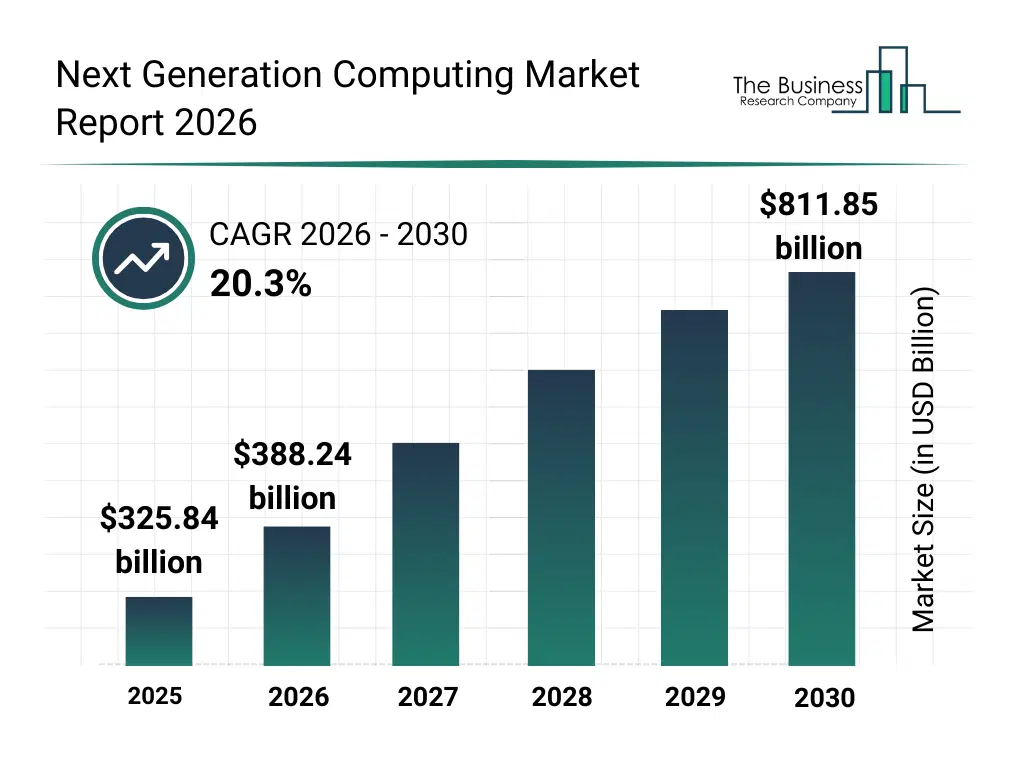
What Is The Next Generation Computing Market Size and Share 2026?
The next generation computing market size has grown rapidly in recent years. It will grow from $325.84 billion in 2025 to $388.24 billion in 2026 at a compound annual growth rate (CAGR) of 19.2%. The growth in the historic period can be attributed to evolution of high-performance computing, advances in semiconductor technology, demand for faster data processing, growth of cloud computing, rise in computational research.What Is The Next Generation Computing Market Growth Forecast?
The next generation computing market size is expected to see exponential growth in the next few years. It will grow to $811.85 billion in 2030 at a compound annual growth rate (CAGR) of 20.3%. The growth in the forecast period can be attributed to development of quantum computing systems, expansion of edge computing devices, adoption in healthcare and BFSI sectors, advancement in energy-efficient processors, growth in ai-driven computing applications. Major trends in the forecast period include high-performance computing solutions, quantum computing integration, energy-efficient processing, advanced data processing techniques, edge computing deployment.
Global Next Generation Computing Market Segmentation
1) By Type: High Performance Computing, Quantum Computing, Brain Type Computing, Approximate And Probabilistic Computing, Energy Efficiency Computing, Thermodynamic Computing, Memory Based Computing, Optical Computing, Edge Computing, Other Types 2) By Component: Hardware, Software, Solution 3) By Deployment: Cloud, On-Premise 4) By Enterprise Size: Small And Medium-Sized Enterprises (SMEs), Large Enterprises 5) By End-Use Industry: Banking, Financial Services And Insurance (BFSI), Energy And Power, Transportation And Logistics, Chemicals, Academic, Government, Information Technology (IT) And Telecommunications, Healthcare, Space And Defense, Manufacturing Subsegments: 1) By High Performance Computing: Supercomputers, Distributed Computing Systems 2) By Quantum Computing: Quantum Annealers, Gate Model Quantum Computers 3) By Brain Type Computing: Neuromorphic Computing, Spiking Neural Networks 4) By Approximate And Probabilistic Computing: Stochastic Computing, Probabilistic Programming 5) By Energy Efficiency Computing: Low-Power Processors, Green Computing Solutions 6) By Thermodynamic Computing: Thermal Management Systems, Thermodynamic Models 7) By Memory Based Computing: In-Memory Computing, Memristor Technology 8) By Optical Computing: Photonic Processors, Optical Interconnects 9) By Edge Computing: Edge Devices, Edge Analytics 10) By Other Types: Hybrid Computing, Reversible ComputingWhat Is The Driver Of The Next Generation Computing Market?
The expansion in the adoption of artificial intelligence is expected to propel the growth of the next-generation computing market going forward. Artificial intelligence is the capability of machines to perform tasks that typically require human intelligence, such as learning, reasoning, and decision-making. The growing use of AI, especially machine learning and deep learning, demands substantial computational power is growing due to the development of next-gen technologies like quantum and neuromorphic computing to perform complex AI tasks more efficiently and quickly than traditional computing methods. Next-generation computing enhances artificial intelligence by providing the advanced processing power, speed, and efficiency required to train complex models, analyse massive datasets in real time, and enable smarter, more adaptive AI systems across diverse applications. For instance, in March 2025, according to the Office for National Statistics, a UK-based government department, in 2023, 9 % of firms adopted artificial intelligence (AI), up from previous years and projected to reach 22 % in 2024. Therefore, the adoption of artificial intelligence is driving the growth of the next-generation computing market.Key Players In The Global Next Generation Computing Market
Major companies operating in the next generation computing market are Amazon Web Services Inc.; Alphabet Inc.; Google LLC; Microsoft Corporation; Alibaba Group Holding Limited; Dell Inc.; Lenovo Group Ltd.; Intel Corp.; International Business Machines Corporation; Cisco Systems Inc.; Oracle Corporation; Broadcom Inc.; SAP SE; Micron Technology Inc.; Hewlett Packard Enterprise Development LP; NVIDIA Corp.; NEC Corporation; Advanced Micro Device Inc.; Infosys Limited; VMware Inc.; Atos SE; Equinix Inc.; NetApp Inc.; Juniper Networks Inc.; Citrix Systems Inc.; Splunk Inc.; Pure Storage Inc.; Nutanix Inc.Global Next Generation Computing Market Trends and Insights
Major companies operating in the next-generation computing market are developing innovative technologies, such as integrated hybrids, to address the increasing demand for more powerful, energy-efficient, and versatile computing solutions. Integrated Hybrid is a feature of Azure Quantum that allows researchers to combine classical and quantum computing resources seamlessly. For instance, in March 2023, Microsoft Corporation, a US-based technology corporation, launched the next generation of hybrid quantum computing called Integrated Hybrid. This innovative technology includes a feature of Azure Quantum that allows researchers to combine classical and quantum computing resources seamlessly. This makes it easy to develop and deploy hybrid quantum computing applications. This interface abstracts away the underlying complexity of the different hardware platforms, making it easy for researchers to focus on developing their applications.What Are Latest Mergers And Acquisitions In The Next Generation Computing Market?
In August 2023, Sidus Space Inc., a US-based engineering services company specialising in space-based missions and exploration solutions, acquired Exo-Space Inc. for an undisclosed amount. With this acquisition, Sidus aims to enter the expanding AI sector and broaden its portfolio within the earth and space observation services sector. Exo-Space Inc. is a US-based edge AI computing service company.Regional Insights
North America was the largest region in the next generation computing market in 2025. Asia-Pacific is expected to be the fastest-growing region in the forecast period. The regions covered in this market report are Asia-Pacific, South East Asia, Western Europe, Eastern Europe, North America, South America, Middle East, Africa. The countries covered in this market report are Australia, Brazil, China, France, Germany, India, Indonesia, Japan, Taiwan, Russia, South Korea, UK, USA, Canada, Italy, SpainWhat Defines the Next Generation Computing Market?
The next-generation computing market consists of revenues earned by entities by providing services such as cybersecurity services, consulting services, cloud services, software development, prototyping services, and big data services. The market value includes the value of related goods sold by the service provider or included within the service offering. The next-generation computing market also includes sales of AI accelerators, supercomputers, next-generation processors, qubit systems, neuromorphic systems, edge servers, and hardware accelerators. Values in this market are ‘factory gate’ values, that is the value of goods sold by the manufacturers or creators of the goods, whether to other entities (including downstream manufacturers, wholesalers, distributors and retailers) or directly to end customers. The value of goods in this market includes related services sold by the creators of the goods.How is Market Value Defined and Measured?
The market value is defined as the revenues that enterprises gain from the sale of goods and/or services within the specified market and geography through sales, grants, or donations in terms of the currency (in USD unless otherwise specified). The revenues for a specified geography are consumption values that are revenues generated by organizations in the specified geography within the market, irrespective of where they are produced. It does not include revenues from resales along the supply chain, either further along the supply chain or as part of other products.What Key Data and Analysis Are Included in the Next Generation Computing Market Report 2026?
The next generation computing market research report is one of a series of new reports from The Business Research Company that provides market statistics, including industry global market size, regional shares, competitors with the market share, detailed market segments, market trends and opportunities, and any further data you may need to thrive in the next generation computing industry. The market research report delivers a complete perspective of everything you need, with an in-depth analysis of the current and future state of the industry.Next Generation Computing Market Report Forecast Analysis
| Report Attribute | Details |
|---|---|
| Market Size Value In 2026 | $388.24 billion |
| Revenue Forecast In 2035 | $811.85 billion |
| Growth Rate | CAGR of 19.2% from 2026 to 2035 |
| Base Year For Estimation | 2025 |
| Actual Estimates/Historical Data | 2020-2025 |
| Forecast Period | 2026 - 2030 - 2035 |
| Market Representation | Revenue in USD Billion and CAGR from 2026 to 2035 |
| Segments Covered | Type, Component, Deployment, Enterprise Size, End-Use Industry |
| Regional Scope | Asia-Pacific, Western Europe, Eastern Europe, North America, South America, Middle East, Africa |
| Country Scope | The countries covered in the report are Australia, Brazil, China, France, Germany, India, ... |
| Key Companies Profiled | Amazon Web Services Inc.; Alphabet Inc.; Google LLC; Microsoft Corporation; Alibaba Group Holding Limited; Dell Inc.; Lenovo Group Ltd.; Intel Corp.; International Business Machines Corporation; Cisco Systems Inc.; Oracle Corporation; Broadcom Inc.; SAP SE; Micron Technology Inc.; Hewlett Packard Enterprise Development LP; NVIDIA Corp.; NEC Corporation; Advanced Micro Device Inc.; Infosys Limited; VMware Inc.; Atos SE; Equinix Inc.; NetApp Inc.; Juniper Networks Inc.; Citrix Systems Inc.; Splunk Inc.; Pure Storage Inc.; Nutanix Inc. |
| Customization Scope | Request for Customization |
| Pricing And Purchase Options | Explore Purchase Options |