
Network Infrastructure Market Report 2026

Network Infrastructure Market Report 2026
Global Outlook – By Type (Hardware, Software, Services), By Infrastructure Category (Access Network Infrastructure, Core Network Infrastructure, Edge Network Infrastructure), By Deployment (On Premises, Cloud Based), By Organization Size (Small And Medium Enterprises, Large Enterprises), By End User (Information Technology (IT) And Telecom, Banking Financial Services And Insurance, Healthcare, Retail And E Commerce, Manufacturing) – Market Size, Trends, Strategies, and Forecast to 2035
Network Infrastructure Market Overview
• Network Infrastructure market size has reached to $160.98 billion in 2025 • Expected to grow to $230.82 billion in 2030 at a compound annual growth rate (CAGR) of 7.5% • Growth Driver: Rising Demand For Data Centers Fueling The Growth Of The Market Due To High-Speed Connectivity, Scalability, And Enhanced Digital Performance • Market Trend: AI-Integrated Cloud RAN Architecture Enables Scalable And Virtualized Network Deployments • North America was the largest region in 2025 and Asia-Pacific is the fastest growing region.

What Is Covered Under Network Infrastructure Market?
Network infrastructure refers to the foundational hardware, software, and systems that enable the transmission, routing, management, and security of data across communication networks, including wired, wireless, and optical networks. It helps to ensure reliable, high-speed, and secure connectivity, supporting digital communication, cloud computing, enterprise operations, and internet services. It also enables seamless data exchange, enhances network performance and resilience, supports digital transformation, and forms the backbone of modern information and communication ecosystems. The main types of network infrastructure offerings include hardware, software, and services. Hardware refers to physical networking equipment such as routers, switches, gateways, and servers that enable data transmission, connectivity, and communication across enterprise and service provider networks. The various infrastructure categories involved are access network infrastructure, core network infrastructure, and edge network infrastructure and are deployed through on premises and cloud based models. The organization sizes include small and medium enterprises and large enterprises and are utilized by end users such as information technology (IT) and telecom, banking financial services and insurance, healthcare, retail and e commerce, and manufacturing.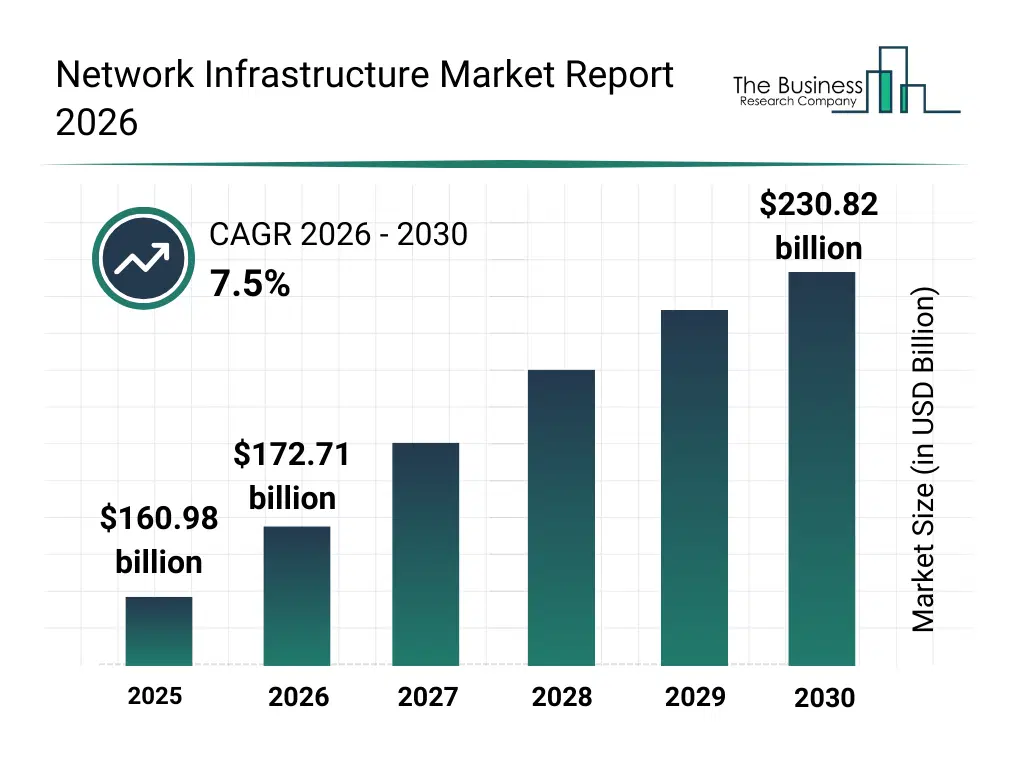
What Is The Network Infrastructure Market Size and Share 2026?
The network infrastructure market size has grown strongly in recent years. It will grow from $160.98 billion in 2025 to $172.71 billion in 2026 at a compound annual growth rate (CAGR) of 7.3%. The growth in the historic period can be attributed to increasing adoption of wired and wireless networking solutions, rising enterprise IT spending, expansion of broadband and high-speed internet, growth in data center deployments, and rising demand for network management and monitoring tools.What Is The Network Infrastructure Market Growth Forecast?
The network infrastructure market size is expected to see strong growth in the next few years. It will grow to $230.82 billion in 2030 at a compound annual growth rate (CAGR) of 7.5%. The growth in the forecast period can be attributed to growing deployment of 5g and next-generation networks, increasing cloud and hybrid IT adoption, rising demand for ai-driven network automation, expansion of edge computing infrastructure, and growing focus on cybersecurity and threat management. Major trends in the forecast period include rising demand for cloud-based network management solutions, increasing adoption of edge network infrastructure, growing investment in network security and firewall solutions, expansion of unified communications and collaboration services, rising integration of performance optimization and analytics software.Global Network Infrastructure Market Segmentation
1) By Type: Hardware, Software, Services 2) By Infrastructure Category: Access Network Infrastructure, Core Network Infrastructure, Edge Network Infrastructure 3) By Deployment: On Premises, Cloud Based 4) By Organization Size: Small And Medium Enterprises, Large Enterprises 5) By End User: Information Technology (IT) And Telecom, Banking Financial Services And Insurance, Healthcare, Retail And E Commerce, Manufacturing Subsegments: 1) By Hardware: Routers, Switches, Gateways, Cables, Wireless Access Points, Network Interface Cards, Servers, Storage Devices, Firewalls, Load Balancers 2) By Software: Network Management Software, Security Software, Monitoring Software, Performance Optimization Software, Virtualization Software, Configuration Management Software, Analytics Software, Automation Software, Collaboration Software, Backup And Recovery Software 3) By Services: Network Optimization, Wireless Infrastructure, Unified Communications And Collaboration, Contact Centre Transformation, Managed Network Services, Service Management Operations, Network Security And Firewalls, Cloud Core ImplementationWhat Is The Driver Of The Network Infrastructure Market?
The rising demand for data centers is expected to propel the growth of the network infrastructure market going forward. Data centers refer to specialized facilities that house networked computers, storage systems, and associated infrastructure used to store, process, and manage large volumes of digital data. The demand for data centers is rising due to the rapid adoption of cloud computing, as businesses increasingly rely on cloud-based services to store and manage their data securely and efficiently. Network infrastructure supports the demand for data centers by providing the high-speed connectivity and reliable bandwidth required to support large-scale data storage and processing. It reduces latency and operational bottlenecks through robust architecture, improving overall performance and scalability of digital services. For instance, in September 2024, according to the National Telecommunications and Information Administration, a US-based government agency, the United States has about 5,000 data centers, and domestic demand for data centers is expected to increase by approximately nine percent annually through 2030. Therefore, the rising demand for data centers is driving the growth of the network infrastructure industry.Key Players In The Global Network Infrastructure Market
Major companies operating in the network infrastructure market are Huawei Technologies Co. Ltd., Dell Technologies Inc., Cisco Systems Inc., Broadcom Inc., Hewlett Packard Enterprise Development LP, Telefonaktiebolaget LM Ericsson, Nokia Corporation, ZTE Corporation, Palo Alto Networks Inc., Arista Networks Inc., Fortinet Inc., Ciena Corporation, F5 Inc., Ubiquiti Inc., Extreme Networks Inc., NETSCOUT Systems Inc., NETGEAR Inc., A10 Networks Inc., MikroTikls SIA, DrayTek Corp., and Zyxel Communications Corp.Global Network Infrastructure Market Trends and Insights
Major companies operating in the network infrastructure market are focusing on integrating artificial intelligence in network management, such as cloud radio access network architecture, to enable virtualized, scalable, and interoperable network deployments that support advanced 5G services and future connectivity demands. Cloud radio access network architecture refers to a virtualized network approach where radio access functions are software-based and run on cloud infrastructure, enabling flexible, scalable, and interoperable mobile networks. For instance, in March 2025, Telefonaktiebolaget LM Ericsson, a Sweden-based networking and telecommunications company, launched the first Cloud RAN network with Ericsson technology. It features a virtualized architecture that decouples hardware and software, enabling more flexible network operations and expansion. It also incorporates centralized control for software, allowing updates and maintenance to be performed more efficiently to ensure customers benefit from the latest 5G features. This move actively promotes the development of open and interoperable mobile networks, fostering a dynamic innovation ecosystem for ground handling operators and business customers.What Are Latest Mergers And Acquisitions In The Network Infrastructure Market?
In July 2023, Vector Capital Management L.P., a US-based private equity firm, acquired Riverbed Technology LLC for an undisclosed amount. With this acquisition, Vector Capital aims to strengthen Riverbed’s growth trajectory by enhancing its product portfolio, accelerating innovation, and expanding its presence in enterprise IT performance, observability, and digital experience solutions. Riverbed Technology LLC is a US-based network infrastructure company specializing in WAN optimization, SD-WAN, and network performance solutions.Regional Insights
North America was the largest region in the network infrastructure market in 2025. Asia-Pacific is expected to be the fastest-growing region in the forecast period. The regions covered in this market report are Asia-Pacific, South East Asia, Western Europe, Eastern Europe, North America, South America, Middle East, Africa. The countries covered in this market report are Australia, Brazil, China, France, Germany, India, Indonesia, Japan, Taiwan, Russia, South Korea, UK, USA, Canada, Italy, Spain.What Defines the Network Infrastructure Market?
The network infrastructure market consists of revenues earned by entities by providing services such as network hardware deployment, connectivity solutions, network management, security services, and performance optimization. The market value includes the value of related goods sold by the service provider or included within the service offering. The network infrastructure market includes sales of routers, switches, gateways, cables, wireless access points, network management software, and smart networking solutions. Values in this market are ‘factory gate’ values, that is, the value of goods sold by the manufacturers or creators of the goods, whether to other entities (including downstream manufacturers, wholesalers, distributors, and retailers) or directly to end customers. The value of goods in this market includes related services sold by the creators of the goods.How is Market Value Defined and Measured?
The market value is defined as the revenues that enterprises gain from the sale of goods and/or services within the specified market and geography through sales, grants, or donations in terms of the currency (in USD unless otherwise specified). The revenues for a specified geography are consumption values that are revenues generated by organizations in the specified geography within the market, irrespective of where they are produced. It does not include revenues from resales along the supply chain, either further along the supply chain or as part of other products.What Key Data and Analysis Are Included in the Network Infrastructure Market Report 2026?
The network infrastructure market research report is one of a series of new reports from The Business Research Company that provides network infrastructure market statistics, including network infrastructure industry global market size, regional shares, competitors with a network infrastructure market share, detailed network infrastructure market segments, market trends and opportunities, and any further data you may need to thrive in the network infrastructure industry. This network infrastructure market research report delivers a complete perspective of everything you need, with an in-depth analysis of the current and future scenario of the industry.Network Infrastructure Market Report Forecast Analysis
| Report Attribute | Details |
|---|---|
| Market Size Value In 2026 | $172.71 billion |
| Revenue Forecast In 2035 | $230.82 billion |
| Growth Rate | CAGR of 7.3% from 2026 to 2035 |
| Base Year For Estimation | 2025 |
| Actual Estimates/Historical Data | 2020-2025 |
| Forecast Period | 2026 - 2030 - 2035 |
| Market Representation | Revenue in USD Billion and CAGR from 2026 to 2035 |
| Segments Covered | Type, Infrastructure Category, Deployment, Organization Size, End User |
| Regional Scope | Asia-Pacific, Western Europe, Eastern Europe, North America, South America, Middle East, Africa |
| Country Scope | The countries covered in the report are Australia, Brazil, China, France, Germany, India, ... |
| Key Companies Profiled | Huawei Technologies Co. Ltd., Dell Technologies Inc., Cisco Systems Inc., Broadcom Inc., Hewlett Packard Enterprise Development LP, Telefonaktiebolaget LM Ericsson, Nokia Corporation, ZTE Corporation, Palo Alto Networks Inc., Arista Networks Inc., Fortinet Inc., Ciena Corporation, F5 Inc., Ubiquiti Inc., Extreme Networks Inc., NETSCOUT Systems Inc., NETGEAR Inc., A10 Networks Inc., MikroTikls SIA, DrayTek Corp., and Zyxel Communications Corp. |
| Customization Scope | Request for Customization |
| Pricing And Purchase Options | Explore Purchase Options |
Frequently Asked Questions
The Network Infrastructure market was valued at $160.98 billion in 2025, increased to $172.71 billion in 2026, and is projected to reach $230.82 billion by 2030.
request a sample hereThe global Network Infrastructure market is expected to grow at a CAGR of 7.5% from 2026 to 2035 to reach $230.82 billion by 2035.
request a sample hereSome Key Players in the Network Infrastructure market Include, Huawei Technologies Co. Ltd., Dell Technologies Inc., Cisco Systems Inc., Broadcom Inc., Hewlett Packard Enterprise Development LP, Telefonaktiebolaget LM Ericsson, Nokia Corporation, ZTE Corporation, Palo Alto Networks Inc., Arista Networks Inc., Fortinet Inc., Ciena Corporation, F5 Inc., Ubiquiti Inc., Extreme Networks Inc., NETSCOUT Systems Inc., NETGEAR Inc., A10 Networks Inc., MikroTikls SIA, DrayTek Corp., and Zyxel Communications Corp..
request a sample hereMajor trend in this market includes: AI-Integrated Cloud RAN Architecture Enables Scalable And Virtualized Network Deployments. For further insights on this market.
request a sample hereNorth America was the largest region in the network infrastructure market in 2025. Asia-Pacific is expected to be the fastest-growing region in the forecast period. The regions covered in the network infrastructure market report are Asia-Pacific, South East Asia, Western Europe, Eastern Europe, North America, South America, Middle East, Africa.
request a sample here