
Nanomaterials In Personalized Medicine Market Report 2026
Global Outlook – By Type Of Nanomaterials (Carbon-Based Nanomaterials, Metallic Nanoparticles, Polymeric Nanomaterials, Nanostructured Materials, Silica Nanoparticles), By Formulation Type (Nanoparticles, Nanosuspensions, Nanoemulsions, Nanocrystals, Nanoformulations For Targeted Delivery), By Technology Utilized (Nanofabrication Techniques, Bioconjugation Methods, Surface Modification Techniques, Molecular Imaging Techniques, Nanotechnology-Based Screening Methods), By Application Areas (Drug Delivery Systems, Diagnostics And Imaging, Therapeutics, Regenerative Medicine, Vaccines), By End-Users (Hospitals And Clinics, Research Laboratories, Pharmaceutical Companies, Biotechnology Firms, Academic Institutions) – Market Size, Trends, Strategies, and Forecast to 2035
Nanomaterials In Personalized Medicine Market Overview
• Nanomaterials In Personalized Medicine market size has reached to $392.97 billion in 2025 • Expected to grow to $674.28 billion in 2030 at a compound annual growth rate (CAGR) of 11.3% • Growth Driver: Increasing Demand For Personalized Medicine Fueling The Growth Of The Market Due To Advancements In Genomic Technologies And Targeted Therapies • Market Trend: Innovative Nanoparticle Platform Boosts Treatment Precision And Patient Outcomes • North America was the largest region in 2025 and Asia-Pacific is the fastest growing region.What Is Covered Under Nanomaterials In Personalized Medicine Market?
Nanomaterials in personalized medicine are highly engineered substances at the nanoscale, designed to interact with biological systems in a precise and controlled manner, allowing healthcare interventions to be tailored to an individual’s specific genetic, molecular, or physiological characteristics. These nanomaterials help maximize therapeutic effectiveness while minimizing potential side effects and improving overall patient outcomes by enabling targeted, controlled, and individualized medical interventions. The main types of nanomaterials in personalized medicine are carbon-based nanomaterials, metallic nanoparticles, polymeric nanomaterials, nanostructured materials, and silica nanoparticles. Carbon-based nanomaterials are tiny structures made mainly of carbon, including graphene, carbon nanotubes, and fullerenes. It includes various formulation types, such as nanoparticles, nanosuspensions, nanoemulsions, nanocrystals, and nanoformulations for targeted delivery, and utilizes technologies such as nanofabrication techniques, bioconjugation methods, surface modification techniques, molecular imaging techniques, and nanotechnology-based screening methods. It finds applications in drug delivery systems, diagnostics and imaging, therapeutics, regenerative medicine, vaccines, and catering to diverse end users, including hospitals and clinics, research laboratories, pharmaceutical companies, biotechnology firms, and academic institutions.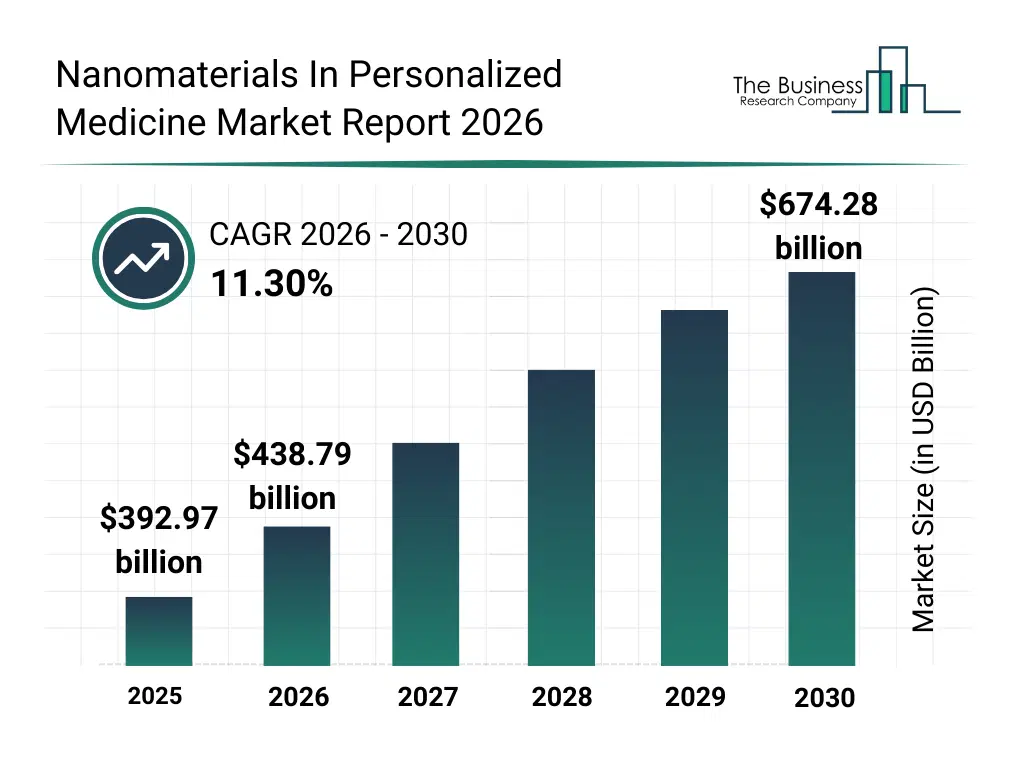
What Is The Nanomaterials In Personalized Medicine Market Size and Share 2026?
The nanomaterials in personalized medicine market size has grown rapidly in recent years. It will grow from $392.97 billion in 2025 to $438.79 billion in 2026 at a compound annual growth rate (CAGR) of 11.7%. The growth in the historic period can be attributed to advancements in genomics and molecular biology, increasing adoption of targeted therapies, expansion of translational medical research, availability of advanced nanofabrication techniques, growth of academic-industry collaborations.What Is The Nanomaterials In Personalized Medicine Market Growth Forecast?
The nanomaterials in personalized medicine market size is expected to see rapid growth in the next few years. It will grow to $674.28 billion in 2030 at a compound annual growth rate (CAGR) of 11.3%. The growth in the forecast period can be attributed to increasing demand for personalized healthcare solutions, rising investment in precision medicine programs, expansion of nanomaterials in diagnostics and imaging, growing focus on minimizing therapy side effects, continued innovation in nano-enabled medical technologies. Major trends in the forecast period include increasing use of targeted nanomaterials for individualized therapies, growing integration of molecular diagnostics with nanotechnology, rising adoption of nanomaterials in precision drug delivery, expansion of nanotechnology in regenerative medicine, enhanced focus on patient-specific treatment outcomes.
Global Nanomaterials In Personalized Medicine Market Segmentation
1) By Type Of Nanomaterials: Carbon-Based Nanomaterials, Metallic Nanoparticles, Polymeric Nanomaterials, Nanostructured Materials, Silica Nanoparticles 2) By Formulation Type: Nanoparticles, Nanosuspensions, Nanoemulsions, Nanocrystals, Nanoformulations For Targeted Delivery 3) By Technology Utilized: Nanofabrication Techniques, Bioconjugation Methods, Surface Modification Techniques, Molecular Imaging Techniques, Nanotechnology-Based Screening Methods 4) By Application Areas: Drug Delivery Systems, Diagnostics And Imaging, Therapeutics, Regenerative Medicine, Vaccines 5) By End-Users: Hospitals And Clinics, Research Laboratories, Pharmaceutical Companies, Biotechnology Firms, Academic Institutions Subsegments: 1) By Carbon-Based Nanomaterials: Fullerenes, Carbon Nanotubes, Graphene, Carbon Dots 2) By Metallic Nanoparticles: Gold Nanoparticles, Silver Nanoparticles, Iron Oxide Nanoparticles, Copper Nanoparticles 3) By Polymeric Nanomaterials: Dendrimers, Micelles, Polymeric Nanoparticles, Hydrogels 4) By Nanostructured Materials: Quantum Dots, Nanowires, Nanosheets, Nanorods 5) By Silica Nanoparticles: Mesoporous Silica Nanoparticles, Colloidal Silica Nanoparticles, Porous Silica Nanoparticles, Functionalized Silica NanoparticlesWhat Is The Driver Of The Nanomaterials In Personalized Medicine Market?
The increasing demand for personalized medicine is expected to propel the growth of the nanomaterials in personalized medicine market going forward. Personalized medicine is a medical approach that involves tailoring treatments to individual patients based on their genetic, environmental, and lifestyle factors to optimize outcomes and improve care. The demand for personalized medicine is increasing due to advancements in genomic technologies, which enable precise identification of genetic variations and tailored treatments for individuals. Nanomaterials in personalized medicine enhance personalized medicine by enabling targeted and patient-specific therapies, improving treatment efficacy and safety. They allow precise delivery of drugs, genes, or RNA, reducing side effects and optimizing therapeutic outcomes. For instance, in February 2024, according to the Personalized Medicine Coalition (PMC), a US-based nonprofit organization, the U.S. Food and Drug Administration (FDA) approved 26 new personalized medicines in 2023, a significant increase from the 12 approved in 2022. Therefore, the increasing demand for personalized medicine is driving the growth of the nanomaterials in personalized medicine industry.Key Players In The Global Nanomaterials In Personalized Medicine Market
Major companies operating in the nanomaterials in personalized medicine market are Pfizer & Co. Inc., BASF SE, Sanofi S.A., The Bristol-Myers Squibb Company, Thermo Fisher Scientific Inc., Abbott Laboratories, Merck KGaA Darmstadt Germany, Evonik Industries AG, Eisai Co. Ltd., TÜV Rheinland AG, OCSiAl S.A., American Elements Inc., Cour Pharmaceuticals Inc., Nanocomposix Inc., NoPo Nanotechnologies Private Limited, Matexcel Biotech Inc., OncoNano Medicine Inc., Molecular Rebar Design Inc., Cello Therapeutics Inc., Apurano Pharmaceuticals GmbH, SGN Nanopharma Inc.Global Nanomaterials In Personalized Medicine Market Trends and Insights
Major companies operating in the nanomaterials in personalized medicine market are focusing on adopting strategic collaborations to accelerate clinical translation, expand therapeutic indications, and shorten time-to-market while meeting evolving regulatory standards. Strategic collaborations refer to partnerships where companies or institutions combine expertise and resources to accelerate innovation and expand opportunities in personalized medicine. For instance, in May 2025, Acuitas Therapeutics Inc., a Canada-based biotechnology company, collaborated with Integrated DNA Technologies Inc., a US-based genomics solutions provider, and launched a personalized CRISPR gene-editing therapy delivery using their lipid nanoparticles platform that treated a single baby with a rare genetic disease, featuring precisely targeted CRISPR payloads, bespoke dose tuning, and rapid custom formulation. This innovation accelerates one-off, highly individualized treatments. It boosts therapeutic precision and patient outcomes while raising challenges in scalable manufacture, stringent regulatory tailoring, and ultra-low-volume production.What Are Latest Mergers And Acquisitions In The Nanomaterials In Personalized Medicine Market?
In June 2023, Bayer AG, a Germany-based pharmaceutical and biotechnology company, partnered with Acuitas Therapeutics Inc. to access its lipid nanoparticle (LNP) delivery technology. This partnership aims to advance Bayer’s in vivo gene editing and protein replacement programs by leveraging Acuitas’ lipid nanoparticle technology to enable efficient and targeted RNA delivery, particularly to the liver. Acuitas Therapeutics Inc. is a Canada-based biotechnology company specializing in lipid nanoparticle (LNP) delivery systems, key nanomaterials for personalized medicine.Regional Insights
North America was the largest region in the nanomaterials in personalized medicine market in 2025. Asia-Pacific is expected to be the fastest-growing region in the forecast period. The regions covered in this market report are Asia-Pacific, South East Asia, Western Europe, Eastern Europe, North America, South America, Middle East, Africa. The countries covered in this market report are Australia, Brazil, China, France, Germany, India, Indonesia, Japan, Taiwan, Russia, South Korea, UK, USA, Canada, Italy, Spain.What Defines the Nanomaterials In Personalized Medicine Market?
The nanomaterials in personalized medicine market consists of revenues earned by entities by providing services such as gene and RNA therapy formulation, personalized diagnostic solutions, nanocarrier design and manufacturing, clinical translation support, and custom nanoparticle-based treatment development. The market value includes the value of related goods sold by the service provider or included within the service offering. The nanomaterials in personalized medicine market also includes sales of targeted gene delivery kits, nanoparticle-based diagnostic kits, nanocarrier-enabled vaccine formulations, nano-biosensors, and lab-scale nanofabrication equipment. Values in this market are ‘factory gate’ values, that is the value of goods sold by the manufacturers or creators of the goods, whether to other entities (including downstream manufacturers, wholesalers, distributors and retailers) or directly to end customers. The value of goods in this market includes related services sold by the creators of the goods.How is Market Value Defined and Measured?
The market value is defined as the revenues that enterprises gain from the sale of goods and/or services within the specified market and geography through sales, grants, or donations in terms of the currency (in USD unless otherwise specified). The revenues for a specified geography are consumption values that are revenues generated by organizations in the specified geography within the market, irrespective of where they are produced. It does not include revenues from resales along the supply chain, either further along the supply chain or as part of other products.What Key Data and Analysis Are Included in the Nanomaterials In Personalized Medicine Market Report 2026?
The nanomaterials in personalized medicine market research report is one of a series of new reports from The Business Research Company that provides market statistics, including industry global market size, regional shares, competitors with the market share, detailed market segments, market trends and opportunities, and any further data you may need to thrive in the nanomaterials in personalized medicine industry. The market research report delivers a complete perspective of everything you need, with an in-depth analysis of the current and future state of the industry.Nanomaterials In Personalized Medicine Market Report Forecast Analysis
| Report Attribute | Details |
|---|---|
| Market Size Value In 2026 | $438.79 billion |
| Revenue Forecast In 2035 | $674.28 billion |
| Growth Rate | CAGR of 11.7% from 2026 to 2035 |
| Base Year For Estimation | 2025 |
| Actual Estimates/Historical Data | 2020-2025 |
| Forecast Period | 2026 - 2030 - 2035 |
| Market Representation | Revenue in USD Billion and CAGR from 2026 to 2035 |
| Segments Covered | Type Of Nanomaterials, Formulation Type, Technology Utilized, Application Areas, End-Users |
| Regional Scope | Asia-Pacific, Western Europe, Eastern Europe, North America, South America, Middle East, Africa |
| Country Scope | The countries covered in the report are Australia, Brazil, China, France, Germany, India, ... |
| Key Companies Profiled | Pfizer & Co. Inc., BASF SE, Sanofi S.A., The Bristol-Myers Squibb Company, Thermo Fisher Scientific Inc., Abbott Laboratories, Merck KGaA Darmstadt Germany, Evonik Industries AG, Eisai Co. Ltd., TÜV Rheinland AG, OCSiAl S.A., American Elements Inc., Cour Pharmaceuticals Inc., Nanocomposix Inc., NoPo Nanotechnologies Private Limited, Matexcel Biotech Inc., OncoNano Medicine Inc., Molecular Rebar Design Inc., Cello Therapeutics Inc., Apurano Pharmaceuticals GmbH, SGN Nanopharma Inc. |
| Customization Scope | Request for Customization |
| Pricing And Purchase Options | Explore Purchase Options |