
Multimodal Traffic Controllers Market Report 2026
Multimodal Traffic Controllers Market Report 2026
Global Outlook – By Product Type (Adaptive Controllers, Fixed-Time Controllers, Coordinated Controllers, Other Product Types), By Installation Type (New Installations, Upgrades And Retrofits), By Technology (Sensor-Based, Artificial Intelligence (AI)-Based, Internet Of Things (IoT)-Enabled, Other Technologies), By Application (Urban Traffic Management, Highways, Rail Intersections, Pedestrian Crossings, Other Applications), By End-User (Government, Municipalities, Private Sector, Other End-Users) – Market Size, Trends, Strategies, and Forecast to 2035
Multimodal Traffic Controllers Market Overview
• Multimodal Traffic Controllers market size has reached to $3.33 billion in 2025 • Expected to grow to $5.89 billion in 2030 at a compound annual growth rate (CAGR) of 12.1% • Growth Driver: Growth In Smart City Initiatives Is Driving The Market Growth Due To Increasing Urbanization And Government Investment • Market Trend: Innovations In Artificial Intelligence (AI) Technology Enhance Predictive Traffic Optimization In Multimodal Traffic Controllers • North America was the largest region in 2025 and Asia-Pacific is the fastest growing region.

What Is Covered Under Multimodal Traffic Controllers Market?
Multimodal traffic controllers are advanced signal control systems designed to regulate and prioritize the movement of vehicles, public transportation, pedestrians, and cyclists at intersections by leveraging real-time data from sensors and connected technologies. Multimodal traffic controllers are used to streamline traffic flow, improve safety, and enhance intersection performance by dynamically modifying signal timings to efficiently support multiple modes of transportation. The main product types of the multimodal traffic controllers market include adaptive controllers, fixed-time controllers, coordinated controllers, and other product types. Adaptive controllers are designed to adjust signal timings in real-time based on traffic flow. The installation types include new installations and upgrades and retrofits and the technologies utilized include sensor-based, artificial intelligence (AI)-based, Internet of Things (IoT)-enabled, and other technologies.The applications include urban traffic management, highways, rail intersections, pedestrian crossings, and other applications, serving end-users such as government, municipalities, private sector, and others.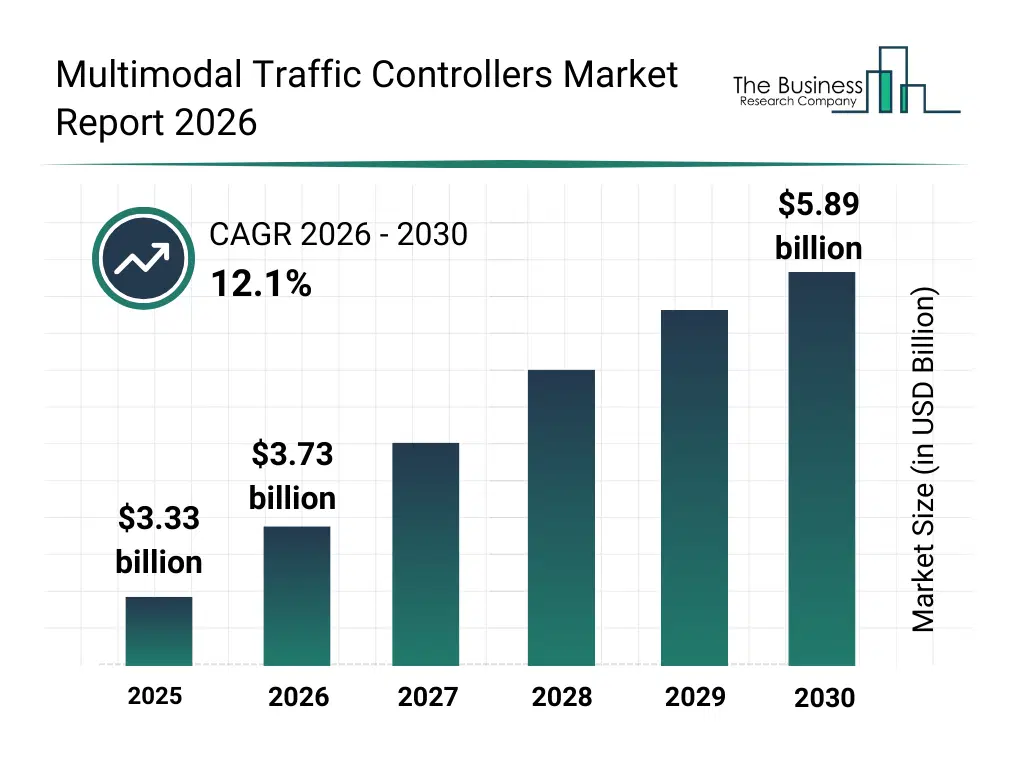
What Is The Multimodal Traffic Controllers Market Size and Share 2026?
The multimodal traffic controllers market size has grown rapidly in recent years. It will grow from $3.33 billion in 2025 to $3.73 billion in 2026 at a compound annual growth rate (CAGR) of 11.9%. The growth in the historic period can be attributed to growing urban traffic congestion, increasing government funding for traffic infrastructure, rising road safety concerns, expansion of public transportation networks, modernization of legacy traffic signal systems.What Is The Multimodal Traffic Controllers Market Growth Forecast?
The multimodal traffic controllers market size is expected to see rapid growth in the next few years. It will grow to $5.89 billion in 2030 at a compound annual growth rate (CAGR) of 12.1%. The growth in the forecast period can be attributed to growing smart city initiatives, increasing vehicle-to-infrastructure (V2I) deployment, rising demand for real-time traffic optimization, expansion of electric and autonomous vehicle ecosystems, increasing investments in intelligent transportation systems. Major trends in the forecast period include increasing deployment of transit signal priority (TSP) controllers, rising adoption of pedestrian hybrid beacon (PHB) controllers, growing integration of emergency vehicle preemption (EVP) systems, expansion of adaptive signal control at urban intersections, rising demand for multi-intersection coordinated controllers.Global Multimodal Traffic Controllers Market Segmentation
1) By Product Type: Adaptive Controllers, Fixed-Time Controllers, Coordinated Controllers, Other Product Types 2) By Installation Type: New Installations, Upgrades And Retrofits 3) By Technology: Sensor-Based, Artificial Intelligence (AI)-Based, Internet Of Things (IoT)-Enabled, Other Technologies 4) By Application: Urban Traffic Management, Highways, Rail Intersections, Pedestrian Crossings, Other Applications 5) By End-User: Government, Municipalities, Private Sector, Other End-Users Subsegments: 1) By Adaptive Controllers: Traffic-Responsive Controllers, AI-Based or Machine-Learning Controllers, Sensor-Integrated Controllers, Real-Time Signal Optimization Controllers, Multi-Intersection Adaptive Controllers, Vehicle-to-Infrastructure (V2I) Enabled Controllers 2) By Fixed-Time Controllers: Pre-Timed Signal Controllers, Time-of-Day Controllers, Isolated Intersection Controllers, Standalone Signal Controllers, Legacy or Electromechanical Controllers, Low-Cost Basic Signal Controllers 3) By Coordinated Controllers: Corridor-Based Signal Controllers, Area Traffic Control (ATC) Systems, Centralized Coordination Controllers, Green-Wave Signal Controllers, Networked Intersection Controllers, Transit Signal Priority Controllers 4) By Other Product Types: Pedestrian-Only Signal Controllers, Multimodal Priority Controllers (Bus, Bike, Emergency), Temporary or Portable Traffic Controllers, Smart City Integrated Controllers, Cloud-Connected Traffic Controllers, Hybrid Traffic Control SystemsWhat Is The Driver Of The Multimodal Traffic Controllers Market?
The growing smart city initiatives are expected to propel the growth of the multimodal traffic controllers market going forward. Smart city initiatives are urban development programs that leverage digital technologies, data analytics, and interconnected systems to improve infrastructure efficiency, public services, and quality of life for residents. The rising implementation of smart city initiatives is primarily driven by rapid urbanization, as expanding urban populations create pressing demands for efficient infrastructure, better traffic management, and sustainable resource utilization that traditional systems cannot adequately address. Smart city initiatives drive multimodal traffic controller growth by requiring advanced traffic management systems that can coordinate multiple transportation modes, optimize signal timing, and integrate real-time data across complex urban networks. For instance, in January 2024, according to the Institute of the Americas, a US-based non-profit organization, global spending on smart city initiatives in 2023 would surpass $190 billion. Therefore, growing smart city initiatives are driving the growth of the multimodal traffic controllers industry.Key Players In The Global Multimodal Traffic Controllers Market
Major companies operating in the multimodal traffic controllers market are Sumitomo Electric Industries Ltd., Thales S A, Siemens Mobility GmbH, Indra Sistemas S A, Advantech Co Ltd, Swarco AG, Kapsch TrafficCom AG, Kyosan Electric Manufacturing Co Ltd, TransCore LP, McCain Inc, Q Free ASA, Miovision Technologies Inc, Control Technologies Inc, Econolite Group Inc, Eberle Design Inc, Telegra d o o, Aldridge Traffic Controllers Pty Ltd, Smartmicro GmbH, Cubic Transportation Systems, Yunex Traffic, Traffic Technologies Ltd, and SENA Traffic Systems Sdn Bhd.Global Multimodal Traffic Controllers Market Trends and Insights
Major companies operating in the multimodal traffic controllers market are focusing on developing advanced multimodal traffic solutions, such as AI-powered predictive traffic control systems, to meet the rising demand for reduced congestion, improved travel efficiency, and better integration of vehicles, public transit, and active mobility in urban areas. AI-powered predictive traffic control systems use machine learning and real-time traffic data to predict traffic patterns and change signal timings ahead of time, which is a big improvement over traditional traffic controllers that only follow set schedules or make changes after traffic jams happen. For instance, in September 2025, TRL Software, a UK-based transportation software company, launched SCOOT 8 AI, a predictive urban traffic control solution designed for multimodal networks that integrates real-time sensor feeds, connected vehicle data, and traffic forecasts to optimize signal timing up to 30 minutes in advance. It combines decades of adaptive signal control expertise with advanced AI algorithms, providing features such as predictive congestion management, automatic scenario evaluation, real-time performance dashboards, and compatibility with existing traffic infrastructure, allowing cities to improve throughput, reduce journey times, and enhance multimodal traffic flow. Its hardware-agnostic design ensures seamless integration with legacy systems while supporting future mobility initiatives, making it ideal for urban traffic authorities focused on smart city implementations.What Are Latest Mergers And Acquisitions In The Multimodal Traffic Controllers Market?
In August 2023, Econolite, a US-based provider of traffic control hardware and software, acquired Western Pacific Signal (WPS) for an undisclosed amount. With this acquisition, Econolite aimed to broaden its technical support capabilities and strengthen field service delivery across its traffic controller and signal system product lines. Western Pacific Signal is a US‑based company specializing in traffic signal products, testing, support services, and field deployment expertise.Regional Insights
North America was the largest region in the multimodal traffic controllers market in 2025. Asia-Pacific is expected to be the fastest-growing region in the forecast period. The regions covered in this market report are Asia-Pacific, South East Asia, Western Europe, Eastern Europe, North America, South America, Middle East, Africa. The countries covered in this market report are Australia, Brazil, China, France, Germany, India, Indonesia, Japan, Taiwan, Russia, South Korea, UK, USA, Canada, Italy, Spain.What Defines the Multimodal Traffic Controllers Market?
The multimodal traffic controllers market consists of sales of transit signal priority (TSP) controllers, pedestrian hybrid beacon (PHB) controllers, AI-based smart traffic controllers, and emergency vehicle preemption (EVP) controllers. Values in this market are ‘factory gate’ values, that is, the value of goods sold by the manufacturers or creators of the goods, whether to other entities (including downstream manufacturers, wholesalers, distributors, and retailers) or directly to end customers. The value of goods in this market includes related services sold by the creators of the goods.How is Market Value Defined and Measured?
The market value is defined as the revenues that enterprises gain from the sale of goods and/or services within the specified market and geography through sales, grants, or donations in terms of the currency (in USD unless otherwise specified). The revenues for a specified geography are consumption values that are revenues generated by organizations in the specified geography within the market, irrespective of where they are produced. It does not include revenues from resales along the supply chain, either further along the supply chain or as part of other products.What Key Data and Analysis Are Included in the Multimodal Traffic Controllers Market Report 2026?
The multimodal traffic controllers market research report is one of a series of new reports from The Business Research Company that provides multimodal traffic controllers market statistics, including multimodal traffic controllers industry global market size, regional shares, competitors with a multimodal traffic controllers market share, detailed multimodal traffic controllers market segments, market trends and opportunities, and any further data you may need to thrive in the multimodal traffic controllers industry. This multimodal traffic controllers market research report delivers a complete perspective of everything you need, with an in-depth analysis of the current and future scenario of the industry.Multimodal Traffic Controllers Market Report Forecast Analysis
| Report Attribute | Details |
|---|---|
| Market Size Value In 2026 | $3.73 billion |
| Revenue Forecast In 2035 | $5.89 billion |
| Growth Rate | CAGR of 11.9% from 2026 to 2035 |
| Base Year For Estimation | 2025 |
| Actual Estimates/Historical Data | 2020-2025 |
| Forecast Period | 2026 - 2030 - 2035 |
| Market Representation | Revenue in USD Billion and CAGR from 2026 to 2035 |
| Segments Covered | Product Type, Installation Type, Technology, Application, End-User |
| Regional Scope | Asia-Pacific, Western Europe, Eastern Europe, North America, South America, Middle East, Africa |
| Country Scope | The countries covered in the report are Australia, Brazil, China, France, Germany, India, ... |
| Key Companies Profiled | Sumitomo Electric Industries Ltd., Thales S A, Siemens Mobility GmbH, Indra Sistemas S A, Advantech Co Ltd, Swarco AG, Kapsch TrafficCom AG, Kyosan Electric Manufacturing Co Ltd, TransCore LP, McCain Inc, Q Free ASA, Miovision Technologies Inc, Control Technologies Inc, Econolite Group Inc, Eberle Design Inc, Telegra d o o, Aldridge Traffic Controllers Pty Ltd, Smartmicro GmbH, Cubic Transportation Systems, Yunex Traffic, Traffic Technologies Ltd, and SENA Traffic Systems Sdn Bhd. |
| Customization Scope | Request for Customization |
| Pricing And Purchase Options | Explore Purchase Options |
Frequently Asked Questions
The Multimodal Traffic Controllers market was valued at $3.33 billion in 2025, increased to $3.73 billion in 2026, and is projected to reach $5.89 billion by 2030.
request a sample hereThe global Multimodal Traffic Controllers market is expected to grow at a CAGR of 12.1% from 2026 to 2035 to reach $5.89 billion by 2035.
request a sample hereSome Key Players in the Multimodal Traffic Controllers market Include, Sumitomo Electric Industries Ltd., Thales S A, Siemens Mobility GmbH, Indra Sistemas S A, Advantech Co Ltd, Swarco AG, Kapsch TrafficCom AG, Kyosan Electric Manufacturing Co Ltd, TransCore LP, McCain Inc, Q Free ASA, Miovision Technologies Inc, Control Technologies Inc, Econolite Group Inc, Eberle Design Inc, Telegra d o o, Aldridge Traffic Controllers Pty Ltd, Smartmicro GmbH, Cubic Transportation Systems, Yunex Traffic, Traffic Technologies Ltd, and SENA Traffic Systems Sdn Bhd..
request a sample hereMajor trend in this market includes: Innovations In Artificial Intelligence (AI) Technology Enhance Predictive Traffic Optimization In Multimodal Traffic Controllers. For further insights on this market.
request a sample hereNorth America was the largest region in the multimodal traffic controllers market in 2025. Asia-Pacific is expected to be the fastest-growing region in the forecast period. The regions covered in the multimodal traffic controllers market report are Asia-Pacific, South East Asia, Western Europe, Eastern Europe, North America, South America, Middle East, Africa.
request a sample here