
Movies And Entertainment Market 2026

Movies And Entertainment Market 2026
By Type (Print Media, Digital Media, Streaming Media), By Mode Of Watching (Theatres, Over-The-Top Platforms, Others), By Application (Residential, Commercial), And By Region, Opportunities And Strategies – Global Forecast To 2035
Movies And Entertainment Market Definition
The movies and entertainment industry encompasses the creation, production, distribution and exhibition of films, television shows, music and digital content. It includes activities such as filmmaking, post-production, broadcasting, streaming and live performances, as well as supporting sectors like talent management, marketing and content licensing. The primary purpose of the movies and entertainment industry is to inform, engage and entertain audiences through creative storytelling and visual experiences. The movies and entertainment market consists of sales by entities (organizations, sole traders and partnerships) of movies and entertainment services that serve a diverse range of users including individuals, families, educational institutions, hospitality providers and corporate entities seeking entertainment content for private viewing or public presentation. Content in this market is consumed in numerous scenarios including leisure at home, communal experiences in cinemas, entertainment in commercial establishments such as hotels and restaurants and in corporate settings where media is used for branding or engagement.

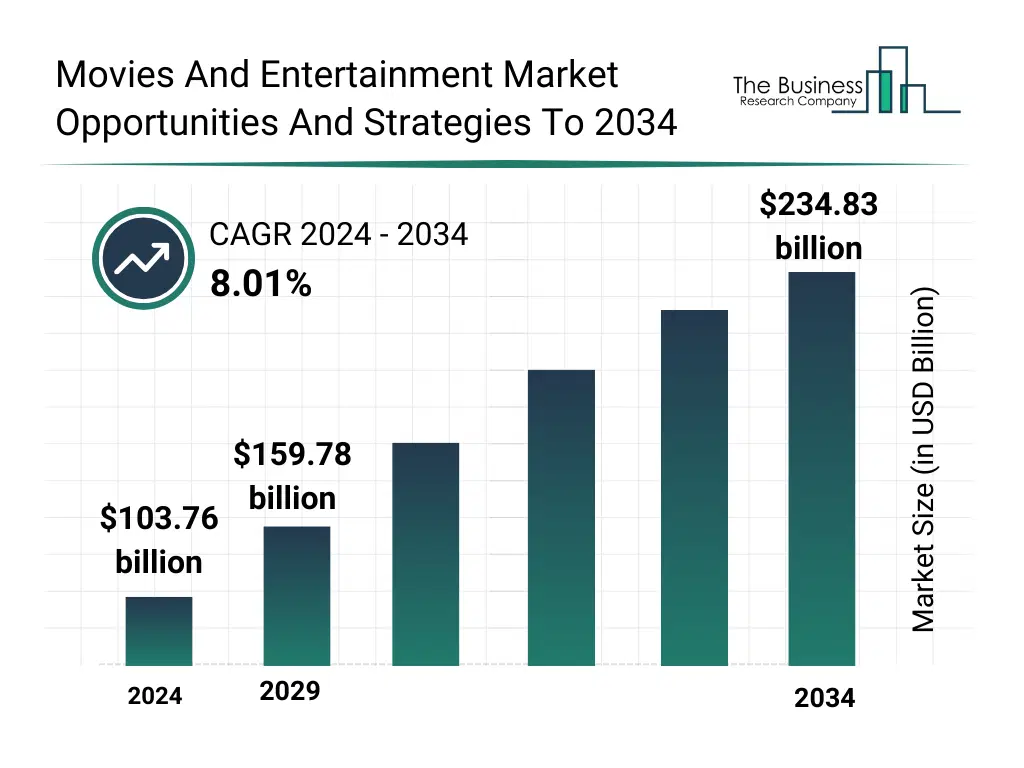
Movies And Entertainment Market Size
The global movies and entertainment market reached a value of nearly $103,758.03 million in 2024, having grown at a compound annual growth rate (CAGR) of 6.91% since 2019. The market is expected to grow from $103,758.03 million in 2024 to $159,784.03 million in 2029 at a rate of 9.02%. The market is then expected to grow at a CAGR of 8.01% from 2029 and reach $234,830.24 million in 2034. Growth in the historic period resulted from the growth in home theatre setups, growing internet and smartphone penetration, increasing popularity of hybrid entertainment experiences and rising content consumption. Factors that negatively affected growth in the historic period were rising production and distribution costs and piracy and copyright infringement. Going forward, the rising presence of online video platforms, increasing marketing and promotion spend, expansion of streaming platforms and subscription-based models and growing shift towards OTT media services will drive the growth. Factors that could hinder the growth of the movies and entertainment market in the future include regulatory censorship and content restrictions, stronger competition from non-film leisure and impact of trade war and tariff.Movies And Entertainment Market Drivers
The key drivers of the movies and entertainment market include: Growing Shift Towards OTT Media Services During the forecast period, the growing shift towards OTT media services is expected to propel the growth of the movies and entertainment market. As consumers increasingly prefer on-demand, personalized and cross-platform viewing experiences, traditional media consumption patterns are being rapidly replaced by digital streaming. The convenience of accessing diverse content libraries, coupled with affordable subscription options and widespread internet availability, has made OTT platforms a dominant force in the entertainment landscape. Moreover, the focus on regional storytelling, user-driven recommendations and ad-free viewing experiences continues to attract a broad audience base. This ongoing transformation toward flexible and digital-first entertainment consumption is anticipated to drive significant growth in the movies and entertainment market during the forecast period. The growing shift towards OTT media services growth contribution during the forecast period in 2024 is 2.00%.Movies And Entertainment Market Restraints
The key restraints on the movies and entertainment market include: Regulatory Censorship And Content Restrictions Regulatory censorship and content restrictions are expected to hinder the growth of the movies and entertainment market during the forecast period. Increasing government oversight of digital and streaming content has led to stricter compliance requirements, regional licensing barriers and the removal or alteration of content deemed sensitive or inappropriate under local regulations. Such measures restrict creative freedom, delay global releases and add significant administrative and legal costs for production houses and distributors. Moreover, content creators are increasingly resorting to self-censorship to avoid potential bans or legal challenges, limiting the diversity and innovation within entertainment offerings. Therefore, regulatory censorship and content restrictions are expected to restrain the growth of the movies and entertainment market in the coming years. Growth affected by regulatory censorship and content restrictions across regions during the forecast period in 2024 is -1.59%.Movies And Entertainment Market Trends
Major trends shaping the movies and entertainment market include: Advancements In HDR Technology To Enhance Visual Quality In Entertainment Content Major companies in the movies and entertainment market are focusing on the development and adoption of next-generation high dynamic range (HDR) technologies to deliver superior visual quality and elevate audience viewing experiences. These innovations aim to provide filmmakers and content creators with enhanced brightness, contrast and color depth, ensuring that on-screen visuals appear more lifelike and immersive across various devices and platforms. For instance, in September 2025, Dolby Laboratories, a US-based company specializing in audio-visual technologies, introduced Dolby Vision 2, the latest evolution of its industry-leading HDR format. The new version incorporates advanced image processing, AI-driven “Content Intelligence,” and bi-directional tone mapping, allowing optimized picture performance for films, TV shows, live sports and gaming content. By leveraging Dolby Vision 2, entertainment companies aim to improve creative expression, strengthen premium content offerings and meet the growing consumer demand for high-quality, immersive visual experiences in both cinematic and home entertainment environments. Emergence Of AI-Driven Video Generation To Transform Content Creation Key companies in the movies and entertainment market are focusing on the adoption of AI-driven video generation tools to revolutionize content creation and streamline production workflows. These innovations aim to enable creators to produce high-quality, realistic videos directly from text prompts, significantly reducing production time and cost while expanding creative possibilities. For instance, in December 2024, OpenAI, a US-based artificial intelligence research company, introduced Sora, an advanced text-to-video generation model designed to create detailed and coherent videos up to one minute long from simple text instructions. The technology allows filmmakers, studios and content creators to generate cinematic visuals, simulate complex environments and enhance storytelling without traditional filming constraints. By leveraging Sora’s capabilities, companies in the entertainment industry aim to boost creative efficiency, democratize video production and cater to the growing global demand for diverse, high-quality digital content.Opportunities And Recommendations In The Movies And Entertainment Market
Opportunities – The top opportunities in the direct air carbon capture technology market segmented by technology type will arise in the solid-direct air carbon capture (DAC) segment, which will gain $2,203.82 million of global annual sales by 2029. The top opportunities in the direct air carbon capture technology market segmented by application will arise in the carbon capture and storage (CCS) segment, which will gain $2,671.24 million of global annual sales by 2029. The top opportunities in the direct air carbon capture technology market segmented by end-use industry will arise in the energy industry (including clear energy industry) segment, which will gain $1,695.16 million of global annual sales by 2029. The top opportunities in the direct air carbon capture technology market segmented by operating temperature will arise in the low-temperature direct air carbon capture (DAC) segment, which will gain $2,344.36 million of global annual sales by 2029. The top opportunities in the direct air carbon capture technology market segmented by number of collectors will arise in the less than 10 collectors’ segment, which will gain $2,997.38 million of global annual sales by 2029. The direct air carbon capture technology market size will gain the most in the USA at $2,020.02 million. Recommendations- To take advantage of the opportunities, The Business Research Company recommends the movies and entertainment companies to focus on user-friendly reality capture with automated workflows , focus on advanced handheld solutions for industrial workflows, focus on scalable handheld 3d scanning for industrial use, focus on flexible high-precision optical scanning solutions, focus on high-precision and versatile 3d scanning solutions, focus on high-precision terrestrial scanning for large-scale applications, focus on structured light scanning solutions, focus on software-led growth in 3d scanning, expand in emerging markets, continue to focus on developed markets, focus on expanding multi-channel distribution reach, focus on value-based and segment-specific pricing, focus on industry-specific value communication, focus on data-driven digital promotion, focus on healthcare end-user engagement.Movies And Entertainment Market Segmentation
The movies and entertainment market is segmented by type, by mode of watching and by application.By Type –
The movies and entertainment market is segmented by type into:
- a) Print Media
- b) Digital Media
- c) Streaming Media
By Mode Of Watching –
The movies and entertainment market is segmented by mode of watching into:
- a) Theatres
- b) Over-The-Top Platforms
- c) Others
By Application –
The movies and entertainment market is segmented by application into:
- a) Residential
- b) Commercial
By Geography - The movies and entertainment market is segmented by geography into:
- • China
- • India
- • Japan
- • Australia
- • Indonesia
- • South Korea
- • Bangladesh
- • Thailand
- • Vietnam
- • Malaysia
- • Singapore
- • Phillipines
- • Hong kong
- • New Zealand
- • USA
- • Canada
- • Mexico
- • Brazil
- • Argentina
- • Chile
- • Colombiia
- • Peru
- • France
- • Germany
- • UK
- • Italy
- • Spain
- • Austria
- • Belgium
- • Denmark
- • Finland
- • Ireland
- • Netherland
- • Norway
- • Portugal
- • Sweden
- • Switzerland
- • Russia
- • Czech Republic
- • Poland
- • Romania
- • Ukraine
- • Saudi Arabia
- • Israel
- • Iran
- • Turkey
- • UAE o Africa
- • Egypt
- • Nigeria
- • South Africa
-
o Asia Pacific