
Molecular electronics Market Report 2026

Molecular electronics Market Report 2026
Global Outlook – By Component (Active, Passive), By Type Of Molecular Device (Molecular Diodes, Molecular Sensors, Molecular Switches, Molecular Wires, Other Type Of Molecular Devices), By Material (Conductors, Conductive, Dielectric, Semiconductor, Substrate, Other Materials), By Application (Three Dimensional (3D) Printing, Conductive Ink, Displays, Memory Devices, Organic Light Emitting Diode (LED) Lighting, Photovoltaic Cells, Sensors And Actuators, Solar Batteries, Other Applications), By End Use Industry (Aerospace, Automotive, Consumer Electronics, Energy, Healthcare And Medicine, Industrial Automation, Information Technology (IT) And Telecommunications, Military And Defense, Other End-Use Industries) – Market Size, Trends, Strategies, and Forecast to 2035
Molecular electronics Market Overview
• Molecular electronics market size has reached to $29.36 billion in 2025 • Expected to grow to $74.27 billion in 2030 at a compound annual growth rate (CAGR) of 20.4% • Growth Driver: Increasing Adoption Of Industrial Automation Fueling The Growth Of The Market Due To Ultra-miniaturized, Energy-efficient Components Enhancing Sensor Density And Processing Reliability • Market Trend: Scaling Brain-Inspired Molecular Architectures For Next-Generation Low-Power Electronics • North America was the largest region in 2025 and Asia-Pacific is the fastest growing region.

What Is Covered Under Molecular electronics Market?
Molecular electronics is a field of electronics that studies and utilizes individual molecules or molecular assemblies as the fundamental building blocks of electronic components and circuits. It focuses on understanding charge transport, switching behavior, and signal processing at the molecular scale to enable ultra-miniaturized and energy-efficient electronic systems. This approach aims to overcome the physical and performance limitations of conventional silicon-based electronics by enabling new device architectures at the nanoscale. The main components of molecular electronics include active and passive. Active components refer to molecular elements capable of controlling electrical flow and amplifying signals within a device. The type of molecular devices involved are molecular diodes, molecular sensors, molecular switches, molecular wires, and other types of molecular devices and the materials used include conductors, conductive materials, dielectric, semiconductor, substrate, and other materials. The various applications involved are three dimensional (3D) printing, conductive ink, displays, memory devices, organic light emitting diode (LED) lighting, photovoltaic cells, sensors and actuators, solar batteries, and other applications and are adopted across several end-use industries such as aerospace, automotive, consumer electronics, energy, healthcare and medicine, industrial automation, information technology (IT) and telecommunications, military and defense, and other end-use industries.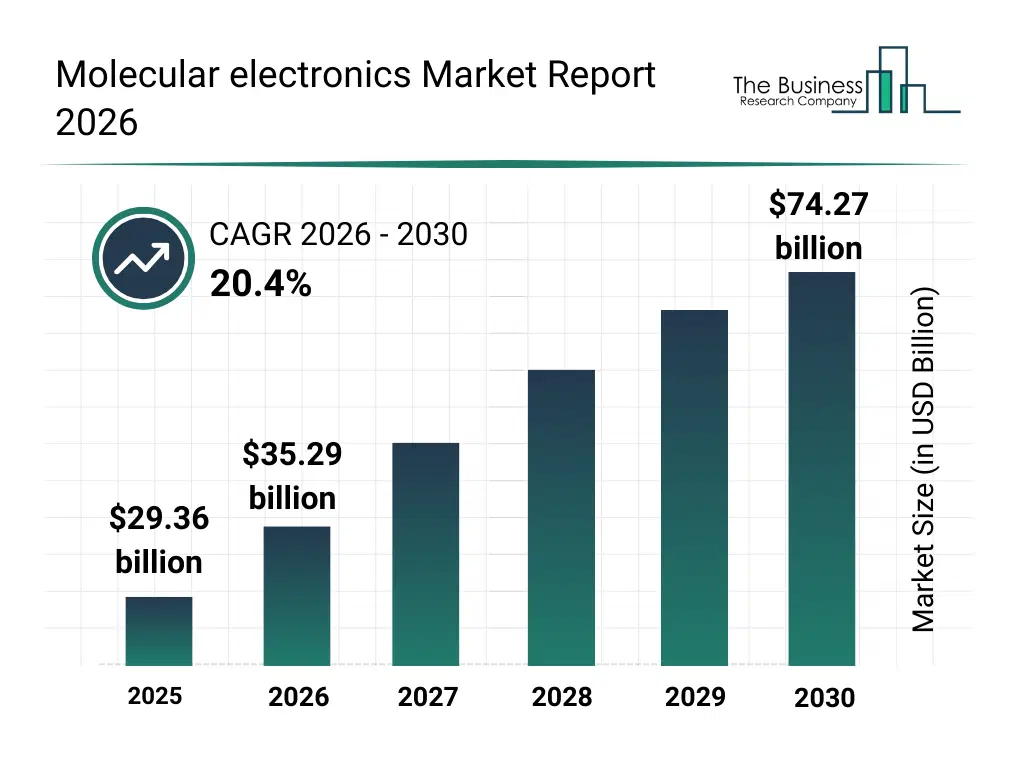
What Is The Molecular electronics Market Size and Share 2026?
The molecular electronics market size has grown exponentially in recent years. It will grow from $29.36 billion in 2025 to $35.29 billion in 2026 at a compound annual growth rate (CAGR) of 20.2%. The growth in the historic period can be attributed to miniaturization of semiconductor devices, growth in nanotechnology research funding, increasing academic and industrial collaborations, demand for high-density memory solutions, advances in molecular synthesis techniques.What Is The Molecular electronics Market Growth Forecast?
The molecular electronics market size is expected to see exponential growth in the next few years. It will grow to $74.27 billion in 2030 at a compound annual growth rate (CAGR) of 20.4%. The growth in the forecast period can be attributed to rising investment in post-silicon electronics, growing demand for ultra-low power devices, expansion of flexible and printable electronics, increasing commercialization of nanoscale components, development of hybrid molecular-semiconductor architectures. Major trends in the forecast period include advancements in single-molecule junction fabrication, rising development of molecular transistors for nanoscale circuits, growing adoption of self-assembled monolayers in device engineering, expansion of molecular memory device research, increasing integration of molecular thin films in nanoelectronics.Global Molecular electronics Market Segmentation
1) By Component: Active, Passive 2) By Type Of Molecular Device: Molecular Diodes, Molecular Sensors, Molecular Switches, Molecular Wires, Other Type Of Molecular Devices 3) By Material: Conductors, Conductive, Dielectric, Semiconductor, Substrate, Other Materials 4) By Application: Three Dimensional (3D) Printing, Conductive Ink, Displays, Memory Devices, Organic Light Emitting Diode (LED) Lighting, Photovoltaic Cells, Sensors And Actuators, Solar Batteries, Other Applications 5) By End Use Industry: Aerospace, Automotive, Consumer Electronics, Energy, Healthcare And Medicine, Industrial Automation, Information Technology (IT) And Telecommunications, Military And Defense, Other End-Use Industries Subsegments: 1) By Active: Transistors, Diodes, Photodetectors, Sensors 2) By Passive: Resistors, Capacitors, Inductors, InterconnectsWhat Is The Driver Of The Molecular electronics Market?
The increasing adoption of industrial automation is expected to propel the growth of the molecular electronics market going forward. Industrial automation refers to the integration of robotic and automated systems into factory operations to improve efficiency, precision, and output. The rise in industrial automation adoption is due to labor shortages, the need to enhance productivity, and competitive pressure to modernize production lines globally. Molecular electronics supports the adoption of industrial automation by enabling ultra-miniaturized, energy-efficient electronic components that enhance sensor density, processing capability, and reliability within compact automated systems. For instance, in September 2024, according to the International Federation of Robotics (IFR), a Germany-based trade association, the number of industrial robots installed in UK factories hit a record high of 3,830 units in 2023, this is an increase of 51% over 2022, showing a significant year-on-year rise in automation adoption across manufacturing sectors. Therefore, the increasing adoption of industrial automation is driving the growth of the molecular electronics industry. Growth In Semiconductor Manufacturing Fueling The Growth Of The Market Due To Exploration Of Molecule-scale Components Beyond Traditional Silicon CMOC Limits The growth in semiconductor manufacturing is expected to propel the growth of the molecular electronics market going forward. A semiconductor refers to a material with electrical conductivity between that of a conductor and an insulator, used extensively in electronic devices to control the flow of current. Semiconductor manufacturing is increasing due to the surging demand for advanced electronics such as smartphones, electric vehicles, and AI-powered devices. Molecular electronics is used in semiconductor manufacturing research to explore molecule-scale components and materials that can enable device architectures beyond the limits of traditional silicon CMOS scaling. For instance, in May 2024, the Semiconductor Industry Association (SIA), a US-based trade association, reported that worldwide sales of semiconductors totaled $137.7 billion during the first quarter of 2024, marking a 15.2% increase compared to the first quarter of 2023. Therefore, the growth in semiconductor manufacturing is driving the growth of the molecular electronics industry.Key Players In The Global Molecular electronics Market
Major companies operating in the molecular electronics market are Samsung Electronics Co. Ltd., BASF SE, IBM Corporation, Heraeus Holding GmbH, Merck KGaA, FUJIFILM Holdings Corporation, Sumitomo Chemical Co. Ltd., Toray Industries Inc., AGC Inc., DuPont de Nemours Inc., Arkema S.A., DIC Corporation, Universal Display Corporation, Oxford Instruments plc, VON ARDENNE GmbH, Brewer Science Inc., Roswell Biotechnologies, Inc., EV Group GmbH, Nanosurf AG, and Laboratorio de Microscopias Avanzadas.Global Molecular electronics Market Trends and Insights
Major companies operating in the molecular electronics market are focusing on innovative technologies, such as brain-inspired molecular computing platforms, to enable next-generation low-power, high-efficiency electronic systems. Brain-inspired molecular computing platforms refer to molecular-scale devices that combine memory, logic, and learning behaviour within a single material system, mimicking the adaptive functions of biological neural networks. For instance, in December 2025, the Indian Institute of Science (IISc), an India-based academic research institution, developed a molecular-scale technology that mimics brain functions, where chemically engineered molecular devices can dynamically switch roles to perform memory, logic, and synaptic operations within the same structure; this innovation is designed to overcome limitations of conventional silicon electronics by enabling highly adaptive and energy-efficient neuromorphic computing, offering benefits such as multifunctionality, reduced power consumption, and potential integration with future AI hardware and molecular electronics applications.Regional Insights
North America was the largest region in the molecular electronics market in 2025. Asia-Pacific is expected to be the fastest-growing region in the forecast period. The regions covered in this market report are Asia-Pacific, South East Asia, Western Europe, Eastern Europe, North America, South America, Middle East, Africa. The countries covered in this market report are Australia, Brazil, China, France, Germany, India, Indonesia, Japan, Taiwan, Russia, South Korea, UK, USA, Canada, Italy, Spain.What Defines the Molecular electronics Market?
The molecular electronics market consists of sales of molecular electronic devices, molecular transistors, single-molecule junctions, molecular memory devices, nanoscale electrodes, molecular thin films, self-assembled monolayers, and nanoelectronics test chips. Values in this market are ‘factory gate’ values, that is, the value of goods sold by the manufacturers or creators of the goods, whether to other entities (including downstream manufacturers, wholesalers, distributors, and retailers) or directly to end customers. The value of goods in this market includes related services sold by the creators of the goods.How is Market Value Defined and Measured?
The market value is defined as the revenues that enterprises gain from the sale of goods and/or services within the specified market and geography through sales, grants, or donations in terms of the currency (in USD unless otherwise specified). The revenues for a specified geography are consumption values that are revenues generated by organizations in the specified geography within the market, irrespective of where they are produced. It does not include revenues from resales along the supply chain, either further along the supply chain or as part of other products.What Key Data and Analysis Are Included in the Molecular electronics Market Report 2026?
The molecular electronics market research report is one of a series of new reports from The Business Research Company that provides molecular electronics market statistics, including molecular electronics industry global market size, regional shares, competitors with a molecular electronics market share, detailed molecular electronics market segments, market trends and opportunities, and any further data you may need to thrive in the molecular electronics industry. This molecular electronics market research report delivers a complete perspective of everything you need, with an in-depth analysis of the current and future scenario of the industry.Molecular electronics Market Report Forecast Analysis
| Report Attribute | Details |
|---|---|
| Market Size Value In 2026 | $35.29 billion |
| Revenue Forecast In 2035 | $74.27 billion |
| Growth Rate | CAGR of 20.2% from 2026 to 2035 |
| Base Year For Estimation | 2025 |
| Actual Estimates/Historical Data | 2020-2025 |
| Forecast Period | 2026 - 2030 - 2035 |
| Market Representation | Revenue in USD Billion and CAGR from 2026 to 2035 |
| Segments Covered | Component, Type Of Molecular Device, Material, Application, End Use Industry |
| Regional Scope | Asia-Pacific, Western Europe, Eastern Europe, North America, South America, Middle East, Africa |
| Country Scope | The countries covered in the report are Australia, Brazil, China, France, Germany, India, ... |
| Key Companies Profiled | Samsung Electronics Co. Ltd., BASF SE, IBM Corporation, Heraeus Holding GmbH, Merck KGaA, FUJIFILM Holdings Corporation, Sumitomo Chemical Co. Ltd., Toray Industries Inc., AGC Inc., DuPont de Nemours Inc., Arkema S.A., DIC Corporation, Universal Display Corporation, Oxford Instruments plc, VON ARDENNE GmbH, Brewer Science Inc., Roswell Biotechnologies, Inc., EV Group GmbH, Nanosurf AG, and Laboratorio de Microscopias Avanzadas. |
| Customization Scope | Request for Customization |
| Pricing And Purchase Options | Explore Purchase Options |