
Model Hallucination Detection Market Report 2026
Model Hallucination Detection Market Report 2026
Global Outlook – By Component (Software, Hardware, Services), By Deployment Mode (On-Premises, Cloud), By Enterprise Size (Small And Medium Enterprises, Large Enterprises), By Application (Content Generation Validation, Conversational Artificial Intelligence (AI) Monitoring, Decision Support Systems, Enterprise Artificial Intelligence (AI) Governance), By End-User (Banking, Financial Services, And Insurance (BFSI), Healthcare, Retail And E-commerce, Media And Entertainment, Manufacturing, Information Technology And Telecommunications, Other End-Users) – Market Size, Trends, Strategies, and Forecast to 2035
Model Hallucination Detection Market Overview
• Model Hallucination Detection market size has reached to $1.86 billion in 2025 • Expected to grow to $7.85 billion in 2030 at a compound annual growth rate (CAGR) of 33.5% • Growth Driver: Surge In Rapid Adoption Of Generative AI And Large Language Models (Llms) Fueling The Growth Of The Market Due To Rising Enterprise And User Demand • Market Trend: Advancements In Artificial Intelligence (AI) Safety Technologies Improve Model Hallucination Detection And Output Reliability • North America was the largest region in 2025 and Asia-Pacific is the fastest growing region.

What Is Covered Under Model Hallucination Detection Market?
Model hallucination detection is the practice of recognizing when an AI model produces information that is inaccurate, made-up, or unsupported by facts. Its main purpose is to improve the credibility and dependability of AI outputs, particularly in critical use cases. Model hallucination detection helps prevent the spread of misinformation, supports better decision-making, and plays an important role in maintaining responsible and trustworthy AI systems. The main components of the model hallucination detection market include software, hardware, and services. Software refers to platforms and tools used to detect, monitor, and mitigate errors or false outputs generated by AI models. The deployment modes include on-premises and cloud and caters to enterprise sizes including small and medium enterprises and large enterprises. The applications include content generation validation, conversational artificial intelligence (AI) monitoring, decision support systems, and enterprise AI governance and are utilized across end-users that include banking, financial services, and insurance (BFSI), healthcare, retail and e-commerce, media and entertainment, manufacturing, information technology and telecommunications, and others.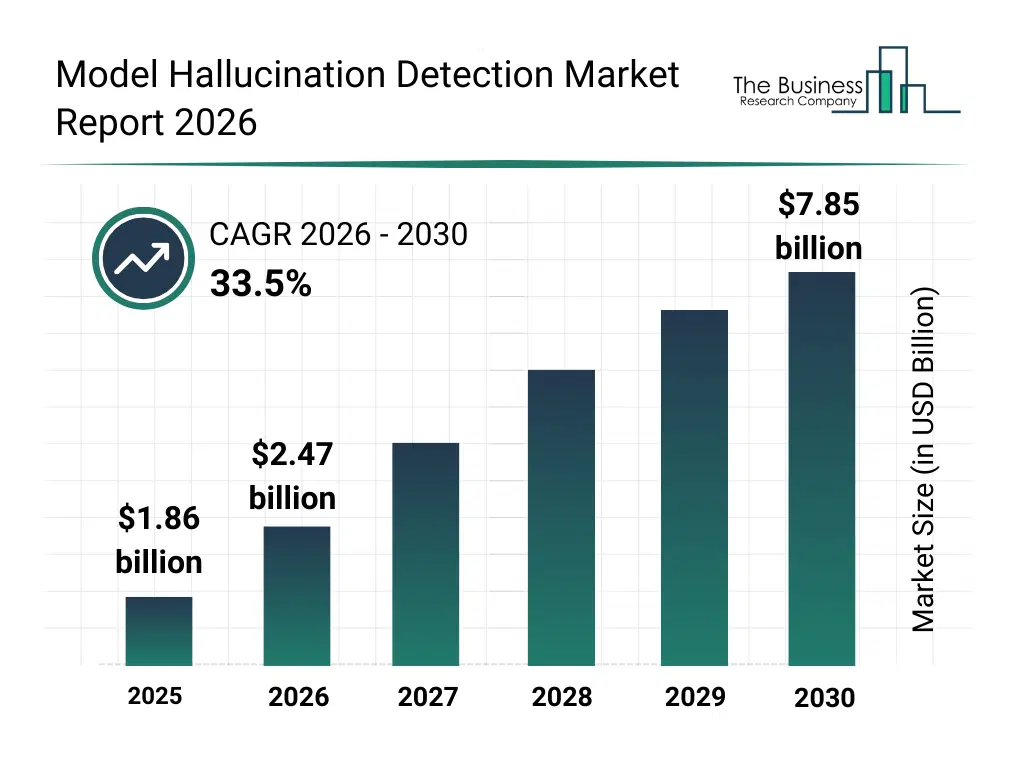
What Is The Model Hallucination Detection Market Size and Share 2026?
The model hallucination detection market size has grown exponentially in recent years. It will grow from $1.86 billion in 2025 to $2.47 billion in 2026 at a compound annual growth rate (CAGR) of 33.2%. The growth in the historic period can be attributed to rapid adoption of generative AI models, increasing instances of AI-generated misinformation, growing enterprise reliance on automated decision systems, rising regulatory scrutiny on AI transparency, expansion of cloud-based AI deployments.What Is The Model Hallucination Detection Market Growth Forecast?
The model hallucination detection market size is expected to see exponential growth in the next few years. It will grow to $7.85 billion in 2030 at a compound annual growth rate (CAGR) of 33.5%. The growth in the forecast period can be attributed to increasing demand for trustworthy AI frameworks, growing investment in AI governance infrastructure, rising deployment of enterprise AI monitoring solutions, expansion of AI use in high-risk sectors, increasing need for real-time AI validation tools. Major trends in the forecast period include rising adoption of AI model auditing services, increasing deployment of real-time hallucination monitoring platforms, growing demand for compliance and governance consulting, expansion of data annotation and validation services, integration of explainability and visualization tools in AI testing.Global Model Hallucination Detection Market Segmentation
1) By Component: Software, Hardware, Services 2) By Deployment Mode: On-Premises, Cloud 3) By Enterprise Size: Small And Medium Enterprises, Large Enterprises 4) By Application: Content Generation Validation, Conversational Artificial Intelligence (AI) Monitoring, Decision Support Systems, Enterprise Artificial Intelligence (AI) Governance 5) By End-User: Banking, Financial Services, And Insurance (BFSI), Healthcare, Retail And E-commerce, Media And Entertainment, Manufacturing, Information Technology And Telecommunications, Other End-Users Subsegments: 1) By Software: Model Monitoring Platforms, Hallucination Detection Algorithms, Explainability And Visualization Tools, Data Validation And Quality Management Software, Reporting And Analytics Solutions 2) By Hardware: High Performance Servers, Graphics Processing Units, Edge Computing Devices, Data Storage Systems, Network Infrastructure Equipment 3) By Services: Consulting And Strategy Services, System Integration And Deployment Services, Model Auditing And Validation Services, Training And Knowledge Transfer Services, Maintenance And Technical Support ServicesWhat Is The Driver Of The Model Hallucination Detection Market?
The rapid adoption of generative AI and large language models (LLMs) is expected to propel the growth of the model hallucination detection market going forward. Generative AI and large language models (LLMs) are advanced artificial intelligence systems that generate human?like text, code, or content in response to user prompts. Adoption of generative AI and LLMs is rising due to organizations and individuals increasingly integrating these tools into business and daily tasks to enhance productivity and decision support. Model hallucination detection solutions help ensure the accuracy and reliability of outputs from generative AI and LLM deployments, addressing the rising demand for trustworthy AI in critical applications. For instance, in November 2025, according to the Federal Reserve Bank of St. Louis, a US-based government?affiliated central banking institution, overall adoption of generative AI for both professional and personal use rose significantly between August 2024 and August 2025. In August 2024, 44.6% of adults aged 18–64 reported using generative AI, and over the following 12 months, this share increased by 10 percentage points, reaching 54.6%. Therefore, a rapid adoption of generative AI and large language models (LLMs) is driving the growth of the model hallucination detection industry.Key Players In The Global Model Hallucination Detection Market
Major companies operating in the model hallucination detection market are Arthur AI Inc, Aporia Technologies Ltd, Patronus AI Inc, Vectara Inc, Confident AI Inc, Lakera AI AG, Galileo Technologies Inc, Helicone Inc, Weights and Biases LLC, Fiddler Labs Inc, Arize AI Inc, Giskard Datatech Private Limited, Deepchecks Inc, Parea AI Inc, RivetAI Inc, Credo AI Corp, NannyML NV, Portkey AI Software India Private Limited, LatticeFlow AG, Robust Intelligence Inc, Monitaur Inc, Seldon Technologies Limited, UpTrain AI India Private Limited, Langfuse GmbH, and Magniv Inc.Global Model Hallucination Detection Market Trends and Insights
Major companies operating in the model hallucination detection market are focusing on technological advancements, such as real‑time hallucination detection models, to improve the accuracy, reliability, and trustworthiness of AI-generated outputs across critical applications. Real-time hallucination detection models refer to AI systems that continuously monitor and evaluate outputs from generative models as they are produced, identifying inaccuracies or unsupported information immediately. For instance, in July 2024, Patronus AI, a US‑based AI safety platform company, launched Lynx, a state-of-the-art, open-source hallucination detection model designed to identify inaccurate or unfaithful responses generated by large language models (LLMs) in real time. It helps enterprises and developers improve the reliability of AI outputs without relying heavily on manual annotation or expensive proprietary “LLM-as-a-judge” approaches. Patronus AI also introduced HaluBench, a real-world benchmark dataset to evaluate hallucination detection performance across domains like finance and medicine. Lynx reportedly outperforms leading models such as GPT-4o, GPT-4-Turbo, and Claude-3 in detecting hallucinations.What Are Latest Mergers And Acquisitions In The Model Hallucination Detection Market?
In May 2024, Snowflake Inc., a US-based provider of cloud data platforms and AI data solutions, acquired the TruEra AI Observability platform from TruEra for an undisclosed amount. With this acquisition, Snowflake aimed to strengthen its AI governance and reliability capabilities by integrating TruEra’s AI quality evaluation, monitoring, and observability tools to improve LLM performance and help reduce risks such as hallucinations in enterprise AI applications, and enhance trust and responsible AI adoption. TruEra is a US-based AI observability provider that supports model hallucination detection and mitigation, especially for language model applications.Regional Insights
North America was the largest region in the model hallucination detection market in 2025. Asia-Pacific is expected to be the fastest-growing region in the forecast period. The regions covered in this market report are Asia-Pacific, South East Asia, Western Europe, Eastern Europe, North America, South America, Middle East, Africa. The countries covered in this market report are Australia, Brazil, China, France, Germany, India, Indonesia, Japan, Taiwan, Russia, South Korea, UK, USA, Canada, Italy, Spain.What Defines the Model Hallucination Detection Market?
The model hallucination detection market consists of revenues earned by entities by providing services such as AI model validation services, hallucination risk assessment, model auditing services, AI testing and evaluation, data annotation services, compliance and governance consulting, AI monitoring and reporting services, and system integration services. The market value includes the value of related goods sold by the service provider or included within the service offering. The model hallucination detection market also includes sales of AI accelerator hardware, GPU servers, edge AI devices, inference chips, secure data storage systems, on-premise AI appliances, high-performance computing clusters, and network security appliances. Values in this market are ‘factory gate’ values, that is, the value of goods sold by the manufacturers or creators of the goods, whether to other entities (including downstream manufacturers, wholesalers, distributors, and retailers) or directly to end customers. The value of goods in this market includes related services sold by the creators of the goods.How is Market Value Defined and Measured?
The market value is defined as the revenues that enterprises gain from the sale of goods and/or services within the specified market and geography through sales, grants, or donations in terms of the currency (in USD unless otherwise specified). The revenues for a specified geography are consumption values that are revenues generated by organizations in the specified geography within the market, irrespective of where they are produced. It does not include revenues from resales along the supply chain, either further along the supply chain or as part of other products.What Key Data and Analysis Are Included in the Model Hallucination Detection Market Report 2026?
The model hallucination detection market research report is one of a series of new reports from The Business Research Company that provides model hallucination detection market statistics, including model hallucination detection industry global market size, regional shares, competitors with a model hallucination detection market share, detailed model hallucination detection market segments, market trends and opportunities, and any further data you may need to thrive in the model hallucination detection industry. This model hallucination detection market research report delivers a complete perspective of everything you need, with an in-depth analysis of the current and future scenario of the industry.Model Hallucination Detection Market Report Forecast Analysis
| Report Attribute | Details |
|---|---|
| Market Size Value In 2026 | $2.47 billion |
| Revenue Forecast In 2035 | $7.85 billion |
| Growth Rate | CAGR of 33.2% from 2026 to 2035 |
| Base Year For Estimation | 2025 |
| Actual Estimates/Historical Data | 2020-2025 |
| Forecast Period | 2026 - 2030 - 2035 |
| Market Representation | Revenue in USD Billion and CAGR from 2026 to 2035 |
| Segments Covered | Component, Deployment Mode, Enterprise Size, Application, End-User |
| Regional Scope | Asia-Pacific, Western Europe, Eastern Europe, North America, South America, Middle East, Africa |
| Country Scope | The countries covered in the report are Australia, Brazil, China, France, Germany, India, ... |
| Key Companies Profiled | Arthur AI Inc, Aporia Technologies Ltd, Patronus AI Inc, Vectara Inc, Confident AI Inc, Lakera AI AG, Galileo Technologies Inc, Helicone Inc, Weights and Biases LLC, Fiddler Labs Inc, Arize AI Inc, Giskard Datatech Private Limited, Deepchecks Inc, Parea AI Inc, RivetAI Inc, Credo AI Corp, NannyML NV, Portkey AI Software India Private Limited, LatticeFlow AG, Robust Intelligence Inc, Monitaur Inc, Seldon Technologies Limited, UpTrain AI India Private Limited, Langfuse GmbH, and Magniv Inc. |
| Customization Scope | Request for Customization |
| Pricing And Purchase Options | Explore Purchase Options |
Frequently Asked Questions
The Model Hallucination Detection market was valued at $1.86 billion in 2025, increased to $2.47 billion in 2026, and is projected to reach $7.85 billion by 2030.
request a sample hereThe global Model Hallucination Detection market is expected to grow at a CAGR of 33.5% from 2026 to 2035 to reach $7.85 billion by 2035.
request a sample hereSome Key Players in the Model Hallucination Detection market Include, Arthur AI Inc, Aporia Technologies Ltd, Patronus AI Inc, Vectara Inc, Confident AI Inc, Lakera AI AG, Galileo Technologies Inc, Helicone Inc, Weights and Biases LLC, Fiddler Labs Inc, Arize AI Inc, Giskard Datatech Private Limited, Deepchecks Inc, Parea AI Inc, RivetAI Inc, Credo AI Corp, NannyML NV, Portkey AI Software India Private Limited, LatticeFlow AG, Robust Intelligence Inc, Monitaur Inc, Seldon Technologies Limited, UpTrain AI India Private Limited, Langfuse GmbH, and Magniv Inc..
request a sample hereMajor trend in this market includes: Advancements In Artificial Intelligence (AI) Safety Technologies Improve Model Hallucination Detection And Output Reliability. For further insights on this market.
request a sample hereNorth America was the largest region in the model hallucination detection market in 2025. Asia-Pacific is expected to be the fastest-growing region in the forecast period. The regions covered in the model hallucination detection market report are Asia-Pacific, South East Asia, Western Europe, Eastern Europe, North America, South America, Middle East, Africa.
request a sample here