
Missile Interceptors Market Report 2026
Global Outlook – By Type (Kinetic Kill Interceptors, Explosive Warhead Interceptors, Directed Energy Interceptors), By Range (Short-Range Interceptors, Medium-Range Interceptors, Long-Range Interceptors), By Platform (Ground-Based, Naval-Based, Airborne-Based), By End User (Military Defense Forces, Homeland Security Departments, Joint Multinational Defense Coalitions) – Market Size, Trends, Strategies, and Forecast to 2035
Missile Interceptors Market Overview
• Missile Interceptors market size has reached to $13.56 billion in 2025 • Expected to grow to $19.88 billion in 2030 at a compound annual growth rate (CAGR) of 8% • Growth Driver: Rising Defense Budgets Fueling The Growth Of The Market Due To Increased Investment In Advanced Air And Missile Defense Systems • Market Trend: Expansion Of Integrated Air And Missile Defense Programs Accelerates Interceptor Deployment • North America was the largest region in 2025 and Asia-Pacific is the fastest growing region.What Is Covered Under Missile Interceptors Market?
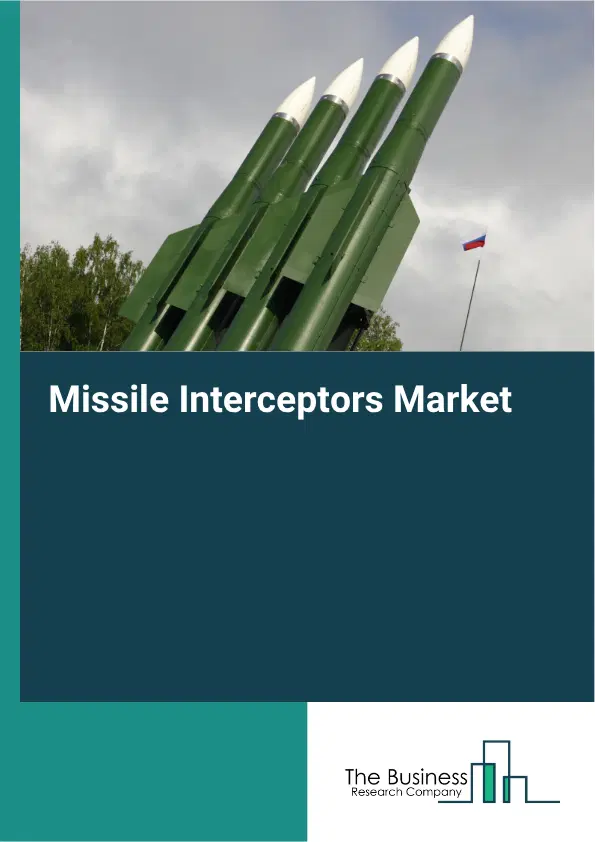
Missile interceptors refers to advanced defense systems designed to detect, track, and neutralize incoming ballistic or airborne missiles before they reach their intended targets. These systems typically include interceptor missiles, launch platforms, radar and sensor networks, guidance and control systems, and command-and-control infrastructure. Missile interceptors are deployed by military and defense organizations to protect strategic assets, civilian populations, and critical infrastructure from missile threats. The main types of missile interceptors include kinetic kill interceptors, explosive warhead interceptors, and directed energy interceptors. Kinetic kill interceptors refer to systems designed to destroy incoming missiles through direct collision, neutralizing threats without explosive payloads. These systems are categorized by range such as short-range interceptors, medium-range interceptors, and long-range interceptors. They are deployed through platforms including ground-based, naval-based, and airborne-based systems, serving end users including military defense forces, homeland security departments, and joint multinational defense coalitions.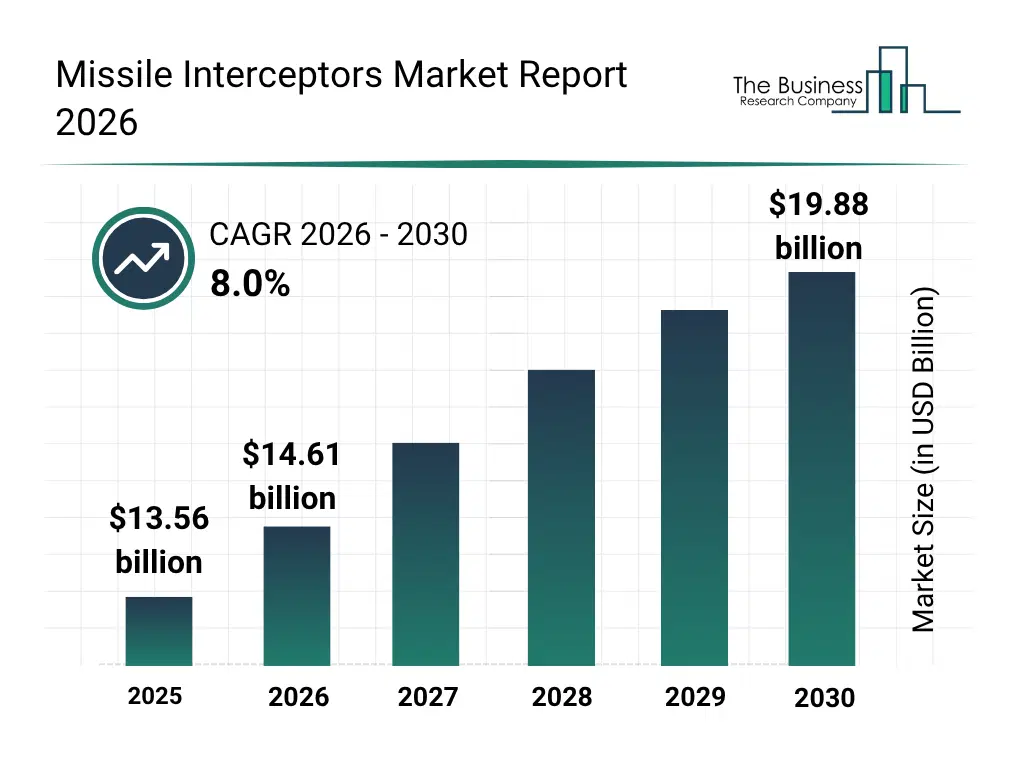
What Is The Missile Interceptors Market Size and Share 2026?
The missile interceptors market size has grown strongly in recent years.It will grow from $13.56 billion in 2025 to $14.61 billion in 2026 at a compound annual growth rate (CAGR) of 7.8%. The growth in the historic period can be attributed to rising global geopolitical tensions, increasing missile proliferation among nations, development of early ballistic missile defense systems, growing defense modernization programs, expansion of radar and surveillance infrastructure.What Is The Missile Interceptors Market Growth Forecast?
The missile interceptors market size is expected to see strong growth in the next few years.It will grow to $19.88 billion by 2030 at a compound annual growth rate (CAGR) of 8.0%. The growth in the forecast period can be attributed to rising adoption of hypersonic defense countermeasures, increasing investment in multi-domain defense systems, growth in autonomous and AI-enabled defense platforms, expansion of space-based missile detection systems, increasing focus on national security and critical infrastructure protection.Major trends in the forecast period include increasing deployment of multi-layered missile defense architectures integrating space, air, and ground-based intercept systems, rising adoption of advanced radar and sensor fusion technologies for faster threat detection and tracking, growing integration of hypersonic missile interception capabilities in defense systems, expansion of modular and mobile interceptor launch platforms for rapid battlefield deployment, increasing use of network-centric warfare systems for real-time command and control coordination of missile defense operations.
Global Missile Interceptors Market Segmentation
1) By Type: Kinetic Kill Interceptors, Explosive Warhead Interceptors, Directed Energy Interceptors 2) By Range: Short-Range Interceptors, Medium-Range Interceptors, Long-Range Interceptors 3) By Platform: Ground-Based, Naval-Based, Airborne-Based 4) By End User: Military Defense Forces, Homeland Security Departments, Joint Multinational Defense Coalitions Subsegments: 1) By Kinetic Kill Interceptors: Exo Atmospheric Interceptors, Endo Atmospheric Interceptors, Midcourse Interception Systems, Terminal Phase Interceptors, Ground Based Interceptors 2) By Explosive Warhead Interceptors: Fragmentation Warhead Interceptors, Blast Fragmentation Warhead Interceptors, Proximity Fuze Warhead Interceptors, High Explosive Warhead Interceptors, Directional Fragmentation Warhead Interceptors 3) By Directed Energy Interceptors: High Energy Laser Interceptors, Particle Beam Interceptors, Microwave Energy Interceptors, Laser Based Missile Defense Systems, Electromagnetic Energy InterceptorsWhat Is The Driver Of The Missile Interceptors Market?
The rising defense budgets are expected to propel the growth of the missile interceptors industry going forward.Defense budgets represent government allocations for military capabilities, including research, development, procurement, and operational deployment of defense systems.These budgets are increasing due to heightened security concerns, modernization initiatives, and evolving aerial and missile threats.As a result, governments are allocating a growing portion of defense spending toward air and missile defense systems, including interceptor procurement and upgrades.For instance, in February 2024, according to the North Atlantic Treaty Organization (NATO), a Belgium-based intergovernmental military alliance, reported that its member states collectively spent over USD 1.3 trillion on defense in 2023, reflecting a real-term increase of about 3% from 2022.Therefore, rising defense budgets are driving the growth of the Missile Interceptors industry.Key Players In The Global Missile Interceptors Market
Major companies operating in the missile interceptors market are Boeing, Raytheon Technologies, Lockheed Martin, General Dynamics, Northrop Grumman, BAE Systems, Mitsubishi Heavy Industries, Thales Group, L3Harris Technologies, Leonardo S. p. A., Hanwha Aerospace, Elbit Systems, Israel Aerospace Industries, Saab AB, Rafael Advanced Defense Systems, Kongsberg Defence and Aerospace, MBDA, Aerojet Rocketdyne, Roketsan, Denel Dynamics, Bharat Dynamics LimitedGlobal Missile Interceptors Market Trends and Insights
Major companies operating in the missile interceptors market are focusing on developing innovative interceptors, such as networked multi-layer interception platforms, to enhance detection accuracy, improve engagement coordination, and reduce response time against complex aerial threats. Integrated air and missile defense systems combine radar networks, command-and-control infrastructure, and interceptor launch units into a unified architecture that enables real-time threat tracking and coordinated engagement across multiple defense layers. These systems strengthen national security frameworks by improving interoperability between sensors and interceptors while increasing system scalability. For instance, in December 2023, the U. S. Army, a US-based defense organization, conducted live-fire testing of the Integrated Battle Command System (IBCS) as part of its air and missile defense modernization program, demonstrating improved sensor-to-shooter integration and successful engagement coordination between multiple defense assets. Furthermore, increasing geopolitical tensions and the proliferation of advanced missile technologies are encouraging governments to invest in layered defense systems capable of countering diverse and simultaneous threats.What Are Latest Mergers And Acquisitions In The Missile Interceptors Market?
In March 2026, Anduril Industries, a US-based defense technology company, acquired ExoAnalytic Solutions for an undisclosed amount. The acquisition aims to strengthen Anduril’s capabilities in space sensing, tracking, and battle management systems used for missile interception programs. ExoAnalytic Solutions is a US-based company that develops advanced technologies for missile defense systems, including AI-driven tracking and discrimination algorithms that enhance interceptor effectiveness.Regional Insights
North America was the largest region in the missile interceptors market in 2025. Asia-Pacific is expected to be the fastest-growing region in the forecast period. The regions covered in this market report are Asia-Pacific, South East Asia, Western Europe, Eastern Europe, North America, South America, Middle East and Africa. The countries covered in this market report are Australia, Brazil, China, France, Germany, India, Indonesia, Japan, Taiwan, Russia, South Korea, UK, USA, Canada, Italy, Spain.What Defines the Missile Interceptors Market?
The missile interceptors market consists of sales of ballistic missile interceptor, exo-atmospheric interceptors and endo-atmospheric interceptors. The market value also includes the sale of related goods, including interceptor missiles, launch systems, radar and tracking equipment, and guidance of electronics. Values in this market are measured at ‘factory gate’ prices—that is, the value of goods sold by manufacturers or creators, whether to other entities (including downstream defense contractors, distributors, and military organizations) or directly to end customers. The value of these goods includes any related services provided by the manufacturers.What is the Market Assessment and Strategic Outlook for the Missile Interceptors Industry?
The missile interceptors market research report is one of a series of new reports from The Business Research Company that provides market statistics, including industry global market size, regional shares, competitors with the market share, detailed market segments, market trends and opportunities, and any further data you may need to thrive in the missile interceptors industry. The market research report delivers a complete perspective of everything you need, with an in-depth analysis of the current and future state of the industry.What is the Market Assessment and Strategic Outlook for the Missile Interceptors Market Report 2026?
The missile interceptors market research report is one of a series of new reports from The Business Research Company that provides missile interceptors market statistics, including missile interceptors industry global market size, regional shares, competitors with a missile interceptors market share, detailed missile interceptors market segments, market trends and opportunities, and any further data you may need to thrive in the missile interceptors industry. This missile interceptors market research report delivers a complete perspective of everything you need, with an in-depth analysis of the current and future scenario of the industry.Missile Interceptors Market Report Forecast Analysis
| Report Attribute | Details |
|---|---|
| Market Size Value In 2026 | $14.61 billion |
| Revenue Forecast In 2035 | $19.88 billion |
| Growth Rate | CAGR of 8.0% from 2026 to 2035 |
| Base Year For Estimation | 2025 |
| Actual Estimates/Historical Data | 2020-2025 |
| Forecast Period | 2026 - 2030 - 2035 |
| Market Representation | Revenue in USD Billion and CAGR from 2026 to 2035 |
| Segments Covered | Type, Range, Platform, End User |
| Regional Scope | Asia-Pacific, Western Europe, Eastern Europe, North America, South America, Middle East, Africa |
| Country Scope | The countries covered in the report are Australia, Brazil, China, France, Germany, India, Indonesia, Japan, Taiwan, Russia, South Korea, UK, USA, Canada, Italy, Spain. |
| Key Companies Profiled | Boeing, Raytheon Technologies, Lockheed Martin, General Dynamics, Northrop Grumman, BAE Systems, Mitsubishi Heavy Industries, Thales Group, L3Harris Technologies, Leonardo S. p. A., Hanwha Aerospace, Elbit Systems, Israel Aerospace Industries, Saab AB, Rafael Advanced Defense Systems, Kongsberg Defence and Aerospace, MBDA, Aerojet Rocketdyne, Roketsan, Denel Dynamics, Bharat Dynamics Limited |
| Customization Scope | Request for Customization |
| Pricing And Purchase Options | Explore Purchase Options |