
Metro Market Report 2026

Metro Market Report 2026
Global Outlook – By Type (Autonomous, Manual), By Structure (Elevated, Underground, At-Grade), By Service Type (Passenger Transportation, Ticketing And Fare Management, Station And Facility Management), By Application (Local Commute Transportation, Amusement Parks, Other Applications), By End User (Daily Commuters, Tourists And Visitors, Corporate And Institutional Users, Students) – Market Size, Trends, Strategies, and Forecast to 2035
Metro Market Overview
• Metro market size has reached to $68 billion in 2025 • Expected to grow to $93 billion in 2030 at a compound annual growth rate (CAGR) of 6.5% • Growth Driver: The Rising Urban Traffic Congestion Driving The Growth Of The Due To Increasing Vehicle Ownership • Market Trend: Advancements In Indigenous Signalling And Train Supervision Technologies Enhance Rail Network Efficiency And Safety • Asia-Pacific was the largest region and fastest growing region.

What Is Covered Under Metro Market?
A metro refers to a high-capacity urban rail transit system designed to transport large numbers of passengers efficiently within metropolitan areas. It typically operates on dedicated tracks separated from road traffic, ensuring faster travel, higher frequency, and improved reliability compared to conventional rail or road transport. The main types of metro systems include autonomous and manual. Autonomous refers to metro operations that utilize driverless train technology and automated control systems to manage movement, scheduling, and safety with minimal human intervention. The various structures involved are elevated and underground and at-grade and support passenger transportation and ticketing and fare management and station and facility management. The applications include local commute transportation and amusement parks and others and are utilized by end users such as daily commuters, tourists and visitors, corporate and institutional users, and students.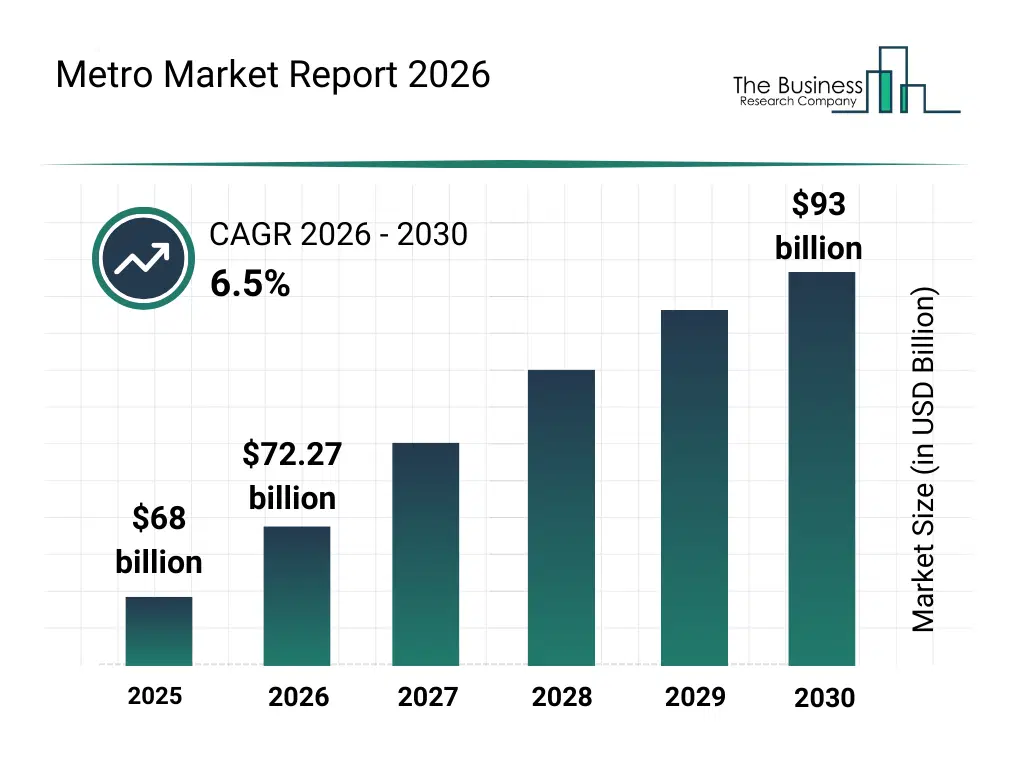
What Is The Metro Market Size and Share 2026?
The metro market size has grown strongly in recent years. It will grow from $68 billion in 2025 to $72.27 billion in 2026 at a compound annual growth rate (CAGR) of 6.3%. The growth in the historic period can be attributed to rapid urbanization in metropolitan regions, rising road traffic congestion, government investment in public transport infrastructure, population growth in cities, demand for cost-effective mass transit.What Is The Metro Market Growth Forecast?
The metro market size is expected to see strong growth in the next few years. It will grow to $93 billion in 2030 at a compound annual growth rate (CAGR) of 6.5%. The growth in the forecast period can be attributed to smart city development initiatives, increasing adoption of autonomous metro systems, rising environmental concerns and emission reduction goals, expansion of metro projects in emerging economies, growing public-private partnerships in rail infrastructure. Major trends in the forecast period include expansion of metro rail networks in urban areas, increasing investments in underground and elevated infrastructure, rising demand for high-capacity rolling stock, growing adoption of advanced signaling systems, increasing focus on passenger safety and comfort.Global Metro Market Segmentation
1) By Type: Autonomous, Manual 2) By Structure: Elevated, Underground, At-Grade 3) By Service Type: Passenger Transportation, Ticketing And Fare Management, Station And Facility Management 4) By Application: Local Commute Transportation, Amusement Parks, Other Applications 5) By End User: Daily Commuters, Tourists And Visitors, Corporate And Institutional Users, Students Subsegments: 1) By Autonomous: Driverless Train Operation, Fully Automated Control Systems, Remote Monitoring And Management, Artificial Intelligence Based Scheduling, Sensor Based Safety Systems 2) By Manual: Driver Operated Trains, Human Controlled Signalling, Manual Speed Regulation, Operator Assisted Safety Systems, Conventional Train ManagementWhat Is The Driver Of The Metro Market?
The rise in urban traffic congestion is expected to propel the growth of the metro market in comping years. Urban traffic congestion refers to a condition in which the volume of vehicles on road networks exceeds their capacity, resulting in slower travel speeds, longer travel times, and increased delays. The rising urban traffic congestion is due to increasing vehicle ownership, as more private vehicles on limited road infrastructure led to higher traffic density and slower travel speeds. Metro systems help address traffic congestion by shifting large volumes of commuters from private vehicles to fast, reliable, and space-efficient public transportation. For instance, in June 2025, according to the Department for Transport (DfT), a UK-based ministerial department, motor vehicle traffic on Great Britain’s roads reached 336.2 billion vehicle miles in 2024, representing a 1.6% increase compared to 2023. Therefore, rising urban traffic congestion is driving the growth of the metro industry.Key Players In The Global Metro Market
Major companies operating in the metro market are Siemens AG, Hitachi Ltd., Mitsubishi Heavy Industries Ltd., Thales S.A., Kawasaki Heavy Industries Ltd., Wabtec Corporation, Webuild S.p.A., Acciona S.A., Balfour Beatty plc, Construcciones y Auxiliar de Ferrocarriles S.A, HyundAI Rotem Company, Delhi Metro Rail Corporation Limited, Keller Group plc, Vossloh AG, SBS Transit Ltd., Hübner GmbH And Co. KG, Bharat Earth Movers Limited, Noida Metro Rail Corporation Limited, Taipei Rapid Transit Corporation, MumbAI Metro One Private Limited, and Medha Servo Drives Private Limited.Global Metro Market Trends and Insights
Major companies operating in the metro market are focusing on developing advanced technologies, such as signalling and train supervision systems, to enhance operational efficiency, safety, and real-time monitoring of rail networks. Signalling and train supervision systems are technologies that control train movements, manage track signals, and monitor real-time operations to ensure safe, efficient, and coordinated railway services. For instance, in February 2023, Delhi Metro Rail Corporation (DMRC), an India-based transport company, partnered with Bharat Electronics Limited, an India-based manufacturing company, to launch the indigenous automatic train supervision (i-ATS) system, a signaling and train supervision system. The system is a locally developed train control and supervision platform designed to monitor train operations, manage running schedules, and ensure precise control over train movements across metro corridors. It is built as a flexible, computer-based module that integrates with communication-based train control (CBTC) signalling frameworks and reduces reliance on foreign signalling vendors. The solution enhances operational reliability, supports automation and driverless operations, and can be adapted for deployment across other rail-based transit systems in the future.What Are Latest Mergers And Acquisitions In The Metro Market?
In February 2026, Colliers International Group Inc., a Canada‑based diversified professional services and investment management company, acquired Ramos Consulting Services for an undisclosed amount. With this acquisition, Colliers aims to expand and deepen its U.S. public transportation engineering and infrastructure capabilities in a key market by integrating specialized transit program management and construction expertise into its engineering segment. Ramos Consulting Services Inc. is a US‑based transit engineering and program management firm that specializes in providing program management, construction management, and engineering support services for Los Angeles metro projects.Regional Insights
Asia-Pacific was the largest region in the metro market in 2025 and is expected to be the fastest-growing region in the forecast period. The regions covered in this market report are Asia-Pacific, South East Asia, Western Europe, Eastern Europe, North America, South America, Middle East, Africa. The countries covered in this market report are Australia, Brazil, China, France, Germany, India, Indonesia, Japan, Taiwan, Russia, South Korea, UK, USA, Canada, Italy, Spain.What Defines the Metro Market?
The metro market consists of sales of metro trains and rolling stock, ticketing and fare collection systems, signaling and communication systems, infrastructure components, and power supply and electrification systems. Values in this market are ‘factory gate’ values, that is, the value of goods sold by the manufacturers or creators of the goods, whether to other entities (including downstream manufacturers, wholesalers, distributors, and retailers) or directly to end customers. The value of goods in this market includes related services sold by the creators of the goods.How is Market Value Defined and Measured?
The market value is defined as the revenues that enterprises gain from the sale of goods and/or services within the specified market and geography through sales, grants, or donations in terms of the currency (in USD unless otherwise specified). The revenues for a specified geography are consumption values that are revenues generated by organizations in the specified geography within the market, irrespective of where they are produced. It does not include revenues from resales along the supply chain, either further along the supply chain or as part of other products.What Key Data and Analysis Are Included in the Metro Market Report 2026?
The metro market research report is one of a series of new reports from The Business Research Company that provides metro market statistics, including metro industry global market size, regional shares, competitors with a metro market share, detailed metro market segments, market trends and opportunities, and any further data you may need to thrive in the metro industry. This metro market research report delivers a complete perspective of everything you need, with an in-depth analysis of the current and future scenario of the industry.Metro Market Report Forecast Analysis
| Report Attribute | Details |
|---|---|
| Market Size Value In 2026 | $72.27 billion |
| Revenue Forecast In 2035 | $93 billion |
| Growth Rate | CAGR of 6.3% from 2026 to 2035 |
| Base Year For Estimation | 2025 |
| Actual Estimates/Historical Data | 2020-2025 |
| Forecast Period | 2026 - 2030 - 2035 |
| Market Representation | Revenue in USD Billion and CAGR from 2026 to 2035 |
| Segments Covered | Type, Structure, Service Type, Application, End User |
| Regional Scope | Asia-Pacific, Western Europe, Eastern Europe, North America, South America, Middle East, Africa |
| Country Scope | The countries covered in the report are Australia, Brazil, China, France, Germany, India, ... |
| Key Companies Profiled | Siemens AG, Hitachi Ltd., Mitsubishi Heavy Industries Ltd., Thales S.A., Kawasaki Heavy Industries Ltd., Wabtec Corporation, Webuild S.p.A., Acciona S.A., Balfour Beatty plc, Construcciones y Auxiliar de Ferrocarriles S.A, HyundAI Rotem Company, Delhi Metro Rail Corporation Limited, Keller Group plc, Vossloh AG, SBS Transit Ltd., Hübner GmbH And Co. KG, Bharat Earth Movers Limited, Noida Metro Rail Corporation Limited, Taipei Rapid Transit Corporation, MumbAI Metro One Private Limited, and Medha Servo Drives Private Limited. |
| Customization Scope | Request for Customization |
| Pricing And Purchase Options | Explore Purchase Options |
Frequently Asked Questions
The Metro market was valued at $68 billion in 2025, increased to $72.27 billion in 2026, and is projected to reach $93 billion by 2030.
request a sample hereThe global Metro market is expected to grow at a CAGR of 6.5% from 2026 to 2035 to reach $93 billion by 2035.
request a sample hereSome Key Players in the Metro market Include, Siemens AG, Hitachi Ltd., Mitsubishi Heavy Industries Ltd., Thales S.A., Kawasaki Heavy Industries Ltd., Wabtec Corporation, Webuild S.p.A., Acciona S.A., Balfour Beatty plc, Construcciones y Auxiliar de Ferrocarriles S.A, HyundAI Rotem Company, Delhi Metro Rail Corporation Limited, Keller Group plc, Vossloh AG, SBS Transit Ltd., Hübner GmbH And Co. KG, Bharat Earth Movers Limited, Noida Metro Rail Corporation Limited, Taipei Rapid Transit Corporation, MumbAI Metro One Private Limited, and Medha Servo Drives Private Limited..
request a sample hereMajor trend in this market includes: Advancements In Indigenous Signalling And Train Supervision Technologies Enhance Rail Network Efficiency And Safety. For further insights on this market.
request a sample hereAsia-Pacific was the largest region in the metro market in 2025 and is expected to be the fastest-growing region in the forecast period. The regions covered in the metro market report are Asia-Pacific, South East Asia, Western Europe, Eastern Europe, North America, South America, Middle East, Africa.
request a sample here