
Lunar Energy Harvesting Market 2026
Lunar Energy Harvesting Market 2026
By Technology (Solar Power, Nuclear Power, Regolith-Based Power, Other Technologies), By Application (Space Missions, Lunar Bases, Satellite Operations, Other Applications), By End-User (Government, Commercial, Research Institutions, Other End-Users), And By Region, Opportunities And Strategies – Global Forecast To 2035
Lunar Energy Harvesting Market Definition
Lunar energy harvesting refers to the generation of power using natural or locally available resources on or around the Moon. This market involves the development, deployment and operation of systems that convert energy sources such as solar radiation, nuclear materials, or lunar regolith into usable electrical power, specifically designed for the unique conditions of the lunar environment. The lunar energy harvesting market consists of sales by entities (organizations, sole traders and partnerships) that is used by government space agencies, private aerospace companies, research institutions, and emerging commercial lunar enterprises. These stakeholders rely on lunar energy systems to power equipment, habitats, instruments, and other assets on the lunar surface or in orbit. It is typically used during space missions, long-term lunar habitation projects, robotic explorations, and satellite operations requiring uninterrupted energy supply in the absence of terrestrial power grids.

Lunar Energy Harvesting Market Size
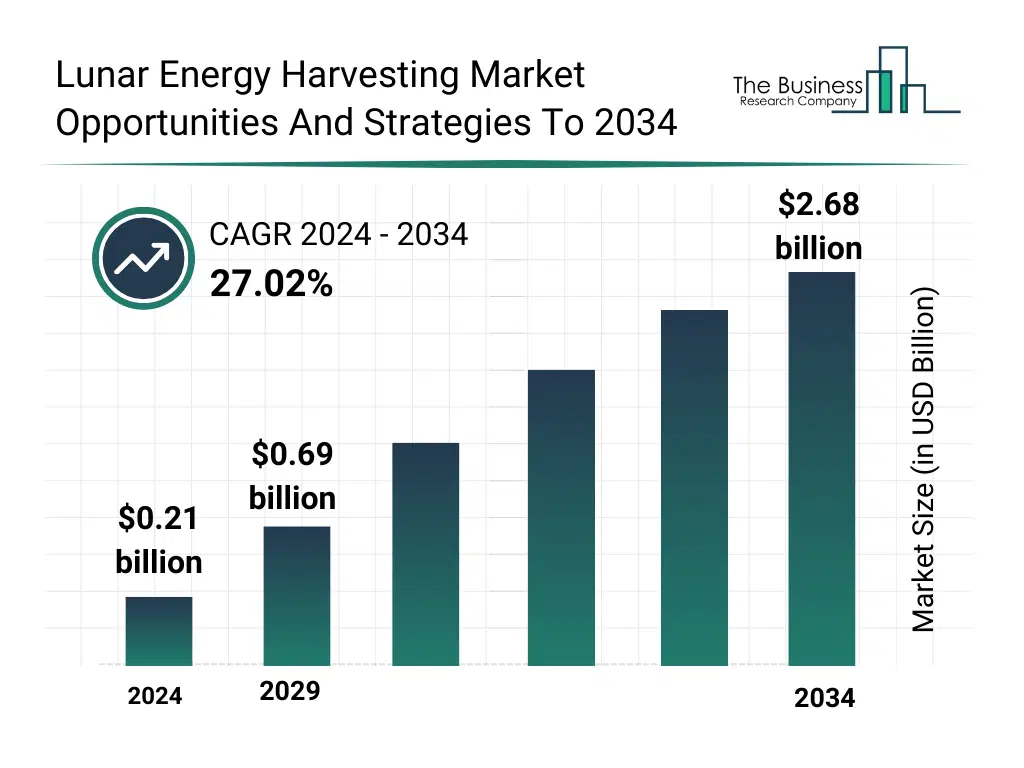
The global lunar energy harvesting market reached a value of nearly $211.47 million in 2024. The market is expected to grow from $211.47 million in 2024 to $687.52 million in 2029 at a rate of 26.59%. The market is then expected to grow at a CAGR of 31.30% from 2029 and reach $2,682.82 million in 2034. Growth in the historic period resulted from expansion of aerospace and space exploration initiatives, rise in commercial space activities, rising investment in space programs and initiatives toward space resource governance. Factors that negatively affected growth in the historic period were the limited number of committed missions and high capital and launch costs. Going forward, development of lunar habitats and surface bases, defense interest in space-based power infrastructure, advancements in in-situ resource utilization (ISRU) and growing focus on renewable and sustainable energy solutions will drive growth. Factors that could hinder the growth of the lunar energy harvesting market in the future include difficulty in wireless power transmission on the moon, limited standardization across space energy systems and impact of trade war and tariff.Lunar Energy Harvesting Market Drivers
The key drivers of the lunar energy harvesting market include: Development Of Lunar Habitats and Surface Bases During the forecast period, the development of lunar habitats and surface bases will propel the growth of the lunar energy harvesting market. Establishing permanent and semi-permanent infrastructure on the Moon requires consistent and sustainable energy systems to power essential functions such as life support, communication, research and industrial activities. Lunar habitats depend on reliable energy harvesting technologies to operate under extreme temperature variations and prolonged lunar nights. Moreover, these surface bases demand integrated energy storage and power distribution networks to support continuous operations and future human expansion. These developments highlight the growing emphasis on sustainable power systems and energy infrastructure to support lunar surface operations. The development of lunar habitats and surface bases growth contribution during the forecast period in 2024 is 2.50%.Lunar Energy Harvesting Market Restraints
The key restraints on the lunar energy harvesting market include: Limited Standardization Across Space Energy Systems Limited standardization across space energy systems is restricting the growth of the lunar energy harvesting market during the forecast period. The absence of unified technical standards for space-based power systems has created challenges in interoperability, compatibility and long-term system integration. Companies developing lunar energy technologies often rely on proprietary designs and mission-specific configurations, leading to inefficiencies and increased development costs. The lack of consistent frameworks for components such as power modules, connectors and energy transmission systems further complicates collaboration between international space agencies and private firms. This lack of standardization results in limited cross-platform compatibility, delayed system certification and higher operational risks. Growth affected by limited standardization across space energy systems during the forecast period in 2024 is -1.41%.Lunar Energy Harvesting Market Trends
Major trends shaping the lunar energy harvesting market include: Innovation in Carbothermal Oxygen Extraction Technology To Utilize Lunar Regolith Companies in the lunar resource utilization market are focusing on the development of carbothermal oxygen extraction technology designed to enable the production of oxygen directly from lunar regolith. These innovations focus on improving system efficiency, thermal stability and automation under extreme lunar conditions, while also offering scalable formats that support both scientific and commercial missions. For instance, in September 2024, Sierra Space, a US-based commercial space infrastructure company, unveiled a breakthrough reactor system capable of extracting oxygen from lunar soil using a carbothermal reduction process. The system was successfully tested at NASA’s Johnson Space Center, where it operated under simulated lunar conditions to validate its ability to separate oxygen from regolith materials. These reactors feature high-temperature resistance, vacuum-sealed chambers and fully automated regolith-handling mechanisms, offering a more reliable and efficient solution for generating oxygen to support lunar habitats and long-duration space missions. By utilizing advanced thermal-vacuum technology and years of engineering expertise, the company aims to deliver extraction systems that combine durability, precision and scalability to meet the evolving needs of future lunar exploration and habitation efforts. Enhancement of Extra-Large Vertical Solar Array Technology For Lunar Infrastructure Key player in the lunar energy infrastructure market is focusing on the development of extra-large vertical solar array technologies designed to meet the unique requirements of sustained lunar surface operations. These innovations focus on improving deployability, power output and adaptability to challenging lunar environments, while also offering scalable formats that cater to both governmental and commercial demands. For instance, in August 2024, Astrobotic Technology, a US-based aerospace company, was awarded a contract by NASA under its SBIR programme to develop the “VSAT-XL” system, a 34 m tall by 12.5 m wide vertical solar-array unit aiming for 50 kW output (up from the 10-kW baseline). These systems feature deployable and self-leveling mechanical structures, sun-tracking vertical array surfaces optimized for low solar angles near polar craters and both static and mobile variants for lander or rover integration offering a robust solution for long-duration lunar missions. By utilizing advanced space-qualified power-distribution components and leveraging experience from lunar landers and rovers, the company aims to deliver infrastructure that combines high throughput, durability and integration flexibility to meet the evolving needs of lunar surface habitats and robotic operations.Opportunities And Recommendations In The Lunar Energy Harvesting Market
Opportunities – The top opportunities in the lunar energy harvesting market segmented by technology will arise in the solar power segment, which will gain $297.54 million of global annual sales by 2029. The top opportunities in the lunar energy harvesting market segmented by application will arise in the space missions segment, which will gain $476.04 million of global annual sales by 2029. The top opportunities in the lunar energy harvesting market segmented by end-user will arise in the government segment, which will gain $283.62 million of global annual sales by 2029. The lunar energy harvesting market size will gain the most in the USA at $146.82 million. Recommendations- To take advantage of the opportunities, The Business Research Company recommends the lunar energy harvesting companies to focus on scalable carbothermal oxygen extraction from lunar regolith, focus on extra-large vertical solar arrays for sustained lunar infrastructure, focus on space-grade micro-reactors for continuous lunar power, focus on scaled-down micro-reactors for spacecraft and surface power, focus on alternative and hybrid lunar energy technologies, focus on space mission energy systems, expand in emerging markets, continue to focus on developed markets, provide competitively priced offerings, continue to use b2b promotions, participate in trade shows and events, focus on space mission energy systems, focus on commercial lunar energy customers.Lunar Energy Harvesting Market Segmentation
The lunar energy harvesting market is segmented by technology, by application and by end-user.By Technology –
The lunar energy harvesting market is segmented by technology into:
- a) Solar Power
- b) Nuclear Power
- c) Regolith-Based Power
- d) Other Technologies
By Application –
The lunar energy harvesting market is segmented by application into:
- a) Space Missions
- b) Lunar Bases
- c) Satellite Operations
- d) Other Applications
By End-User –
The lunar energy harvesting market is segmented by end-user into:
- a) Government
- b) Commercial
- c) Research Institutions
- d) Other End-Users
By Geography - The lunar energy harvesting market is segmented by geography into:
- • China
- • India
- • Japan
- • Australia
- • Indonesia
- • South Korea
- • Bangladesh
- • Thailand
- • Vietnam
- • Malaysia
- • Singapore
- • Phillipines
- • Hong kong
- • New Zealand
- • USA
- • Canada
- • Mexico
- • Brazil
- • Argentina
- • Chile
- • Colombiia
- • Peru
- • France
- • Germany
- • UK
- • Italy
- • Spain
- • Austria
- • Belgium
- • Denmark
- • Finland
- • Ireland
- • Netherland
- • Norway
- • Portugal
- • Sweden
- • Switzerland
- • Russia
- • Czech Republic
- • Poland
- • Romania
- • Ukraine
- • Saudi Arabia
- • Israel
- • Iran
- • Turkey
- • UAE o Africa
- • Egypt
- • Nigeria
- • South Africa
-
o Asia Pacific