
Liquid Organic Hydrogen Carrier (LOHC) Dehydrogenation Plant Market Report 2026
Global Outlook – By Technology (Catalytic Dehydrogenation, Thermal Dehydrogenation, Electrochemical Dehydrogenation), By Plant Capacity (Small, Medium, Large), By Application (Hydrogen Storage, Hydrogen Transportation, Industrial Hydrogen Supply, Power Generation, Other Applications), By End-User (Chemical Industry, Energy And Power, Transportation, Other End-Users) – Market Size, Trends, Strategies, and Forecast to 2035
Liquid Organic Hydrogen Carrier (LOHC) Dehydrogenation Plant Market Overview
• Liquid Organic Hydrogen Carrier (LOHC) Dehydrogenation Plant market size has reached to $1.01 billion in 2025 • Expected to grow to $2.38 billion in 2030 at a compound annual growth rate (CAGR) of 18.7% • Growth Driver: Rising Electricity Demand From Buildings Driving Growth In The Market Due To Urbanization, Population Growth, And Increasing Adoption Of Energy-Intensive Appliances • Market Trend: Integrated LOHC Supply Chains For Cross-Border Hydrogen Transport Under Ambient Conditions • Europe was the largest region in 2025 and Asia-Pacific is the fastest growing region.What Is Covered Under Liquid Organic Hydrogen Carrier (LOHC) Dehydrogenation Plant Market?
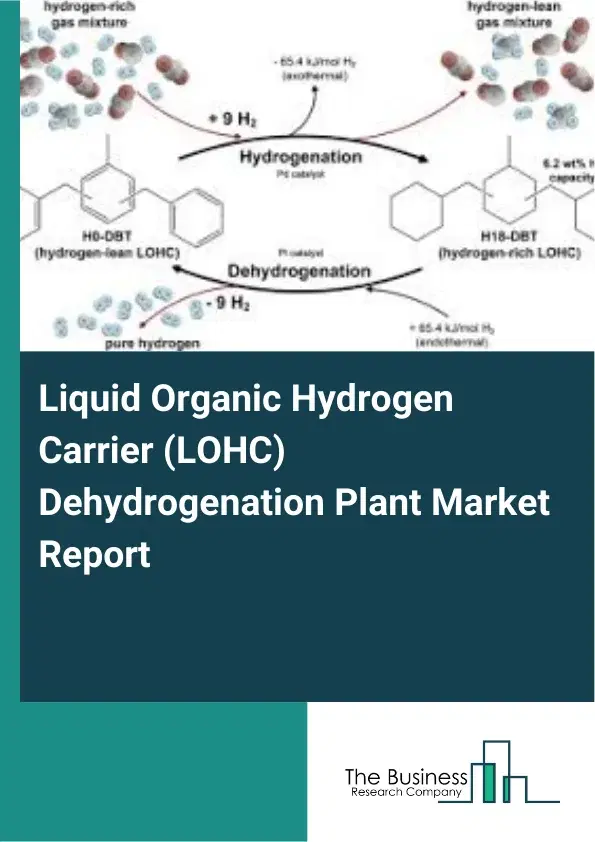
A liquid organic hydrogen carrier (LOHC) dehydrogenation plant refers to a specialized industrial facility designed to extract and release stored hydrogen from hydrogen-rich organic liquids through controlled catalytic dehydrogenation reactions, converting the carrier back into its depleted form. It integrates reactors, heat management systems, catalysts, and purification units to enable efficient, continuous, and safe hydrogen production while allowing the carrier liquid to be recycled for repeated storage and transport cycles. The main technologies of liquid organic hydrogen carrier (LOHC) dehydrogenation plant are catalytic dehydrogenation, thermal dehydrogenation, and electrochemical dehydrogenation. Catalytic dehydrogenation refers to the process of releasing hydrogen from LOHC materials using catalysts to enable efficient hydrogen recovery. These plants are available in different capacities, including small, medium, and large, and are used across various applications, such as hydrogen storage, hydrogen transportation, industrial hydrogen supply, power generation, and other applications. They serve multiple end-users, including the chemical industry, energy and power, transportation, and other end-users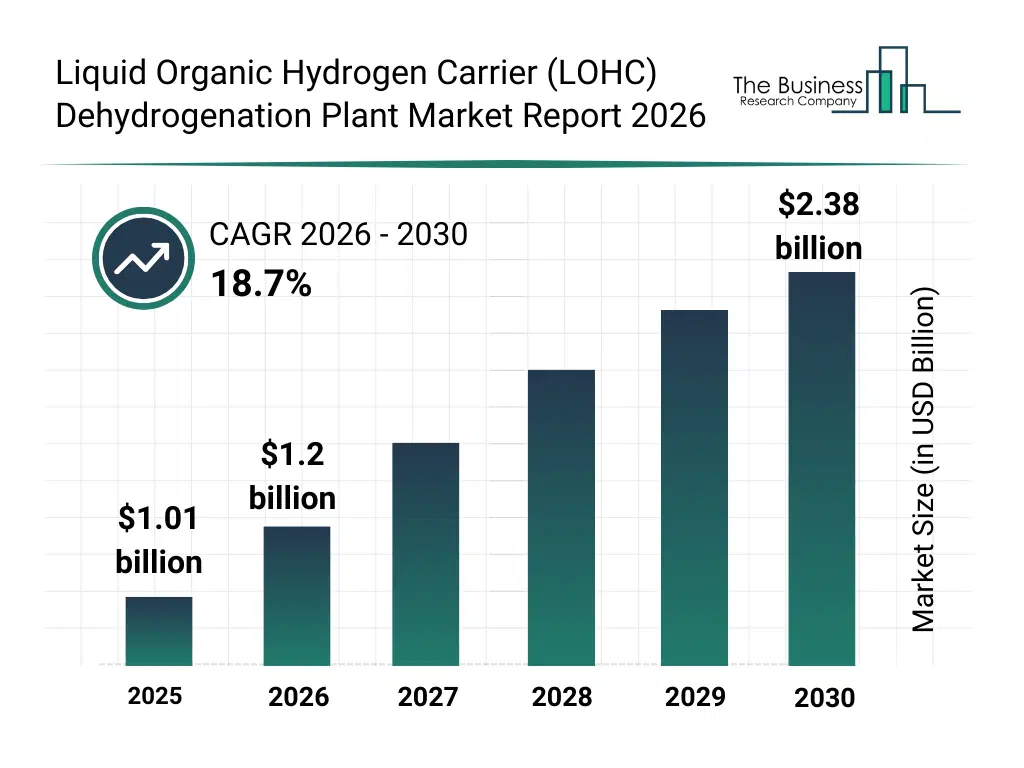
What Is The Liquid Organic Hydrogen Carrier (LOHC) Dehydrogenation Plant Market Size and Share 2026?
The liquid organic hydrogen carrier (lohc) dehydrogenation plant market size has grown rapidly in recent years. It will grow from $1.01 billion in 2025 to $1.2 billion in 2026 at a compound annual growth rate (CAGR) of 18.4%. The growth in the historic period can be attributed to growth of hydrogen pilot projects, early adoption of lohc storage concepts, advancements in catalytic reactor design, increased interest in hydrogen transport solutions, establishment of hydrogen demonstration plants.What Is The Liquid Organic Hydrogen Carrier (LOHC) Dehydrogenation Plant Market Growth Forecast?
The liquid organic hydrogen carrier (lohc) dehydrogenation plant market size is expected to see rapid growth in the next few years. It will grow to $2.38 billion in 2030 at a compound annual growth rate (CAGR) of 18.7%. The growth in the forecast period can be attributed to increasing investments in hydrogen economy infrastructure, expansion of Green Hydrogen production, rising demand for long-distance hydrogen transport, growing adoption of hydrogen in power and industry, continuous improvements in dehydrogenation efficiency. Major trends in the forecast period include increasing development of large-scale lohc dehydrogenation plants, rising adoption of catalytic dehydrogenation technologies, growing integration with hydrogen supply chains, expansion of modular and scalable plant designs, enhanced focus on thermal efficiency and catalyst performance.
Global Liquid Organic Hydrogen Carrier (LOHC) Dehydrogenation Plant Market Segmentation
1) By Technology: Catalytic Dehydrogenation; Thermal Dehydrogenation; Electrochemical Dehydrogenation 2) By Plant Capacity: Small; Medium; Large 3) By Application: Hydrogen Storage; Hydrogen Transportation; Industrial Hydrogen Supply; Power Generation; Other Applications 4) By End-User: Chemical Industry; Energy And Power; Transportation; Other End-Users Subsegments: 1) By Catalytic Dehydrogenation: Fixed-Bed Catalytic Dehydrogenation; Fluidized-Bed Catalytic Dehydrogenation; Oxidative Catalytic Dehydrogenation; Non-Oxidative Catalytic Dehydrogenation; Supported Metal Catalyst Systems 2) By Thermal Dehydrogenation: Gas-Phase Thermal Dehydrogenation; Liquid-Phase Thermal Dehydrogenation; High-Temperature Thermal Dehydrogenation; Plasma-Assisted Thermal Dehydrogenation; Autothermal Dehydrogenation 3) By Electrochemical Dehydrogenation: Low-Temperature Electrochemical Dehydrogenation; Proton-Exchange Membrane (PEM) Dehydrogenation; Solid Oxide Electrochemical Dehydrogenation; Alkaline Electrochemical Dehydrogenation; Direct Electrochemical DehydrogenationWhat Is The Driver Of The Liquid Organic Hydrogen Carrier (LOHC) Dehydrogenation Plant Market?
The rising electricity demand is expected to propel the growth of the liquid organic hydrogen carrier (LOHC) dehydrogenation plant market going forward. The electricity demand is driven by urbanization, population growth, and the increasing adoption of energy-intensive appliances, as residential, commercial, and industrial spaces expand and require more power to support modern living, work, and technological needs. The LOHC dehydrogenation plant supports electricity demand by providing a reliable and on-demand source of hydrogen-derived energy, as the stored chemical energy is converted into electricity to efficiently meet peak consumption, enhance energy security, and reduce reliance on intermittent power sources. For instance, in October 2024, according to the International Institute of Refrigeration, a France-based intergovernmental science and technology-based organization, electricity demand is projected to rise by 500 TWh by 2030 and could reach up to 700 TWh by 2035, which is approximately 20% higher than the estimates outlined in the STEPS scenario. Therefore, rising electricity demand is driving the growth of the liquid organic hydrogen carrier (LOHC) dehydrogenation plant industry.Key Players In The Global Liquid Organic Hydrogen Carrier (LOHC) Dehydrogenation Plant Market
Major companies operating in the liquid organic hydrogen carrier (lohc) dehydrogenation plant market are Shell Global, Mitsui & Co. Ltd., Siemens Energy, BASF SE, Sumitomo Corporation, Thyssenkrupp AG, Honeywell UOP, Linde plc, Mitsubishi Heavy Industries, Air Liquide, Johnson Matthey Plc, Emerson Electric Co., Air Products and Chemicals Inc, Clariant AG, Chiyoda Corporation, Haldor Topsoe A/S, Toshiba Energy Systems And Solutions Corporation, Hydrogenious LOHC Technologies, H2 Industries AG, Iwatani Corporation.Global Liquid Organic Hydrogen Carrier (LOHC) Dehydrogenation Plant Market Trends and Insights
Major companies operating in the liquid organic hydrogen carrier (LOHC) dehydrogenation plant market are increasingly expanding their strategic initiatives into integrated international hydrogen supply chain projects, aimed at enabling cross-border hydrogen trade through LOHC systems to meet diversified regional energy demand. These integrated supply chain initiatives combine storage, dehydrogenation, transportation, and logistics planning to unlock export markets and strengthen global hydrogen infrastructure, offering advantages over conventional pressurized or liquefied hydrogen transport, which requires specialized vessels or pipelines. For instance, in January 2026, Hydrogenious LOHC Technologies, a Germany-based clean energy engineering company, launched the LOHC Bridge project, a collaborative initiative with Moroccan and Egyptian partners to assess the techno-economic feasibility of LOHC-based hydrogen trade routes from North Africa to Europe. The project evaluates optimal locations for large-scale LOHC plants and export infrastructure capable of safely transporting hydrogen to European import terminals under ambient conditions. By leveraging LOHC technology’s ability to chemically bind hydrogen for secure transport using conventional liquid fuel logistics, the initiative aims to establish new international hydrogen corridors and accelerate global decarbonization through the integration of LOHC storage and dehydrogenation facilities with export and import hubs.What Are Latest Mergers And Acquisitions In The Liquid Organic Hydrogen Carrier (LOHC) Dehydrogenation Plant Market?
In January 2023, Vopak, a Netherlands-based tank storage and logistics technology company, partnered with Hydrogenious LOHC Technologies to jointly develop and scale hydrogen logistics infrastructure, including storage, transport, and supply solutions based on Hydrogenious’ liquid organic hydrogen carrier (LOHC) technology, to accelerate international hydrogen value chains and support the energy transition. Hydrogenious LOHC Technologies is a Germany-based technology company that specializes in innovative LOHC solutions for safe, efficient hydrogen storage, transport, and distribution, enabling bulk hydrogen to be handled using existing liquid fuel infrastructure.Regional Insights
Europe was the largest region in the liquid organic hydrogen carrier (LOHC) dehydrogenation plant market in 2025. Asia-Pacific is expected to be the fastest-growing region in the forecast period. The regions covered in this market report are Asia-Pacific, South East Asia, Western Europe, Eastern Europe, North America, South America, Middle East, Africa. The countries covered in this market report are Australia, Brazil, China, France, Germany, India, Indonesia, Japan, Taiwan, Russia, South Korea, UK, USA, Canada, Italy, Spain.What Defines the Liquid Organic Hydrogen Carrier (LOHC) Dehydrogenation Plant Market?
The liquid organic hydrogen carrier (LOHC) dehydrogenation plant market consists of sales of dehydrogenation reactors, hydrogen recovery systems, heat management units, and associated control and safety equipment. Values in this market are ‘factory gate’ values, that is, the value of goods sold by the manufacturers or creators of the goods, whether to other entities (including downstream manufacturers, wholesalers, distributors, and retailers) or directly to end customers. The value of goods in this market includes related services sold by the creators of the goods.How is Market Value Defined and Measured?
The market value is defined as the revenues that enterprises gain from the sale of goods and/or services within the specified market and geography through sales, grants, or donations in terms of the currency (in USD unless otherwise specified). The revenues for a specified geography are consumption values that are revenues generated by organizations in the specified geography within the market, irrespective of where they are produced. It does not include revenues from resales along the supply chain, either further along the supply chain or as part of other products.What Key Data and Analysis Are Included in the Liquid Organic Hydrogen Carrier (LOHC) Dehydrogenation Plant Market Report 2026?
The liquid organic hydrogen carrier (lohc) dehydrogenation plant market research report is one of a series of new reports from The Business Research Company that provides market statistics, including industry global market size, regional shares, competitors with the market share, detailed market segments, market trends and opportunities, and any further data you may need to thrive in the liquid organic hydrogen carrier (lohc) dehydrogenation plant industry. The market research report delivers a complete perspective of everything you need, with an in-depth analysis of the current and future state of the industry.Liquid Organic Hydrogen Carrier (LOHC) Dehydrogenation Plant Market Report Forecast Analysis
| Report Attribute | Details |
|---|---|
| Market Size Value In 2026 | $1.2 billion |
| Revenue Forecast In 2035 | $2.38 billion |
| Growth Rate | CAGR of 18.4% from 2026 to 2035 |
| Base Year For Estimation | 2025 |
| Actual Estimates/Historical Data | 2020-2025 |
| Forecast Period | 2026 - 2030 - 2035 |
| Market Representation | Revenue in USD Billion and CAGR from 2026 to 2035 |
| Segments Covered | Technology, Plant Capacity, Application, End-User |
| Regional Scope | Asia-Pacific, Western Europe, Eastern Europe, North America, South America, Middle East, Africa |
| Country Scope | The countries covered in the report are Australia, Brazil, China, France, Germany, India, ... |
| Key Companies Profiled | Shell Global, Mitsui & Co. Ltd., Siemens Energy, BASF SE, Sumitomo Corporation, Thyssenkrupp AG, Honeywell UOP, Linde plc, Mitsubishi Heavy Industries, Air Liquide, Johnson Matthey Plc, Emerson Electric Co., Air Products and Chemicals Inc, Clariant AG, Chiyoda Corporation, Haldor Topsoe A/S, Toshiba Energy Systems And Solutions Corporation, Hydrogenious LOHC Technologies, H2 Industries AG, Iwatani Corporation. |
| Customization Scope | Request for Customization |
| Pricing And Purchase Options | Explore Purchase Options |