
Kidney Transplant Rejection Market Report 2026
Kidney Transplant Rejection Market Report 2026
Global Outlook – By Rejection Type (Chronic Rejection, Acute Rejection), By Treatment (Immunosuppressive Drugs, Antibody-Mediated Rejection Therapies), By Diagnostic Approach (Biomarker-Based Diagnostics, Genomics-Based Diagnostics), By Therapeutics (Small Molecule Inhibitors, Biologic Therapies), By End-Users (Transplant Centers Or Hospitals, Diagnostic Laboratories, Pharmacies) – Market Size, Trends, Strategies, and Forecast to 2035
Kidney Transplant Rejection Market Overview
• Kidney Transplant Rejection market size has reached to $3.51 billion in 2025 • Expected to grow to $5.01 billion in 2030 at a compound annual growth rate (CAGR) of 7.4% • Growth Driver: The Rising Incidence Of End Stage Renal Disease Driving The Market Growth Due To Increasing Demand For Kidney Transplant Management And Rejection Prevention • Market Trend: Innovative Urine-Based Diagnostics Improving Accuracy And Speed In Post-Transplant Care • North America was the largest region in 2025 and Asia-Pacific is the fastest growing region.

What Is Covered Under Kidney Transplant Rejection Market?
Kidney transplant rejection is an immune-mediated condition in which the recipient’s immune system recognizes the transplanted kidney as foreign and mounts a response against it, leading to impaired graft function or graft failure. It can occur as hyperacute, acute, or chronic rejection, each with distinct immunological mechanisms and clinical features. Kidney transplant rejection management focuses on early detection, prevention, and treatment to preserve graft function and improve patient outcomes. The main rejection types of kidney transplant rejection include chronic rejection and acute rejection. Chronic rejection refers to the gradual loss of kidney function over time due to immune-mediated damage to the transplanted organ. These conditions are treated with immunosuppressive drugs and antibody-mediated rejection therapies. The diagnostic approaches include biomarker-based diagnostics and genomics-based diagnostics. The therapeutics include small molecule inhibitors and biologic therapies, and the end users are transplant centers or hospitals, diagnostic laboratories, and pharmacies.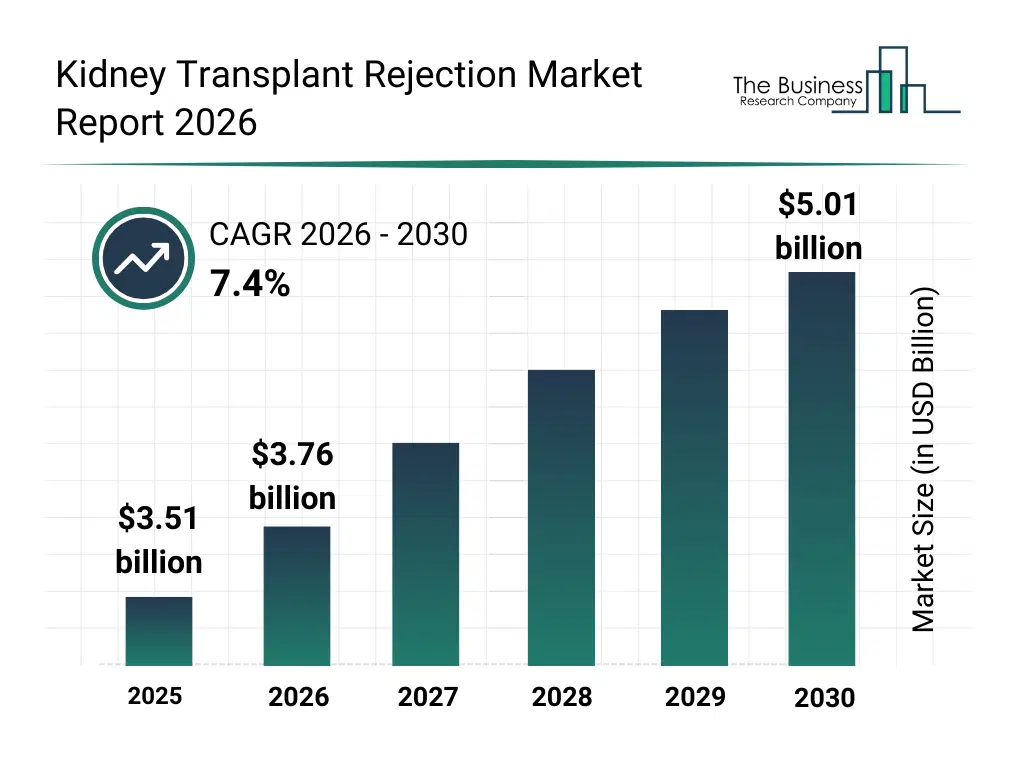
What Is The Kidney Transplant Rejection Market Size and Share 2026?
The kidney transplant rejection market size has grown strongly in recent years. It will grow from $3.51 billion in 2025 to $3.76 billion in 2026 at a compound annual growth rate (CAGR) of 7.2%. The growth in the historic period can be attributed to increasing kidney transplant procedures, advancements in histopathological assessment techniques, wider availability of immunosuppressive drugs, growth of transplant center networks, improving post-transplant patient survival rates.What Is The Kidney Transplant Rejection Market Growth Forecast?
The kidney transplant rejection market size is expected to see strong growth in the next few years. It will grow to $5.01 billion in 2030 at a compound annual growth rate (CAGR) of 7.4%. The growth in the forecast period can be attributed to rising demand for personalized immunosuppression strategies, increasing adoption of molecular diagnostics, expansion of precision medicine in transplant care, growing focus on long-term graft survival, increasing investment in transplant monitoring technologies. Major trends in the forecast period include increasing adoption of biomarker-based rejection monitoring, rising use of genomics-based diagnostic approaches, growing optimization of immunosuppressive therapy protocols, expansion of non-invasive rejection surveillance methods, enhanced focus on early detection of chronic rejection.Global Kidney Transplant Rejection Market Segmentation
1) By Rejection Type: Chronic Rejection; Acute Rejection 2) By Treatment: Immunosuppressive Drugs; Antibody-Mediated Rejection Therapies 3) By Diagnostic Approach: Biomarker-Based Diagnostics; Genomics-Based Diagnostics 4) By Therapeutics: Small Molecule Inhibitors; Biologic Therapies 5) By End-Users: Transplant Centers Or Hospitals; Diagnostic Laboratories; Pharmacies Subsegments: 1) By Chronic Rejection: Antibody Mediated Chronic Rejection; Chronic Allograft Nephropathy; Interstitial Fibrosis And Tubular Atrophy; Vascular Chronic Rejection; Mixed Chronic Rejection 2) By Acute Rejection: Cellular Acute Rejection; Antibody Mediated Acute Rejection; Hyperacute Rejection; Mixed Acute Rejection; Vascular Acute RejectionWhat Is The Driver Of The Kidney Transplant Rejection Market?
The rising incidence of end-stage renal disease is expected to propel the growth of the kidney transplant rejection market going forward. End-stage renal disease (ESRD) refers to the final, irreversible stage of chronic Kidney Disease in which the kidneys fail to function adequately without dialysis or a kidney transplant. The incidence of end-stage renal disease is rising due to the increasing prevalence of chronic conditions, diabetes and hypertension, which progressively damage the kidneys and lead to kidney failure. Kidney transplant rejection drives the need for advanced monitoring and therapeutic interventions, directly supporting the management of end-stage renal disease by ensuring transplanted kidneys remain functional and patients maintain kidney health. For instance, in September 2024, according to the National Institute of Diabetes and Digestive and Kidney Diseases, a US-based government institute, in 2023, more than 808,000 people in the United States were living with end-stage kidney disease (ESKD), also known as end-stage renal disease (ESRD), with 68% receiving dialysis and 32% having undergone a kidney transplant. Therefore, the rising incidence of end-stage renal disease is driving the growth of the kidney transplant rejection industry.Key Players In The Global Kidney Transplant Rejection Market
Major companies operating in the kidney transplant rejection market are F. Hoffmann-La Roche AG, Merck & Co. Inc., Sanofi SA, Novartis AG, Bristol-Myers Squibb Company, Thermo Fisher Scientific Inc., Takeda Pharmaceutical Company Limited, Amgen Inc., Asahi Kasei Corporation, Teva Pharmaceutical Industries Ltd., Astellas Pharma Inc., Biogen Inc., ChugAI Pharmaceutical Co. Ltd., Eurofins Scientific SE, Illumina Inc., Natera Inc., CareDx Inc., Azurity Pharmaceuticals Inc., Insight Molecular Diagnostics, and RenalytixAI plc.Global Kidney Transplant Rejection Market Trends and Insights
Major companies operating in the kidney transplant rejection market are focusing on developing innovative diagnostic solutions, such as noninvasive urinary biomarker testing, to enable faster, safer, and more accurate detection of transplant rejection. Noninvasive urinary biomarker testing analyzes urine samples to detect molecular indicators of kidney inflammation or rejection, helping clinicians identify transplant complications quickly and safely without the need for invasive biopsies. For instance, in May 2024, Thermo Fisher Scientific Inc., a US-based biotechnology company, launched the CXCL10 testing service, an innovative diagnostic tool for kidney transplant recipients. The CXCL10 test detects the CXCL10 chemokine in urine, which is associated with early transplant rejection and inflammation. It delivers results within 24 hours, enabling quicker clinical decisions, reducing the need for unnecessary biopsies, and improving patient convenience by utilizing noninvasive sample collection. Developed and validated by Thermo Fisher’s One Lambda Laboratories, the assay combines high sensitivity and specificity with ease of use in clinical settings, supporting better post-transplant care and patient outcomes.What Are Latest Mergers And Acquisitions In The Kidney Transplant Rejection Market?
In July 2024, Biogen Inc., a US-based biotechnology company, acquired Human Immunology Biosciences for an undisclosed amount. With this acquisition, Biogen sought to strengthen and expand its immunology and rare-disease pipeline by integrating late-stage therapeutic assets and expertise in immune-mediated diseases. Human Immunology Biosciences is a US-based clinical-stage biotechnology company that specializes in providing kidney transplant rejection.Regional Insights
North America was the largest region in the kidney transplant rejection market in 2025. Asia-Pacific is expected to be the fastest-growing region in the forecast period. The regions covered in this market report are Asia-Pacific, South East Asia, Western Europe, Eastern Europe, North America, South America, Middle East, Africa. The countries covered in this market report are Australia, Brazil, China, France, Germany, India, Indonesia, Japan, Taiwan, Russia, South Korea, UK, USA, Canada, Italy, Spain.What Defines the Kidney Transplant Rejection Market?
The kidney transplant rejection market includes revenues earned by entities through transplant monitoring and diagnostic testing, immunological and histopathological assessments, clinical management of rejection episodes, immunosuppressive therapy administration and optimization, patient follow-up, and post-transplant care. The market value includes the value of related goods sold by the service provider or included within the service offering. Only goods and services traded between entities or sold to end consumers are included.How is Market Value Defined and Measured?
The market value is defined as the revenues that enterprises gain from the sale of goods and/or services within the specified market and geography through sales, grants, or donations in terms of the currency (in USD unless otherwise specified). The revenues for a specified geography are consumption values that are revenues generated by organizations in the specified geography within the market, irrespective of where they are produced. It does not include revenues from resales along the supply chain, either further along the supply chain or as part of other products.What Key Data and Analysis Are Included in the Kidney Transplant Rejection Market Report 2026?
The kidney transplant rejection market research report is one of a series of new reports from The Business Research Company that provides market statistics, including industry global market size, regional shares, competitors with the market share, detailed market segments, market trends and opportunities, and any further data you may need to thrive in the kidney transplant rejection industry. The market research report delivers a complete perspective of everything you need, with an in-depth analysis of the current and future state of the industry.Kidney Transplant Rejection Market Report Forecast Analysis
| Report Attribute | Details |
|---|---|
| Market Size Value In 2026 | $3.76 billion |
| Revenue Forecast In 2035 | $5.01 billion |
| Growth Rate | CAGR of 7.2% from 2026 to 2035 |
| Base Year For Estimation | 2025 |
| Actual Estimates/Historical Data | 2020-2025 |
| Forecast Period | 2026 - 2030 - 2035 |
| Market Representation | Revenue in USD Billion and CAGR from 2026 to 2035 |
| Segments Covered | Rejection Type, Treatment, Diagnostic Approach, Therapeutics, End-Users |
| Regional Scope | Asia-Pacific, Western Europe, Eastern Europe, North America, South America, Middle East, Africa |
| Country Scope | The countries covered in the report are Australia, Brazil, China, France, Germany, India, ... |
| Key Companies Profiled | F. Hoffmann-La Roche AG, Merck & Co. Inc., Sanofi SA, Novartis AG, Bristol-Myers Squibb Company, Thermo Fisher Scientific Inc., Takeda Pharmaceutical Company Limited, Amgen Inc., Asahi Kasei Corporation, Teva Pharmaceutical Industries Ltd., Astellas Pharma Inc., Biogen Inc., ChugAI Pharmaceutical Co. Ltd., Eurofins Scientific SE, Illumina Inc., Natera Inc., CareDx Inc., Azurity Pharmaceuticals Inc., Insight Molecular Diagnostics, and RenalytixAI plc. |
| Customization Scope | Request for Customization |
| Pricing And Purchase Options | Explore Purchase Options |
Frequently Asked Questions
The Kidney Transplant Rejection market was valued at $3.51 billion in 2025, increased to $3.76 billion in 2026, and is projected to reach $5.01 billion by 2030.
request a sample hereThe global Kidney Transplant Rejection market is expected to grow at a CAGR of 7.4% from 2026 to 2035 to reach $5.01 billion by 2035.
request a sample hereSome Key Players in the Kidney Transplant Rejection market Include, F. Hoffmann-La Roche AG, Merck & Co. Inc., Sanofi SA, Novartis AG, Bristol-Myers Squibb Company, Thermo Fisher Scientific Inc., Takeda Pharmaceutical Company Limited, Amgen Inc., Asahi Kasei Corporation, Teva Pharmaceutical Industries Ltd., Astellas Pharma Inc., Biogen Inc., ChugAI Pharmaceutical Co. Ltd., Eurofins Scientific SE, Illumina Inc., Natera Inc., CareDx Inc., Azurity Pharmaceuticals Inc., Insight Molecular Diagnostics, and RenalytixAI plc. .
request a sample hereMajor trend in this market includes: Innovative Urine-Based Diagnostics Improving Accuracy And Speed In Post-Transplant Care. For further insights on this market.
request a sample hereNorth America was the largest region in the kidney transplant rejection market in 2025. Asia-Pacific is expected to be the fastest-growing region in the forecast period. The regions covered in the kidney transplant rejection market report are Asia-Pacific, South East Asia, Western Europe, Eastern Europe, North America, South America, Middle East, Africa.
request a sample here