
Internet Protocol (IP) Transit Market Report 2026
Internet Protocol (IP) Transit Market Report 2026
Global Outlook – By Service Type (Full Transit, Partial Transit, Burstable Transit, Dedicated And Flat-Rate Transit), By Bandwidth (100 Mbps And Below, 100 Mbps–1 Gbps, Above 1 Gbps), By Application (Cloud Services, Content Delivery, Web Hosting, Other Application), By End-User (Internet Service Provider, Enterprises, Data Centers, Content Providers, Other End-Users) – Market Size, Trends, Strategies, and Forecast to 2035
Internet Protocol (IP) Transit Market Overview
• Internet Protocol (IP) Transit market size has reached to $8.47 billion in 2025 • Expected to grow to $12.86 billion in 2030 at a compound annual growth rate (CAGR) of 8.8% • Growth Driver: The Increasing Deployment Of 5G Networks Driving The Growth Of The Market Due To Faster, More Reliable, And Low-Latency Connectivity • Market Trend: Next-Generation Ddos Mitigation Enhances Network Security And Resilience Against AI-Driven Threats • North America was the largest region in 2025 and Asia-Pacific is the fastest growing region.
%20Transit%20Market%20Report%202026&content_id=a35b13bf-3497-49f3-87fe-7b1395d26923&price=4490&discount=0&image=https%3A%2F%2Fd1lt5802h39cn9.cloudfront.net%2Fcoverimages%2Finternet_protocol_ip_transit_market_report.webp)
What Is Covered Under Internet Protocol (IP) Transit Market?
Internet protocol (IP) transit is a service that provides an organization with direct access to the global internet by allowing its network to exchange data with all other networks through a transit provider. The provider carries the customer’s IP traffic across its backbone and onward to the wider internet, enabling full internet reachability beyond the customer’s own network. The main service types of internet protocol (IP) transit include full transit, partial transit, burstable transit and dedicated and flat-rate transit. Full transit refers to a type of fiber optic network architecture where the fiber connection runs continuously from the service provider’s central office to the end user without intermediate splitting or sharing, ensuring dedicated bandwidth and higher performance. The various bandwidths include 100 Mbps and below, 100 Mbps–1 Gbps, and above 1 Gbps bandwidth offerings. The various service types involved are full transit and partial transit and burstable transit and dedicated and flat-rate transit. The applications include cloud services and content delivery and web hosting and others and are utilized by end-users such as internet service provider, enterprises, data centers, content providers, and others.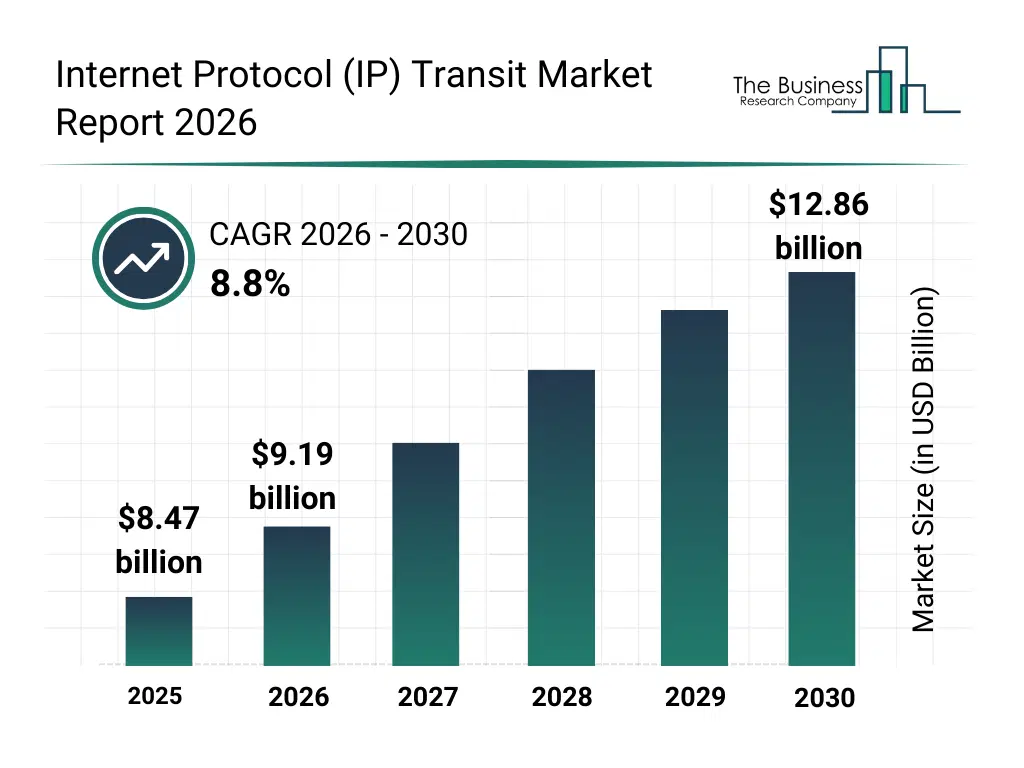
What Is The Internet Protocol (IP) Transit Market Size and Share 2026?
The internet protocol (ip) transit market size has grown strongly in recent years. It will grow from $8.47 billion in 2025 to $9.19 billion in 2026 at a compound annual growth rate (CAGR) of 8.5%. The growth in the historic period can be attributed to increasing internet penetration, growing adoption of cloud computing, expansion of data center infrastructure, rising traffic from content delivery services, increasing enterprise digitalization.What Is The Internet Protocol (IP) Transit Market Growth Forecast?
The internet protocol (ip) transit market size is expected to see strong growth in the next few years. It will grow to $12.86 billion in 2030 at a compound annual growth rate (CAGR) of 8.8%. The growth in the forecast period can be attributed to growing demand for 5g-enabled services, expansion of international network connectivity, increasing adoption of ai-driven traffic management, rising enterprise cloud adoption, growth of streaming and on-demand content services. Major trends in the forecast period include rising demand for high-bandwidth connectivity, increasing adoption of burstable transit services, growing need for redundant path and multi-region connectivity, expansion of tier-one backbone access solutions, rising focus on cost-optimized and flexible routing services.Global Internet Protocol (IP) Transit Market Segmentation
1) By Service Type: Full Transit, Partial Transit, Burstable Transit, Dedicated And Flat-Rate Transit 2) By Bandwidth: 100 Mbps And Below, 100 Mbps–1 Gbps, Above 1 Gbps 3) By Application: Cloud Services, Content Delivery, Web Hosting, Other Application 4) By End-User: Internet Service Provider, Enterprises, Data Centers, Content Providers, Other End-Users Subsegments: 1) By Full Transit: Domestic Network Connectivity, International Network Connectivity, Multi Region Connectivity, Tier One Backbone Access, Redundant Path Connectivity 2) By Partial Transit: Regional Network Connectivity, Selective Routing Access, Peering Assisted Connectivity, Cost Optimized Routing, Limited Backbone Access 3) By Burstable Transit: On Demand Bandwidth Scaling, Seasonal Traffic Management, Peak Usage Support, Flexible Capacity Allocation, Usage Based Bandwidth Expansion 4) By Dedicated And Flat-Rate Transit: Fixed Bandwidth Allocation, Guaranteed Throughput Services, Service Level Agreement Based Connectivity, Private Backbone Access, High Availability ConnectivityWhat Is The Driver Of The Internet Protocol (IP) Transit Market?
The increasing deployment of 5G networks is expected to propel the growth of the internet protocol (IP) transit market going forward. Deployment of 5G networks refers to the process of planning, installing, and activating fifth-generation mobile network infrastructure and technologies to provide faster, more reliable, and low-latency wireless communication. The increasing deployment of 5G networks is due to the growing demand for faster, more reliable, and low-latency wireless connectivity to support data-intensive applications and emerging technologies. 5G networks enhance internet protocol (IP) transit by providing ultra-low latency, higher bandwidth, and more reliable connectivity, enabling faster and more efficient data transfer across global networks. For instance, in April 2025, according to 5G Americas, a US-based wireless industry trade organization, global 5G connections reached 2.25 billion by the end of 2024, up from nearly 2 billion in early 2024, with forecasts projecting growth to 8 billion connections by 2029. Therefore, increasing deployment of 5G networks is driving the growth of the internet protocol (IP) transit industry.Key Players In The Global Internet Protocol (IP) Transit Market
Major companies operating in the internet protocol (IP) transit market are Verizon Business Network Services, Comcast Corporation, AT&T Inc., Telefónica S.A., KDDI Corporation, Saudi Telecom Company, Telstra Corporation Limited, Singapore Telecommunications Limited, Proximus Group, Ooredoo Group, NTT Communications Corporation, Telekom Malaysia Berhad, Tata Communications Limited, Sify Technologies Limited, China Mobile International Limited, EXA Infrastructure Limited, West Indian Ocean Cable Company, British Telecommunications plc, Hurricane Electric Inc., and Elisa Corporation.Global Internet Protocol (IP) Transit Market Trends and Insights
Major companies operating in the internet protocol (IP) transit market are focusing on developing innovative solutions, such as built-in DDoS mitigation technologies, to automatically detect and block malicious traffic and protect networks from Distributed Denial of Service (DDoS) attacks. These built-in mitigation capabilities are integrated directly into IP transit services, enabling real-time traffic monitoring and automated threat filtering without the need for separate external security solutions. For instance, in October 2025, Arelion, a Sweden-based telecommunications company, launched SecureConnect Transit and SecureConnect Dedicated Internet Access (DIA), advanced connectivity solutions bundled with its IP transit services. These offerings provide automated volumetric DDoS mitigation using technologies such as FlowSpec and distributed edge defenses to filter malicious traffic before it disrupts customer operations. By combining its global Tier-1 backbone with integrated security features, Arelion enables enterprises and service providers to maintain service continuity, meet regulatory requirements, and enhance network resilience against increasingly sophisticated cyber threats.What Are Latest Mergers And Acquisitions In The Internet Protocol (IP) Transit Market?
In November 2023, Colt Technology Services Group Limited, a UK-based digital infrastructure company, acquired Lumen Technologies’ EMEA business for an undisclosed amount. With this acquisition, Colt aimed to strengthen its global IP-Transit and backbone network capabilities, expand its presence across Europe, the Middle East, and Africa, and enhance its ability to deliver high-capacity, low-latency connectivity services by integrating Lumen’s extensive fiber assets and network infrastructure. Lumen Technologies Inc. is a US-based company that offers high-speed IP transit (HSIP).Regional Insights
North America was the largest region in the internet protocol (IP) transit market in 2025. Asia-Pacific is expected to be the fastest-growing region in the forecast period. The regions covered in this market report are Asia-Pacific, South East Asia, Western Europe, Eastern Europe, North America, South America, Middle East, Africa. The countries covered in this market report are Australia, Brazil, China, France, Germany, India, Indonesia, Japan, Taiwan, Russia, South Korea, UK, USA, Canada, Italy, Spain.What Defines the Internet Protocol (IP) Transit Market?
The internet protocol (IP) transit market includes revenues earned by entities by providing services such as bandwidth provisioning, peering services, network routing and management, content delivery optimization, and peering exchanges and interconnect services. The market value includes the value of related goods sold by the service provider or included within the service offering. Only goods and services traded between entities or sold to end consumers are included.How is Market Value Defined and Measured?
The market value is defined as the revenues that enterprises gain from the sale of goods and/or services within the specified market and geography through sales, grants, or donations in terms of the currency (in USD unless otherwise specified). The revenues for a specified geography are consumption values that are revenues generated by organizations in the specified geography within the market, irrespective of where they are produced. It does not include revenues from resales along the supply chain, either further along the supply chain or as part of other products.What Key Data and Analysis Are Included in the Internet Protocol (IP) Transit Market Report 2026?
The internet protocol (IP) transit market research report is one of a series of new reports from The Business Research Company that provides internet protocol (IP) transit market statistics, including internet protocol (IP) transit industry global market size, regional shares, competitors with a internet protocol (IP) transit market share, detailed internet protocol (IP) transit market segments, market trends and opportunities, and any further data you may need to thrive in the internet protocol (IP) transit industry. This internet protocol (IP) transit market research report delivers a complete perspective of everything you need, with an in-depth analysis of the current and future scenario of the industry.Internet Protocol (IP) Transit Market Report Forecast Analysis
| Report Attribute | Details |
|---|---|
| Market Size Value In 2026 | $9.19 billion |
| Revenue Forecast In 2035 | $12.86 billion |
| Growth Rate | CAGR of 8.5% from 2026 to 2035 |
| Base Year For Estimation | 2025 |
| Actual Estimates/Historical Data | 2020-2025 |
| Forecast Period | 2026 - 2030 - 2035 |
| Market Representation | Revenue in USD Billion and CAGR from 2026 to 2035 |
| Segments Covered | Service Type, Bandwidth, Application, End-User |
| Regional Scope | Asia-Pacific, Western Europe, Eastern Europe, North America, South America, Middle East, Africa |
| Country Scope | The countries covered in the report are Australia, Brazil, China, France, Germany, India, ... |
| Key Companies Profiled | Verizon Business Network Services, Comcast Corporation, AT&T Inc., Telefónica S.A., KDDI Corporation, Saudi Telecom Company, Telstra Corporation Limited, Singapore Telecommunications Limited, Proximus Group, Ooredoo Group, NTT Communications Corporation, Telekom Malaysia Berhad, Tata Communications Limited, Sify Technologies Limited, China Mobile International Limited, EXA Infrastructure Limited, West Indian Ocean Cable Company, British Telecommunications plc, Hurricane Electric Inc., and Elisa Corporation. |
| Customization Scope | Request for Customization |
| Pricing And Purchase Options | Explore Purchase Options |
Frequently Asked Questions
The Internet Protocol (IP) Transit market was valued at $8.47 billion in 2025, increased to $9.19 billion in 2026, and is projected to reach $12.86 billion by 2030.
request a sample hereThe global Internet Protocol (IP) Transit market is expected to grow at a CAGR of 8.8% from 2026 to 2035 to reach $12.86 billion by 2035.
request a sample hereSome Key Players in the Internet Protocol (IP) Transit market Include, Verizon Business Network Services, Comcast Corporation, AT&T Inc., Telefónica S.A., KDDI Corporation, Saudi Telecom Company, Telstra Corporation Limited, Singapore Telecommunications Limited, Proximus Group, Ooredoo Group, NTT Communications Corporation, Telekom Malaysia Berhad, Tata Communications Limited, Sify Technologies Limited, China Mobile International Limited, EXA Infrastructure Limited, West Indian Ocean Cable Company, British Telecommunications plc, Hurricane Electric Inc., and Elisa Corporation..
request a sample hereMajor trend in this market includes: Next-Generation Ddos Mitigation Enhances Network Security And Resilience Against AI-Driven Threats. For further insights on this market.
request a sample hereNorth America was the largest region in the internet protocol (IP) transit market in 2025. Asia-Pacific is expected to be the fastest-growing region in the forecast period. The regions covered in the internet protocol (IP) transit market report are Asia-Pacific, South East Asia, Western Europe, Eastern Europe, North America, South America, Middle East, Africa.
request a sample here