
Internet Of Medical Things (IOMT) For Drug Delivery Market Report 2026
Internet Of Medical Things (IOMT) For Drug Delivery Market Report 2026
Global Outlook – By Type (Wearable Drug Delivery Devices, Smart Inhalers, Injectable Drug Delivery Systems, Implantable Drug Delivery Devices, Remote Drug Monitoring), By Connectivity (Bluetooth And Low Energy Connectivity, Wi Fi Connectivity, Cellular Connectivity, Near Field Communication, Cloud And Edge Based Connectivity), By Application (Chronic Disease Management, Acute Care Drug Delivery, Home Based Drug Administration, Hospital And Clinical Drug Delivery, Personalized And Precision Medicine), By End User (Hospitals And Clinics, Home Care Settings, Pharmaceutical And Biotechnology Companies, Research And Development Organizations, Contract Research And Clinical Trial Centers) – Market Size, Trends, Strategies, and Forecast to 2035
Internet Of Medical Things (IOMT) For Drug Delivery Market Overview
• Internet Of Medical Things (IoMT) For Drug Delivery market size has reached to $6.57 billion in 2025 • Expected to grow to $10.09 billion in 2030 at a compound annual growth rate (CAGR) of 9% • Growth Driver: Rise Of Telehealth And Remote Care Services Driving The Market Growth Due To Increasing Patient Demand For Convenient • Market Trend: Advancement Of Intelligent Drug-Delivery Technologies In Healthcare • North America was the largest region in 2025 and Asia-Pacific is the fastest growing region.
%20For%20Drug%20Delivery%20Market%20Report%202026&content_id=2269730b-76db-434f-a092-7b24d6f657ff&price=4490&discount=0&image=https%3A%2F%2Fd1lt5802h39cn9.cloudfront.net%2Fcoverimages%2Finternet_of_medical_things_iomt_for_drug_delivery_market_report.webp)
What Is Covered Under Internet Of Medical Things (IOMT) For Drug Delivery Market?
The internet of medical things (IoMT) for drug delivery refers to the deployment and integration of connected medical devices, sensors, software, and communication technologies that enable the monitoring, control, and administration of drug delivery through networked systems. It allows precise dosage control, real-time patient monitoring, improved treatment adherence, and enhanced safety tailored to specific therapeutic and clinical requirements. The main types of Internet of Medical Things (IoMT) for drug delivery include wearable drug delivery devices, smart inhalers, injectable drug delivery systems, implantable drug delivery devices, and remote drug monitoring. Wearable drug delivery devices refer to wearable technologies that enable controlled administration of medications while monitoring patient adherence and physiological responses. These products use connectivity options such as Bluetooth and low energy (BLE) connectivity, Wi-Fi connectivity, cellular connectivity, near field communication (NFC), and cloud and edge-based connectivity. They are applied across areas including chronic disease management, acute care drug delivery, home-based drug administration, hospital and clinical drug delivery, and personalized and precision medicine, and are used by end users including hospitals and clinics, home care settings, pharmaceutical and bIoTechnology companies, research and development organizations, and contract research and clinical trial centers.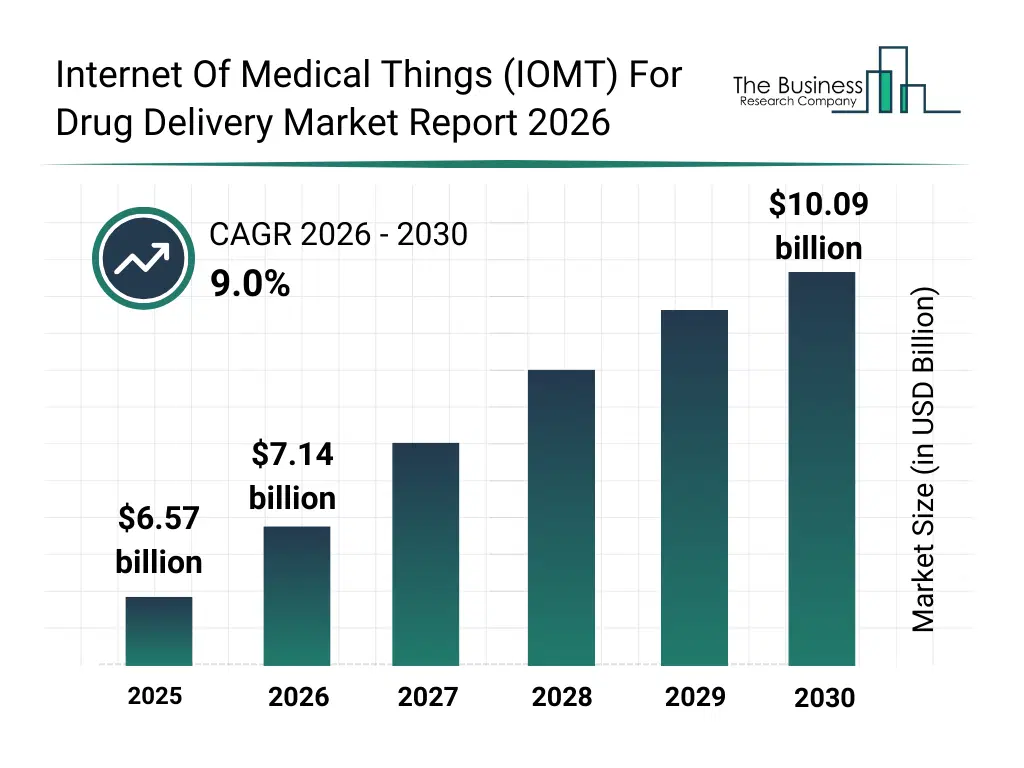
What Is The Internet Of Medical Things (IOMT) For Drug Delivery Market Size and Share 2026?
The internet of medical things (iomt) for drug delivery market size has grown strongly in recent years. It will grow from $6.57 billion in 2025 to $7.14 billion in 2026 at a compound annual growth rate (CAGR) of 8.8%. The growth in the historic period can be attributed to increasing prevalence of chronic diseases, early adoption of smart infusion and monitoring devices, growth of home healthcare services, rising focus on medication adherence, expansion of digital health infrastructure.What Is The Internet Of Medical Things (IOMT) For Drug Delivery Market Growth Forecast?
The internet of medical things (iomt) for drug delivery market size is expected to see strong growth in the next few years. It will grow to $10.09 billion in 2030 at a compound annual growth rate (CAGR) of 9.0%. The growth in the forecast period can be attributed to expansion of personalized medicine applications, rising investments in connected healthcare platforms, growing demand for remote patient management, increasing integration of AI-driven dosing algorithms, rising regulatory support for digital therapeutics. Major trends in the forecast period include increasing adoption of connected drug delivery devices, rising use of real-time patient monitoring platforms, growing integration of wearable and implantable delivery systems, expansion of personalized dosage management solutions, enhanced focus on remote therapy management.Global Internet Of Medical Things (IOMT) For Drug Delivery Market Segmentation
1) By Type: Wearable Drug Delivery Devices; Smart Inhalers; Injectable Drug Delivery Systems; Implantable Drug Delivery Devices; Remote Drug Monitoring 2) By Connectivity: Bluetooth And Low Energy Connectivity; Wi Fi Connectivity; Cellular Connectivity; Near Field Communication; Cloud And Edge Based Connectivity 3) By Application: Chronic Disease Management; Acute Care Drug Delivery; Home Based Drug Administration; Hospital And Clinical Drug Delivery; Personalized And Precision Medicine 4) By End User: Hospitals And Clinics; Home Care Settings; Pharmaceutical And Biotechnology Companies; Research And Development Organizations; Contract Research And Clinical Trial Centers Subsegments: 1) By Wearable Drug Delivery Devices: On Body Infusion Pumps; Patch Based Drug Delivery Systems; Wearable Insulin Delivery Devices; Wearable Pain Management Devices 2) By Smart Inhalers: Connected Metered Dose Inhalers; Connected Dry Powder Inhalers; Medication Adherence Monitoring Inhalers; Dose Tracking Inhaler Systems 3) By Injectable Drug Delivery Systems: Connected Auto Injectors; Smart Pen Injectors; Pre Filled Smart Syringes; Electronic Injection Monitoring Systems 4) By Implantable Drug Delivery Devices: Implantable Infusion Pumps; Controlled Release Implant Systems; Programmable Drug Delivery Implants; Long Term Therapeutic Implants 5) By Remote Drug Monitoring: Medication Adherence Monitoring Systems; Real Time Dosage Tracking Platforms; Remote Therapy Management Systems; Patient Compliance Monitoring SolutionsWhat Is The Driver Of The Internet Of Medical Things (IOMT) For Drug Delivery Market?
The rise of telehealth and remote care services is expected to propel the growth of the internet of medical things (IoMT) for drug delivery market going forward. Telehealth and remote care services refer to the delivery of healthcare through digital technologies that enable patients to receive medical consultations, monitoring, and treatment from their homes without requiring in-person visits. Telehealth and remote care services are rising due to increasing patient demand for convenient, on-demand healthcare that allows them to consult doctors, monitor health, and manage treatments from home without the need for frequent hospital visits. Internet of medical things (IoMT) for drug delivery supports telehealth and remote care services by enabling real-time monitoring of patient medication adherence, automated and precise drug administration, and seamless data sharing with healthcare providers, allowing doctors to remotely track treatment progress, adjust dosages, and ensure personalized care without requiring in-person visits. For instance, in April 2023, according to FAIR Health Inc., a US-based non-profit organization, national telehealth use increased by 7.3%, rising from 5.5% of medical claim lines in December 2022 to 5.9% in January 2023. Therefore, the growing adoption of telemedicine platforms is driving the growth of the internet of medical things (IoMT) for drug delivery industry.Key Players In The Global Internet Of Medical Things (IOMT) For Drug Delivery Market
Major companies operating in the internet of medical things (iomt) for drug delivery market are Siemens AG, F. Hoffmann-La Roche AG, IBM Corporation, Bayer AG, Oracle Corporation, Abbott Laboratories, Honeywell Life Care Solutions Inc., Medtronic plc, Koninklijke Philips N.V., GE HealthCare Technologies Inc., Becton Dickinson and Company, Cognizant Technology Solutions Corporation, Biogen Inc., Omron Healthcare Co. Ltd., Dexcom Inc., Insulet Corporation, Tandem Diabetes Care Inc., Senseonics Inc., AdhereTech Inc., Adherium LimitedGlobal Internet Of Medical Things (IOMT) For Drug Delivery Market Trends and Insights
Major companies operating in the internet of medical things (IoMT) for drug delivery market are focusing on developing innovative solutions such as connected smart drug-delivery devices with real-time monitoring to enable personalized dosing, improve treatment adherence, and enhance patient outcomes. Connected smart drug-delivery devices with real-time monitoring are medical devices that automatically track medication delivery and patient data and wirelessly share it with apps or healthcare systems, helping optimize dosing, improve adherence, and enable timely clinical decisions. For instance, in November 2024, Medtronic plc, an Ireland-based healthcare technology company, launched its Smart MDI system featuring the InPen app with Simplera CGM. The system integrates a smart insulin pen with a disposable, all-in-one CGM to deliver real-time, personalized insulin dosing insights, including detection and correction recommendations for missed or inaccurate mealtime doses. It continuously monitors glucose levels, records insulin administration, and analyzes patient data through a mobile application to reduce hyperglycemia risk and support better glycemic control. Compared to conventional insulin pens, the solution offers automated data capture, intelligent alerts, and clinical decision support, significantly reducing dosing guesswork and improving patient outcomes.What Are Latest Mergers And Acquisitions In The Internet Of Medical Things (IOMT) For Drug Delivery Market?
In June 2024, Aptar Digital Health LLC, a US-based manufacturing company, partnered with SHL Medical AG to develop connected drug delivery solutions by integrating digital health platforms with advanced self-injection systems. With this partnership, Aptar Digital Health and SHL Medical aim to combine Aptar’s digital health platforms and connected device capabilities with SHL Medical’s autoinjector and pen injector technologies to develop integrated, connected drug delivery solutions that improve patient adherence, enhance therapy outcomes, and support pharmaceutical companies with real-world data insights. SHL Medical AG is a Switzerland-based medical device company focused on the design and manufacturing of advanced self-injection systems for pharmaceutical and biotech partners.Regional Insights
North America was the largest region in the internet of medical things (IOMT) for drug delivery market in 2025. The regions covered in this market report are Asia-Pacific, South East Asia, Western Europe, Eastern Europe, North America, South America, Middle East, Africa. The countries covered in this market report are Australia, Brazil, China, France, Germany, India, Indonesia, Japan, Taiwan, Russia, South Korea, UK, USA, Canada, Italy, Spain.What Defines the Internet Of Medical Things (IOMT) For Drug Delivery Market?
The internet of medical things (IoMT) for drug delivery market consists of sales of connected drug delivery devices, smart infusion systems, wearable and implantable drug delivery solutions, remote monitoring software, data management platforms, and secure device orchestration products. Values in this market are ‘factory gate’ values, that is, the value of goods sold by the manufacturers or creators of the goods, whether to other entities (including downstream manufacturers, wholesalers, distributors, and retailers) or directly to end customers. The value of goods in this market includes related services sold by the creators of the goods.How is Market Value Defined and Measured?
The market value is defined as the revenues that enterprises gain from the sale of goods and/or services within the specified market and geography through sales, grants, or donations in terms of the currency (in USD unless otherwise specified). The revenues for a specified geography are consumption values that are revenues generated by organizations in the specified geography within the market, irrespective of where they are produced. It does not include revenues from resales along the supply chain, either further along the supply chain or as part of other products.What Key Data and Analysis Are Included in the Internet Of Medical Things (IOMT) For Drug Delivery Market Report 2026?
The internet of medical things (iomt) for drug delivery market research report is one of a series of new reports from The Business Research Company that provides market statistics, including industry global market size, regional shares, competitors with the market share, detailed market segments, market trends and opportunities, and any further data you may need to thrive in the internet of medical things (iomt) for drug delivery industry. The market research report delivers a complete perspective of everything you need, with an in-depth analysis of the current and future state of the industry.Internet Of Medical Things (IOMT) For Drug Delivery Market Report Forecast Analysis
| Report Attribute | Details |
|---|---|
| Market Size Value In 2026 | $7.14 billion |
| Revenue Forecast In 2035 | $10.09 billion |
| Growth Rate | CAGR of 8.8% from 2026 to 2035 |
| Base Year For Estimation | 2025 |
| Actual Estimates/Historical Data | 2020-2025 |
| Forecast Period | 2026 - 2030 - 2035 |
| Market Representation | Revenue in USD Billion and CAGR from 2026 to 2035 |
| Segments Covered | Type, Connectivity, Application, End User |
| Regional Scope | Asia-Pacific, Western Europe, Eastern Europe, North America, South America, Middle East, Africa |
| Country Scope | The countries covered in the report are Australia, Brazil, China, France, Germany, India, ... |
| Key Companies Profiled | Siemens AG, F. Hoffmann-La Roche AG, IBM Corporation, Bayer AG, Oracle Corporation, Abbott Laboratories, Honeywell Life Care Solutions Inc., Medtronic plc, Koninklijke Philips N.V., GE HealthCare Technologies Inc., Becton Dickinson and Company, Cognizant Technology Solutions Corporation, Biogen Inc., Omron Healthcare Co. Ltd., Dexcom Inc., Insulet Corporation, Tandem Diabetes Care Inc., Senseonics Inc., AdhereTech Inc., Adherium Limited |
| Customization Scope | Request for Customization |
| Pricing And Purchase Options | Explore Purchase Options |
Frequently Asked Questions
The Internet Of Medical Things (IOMT) For Drug Delivery market was valued at $6.57 billion in 2025, increased to $7.14 billion in 2026, and is projected to reach $10.09 billion by 2030.
request a sample hereThe global Internet Of Medical Things (IOMT) For Drug Delivery market is expected to grow at a CAGR of 9.0% from 2026 to 2035 to reach $10.09 billion by 2035.
request a sample hereSome Key Players in the Internet Of Medical Things (IOMT) For Drug Delivery market Include, Siemens AG, F. Hoffmann-La Roche AG, IBM Corporation, Bayer AG, Oracle Corporation, Abbott Laboratories, Honeywell Life Care Solutions Inc., Medtronic plc, Koninklijke Philips N.V., GE HealthCare Technologies Inc., Becton Dickinson and Company, Cognizant Technology Solutions Corporation, Biogen Inc., Omron Healthcare Co. Ltd., Dexcom Inc., Insulet Corporation, Tandem Diabetes Care Inc., Senseonics Inc., AdhereTech Inc., Adherium Limited .
request a sample hereMajor trend in this market includes: Advancement Of Intelligent Drug-Delivery Technologies In Healthcare. For further insights on this market.
request a sample hereNorth America was the largest region in the internet of medical things (IOMT) for drug delivery market in 2025. The regions covered in the internet of medical things (iomt) for drug delivery market report are Asia-Pacific, South East Asia, Western Europe, Eastern Europe, North America, South America, Middle East, Africa.
request a sample here