
Infrastructure Market Report 2026

Infrastructure Market Report 2026
Global Outlook – By Infrastructure Type (Transportation Infrastructure, Energy And Power Infrastructure, Water And Wastewater Infrastructure, Digital Infrastructure, Social Infrastructure, Industrial Infrastructure), By Component (Planning And Design Services, Construction And Engineering Services, Operation And Maintenance Services, Upgradation And Modernization Services), By Project Type (Greenfield Infrastructure Projects, Brownfield Infrastructure Projects), By Ownership Model (Public Infrastructure, Private Infrastructure, Public Private Partnership Infrastructure), By End User (Government And Public Authorities, Private Enterprises, Utility Providers, Industrial Operators, Community And Social Organizations) – Market Size, Trends, Strategies, and Forecast to 2035
Infrastructure Market Overview
• Infrastructure market size has reached to $4583.59 billion in 2025 • Expected to grow to $8038.56 billion in 2030 at a compound annual growth rate (CAGR) of 11.9% • Growth Driver: Increasing Investment In Smart Cities Fueling Infrastructure Growth Due To Government-Led Digital Modernization And Urban Sustainability Initiatives • Market Trend: Strategic AI Infrastructure Investments Accelerate Digital Capacity Expansion • Asia-Pacific was the largest region in 2025 and Middle East And Africa is the fastest growing region.

What Is Covered Under Infrastructure Market?
Infrastructure refers to the fundamental physical and organizational structures, facilities, and systems required for the operation and development of an economy and society. It includes assets such as transportation networks, energy and power systems, water and wastewater facilities, telecommunications, and social infrastructure that support economic activity, public services, and quality of life. The main types of infrastructure include transportation infrastructure, energy and power infrastructure, water and wastewater infrastructure, digital infrastructure, social infrastructure, and industrial infrastructure. Transportation infrastructure refers to physical networks such as roads, railways, airports, and ports that enable the movement of people and goods across regions and countries to support economic and social development. The various project types involved are greenfield infrastructure projects and brownfield infrastructure projects and are executed through planning and design services and construction and engineering services. The ownership models include public infrastructure, private infrastructure, and public private partnership infrastructure and are utilized by end users such as government and public authorities, private enterprises, utility providers, industrial operators, and community and social organizations.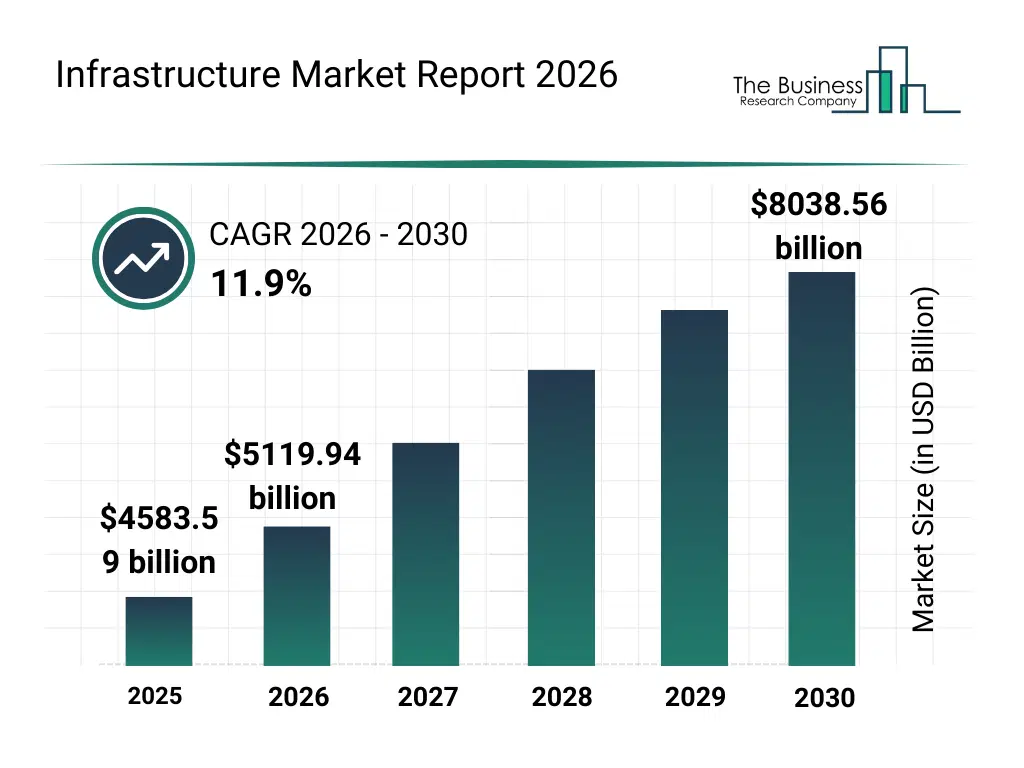
What Is The Infrastructure Market Size and Share 2026?
The infrastructure market size has grown rapidly in recent years. It will grow from $4583.59 billion in 2025 to $5119.94 billion in 2026 at a compound annual growth rate (CAGR) of 11.7%. The growth in the historic period can be attributed to increasing government infrastructure spending, expansion of urban transportation systems, growing industrialization and manufacturing facilities, rising demand for power generation and distribution, development of water and wastewater management systems.What Is The Infrastructure Market Growth Forecast?
The infrastructure market size is expected to see rapid growth in the next few years. It will grow to $8038.56 billion in 2030 at a compound annual growth rate (CAGR) of 11.9%. The growth in the forecast period can be attributed to growing deployment of smart city initiatives, increasing investment in digital infrastructure and data centers, rising focus on sustainable and climate-resilient infrastructure, expansion of renewable energy facilities and electric mobility infrastructure, adoption of advanced construction technologies and automation. Major trends in the forecast period include increasing investment in greenfield infrastructure projects, rising demand for upgradation and modernization services, growing focus on public-private partnership infrastructure models, expansion of smart urban transportation networks, rising adoption of renewable energy and energy storage solutions.Global Infrastructure Market Segmentation
1) By Infrastructure Type: Transportation Infrastructure, Energy And Power Infrastructure, Water And Wastewater Infrastructure, Digital Infrastructure, Social Infrastructure, Industrial Infrastructure 2) By Component: Planning And Design Services, Construction And Engineering Services, Operation And Maintenance Services, Upgradation And Modernization Services 3) By Project Type: Greenfield Infrastructure Projects, Brownfield Infrastructure Projects 4) By Ownership Model: Public Infrastructure, Private Infrastructure, Public Private Partnership Infrastructure 5) By End User: Government And Public Authorities, Private Enterprises, Utility Providers, Industrial Operators, Community And Social Organizations Subsegments: 1) By Transportation Infrastructure: Roadways, Railways, Airports, Seaports And Inland Waterways, Urban Public Transport Systems 2) By Energy And Power Infrastructure: Power Generation Facilities, Power Transmission Networks, Power Distribution Systems, Renewable Energy Facilities, Energy Storage Systems 3) By Water And Wastewater Infrastructure: Water Supply Systems, Water Treatment Facilities, Wastewater Collection Systems, Wastewater Treatment Plants, Stormwater Management Systems 4) By Digital Infrastructure: Telecommunication Networks, Data Centers, Broadband Infrastructure, Mobile Network Infrastructure, Cloud Computing Infrastructure 5) By Social Infrastructure: Educational Facilities, Healthcare Facilities, Residential Housing, Public Safety Facilities, Recreational And Cultural Facilities 6) By Industrial Infrastructure: Manufacturing Facilities, Warehousing And Logistics Facilities, Industrial Parks And Zones, Processing Plants, Research And Development FacilitiesWhat Is The Driver Of The Infrastructure Market?
The increasing investment in smart cities is expected to propel the growth of the infrastructure market going forward. Smart cities are urban areas that use digital technologies, data analytics, and connected infrastructure to improve efficiency, sustainability, and quality of life for residents. Increasing investment in smart cities due to growing urbanization and government commitments to modernize public services and reduce environmental impact. Infrastructure supports smart city development by providing the essential physical and digital frameworks, such as transportation networks, utilities, and IoT connectivity, needed for efficient urban management. It reduces operational inefficiencies through integrated systems and real-time monitoring, improving the quality of life, sustainability, and city-wide innovation. For instance, in October 2023, according to the Organization for Economic Co-operation and Development, a France-based intergovernmental forum, global smart city spending is projected to surge, with the Internet of Things market expected to exceed USD 650 billion by 2026 and cities in the United States anticipated to invest USD 41 trillion over the next two decades to advance digital technologies. Therefore, the increasing investment in smart cities is driving the growth of the infrastructure industry.Key Players In The Global Infrastructure Market
Major companies operating in the infrastructure market are China State Construction Engineering Corporation (CSCEC), Siemens AG, VINCI S.A., Hitachi Ltd., International Business Machines Corporation (IBM), Bouygues Construction, Schneider Electric SE, Mitsubishi Electric Corporation, Honeywell International Inc., ABB Ltd., Fujitsu Limited, Larsen & Toubro Limited, Bechtel Group Inc., Emerson Electric Co., Skanska AB, Fluor Corporation, Jacobs Engineering Group Inc., AECOM, Rockwell Automation Inc., Hexagon AB, Trimble Inc. (AGCO), Reliance Infrastructure Limited, ACS Group, Bentley Systems Incorporated, and Gammon India Limited.Global Infrastructure Market Trends and Insights
Major companies operating in the infrastructure market are focusing on strategic collaborations, such as strategic investment initiatives in artificial intelligence infrastructure, to accelerate capital deployment, scale digital infrastructure capacity, and support the growing compute demands of data-intensive applications across smart cities and enterprise environments. A strategic investment initiative in artificial intelligence infrastructure refers to large-scale, long-term capital partnerships formed to develop, own, and operate mission-critical digital assets, including data centers and high-performance compute facilities, that support artificial intelligence workloads. For instance, in December 2025, Brookfield Corporation, a Canada-based asset management company, partnered with Qatar Investment Authority, a Qatar-based sovereign wealth fund, and announced the formation of a $20 billion joint venture to develop global artificial intelligence infrastructure assets. The initiative focuses on building large-scale data centers optimized for artificial intelligence workloads, integrating high-density power and cooling systems to support continuous operations, and enabling rapid deployment near major urban centers to meet rising smart city compute demand.What Are Latest Mergers And Acquisitions In The Infrastructure Market?
In October 2024, BlackRock Inc., a US-based investment management firm, acquired Global Infrastructure Partners (GIP) for an undisclosed amount. Through this acquisition, BlackRock aims to strengthen its infrastructure investment capabilities, consolidate private market assets under management, and expand its global footprint across developed and emerging markets. Global Infrastructure Partners is a US-based infrastructure investment firm that manages a diversified portfolio of more than 300 active infrastructure investments across over 100 countries.Regional Insights
Asia-Pacific was the largest region in the infrastructure market in 2025. Middle East And Africa is expected to be the fastest-growing region in the forecast period. The regions covered in this market report are Asia-Pacific, South East Asia, Western Europe, Eastern Europe, North America, South America, Middle East, Africa. The countries covered in this market report are Australia, Brazil, China, France, Germany, India, Indonesia, Japan, Taiwan, Russia, South Korea, UK, USA, Canada, Italy, Spain.What Defines the Infrastructure Market?
The infrastructure market includes revenues earned by entities through the planning, development, construction, operation, maintenance, and upgrading of infrastructure assets and services. The market covers public and private investments in sectors such as transportation, energy, utilities, digital infrastructure, and social infrastructure. The market value includes the value of related goods and services sold by infrastructure developers, operators, contractors, and service providers as part of infrastructure projects and offerings. Only goods and services traded between entities or sold to end users are included.How is Market Value Defined and Measured?
The market value is defined as the revenues that enterprises gain from the sale of goods and/or services within the specified market and geography through sales, grants, or donations in terms of the currency (in USD unless otherwise specified). The revenues for a specified geography are consumption values that are revenues generated by organizations in the specified geography within the market, irrespective of where they are produced. It does not include revenues from resales along the supply chain, either further along the supply chain or as part of other products.What Key Data and Analysis Are Included in the Infrastructure Market Report 2026?
The infrastructure market research report is one of a series of new reports from The Business Research Company that provides infrastructure market statistics, including infrastructure industry global market size, regional shares, competitors with a infrastructure market share, detailed infrastructure market segments, market trends and opportunities, and any further data you may need to thrive in the infrastructure industry. This infrastructure market research report delivers a complete perspective of everything you need, with an in-depth analysis of the current and future scenario of the industry.Infrastructure Market Report Forecast Analysis
| Report Attribute | Details |
|---|---|
| Market Size Value In 2026 | $5119.94 billion |
| Revenue Forecast In 2035 | $8038.56 billion |
| Growth Rate | CAGR of 11.7% from 2026 to 2035 |
| Base Year For Estimation | 2025 |
| Actual Estimates/Historical Data | 2020-2025 |
| Forecast Period | 2026 - 2030 - 2035 |
| Market Representation | Revenue in USD Billion and CAGR from 2026 to 2035 |
| Segments Covered | Infrastructure Type, Component, Project Type, Ownership Model, End User |
| Regional Scope | Asia-Pacific, Western Europe, Eastern Europe, North America, South America, Middle East, Africa |
| Country Scope | The countries covered in the report are Australia, Brazil, China, France, Germany, India, ... |
| Key Companies Profiled | China State Construction Engineering Corporation (CSCEC), Siemens AG, VINCI S.A., Hitachi Ltd., International Business Machines Corporation (IBM), Bouygues Construction, Schneider Electric SE, Mitsubishi Electric Corporation, Honeywell International Inc., ABB Ltd., Fujitsu Limited, Larsen & Toubro Limited, Bechtel Group Inc., Emerson Electric Co., Skanska AB, Fluor Corporation, Jacobs Engineering Group Inc., AECOM, Rockwell Automation Inc., Hexagon AB, Trimble Inc. (AGCO), Reliance Infrastructure Limited, ACS Group, Bentley Systems Incorporated, and Gammon India Limited. |
| Customization Scope | Request for Customization |
| Pricing And Purchase Options | Explore Purchase Options |