
Industrial Robots Market Report 2026
Global Outlook – By Product Type (Articulated Robots, Linear Robots, Cylindrical Robots, Parallel Robots, Scara Robots, Other Product Types), By Application (Pick And Plane, Wielding And Soldering, Material Handling, Assembling, Cutting And Processing, Other Applications ), By End-User Industry (Automotive, Electrical And Electronics, Healthcare And Pharmaceuticals, Food And Beverages, Rubber And Plastics, Metals And Machinery, Other End-User Industries) – Market Size, Trends, Strategies, and Forecast to 2035
Industrial Robots Market Overview
• Industrial Robots market size has reached to $73 billion in 2025 • Expected to grow to $144.28 billion in 2030 at a compound annual growth rate (CAGR) of 13.9% • Growth Driver: Shortage Of Skilled Workers Drives Growth In The Industrial Robots Market • Market Trend: Cobots Transforming The Industrial Landscape • Asia-Pacific was the largest region in 2025 and Western Europe is the fastest growing region.What Is Covered Under Industrial Robots Market?
Industrial robots refer to programmable, mechanical devices used in place of people to perform dangerous or repetitive tasks with a high degree of accuracy. A robot has its own control system and is not controlled by a machine. The main types of industrial robots are articulated robots, linear robots, cylindrical robots, parallel robots, and other robots. Linear robots are a form of industrial robots that have two or three main axes that move in a straight line rather than rotate and work at right angles to each other. The three sliding joints correspond to wrist movement up and down, back and forth, and in and out. The various applications of industrial robots included pick and plane, welding and soldering, material handling, assembling, cutting and processing, and other applications. The various end-user industries involved are automotive, electrical and electronics, healthcare and pharmaceuticals, food and beverages, rubber and plastics, metals and machinery, and others.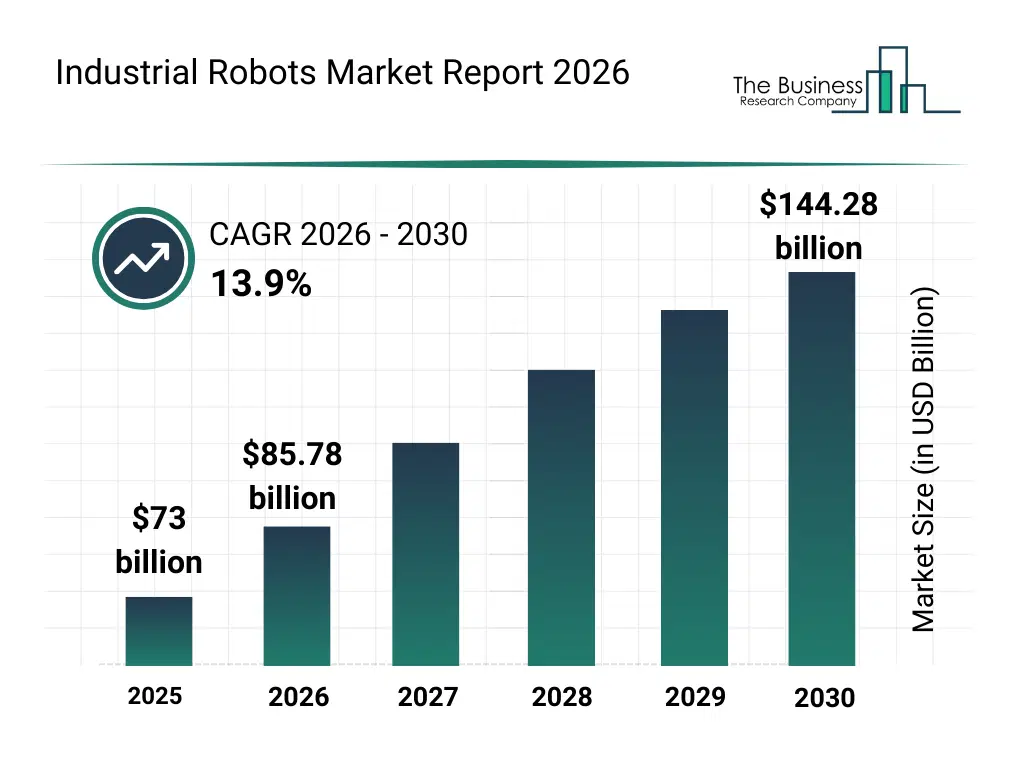
What Is The Industrial Robots Market Size and Share 2026?
The industrial robots market size has grown rapidly in recent years. It will grow from $73 billion in 2025 to $85.78 billion in 2026 at a compound annual growth rate (CAGR) of 17.5%. The growth in the historic period can be attributed to labor cost pressures, demand for consistent quality, automotive automation growth, industrial productivity needs, safety improvements in manufacturing.What Is The Industrial Robots Market Growth Forecast?
The industrial robots market size is expected to see rapid growth in the next few years. It will grow to $144.28 billion in 2030 at a compound annual growth rate (CAGR) of 13.9%. The growth in the forecast period can be attributed to advanced manufacturing adoption, shortage of skilled labor, AI-enabled automation, customization in production, expansion of smart factories. Major trends in the forecast period include increasing adoption of collaborative robots, expansion of automated manufacturing lines, integration of ai-based robot control, rising demand for precision assembly, growth of flexible production systems.Tariff Impact On Industrial Robots Market
Tariffs are impacting the industrial robots market by increasing the cost of imported servomotors, controllers, sensors, gearboxes, and precision mechanical components. Automotive and electronics manufacturers in North America and Europe are most affected due to reliance on imported robotic systems, while Asia-Pacific exporters face pricing challenges. These tariffs are raising automation investment costs and slowing deployment. However, they are also encouraging local robot assembly, regional supply chain development, and innovation in cost-efficient and modular robotic solutions.
Global Industrial Robots Market Segmentation
1) By Product Type: Articulated Robots, Linear Robots, Cylindrical Robots, Parallel Robots, Scara Robots, Other Product Types 2) By Application: Pick And Plane, Wielding And Soldering, Material Handling, Assembling, Cutting And Processing, Other Applications 3) By End-User Industry: Automotive, Electrical And Electronics, Healthcare And Pharmaceuticals, Food And Beverages, Rubber And Plastics, Metals And Machinery, Other End-User Industries Subsegments: 1) By Articulated Robots: Multi-Joint Robots With Rotary Axes, Used In Assembly, Welding, And Material Handling 2) By Linear Robots: Also Known As Cartesian Robots, Operate Along Linear Axes For Pick-And-Place Tasks 3) By Cylindrical Robots: Robots With A Cylindrical Coordinate System, Used In Assembly And Spot Welding 4) By Parallel Robots: Robots With Parallel Kinematic Chains, Used In High-Speed, Precision Tasks Like Packaging 5) By Scara Robots: Selective Compliance Articulated Robot Arms, Ideal For Pick-And-Place, Assembly, And Packaging 6) By Others: Collaborative Robots (Cobots), Delta Robots For High-Speed Tasks, Spherical Robots For Specific ApplicationsWhat Is The Driver Of The Industrial Robots Market?
The shortage of skilled workers is contributing to the growth of the industrial robot’s market. There is an increase in production requirements, and due to high demand, manufacturers are not able to fulfill the supply due to a shortage of skilled labor. A shortage of skilled labor exists due to two main reasons: the presence of unskilled workers and skilled workers not available for work. According to the Bureau of Labor Statistics, as of August 2023, the US economy had a shortage of almost 600,000 stable manufacturing jobs waiting to be filled in manufacturing businesses nationwide. Producers, to maintain a high supply, are thus opting for the installation of robots. Industrial robots increase the overall productivity, efficiency, and effectiveness of the company. Therefore, the shortage of labor gives rise to other opportunities for the addition of robots to the workforce.What Is The Driver Of The Industrial Robots Market?
The shortage of skilled workers is contributing to the growth of the industrial robot’s market. There is an increase in production requirements, and due to high demand, manufacturers are not able to fulfill the supply due to a shortage of skilled labor. A shortage of skilled labor exists due to two main reasons: the presence of unskilled workers and skilled workers not available for work. According to the Bureau of Labor Statistics, as of August 2023, the US economy had a shortage of almost 600,000 stable manufacturing jobs waiting to be filled in manufacturing businesses nationwide. Producers, to maintain a high supply, are thus opting for the installation of robots. Industrial robots increase the overall productivity, efficiency, and effectiveness of the company. Therefore, the shortage of labor gives rise to other opportunities for the addition of robots to the workforce.Global Industrial Robots Market Trends and Insights
Major companies operating in the industrial robots market are developing innovative technologies, such as cobots, to leverage a competitive edge in the market. Cobots, short for collaborative robots, are a type of industrial robot designed to work alongside human workers in a shared workspace. For instance, in August 2023, Schneider Electric SE, a France-based energy management company, launched Lexium Cobot, a collaborative robot designed to handle heavy payloads, reduce downtime, and improve operational efficiency in manufacturing environments. The Lexium cobot offers features like collision detection, compact design, and easy integration, making it ideal for tasks involving heavy, repetitive, or complex operations. It aims to minimize labor shortages’ impact on productivity and space requirements while enhancing worker safety and agility in industrial plants.What Are Latest Mergers And Acquisitions In The Industrial Robots Market?
In October 2023, Rockwell Automation, a US-based provider of industrial automation products and digital transformation solutions, acquired Clearpath Robotics, Inc., for an undisclosed amount. With this acquisition, Rockwell aimed to broaden and strengthen its industrial robotics portfolio by adding autonomous mobile robot (AMR) capabilities and production logistics automation enabling end-to-end material handling, thereby enhancing its value proposition for fully automated “smart factory” solutions. Clearpath Robotics is a Canada-based provider of autonomous robotics solutions for industrial applications, including its research-oriented division and Otto Motors, which develops AMRs and fleet management software for manufacturing and logistics operations.Regional Outlook
Asia-Pacific was the largest region in the industrial robots in 2025. Western Europe was the second largest region in the global industrial robot market. The regions covered in this market report are Asia-Pacific, South East Asia, Western Europe, Eastern Europe, North America, South America, Middle East, Africa The countries covered in this market report are Australia, Brazil, China, France, Germany, India, Indonesia, Japan, Taiwan, Russia, South Korea, UK, USA, Canada, Italy, Spain.What Defines the Industrial Robots Market?
The industrial robots market consists of sales of manipulator, controller, electroactive polymers, elastic nanotubes. Values in this market are factory gate values, that is the value of goods sold by the manufacturers or creators of the goods, whether to other entities (including downstream manufacturers, wholesalers, distributors and retailers) or directly to end customers. The value of goods in this market includes related services sold by the creators of the goods.How is Market Value Defined and Measured?
The market value is defined as the revenues that enterprises gain from the sale of goods and/or services within the specified market and geography through sales, grants, or donations in terms of the currency (in USD unless otherwise specified). The revenues for a specified geography are consumption values that are revenues generated by organizations in the specified geography within the market, irrespective of where they are produced. It does not include revenues from resales along the supply chain, either further along the supply chain or as part of other products.What Key Data and Analysis Are Included in the Industrial Robots Market Report 2026?
The industrial robots market research report is one of a series of new reports from The Business Research Company that provides market statistics, including industry global market size, regional shares, competitors with the market share, detailed market segments, market trends and opportunities, and any further data you may need to thrive in the industrial robots industry. The market research report delivers a complete perspective of everything you need, with an in-depth analysis of the current and future state of the industry.Industrial Robots Market Report Forecast Analysis
| Report Attribute | Details |
|---|---|
| Market Size Value In 2026 | $85.78 billion |
| Revenue Forecast In 2035 | $144.28 billion |
| Growth Rate | CAGR of 17.5% from 2026 to 2035 |
| Base Year For Estimation | 2025 |
| Actual Estimates/Historical Data | 2020-2025 |
| Forecast Period | 2026 - 2030 - 2035 |
| Market Representation | Revenue in USD Billion and CAGR from 2026 to 2035 |
| Segments Covered | Product Type, Application, End-User Industry |
| Regional Scope | Asia-Pacific, Western Europe, Eastern Europe, North America, South America, Middle East, Africa |
| Country Scope | The countries covered in the report are Australia, Brazil, China, France, Germany, India, ... |
| Key Companies Profiled | ABB Ltd, FANUC Corporation, Yaskawa Electric Corporation, Mitsubishi Electric Corporation, Kawasaki Heavy Industries, Ltd., KUKA AG, Denso Corporation, Siasun, Estun, JAKA, Epson India, Omron Corporation, Nachi-Fujikoshi Corp., Agile Robots, Youibot, Fruitcore Robotics, Campetella Robotic Center, Seiko Epson Corporation, Codian Robotics B.V., Mecademic, Schubert UK Ltd, Boston Dynamics, Wandelbots, Proviti, Rinf.tech, Effort, MIP Robotics, Servnews, Multivac UK, Mech-Mind Robotics, Bluewrist Inc., Yuanda Robotics, Simplex Robotics |
| Customization Scope | Request for Customization |
| Pricing And Purchase Options | Explore Purchase Options |