
Industrial Automation Market 2026
Industrial Automation Market 2026
By Component (Industrial Robots, Human Machine Interface (HMI), Industrial Sensors, Control Valves, Other Components), By Control System (Supervisory Control And Data Acquisition (SCADA), Programmable Logic Controller (PLC), Distributed Control System (DCS), Manufacturing Execution System (MES), Product Lifecycle Management (PLM), Enterprise Resource Planning (ERP), Other Control Systems), By Industry (Aerospace And Defense, Automotive, Healthcare, Energy And Utilities, Food And Beverages, Oil And Gas, Mining, Transportation, Pulp And Paper, Process Industries, Other Industries), And By Region, Opportunities And Strategies – Global Forecast To 2035
Industrial Automation Market Definition
Industrial automation is the use of control systems, machines, and advanced technologies such as robotics, sensors, programmable logic controllers (PLCs), and artificial intelligence to operate and monitor industrial processes with minimal human intervention. It enables real-time control, data collection, and optimization of manufacturing and production systems. The primary purpose of industrial automation is to increase productivity, efficiency, and precision while reducing human error, operational costs, and downtime. The industrial automation market consists of sales, by entities (organizations, sole traders, or partnerships), of advanced technologies, systems, and services that automate and control industrial processes with minimal human intervention. It includes products such as hardware (like robotics, PLCs, and sensors), software, and support services used to increase efficiency, productivity, and safety in manufacturing and other industrial sectors.

Industrial Automation Market Size
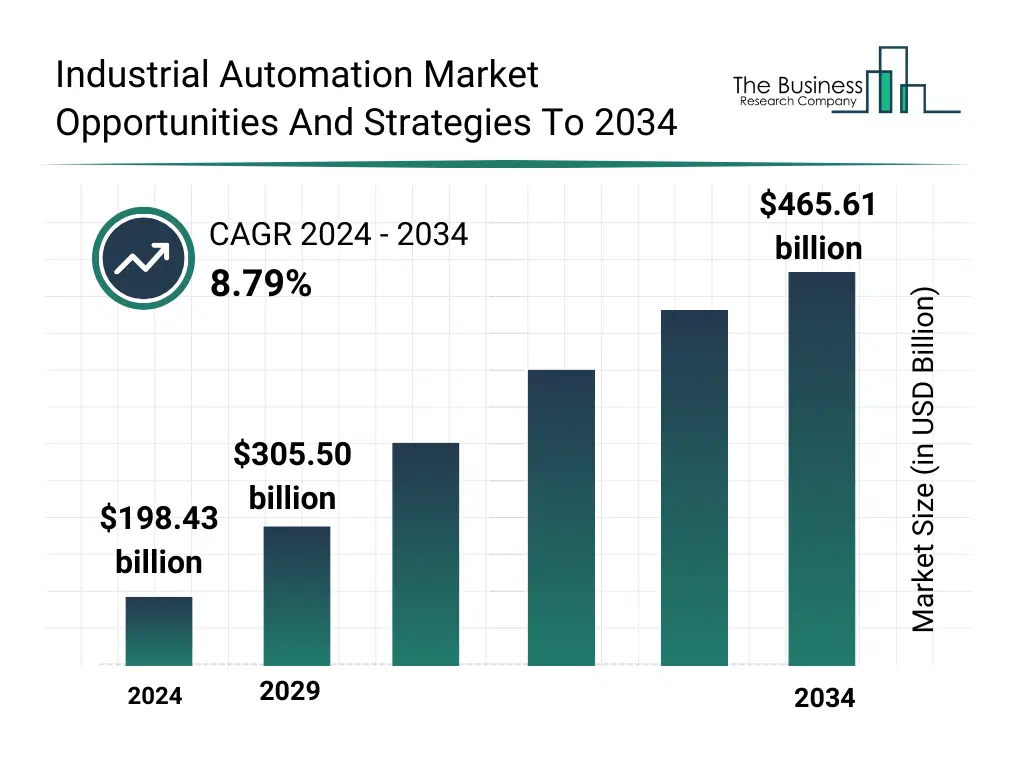
The global industrial automation market reached a value of nearly $198,434.68 million in 2024, having grown at a compound annual growth rate (CAGR) of 6.12% since 2019. The market is expected to grow from $198,434.68 million in 2024 to $305,498.60 million in 2029 at a rate of 9.01%. The market is then expected to grow at a CAGR of 8.79% from 2029 and reach $465,611.57 million in 2034. Growth in the historic period resulted from labor cost pressures and skills shortage, increasing adoption of robotics, increasing automotive production and rising collaboration with cobots. Factors that negatively affected growth in the historic period were cyber-security concerns and slow workforce transition. Going forward, increase in smart factory initiatives and industry 4.0, demand for customization and flexible manufacturing, growth in electronics and semiconductor sector and rise in integration of IoT, artificial intelligence (AI) and machine learning (ML) will drive the growth. Factors that could hinder the growth of the industrial automation market in the future include impact of trade war and tariff, regulatory and compliance hurdles and high initial investment and financing constraintss.Industrial automation Market Drivers
The key drivers of the industrial automation market include: Demand For Customization And Flexible Manufacturing During the forecast period, the industrial automation market is expected to experience significant growth driven by the rising demand for customization and flexible manufacturing. As industries transition from traditional mass production toward adaptive, on-demand manufacturing systems, automation technologies are becoming vital for meeting diverse and rapidly evolving customer needs. To achieve greater flexibility, manufacturers are increasingly adopting digital design tools, robotics, and additive manufacturing technologies that enable rapid product variation, minimize downtime, and simplify production line reconfiguration. This shift toward flexible automation allows companies to deliver customized products efficiently, without compromising on quality or cost-effectiveness. Furthermore, advancements in 3D printing and smart manufacturing systems are accelerating this evolution, fostering innovation and enhancing responsiveness across industrial operations. As consumers and businesses continue to prioritize personalization and fast delivery, flexible and automated manufacturing solutions will play a pivotal role in shaping the future of industrial production, thereby fueling the growth of the industrial automation market throughout the forecast period. The demand for customization and flexible manufacturing growth contribution during the forecast period in 2024 is 1.75%.Industrial automation Market Restraints
The key restraints on the industrial automation market include: High Initial Investment And Financing Constraints High initial investment and financing constraints are expected to restrain the growth of the industrial automation market during the forecast period. The implementation of automation systems requires substantial capital expenditure for robotics, control systems, software integration, and workforce training, making it challenging for many manufacturers to justify the upfront costs. Small and medium-sized enterprises, in particular, face difficulties in securing the necessary funding or loans to adopt large-scale automation due to limited financial resources and long payback periods. Additionally, the cost of system customization, maintenance, and periodic upgrades further increases the overall financial burden, deterring businesses from early adoption. The high capital requirements often lead manufacturers to delay automation initiatives or opt for partial implementations instead of complete process automation. As industries continue to evaluate cost efficiency and return on investment, financial constraints and high setup costs are expected to slow the pace of automation adoption, thereby limiting the growth of the industrial automation market during the forecast period. Growth affected by high initial investment and financing constraints during the forecast period in 2024 is -1.85%.Industrial automation Market Trends
Major trends shaping the industrial automation market include: Integration Of AI-Powered Robotic Item-Picking Modules To Enhance Automation Efficiency Companies in the industrial automation market are focusing on the integration of AI-powered robotic item-picking modules designed to transform operations in industries such as fashion and logistics. These innovations emphasize improved picking accuracy, faster processing speeds, and greater flexibility in handling diverse items, helping businesses optimize efficiency and reduce reliance on manual labor. For instance, in March 2025, ABB Ltd., a Switzerland-based leader in industrial automation and robotics, expanded its robotic item-picking family by launching new AI-powered functional modules, the Fashion Inductor and Parcel Inductor, developed specifically for the fashion and logistics sectors. These modules are capable of achieving over 99.5% picking accuracy and can process up to 1,500 items per hour, offering a highly efficient and adaptable solution for complex warehouse environments. By utilizing advanced vision systems and pre-trained AI models, the company aims to deliver intelligent automation technologies that enhance speed, precision, and scalability across global logistics and e-commerce operations. Launch Of Digital Quality Management System To Enhance Manufacturing Efficiency Key companies in the adhesives market are focusing on the development of advanced Key companies in the industrial automation market are focusing on the launch of digital quality management systems designed to improve product quality, ensure regulatory compliance, and accelerate digital transformation in manufacturing. These innovations focus on automating inspection processes, enhancing data transparency, and reducing manual intervention, while supporting efficiency and consistency across production lines. For instance, in February 2025, Yokogawa Electric Corporation, a Japan-based leader in industrial automation and measurement solutions, introduced the OpreX Quality Management System, a cloud-based platform developed to support digital transformation and quality assurance in the pharmaceutical and manufacturing sectors. The system utilizes real-time data collection, AI-driven analytics, and modular design to automate quality processes, improve traceability, and enable faster decision-making. By leveraging digital connectivity and intelligent analytics, the company aims to help manufacturers strengthen operational reliability, reduce production errors, and enhance overall productivity in smart manufacturing environments.Opportunities And Recommendations In The Industrial automation Market
Opportunities – The top opportunities in the industrial automation market segmented by component will arise in the industrial robots segment, which will gain $28,808.48 million of global annual sales by 2029. The top opportunities in the industrial automation market segmented by control system will arise in the enterprise resource planning (ERP) segment, which will gain $26,780.76 million of global annual sales by 2029. The top opportunities in the industrial automation market segmented by industry will arise in the process industries segment, which will gain $27,147.37 million of global annual sales by 2029. The industrial automation market size will gain the most in China at $25,640.07 million. Recommendations- To take advantage of the opportunities, The Business Research Company recommends the industrial automation companies to focus on ai-enabled robotic picking to raise logistics productivity, focus on ai-powered robotic picking to scale automation in logistics and fashion, focus on digital quality management to strengthen manufacturing performance, focus on generative ai assistants to improve engineering productivity, focus on sustainable digital switchgear to modernize power distribution, focus on smart sensor and protection devices to upgrade medium-voltage networks, focus on industrial sensors for scalable growth, focus on enterprise resource planning to lead digital integration, focus on healthcare to capture the fastest expansion, expand in emerging markets, continue to focus on developed markets, focus on disciplined value-led pricing for durable growth, build promotion around measurable operational and financial outcomes, concentrate promotional investment on high-intent accounts and use cases, focus on people capabilities aligned with automotive operations.Industrial Automation Market Segmentation
The industrial automation market is segmented by component, by control system and by Industry.By Component –
The industrial automation market is segmented by component into:
- a) Industrial Robots
- b) Human Machine Interface (Hmi)
- c) Industrial Sensors
- d) Control Valves
- e) Other Components
By Control System –
The industrial automation market is segmented by control system into:
- a) Supervisory Control And Data Acquisition (SCADA)
- b) Programmable Logic Controller (PLC)
- c) Distributed Control System (DCS)
- d) Manufacturing Execution System (MES)
- e) Product Lifecycle Management (PLM)
- f) Enterprise Resource Planning (ERP)
- g) Other Control Systems
By Industry –
The industrial automation market is segmented by industry into:
- a) Aerospace And Defense
- b) Automotive
- c) Healthcare
- d) Energy And Utilities
- e) Food And Beverages
- f) Oil And Gas
- g) Mining
- h) Transportation
- i) Pulp And Paper
- j) Process Industries
- k) Other Industries
By Geography - The industrial automation market is segmented by geography into:
- • China
- • India
- • Japan
- • Australia
- • Indonesia
- • South Korea
- • Bangladesh
- • Thailand
- • Vietnam
- • Malaysia
- • Singapore
- • Phillipines
- • Hong kong
- • New Zealand
- • USA
- • Canada
- • Mexico
- • Brazil
- • Argentina
- • Chile
- • Colombiia
- • Peru
- • France
- • Germany
- • UK
- • Italy
- • Spain
- • Austria
- • Belgium
- • Denmark
- • Finland
- • Ireland
- • Netherland
- • Norway
- • Portugal
- • Sweden
- • Switzerland
- • Russia
- • Czech Republic
- • Poland
- • Romania
- • Ukraine
- • Saudi Arabia
- • Israel
- • Iran
- • Turkey
- • UAE o Africa
- • Egypt
- • Nigeria
- • South Africa
-
o Asia Pacific