
Hydrogen Plants Market Report 2026
Global Outlook – By Hydrogen Type (Green Hydrogen, Blue Hydrogen, Grey Hydrogen, Brown And Black Hydrogen, Turquoise Hydrogen), By Production Method (Steam Methane Reforming, Electrolysis, Thermochemical, Biological, Direct Solar Water Splitting, Other Production Methods), By Plant Scale (Small-Scale Hydrogen Plants, Medium-Scale Hydrogen Plants, Large-Scale Hydrogen Plants), By Application (Industrial, Energy Sector, Transportation, Residential And Commercial Heating, Other Applications), By End-User Industry (Oil Refining, Chemicals, Steel, Power Generation, Transportation And Mobility) – Market Size, Trends, Strategies, and Forecast to 2035
Hydrogen Plants Market Overview
• Hydrogen Plants market size has reached to $52.75 billion in 2025 • Expected to grow to $92.07 billion in 2030 at a compound annual growth rate (CAGR) of 11.8% • Growth Driver: Rising Adoption Of Renewable Energy Sources Driving The Market Growth Due To Increasing Demand For Grid Infrastructure And Maintenance Services • Market Trend: Advancements In Large-Scale Electrolyzer Technology For Green Hydrogen Production • Asia-Pacific was the largest region and fastest growing region.What Is Covered Under Hydrogen Plants Market?
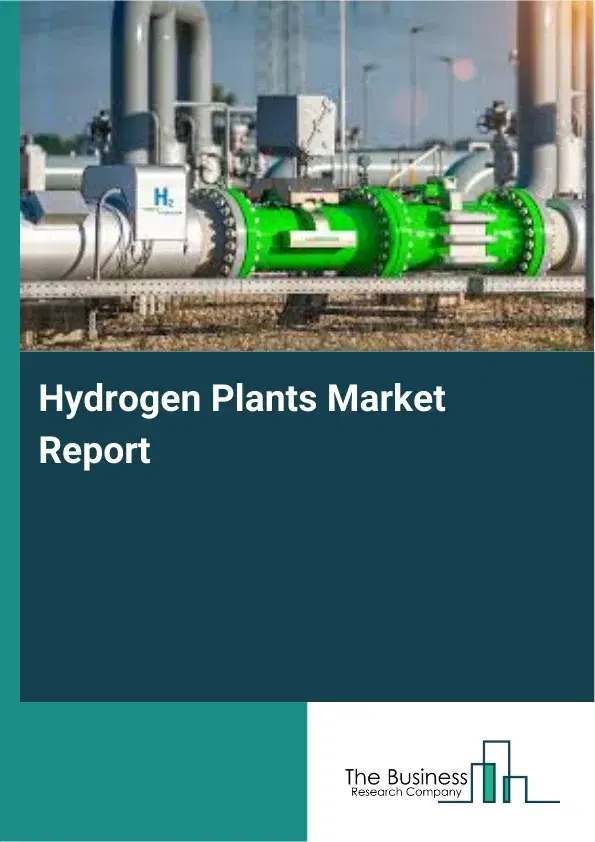
A hydrogen plant refers to an industrial facility equipped with specialized systems and processes for the large-scale production of hydrogen. It enables controlled Hydrogen Generation, purification, and handling using technologies such as electrolysis or reforming to meet required quality standards. The plant integrates production, safety, and control technologies to ensure efficient, reliable, and scalable hydrogen supply across energy, industrial, and mobility applications. The main hydrogen types of hydrogen plants are green hydrogen, blue hydrogen, grey hydrogen, brown and black hydrogen, and turquoise hydrogen. Green hydrogen refers to hydrogen produced using renewable energy sources, such as wind or solar, through processes like electrolysis, resulting in minimal carbon emissions. These plants employ various production methods, including steam methane reforming, electrolysis, thermochemical, biological, direct solar water splitting, and other production methods, and are designed at different plant scales, such as small-scale, medium-scale, and large-scale hydrogen plants. They serve multiple applications, including industrial, energy sector, transportation, residential and commercial heating, and other applications, and cater to various end-user industries, such as oil refining, chemicals, steel, power generation, and transportation and mobility.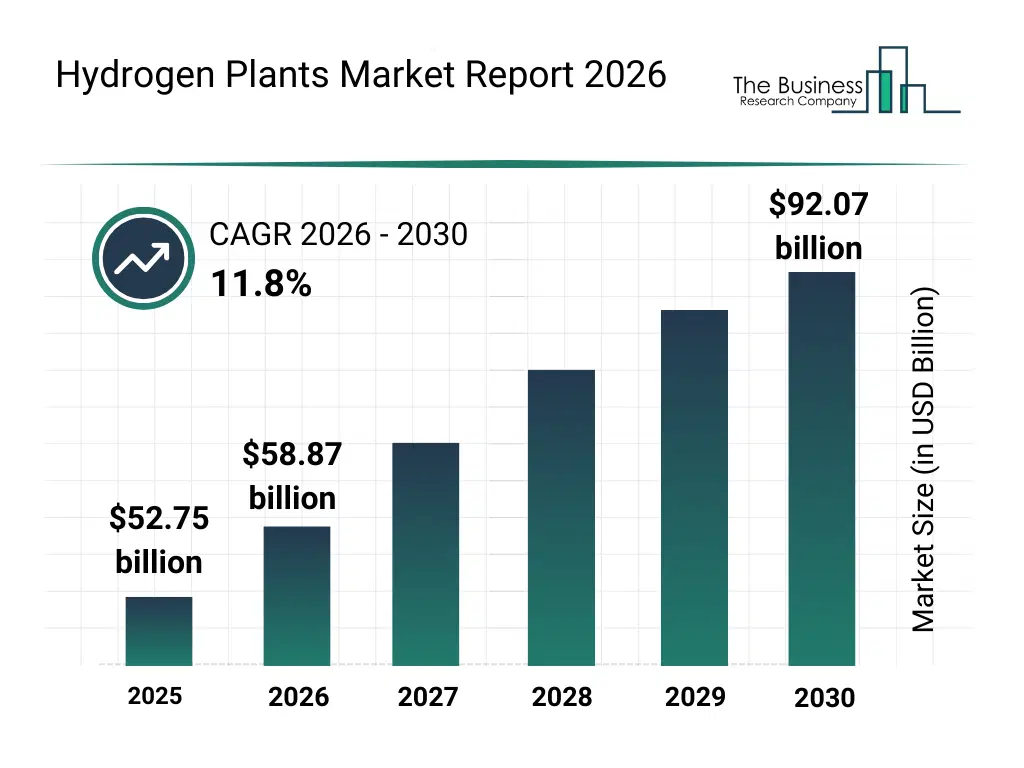
What Is The Hydrogen Plants Market Size and Share 2026?
The hydrogen plants market size has grown rapidly in recent years. It will grow from $52.75 billion in 2025 to $58.87 billion in 2026 at a compound annual growth rate (CAGR) of 11.6%. The growth in the historic period can be attributed to expansion of industrial hydrogen demand, reliance on steam methane reforming plants, increasing use of hydrogen in refining and chemicals, early investments in electrolysis technologies, development of large-scale energy infrastructure.What Is The Hydrogen Plants Market Growth Forecast?
The hydrogen plants market size is expected to see rapid growth in the next few years. It will grow to $92.07 billion in 2030 at a compound annual growth rate (CAGR) of 11.8%. The growth in the forecast period can be attributed to increasing investments in green hydrogen projects, rising demand from transportation and mobility sectors, expansion of renewable-powered electrolysis, growing policy support for hydrogen economy, increasing scale-up of hydrogen production capacity. Major trends in the forecast period include expansion of green hydrogen production facilities, rising deployment of large-scale electrolysis plants, growing integration of hydrogen into energy systems, increasing focus on plant automation and safety systems, adoption of modular hydrogen plant designs.
Global Hydrogen Plants Market Segmentation
1) By Hydrogen Type: Green Hydrogen; Blue Hydrogen; Grey Hydrogen; Brown And Black Hydrogen; Turquoise Hydrogen 2) By Production Method: Steam Methane Reforming; Electrolysis; Thermochemical; Biological; Direct Solar Water Splitting; Other Production Methods 3) By Plant Scale: Small-Scale Hydrogen Plants; Medium-Scale Hydrogen Plants; Large-Scale Hydrogen Plants 4) By Application: Industrial; Energy Sector; Transportation; Residential And Commercial Heating; Other Applications 5) By End-User Industry: Oil Refining; Chemicals; Steel; Power Generation; Transportation And Mobility Subsegments: 1) By Green Hydrogen: Alkaline Water Electrolysis–Based Plants; Proton Exchange Membrane (PEM) Electrolysis–Based Plants; Solid Oxide Electrolysis Cell (SOEC)–Based Plants; Electrolysis Using Other Renewable Sources 2) By Blue Hydrogen: Steam Methane Reforming (SMR) Plants With Carbon Capture And Storage; Autothermal Reforming (ATR) Plants With Carbon Capture And Storage; Partial Oxidation (POX) Plants With Carbon Capture And Storage 3) By Grey Hydrogen: Steam Methane Reforming (SMR) Plants Without Carbon Capture; Autothermal Reforming (ATR) Plants Without Carbon Capture 4) By Brown And Black Hydrogen: Lignite-Based Hydrogen Gasification Plants; Hard Coal-Based Hydrogen Gasification Plants 5) By Turquoise Hydrogen: Methane Pyrolysis Plants Using Plasma Technology; Methane Pyrolysis Plants Using Molten Metal Reactor TechnologyWhat Is The Driver Of The Hydrogen Plants Market?
The rising adoption of renewable energy sources is expected to propel the growth of the hydrogen plant market going forward. Renewable energy sources are power generation systems that harness naturally replenishing resources such as solar, wind, hydro, and geothermal energy to produce electricity. The adoption of renewable energy is growing due to falling costs of solar and wind technologies, which make clean energy more accessible, cost-effective, and attractive for both residential and commercial users. Hydrogen plants play a critical role in renewable energy systems by converting excess electricity from solar and wind sources into green hydrogen through electrolysis, enabling long-term energy storage. This hydrogen can later be used for power generation, transportation, and industrial applications, supporting grid stability and decarbonization. For instance, in December 2025, according to the European Commission, a Belgium-based government body, in 2024, renewable energy made up 25.2% of the EU’s total energy consumption, up from 24.6% in 2023. Therefore, the rising adoption of renewable energy sources is driving the growth of the hydrogen plant industry.Key Players In The Global Hydrogen Plants Market
Major companies operating in the hydrogen plants market are McDermott International Ltd, Jacobs Engineering Group, Fluor Corporation, Air Liquide Engineering & Construction, Linde plc, Fortescue Energy, Andritz, KBR Inc., ITM Power, John Wood Group PLC, Technip Energies N.V., Black & Veatch Holding Company, Elecnor S.A., Hatch Ltd, Mott MacDonald, ACWA Power, Topsoe, Nel ASA, Aker Solutions, HydrogenPro, Stephens Inc., and Splitwaters.Global Hydrogen Plants Market Trends and Insights
Major companies operating in the hydrogen plants market are concentrating on the development of large-scale electrolyzer technology to boost the capacity for commercial green hydrogen production and facilitate the decarbonization of various industrial sectors. Electrolyzer technology utilizes renewable electricity to separate water into hydrogen and oxygen, allowing for the production of green hydrogen with minimal carbon emissions, thereby supporting energy transition objectives. For instance, in December 2025, RWE, a Germany-based energy company, began commissioning Europe’s largest green hydrogen plant in Lingen. This facility features a 100-megawatt electrolyzer as part of the GET H2 Nukleus project, which aims to reach a total capacity of 300 MW by 2027. The hydrogen produced will be supplied to industrial customers, including TotalEnergies’ Leuna refinery, through a network of hydrogen pipelines. This emphasizes the plant's role in scaling up hydrogen production and infrastructure for industrial applications.What Are Latest Mergers And Acquisitions In The Hydrogen Plants Market?
In October 2025, Baker Hughes, a US-based provider of energy services, acquired Chart Industries for $13.6 billion. With this acquisition, Baker Hughes aims to strengthen its position across the hydrogen supply chain, from production to transport and storage, by combining Chart’s cryogenic and gas-handling technologies with its global reach. Chart Industries is a US-based provider of cryogenic equipment, gas-handling systems, and storage solutions for industrial gases, including hydrogen and liquefied gases.Regional Insights
Asia-Pacific was the largest region in the hydrogen plants market in 2025, and it is expected to be the fastest-growing region in the forecast period. The regions covered in this market report are Asia-Pacific, South East Asia, Western Europe, Eastern Europe, North America, South America, Middle East, Africa. The countries covered in this market report are Australia, Brazil, China, France, Germany, India, Indonesia, Japan, Taiwan, Russia, South Korea, UK, USA, Canada, Italy, Spain.What Defines the Hydrogen Plants Market?
The hydrogen plants market consists of sales of industrial scale production facilities, including plants based on steam methane reforming, electrolysis, and hydrogen generation technologies. Values in this market are ‘factory gate’ values, that is, the value of goods sold by the manufacturers or operators of the hydrogen plants, whether to other entities (including downstream manufacturers, wholesalers, distributors, and retailers) or directly to end customers. The value of goods in this market includes related services sold by the creators of the goods.How is Market Value Defined and Measured?
The market value is defined as the revenues that enterprises gain from the sale of goods and/or services within the specified market and geography through sales, grants, or donations in terms of the currency (in USD unless otherwise specified). The revenues for a specified geography are consumption values that are revenues generated by organizations in the specified geography within the market, irrespective of where they are produced. It does not include revenues from resales along the supply chain, either further along the supply chain or as part of other products.What Key Data and Analysis Are Included in the Hydrogen Plants Market Report 2026?
The hydrogen plants market research report is one of a series of new reports from The Business Research Company that provides market statistics, including industry global market size, regional shares, competitors with the market share, detailed market segments, market trends and opportunities, and any further data you may need to thrive in the hydrogen plants industry. The market research report delivers a complete perspective of everything you need, with an in-depth analysis of the current and future state of the industry.Hydrogen Plants Market Report Forecast Analysis
| Report Attribute | Details |
|---|---|
| Market Size Value In 2026 | $58.87 billion |
| Revenue Forecast In 2035 | $92.07 billion |
| Growth Rate | CAGR of 11.6% from 2026 to 2035 |
| Base Year For Estimation | 2025 |
| Actual Estimates/Historical Data | 2020-2025 |
| Forecast Period | 2026 - 2030 - 2035 |
| Market Representation | Revenue in USD Billion and CAGR from 2026 to 2035 |
| Segments Covered | Hydrogen Type, Production Method, Plant Scale, Application, End-User Industry |
| Regional Scope | Asia-Pacific, Western Europe, Eastern Europe, North America, South America, Middle East, Africa |
| Country Scope | The countries covered in the report are Australia, Brazil, China, France, Germany, India, ... |
| Key Companies Profiled | McDermott International Ltd, Jacobs Engineering Group, Fluor Corporation, Air Liquide Engineering & Construction, Linde plc, Fortescue Energy, Andritz, KBR Inc., ITM Power, John Wood Group PLC, Technip Energies N.V., Black & Veatch Holding Company, Elecnor S.A., Hatch Ltd, Mott MacDonald, ACWA Power, Topsoe, Nel ASA, Aker Solutions, HydrogenPro, Stephens Inc., and Splitwaters. |
| Customization Scope | Request for Customization |
| Pricing And Purchase Options | Explore Purchase Options |