
Host-Based Intrusion Detection And Prevention Market Report 2026
Host-Based Intrusion Detection And Prevention Market Report 2026
Global Outlook – By Component (Solutions, Services), By Technology (Hybrid Intrusion Detection System (NIDS), Network Intrusion Detection System (NIDS), Other Technologies), By Deployment (Cloud, On-Premises), By Organization Size (Large Enterprises, Small And Medium-sized Enterprises (SMEs)), By Industry Vertical (Banking, Financial Services, And Insurance (BFSI), Government And Defense, Healthcare And Life Sciences, Information Technology (IT) And Telecommunications, Retail And E-commerce, Manufacturing, Energy And Utilities) – Market Size, Trends, Strategies, and Forecast to 2035
Host-Based Intrusion Detection And Prevention Market Overview
• Host-Based Intrusion Detection And Prevention market size has reached to $1.06 billion in 2025 • Expected to grow to $1.87 billion in 2030 at a compound annual growth rate (CAGR) of 12.1% • Growth Driver: Rising Cybersecurity Threats Fueling The Growth Of The Market Due To Increasing Malware, Ransomware, And Advanced Endpoint Attacks • North America was the largest region in 2025 and Asia-Pacific is the fastest growing region.

What Is Covered Under Host-Based Intrusion Detection And Prevention Market?
Host-based intrusion detection and prevention refers to a cybersecurity solution that monitors and analyzes activities occurring on individual computing hosts, such as servers or endpoints, to identify malicious behavior and policy violations. It operates by inspecting system calls, file integrity, application behavior, and log data in real time to detect potential threats. The host-based intrusion detection and prevention solution can automatically respond to identified risks by blocking, isolating, or mitigating suspicious activities to protect the host system. The main components of host-based intrusion detection and prevention solutions include solutions and services. Solutions encompass software platforms for secure remote access, threat monitoring, and network management. The main deployment types include cloud and on-premises solutions, offering flexible, scalable, and centralized network security. The main technologies include hybrid intrusion detection systems (NIDS), network intrusion detection systems (NIDS), and other technologies. The organization sizes targeted are large enterprises and small and medium-sized enterprises (SMEs). These solutions are used across industry verticals including banking, financial services, and insurance (BFSI), government and defense, healthcare and life sciences, information technology (IT) and telecommunications, retail and e-commerce, manufacturing, and energy and utilities, providing secure, reliable, and threat-aware connectivity for organizations.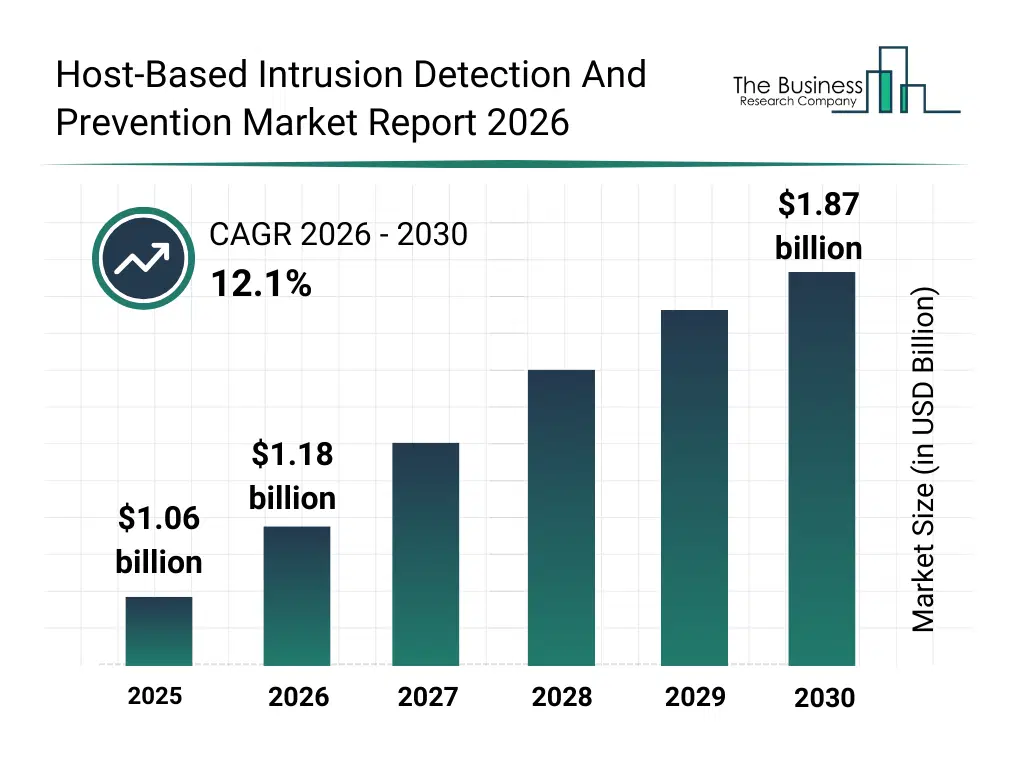
What Is The Host-Based Intrusion Detection And Prevention Market Size and Share 2026?
The host-based intrusion detection and prevention market size has grown rapidly in recent years. It will grow from $1.06 billion in 2025 to $1.18 billion in 2026 at a compound annual growth rate (CAGR) of 11.9%. The growth in the historic period can be attributed to rising cyberattacks on endpoints, increasing adoption of antivirus and firewall solutions, growing regulatory compliance requirements, expansion of enterprise IT infrastructure, rising awareness about data breaches.What Is The Host-Based Intrusion Detection And Prevention Market Growth Forecast?
The host-based intrusion detection and prevention market size is expected to see rapid growth in the next few years. It will grow to $1.87 billion in 2030 at a compound annual growth rate (CAGR) of 12.1%. The growth in the forecast period can be attributed to increasing deployment of ai-driven threat detection, growing adoption of hybrid and cloud-based idps, rising need for continuous monitoring and incident response, expansion of security solutions in smes, increasing focus on integration with it and ot environments. Major trends in the forecast period include increasing adoption of host-based intrusion prevention software, rising integration of behavioral analysis in endpoint security, expansion of log monitoring and file integrity solutions, growing demand for managed security services, rising focus on compliance and regulatory reporting.Global Host-Based Intrusion Detection And Prevention Market Segmentation
1) By Component: Solutions, Services 2) By Technology: Hybrid Intrusion Detection System (NIDS), Network Intrusion Detection System (NIDS), Other Technologies 3) By Deployment: Cloud, On-Premises 4) By Organization Size: Large Enterprises, Small And Medium-sized Enterprises (SMEs) 5) By Industry Vertical: Banking, Financial Services, And Insurance (BFSI), Government And Defense, Healthcare And Life Sciences, Information Technology (IT) And Telecommunications, Retail And E-commerce, Manufacturing, Energy And Utilities Subsegments: 1) By Solutions: Host-Based Intrusion Detection Software, Host-Based Intrusion Prevention Software, File Integrity Monitoring Software, Log Monitoring And Analysis Software, Behavioral Analysis Software 2) By Services: Implementation And Integration Services, Consulting And Advisory Services, Managed Security Services, Support And Maintenance Services, Training And Awareness ServicesWhat Is The Driver Of The Host-Based Intrusion Detection And Prevention Market?
The rising cybersecurity threats are expected to propel the growth of the host-based intrusion detection and prevention market going forward. Cybersecurity threats refer to malicious activities such as malware, ransomware, unauthorized access, and advanced persistent attacks that target systems and data to disrupt operations or steal sensitive information. The increase in cybersecurity risks is primarily driven by the rapid expansion of digital connectivity among organizations and individuals, as more systems, devices, and data assets migrate online, significantly broadening the attack surface and creating additional opportunities for cybercriminals to exploit vulnerabilities. Host-based intrusion detection and prevention solutions enhance cybersecurity by continuously monitoring endpoint activities, identifying suspicious behavior in real time, and automatically blocking threats at the system level. For instance, in April 2025, according to the Federal Bureau of Investigation, a US-based government agency, the 2024 Internet Crime Report documented 859,532 suspected internet crime complaints and reported financial losses exceeding $16 billion, reflecting a 33% year-over-year increase compared to 2023. Therefore, the rising cybersecurity threats are driving the growth of the host-based intrusion detection and prevention industry. Rising Adoption Of Remote And Hybrid Work Models Fueling The Growth Of The Market Due To Increasing Endpoint Security Needs Outside Corporate Networks The growing adoption of remote and hybrid work models is expected to propel the growth of the host-based intrusion detection and prevention market going forward. Remote and hybrid work models are flexible employment arrangements where employees perform work either fully from remote locations or through a combination of remote and on-site office work using digital connectivity tools. Remote and hybrid work models are increasing due to organizational focus on workforce flexibility and distributed talent access, as companies adopt location-independent work to reduce infrastructure costs and improve employee productivity and retention. Host-based intrusion detection and prevention supports remote and hybrid work adoption by securing individual endpoints operating outside traditional corporate network boundaries through continuous monitoring, threat detection, and prevention of unauthorized access, which helps organizations maintain security control across dispersed workforces. For instance, in December 2024, according to the U.S. Office of Personnel Management, a US-based federal government agency, remote work eligibility in the federal government rose from 52% of employees in fiscal year 2022 to 57% in fiscal year 2023. Therefore, the growing adoption of remote and hybrid work models is driving the growth of the host-based intrusion detection and prevention industry.Key Players In The Global Host-Based Intrusion Detection And Prevention Market
Major companies operating in the host-based intrusion detection and prevention market are Microsoft Corporation, Cisco Systems Inc., Quick Heal Technologies Limited, Palo Alto Networks Inc., Fortinet Inc., CrowdStrike Holdings Inc., Check Point Software Technologies Ltd., Trellix LLC, Trend Micro Incorporated, Elastic N.V., Sophos Ltd., Ivanti Inc., SentinelOne Inc., ESET spol. s r.o., Acronis International GmbH, Kaspersky Lab, Bitdefender S.R.L., Cybereason Inc., Atomicorp Inc., Malwarebytes Inc., and Wazuh Inc.nan
What Are Latest Mergers And Acquisitions In The Host-Based Intrusion Detection And Prevention Market?
In February 2025, Sophos Limited, a UK-based cybersecurity company, acquired SecureWorks Corp for an undisclosed amount. Through this acquisition, Sophos aims to strengthen its managed detection and response capabilities, expand its enterprise security portfolio, and enhance threat intelligence and incident response services for global customers. Secureworks Corp. is a US-based cybersecurity company that provides endpoint detection and response, threat intelligence, security analytics, and managed security.Regional Insights
North America was the largest region in the host-based intrusion detection and prevention market in 2025. Asia-Pacific is expected to be the fastest-growing region in the forecast period. The regions covered in this market report are Asia-Pacific, South East Asia, Western Europe, Eastern Europe, North America, South America, Middle East, Africa. The countries covered in this market report are Australia, Brazil, China, France, Germany, India, Indonesia, Japan, Taiwan, Russia, South Korea, UK, USA, Canada, Italy, Spain.What Defines the Host-Based Intrusion Detection And Prevention Market?
The host-based intrusion detection and prevention market consists of revenues earned by entities by providing services such as threat detection and analysis, incident response and remediation, host security configuration management, log management, compliance monitoring, vulnerability assessment, system integrity monitoring, security reporting and alerting. The market value includes the value of related goods sold by the service provider or included within the service offering. The host-based intrusion detection and prevention market also includes sales of dedicated security appliances, endpoint security servers, secure gateway appliances, network-attached security monitoring devices. Values in this market are ‘factory gate’ values, that is, the value of goods sold by the manufacturers or creators of the goods, whether to other entities (including downstream manufacturers, wholesalers, distributors, and retailers) or directly to end customers. The value of goods in this market includes related services sold by the creators of the goods.How is Market Value Defined and Measured?
The market value is defined as the revenues that enterprises gain from the sale of goods and/or services within the specified market and geography through sales, grants, or donations in terms of the currency (in USD unless otherwise specified). The revenues for a specified geography are consumption values that are revenues generated by organizations in the specified geography within the market, irrespective of where they are produced. It does not include revenues from resales along the supply chain, either further along the supply chain or as part of other products.What Key Data and Analysis Are Included in the Host-Based Intrusion Detection And Prevention Market Report 2026?
The host-based intrusion detection and prevention market research report is one of a series of new reports from The Business Research Company that provides host-based intrusion detection and prevention market statistics, including host-based intrusion detection and prevention industry global market size, regional shares, competitors with a host-based intrusion detection and prevention market share, detailed host-based intrusion detection and prevention market segments, market trends and opportunities, and any further data you may need to thrive in the host-based intrusion detection and prevention industry. This host-based intrusion detection and prevention market research report delivers a complete perspective of everything you need, with an in-depth analysis of the current and future scenario of the industry.Host-Based Intrusion Detection And Prevention Market Report Forecast Analysis
| Report Attribute | Details |
|---|---|
| Market Size Value In 2026 | $1.18 billion |
| Revenue Forecast In 2035 | $1.87 billion |
| Growth Rate | CAGR of 11.9% from 2026 to 2035 |
| Base Year For Estimation | 2025 |
| Actual Estimates/Historical Data | 2020-2025 |
| Forecast Period | 2026 - 2030 - 2035 |
| Market Representation | Revenue in USD Billion and CAGR from 2026 to 2035 |
| Segments Covered | Component, Technology, Deployment, Organization Size, Industry Vertical |
| Regional Scope | Asia-Pacific, Western Europe, Eastern Europe, North America, South America, Middle East, Africa |
| Country Scope | The countries covered in the report are Australia, Brazil, China, France, Germany, India, ... |
| Key Companies Profiled | Microsoft Corporation, Cisco Systems Inc., Quick Heal Technologies Limited, Palo Alto Networks Inc., Fortinet Inc., CrowdStrike Holdings Inc., Check Point Software Technologies Ltd., Trellix LLC, Trend Micro Incorporated, Elastic N.V., Sophos Ltd., Ivanti Inc., SentinelOne Inc., ESET spol. s r.o., Acronis International GmbH, Kaspersky Lab, Bitdefender S.R.L., Cybereason Inc., Atomicorp Inc., Malwarebytes Inc., and Wazuh Inc. |
| Customization Scope | Request for Customization |
| Pricing And Purchase Options | Explore Purchase Options |
Frequently Asked Questions
The Host-Based Intrusion Detection And Prevention market was valued at $1.06 billion in 2025, increased to $1.18 billion in 2026, and is projected to reach $1.87 billion by 2030.
request a sample hereThe global Host-Based Intrusion Detection And Prevention market is expected to grow at a CAGR of 12.1% from 2026 to 2035 to reach $1.87 billion by 2035.
request a sample hereSome Key Players in the Host-Based Intrusion Detection And Prevention market Include, Microsoft Corporation, Cisco Systems Inc., Quick Heal Technologies Limited, Palo Alto Networks Inc., Fortinet Inc., CrowdStrike Holdings Inc., Check Point Software Technologies Ltd., Trellix LLC, Trend Micro Incorporated, Elastic N.V., Sophos Ltd., Ivanti Inc., SentinelOne Inc., ESET spol. s r.o., Acronis International GmbH, Kaspersky Lab, Bitdefender S.R.L., Cybereason Inc., Atomicorp Inc., Malwarebytes Inc., and Wazuh Inc..
request a sample hereMajor trend in this market includes: nan. For further insights on this market.
request a sample hereNorth America was the largest region in the host-based intrusion detection and prevention market in 2025. Asia-Pacific is expected to be the fastest-growing region in the forecast period. The regions covered in the host-based intrusion detection and prevention market report are Asia-Pacific, South East Asia, Western Europe, Eastern Europe, North America, South America, Middle East, Africa.
request a sample here