
Honey Food Market Report 2026
Honey Food Market Report 2026
Global Outlook – By Product Type (Raw Honey, Processed Honey, Flavored Honey, Creamed Honey, Comb Honey, Organic Honey, Industrial-Grade Honey, Honey-Based Spreads, Honey-Infused Products, Specialty Or Monofloral Honey), By Packaging Type (Bottles, Jars, Pouches Or Sachets, Tubes, Bulk Packaging), By Distribution Channel (Supermarkets And Hypermarkets, Convenience Stores, Specialty Stores, Online Retail, Direct-To-Consumer Channels, Wholesalers And Distributors, Farm Shops And Local Markets, Other Distribution Channels), By Application (Food And Beverages, Pharmaceuticals, Cosmetics And Personal Care, Dietary Supplements, Foodservice Or HoReCa, Household Consumption, Industrial Food Processing, Other Applications) – Market Size, Trends, Strategies, and Forecast to 2035
Honey Food Market Overview
• Honey Food market size has reached to $10.11 billion in 2025 • Expected to grow to $13.91 billion in 2030 at a compound annual growth rate (CAGR) of 6.6% • Growth Driver: The Rising Demand For Natural Sweeteners Is Driving The Market Growth Due To Health Awareness And Preferences • Market Trend: Product Innovations In Naturally Flavored Honey Expand Consumer Usage And Application Scope • Asia-Pacific was the largest region in 2025 and North America is the fastest growing region.

What Is Covered Under Honey Food Market?
Honey food is a natural, sweet substance produced by bees from the nectar of flowers. It contains Sugars, enzymes, minerals, vitamins, and antioxidants, making it both a food and a functional ingredient. It is widely used as a natural sweetener in cooking and baking, as well as for medicinal and therapeutic purposes due to its antimicrobial and soothing properties. It also acts as a natural preservative and flavor enhancer in various food products. The main product types of honey food include raw honey, processed honey, flavored honey, creamed honey, comb honey, organic honey, industrial-grade honey, honey-based spreads, honey-infused products, and specialty or monofloral honey. Raw honey refers to unprocessed or minimally processed honey extracted directly from the hive, retaining natural enzymes, pollen, and nutrients without heat treatment or extensive filtration. The packaging types used include bottles, jars, pouches or sachets, tubes, and bulk packaging depending on consumer preference and end-use requirements. The distribution channels for honey food include supermarkets and hypermarkets, convenience stores, specialty stores, online retail, direct-to-consumer channels, wholesalers and distributors, farm shops and local markets, and other distribution channels. The various applications involved are food and beverages, pharmaceuticals, cosmetics and personal care, dietary supplements, foodservice or HoReCa, household consumption, industrial food processing, and other applications.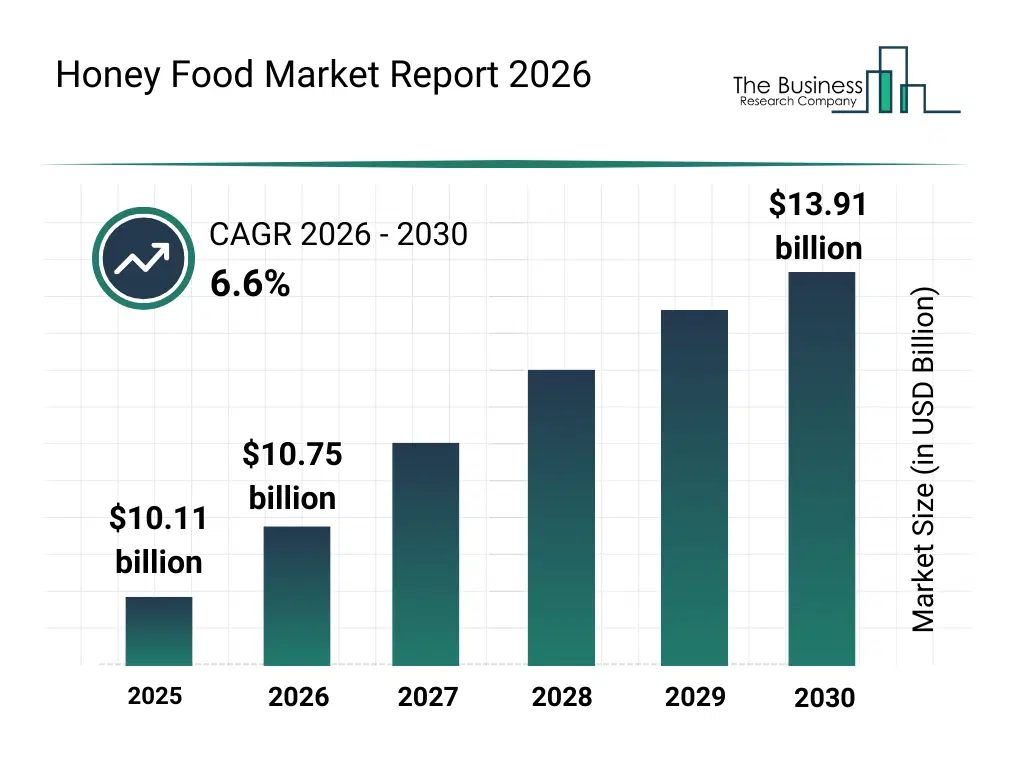
What Is The Honey Food Market Size and Share 2026?
The honey food market size has grown strongly in recent years. It will grow from $10.11 billion in 2025 to $10.75 billion in 2026 at a compound annual growth rate (CAGR) of 6.4%. The growth in the historic period can be attributed to traditional consumption of honey as a sweetener, rising awareness of honey health benefits, growth of local beekeeping and honey production, expansion of retail distribution channels, increasing use in food and beverages.What Is The Honey Food Market Growth Forecast?
The honey food market size is expected to see strong growth in the next few years. It will grow to $13.91 billion in 2030 at a compound annual growth rate (CAGR) of 6.6%. The growth in the forecast period can be attributed to rising demand for infused and functional honey products, growth of online and direct-to-consumer channels, increasing use in pharmaceuticals and cosmetics, expansion of premium and monofloral honey market, adoption of sustainable and traceable honey sourcing practices. Major trends in the forecast period include natural and organic honey demand, functional and infused honey products, premium and specialty honey segments, e-commerce and direct-to-consumer sales, health and wellness applications.Global Honey Food Market Segmentation
1) By Product Type: Raw Honey, Processed Honey, Flavored Honey, Creamed Honey, Comb Honey, Organic Honey, Industrial-Grade Honey, Honey-Based Spreads, Honey-Infused Products, Specialty Or Monofloral Honey 2) By Packaging Type: Bottles, Jars, Pouches Or Sachets, Tubes, Bulk Packaging 3) By Distribution Channel: Supermarkets And Hypermarkets, Convenience Stores, Specialty Stores, Online Retail, Direct-To-Consumer Channels, Wholesalers And Distributors, Farm Shops And Local Markets, Other Distribution Channels 4) By Application: Food And Beverages, Pharmaceuticals, Cosmetics And Personal Care, Dietary Supplements, Foodservice Or HoReCa, Household Consumption, Industrial Food Processing, Other Applications Subsegments: 1) By Raw Honey: Wildflower Raw Honey, Multiflora Raw Honey, Monofloral Raw Honey, Unfiltered Raw Honey, Cold Extracted Raw Honey 2) By Processed Honey: Pasteurized Honey, Filtered Honey, Blended Processed Honey, Heat Treated Honey, Ultrafiltered Honey 3) By Flavored Honey: Herb Infused Honey, Fruit Infused Honey, Spice Infused Honey, Vanilla Flavored Honey, Citrus Flavored Honey 4) By Creamed Honey: Spreadable Creamed Honey, Whipped Creamed Honey, Fine Crystal Creamed Honey, Flavored Creamed Honey, Artisanal Creamed Honey 5) By Comb Honey: Cut Comb Honey, Chunk Comb Honey, Whole Comb Honey, Raw Comb Honey, Premium Edible Comb Honey 6) By Organic Honey: Certified Organic Monofloral Honey, Certified Organic Wildflower Honey, Organic Raw Honey, Organic Forest Honey, Organic Mountain Honey 7) By Industrial-Grade Honey: Bulk Industrial Honey, Commercial Blended Honey, Food Processing Grade Honey, Cosmetic Grade Honey, Pharmaceutical Grade Honey 8) By Honey-Based Spreads: Honey Nut Spread, Honey Chocolate Spread, Honey Fruit Spread, Honey Butter Spread, Honey Cinnamon Spread 9) By Honey-Infused Products: Honey Infused Snacks, Honey Infused Beverages, Honey Infused Sauces, Honey Infused Confectionery, Honey Infused Wellness Products 10) By Specialty Or Monofloral Honey: Manuka Honey, Acacia Honey, Lavender Honey, Sidr Honey, Eucalyptus HoneyWhat Is The Driver Of The Honey Food Market?
The increasing demand for natural sweeteners is expected to propel the growth of the honey food market going forward. Natural sweeteners are derived from whole or minimally processed sources, such as honey, and are valued for providing sweetness along with nutritional benefits compared to refined sugars. The growing preference for natural sweeteners is driven by rising health consciousness and increased awareness of the negative health impacts associated with excessive consumption of refined sugar. Honey food supports healthier dietary choices by serving as a widely accepted natural alternative to refined sweeteners across both developed and emerging markets. For instance, in March 2024, according to the United States Department of Agriculture, a US-based government department, honey production in the United States reached 139 million pounds in 2023, representing an 11% increase compared to 2022. Therefore, the rising demand for natural sweeteners is driving the growth of the honey food industry.Key Players In The Global Honey Food Market
Major companies operating in the honey food market are Dabur India Limited, Capilano Honey Limited, GloryBee Foods Inc, Barkman Honey LLC, Dutch Gold Honey Inc, Nature Nates, Manuka Health New Zealand Limited, Dalian Sangdi Honeybee Co. Ltd., Bee Maid Honey Limited, Comvita Limited, Sioux Honey Association Cooperative, Y.S. Organic Bee Farms, New Zealand Honey Co. Ltd, Little Bee Impex Private Limited, Heavenly Organics, Beeyond the Hive, Hi Tech Natural Products India Limited, Pasiina Oy trading as Polar Honey Finland Lappi Hunaja, Golden Acres Honey Products Ltd, Anhui Mizhiyuan Food Group Co. Ltd., and Streamland Biological Technology LimitedGlobal Honey Food Market Trends and Insights
Major companies operating in the honey food market are focusing on developing innovative, naturally flavored honey products to broaden consumption occasions, enhance taste profiles, and attract health-conscious consumers. Naturally flavored honey refers to pure honey infused with natural ingredients such as fruits or spices, offering added flavor without artificial additives while retaining honey’s nutritional benefits. For instance, in November 2025, Nate’s Honey, a US-based honey brand, launched three new naturally flavored honeys designed to expand everyday honey usage beyond traditional sweetening applications. The new product range aims to appeal to consumers seeking clean-label, versatile food options and is positioned for use across multiple applications, including beverages, breakfast foods, baking, and culinary recipes, thereby supporting increased household adoption and value-added honey consumption.What Are Latest Mergers And Acquisitions In The Honey Food Market?
In February 2023, Sweet Harvest Foods Holdings, a US-based provider of natural sweeteners and honey sourcing, processing, packing, and distribution services, acquired Sweet River Honey for an undisclosed amount. Through this acquisition, Sweet Harvest Foods Holdings aims to strengthen upstream supply integration, expand beekeeping capacity, enhance sourcing transparency, and support long-term growth in the honey and natural sweetener market. Sweet River Honey is a US-based company that offers 100% pure, raw, and unfiltered honey, supported by sustainable beekeeping operations and a hive-to-table supply model.Regional Outlook
Asia-Pacific was the largest region in the honey food market in 2025. North America is expected to be the fastest-growing region in the forecast period. The regions covered in this market report are Asia-Pacific, South East Asia, Western Europe, Eastern Europe, North America, South America, Middle East, Africa. The countries covered in this market report are Australia, Brazil, China, France, Germany, India, Indonesia, Japan, Taiwan, Russia, South Korea, UK, USA, Canada, Italy, Spain.What Defines the Honey Food Market?
The honey food market consists of sales of infused honey, honey powder, honey sticks, honey lozenges, honey-based snacks, honey sweeteners, and honey blends. Values in this market are ‘factory gate’ values, that is, the value of goods sold by the manufacturers or creators of the goods, whether to other entities (including downstream manufacturers, wholesalers, distributors, and retailers) or directly to end customers. The value of goods in this market includes related services sold by the creators of the goods.How is Market Value Defined and Measured?
The market value is defined as the revenues that enterprises gain from the sale of goods and/or services within the specified market and geography through sales, grants, or donations in terms of the currency (in USD unless otherwise specified). The revenues for a specified geography are consumption values that are revenues generated by organizations in the specified geography within the market, irrespective of where they are produced. It does not include revenues from resales along the supply chain, either further along the supply chain or as part of other products.What Key Data and Analysis Are Included in the Honey Food Market Report 2026?
The honey food market research report is one of a series of new reports from The Business Research Company that provides market statistics, including industry global market size, regional shares, competitors with the market share, detailed market segments, market trends and opportunities, and any further data you may need to thrive in the honey food industry. The market research report delivers a complete perspective of everything you need, with an in-depth analysis of the current and future state of the industry.Honey Food Market Report Forecast Analysis
| Report Attribute | Details |
|---|---|
| Market Size Value In 2026 | $10.75 billion |
| Revenue Forecast In 2035 | $13.91 billion |
| Growth Rate | CAGR of 6.4% from 2026 to 2035 |
| Base Year For Estimation | 2025 |
| Actual Estimates/Historical Data | 2020-2025 |
| Forecast Period | 2026 - 2030 - 2035 |
| Market Representation | Revenue in USD Billion and CAGR from 2026 to 2035 |
| Segments Covered | Product Type, Packaging Type, Distribution Channel, Application |
| Regional Scope | Asia-Pacific, Western Europe, Eastern Europe, North America, South America, Middle East, Africa |
| Country Scope | The countries covered in the report are Australia, Brazil, China, France, Germany, India, ... |
| Key Companies Profiled | Dabur India Limited, Capilano Honey Limited, GloryBee Foods Inc, Barkman Honey LLC, Dutch Gold Honey Inc, Nature Nates, Manuka Health New Zealand Limited, Dalian Sangdi Honeybee Co. Ltd., Bee Maid Honey Limited, Comvita Limited, Sioux Honey Association Cooperative, Y.S. Organic Bee Farms, New Zealand Honey Co. Ltd, Little Bee Impex Private Limited, Heavenly Organics, Beeyond the Hive, Hi Tech Natural Products India Limited, Pasiina Oy trading as Polar Honey Finland Lappi Hunaja, Golden Acres Honey Products Ltd, Anhui Mizhiyuan Food Group Co. Ltd., and Streamland Biological Technology Limited |
| Customization Scope | Request for Customization |
| Pricing And Purchase Options | Explore Purchase Options |