

Cell Culture Supplements Market Report 2026
Global Outlook – By Product Type (Growth Factors And Cytokines, Amino Acids, Vitamins, Hormones, Attachment Factors, Other Product Types), By Source (Animal-Based, Human-Based, Synthetic, Plant-Based), By Application (Biopharmaceutical Production, Tissue Engineering And Regenerative Medicine, Diagnostics, Drug Development, Other Applications), By End-User (Pharmaceutical And Biotechnology Companies, Academic And Research Institutes, Other End-Users) - Market Size, Trends, And Global Forecast 2026-2035
Cell Culture Supplements Market Overview
• Cell Culture Supplements market size has reached to $3.96 billion in 2025 • Expected to grow to $6.23 billion in 2030 at a compound annual growth rate (CAGR) of 9.4% • Growth Driver: Increasing Focus On Regenerative Medicine Driving The Market Growth Due To Rising Therapeutic Applications • Market Trend: Advancements In Scaffold-Based 3D Cell Culture Systems Enhance Drug Screening And Tissue Modeling • North America was the largest region in 2025 and Asia-Pacific is the fastest growing region.What Is Covered Under Cell Culture Supplements Market?
Cell culture supplements are specialized formulations that enhance the growth, viability, and productivity of cells in controlled environments. They provide essential nutrients, growth factors, and signaling molecules that support optimal cell function. Cell culture supplements improve consistency and reproducibility in cell culture processes, enabling efficient and reliable outcomes and accelerating experimental and production timelines. The main product types of cell culture supplements are growth factors and cytokines, amino acids, vitamins, hormones, attachment factors, and others. Growth factors and cytokines are biologically active proteins that regulate cell growth, differentiation, and signaling in vitro to support cell culture development. The supplements are derived from several sources, including animal-based, human-based, synthetic, and plant-based, and are applied across multiple applications, such as biopharmaceutical production, tissue engineering and regenerative medicine, diagnostics, drug development, and others, and the key end-users include pharmaceutical and biotechnology companies, academic and research institutes, and others.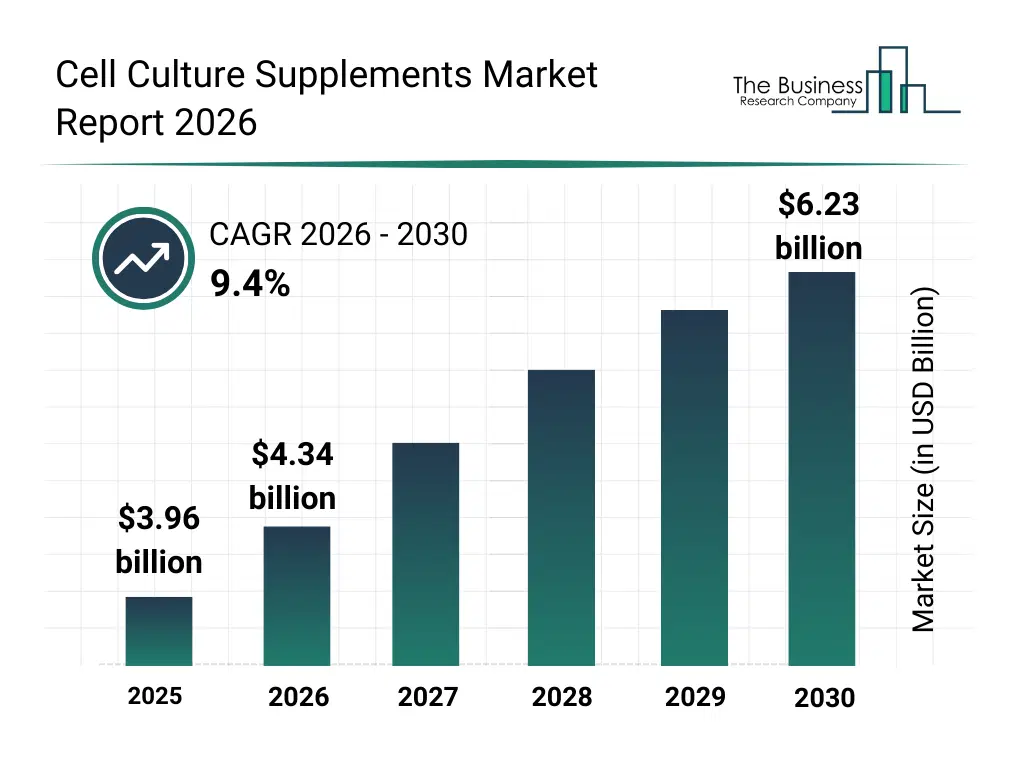
What Is The Cell Culture Supplements Market Size and Share 2026?
The cell culture supplements market size has grown strongly in recent years. It will grow from $3.96 billion in 2025 to $4.34 billion in 2026 at a compound annual growth rate (CAGR) of 9.7%. The growth in the historic period can be attributed to expansion of cell-based research activities, growth in biopharmaceutical manufacturing, increased adoption of in vitro testing models, rising investments in life science research infrastructure, growing demand for reproducible cell culture outcomes.What Is The Cell Culture Supplements Market Growth Forecast?
The cell culture supplements market size is expected to see strong growth in the next few years. It will grow to $6.23 billion in 2030 at a compound annual growth rate (CAGR) of 9.4%. The growth in the forecast period can be attributed to increasing development of cell and gene therapies, rising focus on scalable biologics production, expansion of regenerative medicine research, growing demand for xeno-free culture systems, increasing regulatory emphasis on quality-controlled cell culture inputs. Major trends in the forecast period include increasing adoption of serum-free and chemically defined supplements, rising demand for high-purity growth factors, growing use of animal-origin-free supplements, expansion of customized media formulations, enhanced focus on batch-to-batch consistency.
Global Cell Culture Supplements Market Segmentation
1) By Product Type: Growth Factors And Cytokines, Amino Acids, Vitamins, Hormones, Attachment Factors, Other Product Types 2) By Source: Animal-Based, Human-Based, Synthetic, Plant-Based 3) By Application: Biopharmaceutical Production, Tissue Engineering And Regenerative Medicine, Diagnostics, Drug Development, Other Applications 4) By End-User: Pharmaceutical And Biotechnology Companies, Academic And Research Institutes, Other End-Users Subsegments: 1) By Growth Factors And Cytokines: Epidermal Growth Factor (EGF), Fibroblast Growth Factor (FGF), Vascular Endothelial Growth Factor (VEGF), Transforming Growth Factor Beta (TGF-β), Interleukins (ILs) 2) By Amino Acids: L-Glutamine, L-Arginine, L-Lysine, L-Leucine, L-Methionine 3) By Vitamins: Vitamin A (Retinol), Vitamin B Complex, Vitamin C (Ascorbic Acid), Vitamin D, Vitamin E (Tocopherol), Vitamin K 4) By Hormones: Insulin, Cortisol, Estrogen, Progesterone, Thyroid Hormones 5) By Attachment Factors: Fibronectin, Laminin, Collagen, Vitronectin 6) By Other Product Types: Trace Elements, Lipids, Nucleotides, AntioxidantsWhat Is The Driver Of The Cell Culture Supplements Market?
The increasing focus on regenerative medicine is expected to propel the growth of the cell culture supplements market going forward. Regenerative medicine is an interdisciplinary field that harnesses biological techniques to repair, replace, or regenerate damaged cells, tissues, and organs to restore normal function. The focus on regenerative medicine is intensifying due to growing investments from both government agencies and the private sector aimed at advancing stem cell research, gene therapies, and tissue engineering solutions for treating previously incurable conditions. The heightened attention to regenerative medicine drives demand for cell culture supplements, as these products are essential for cultivating and maintaining the various cell types used in developing regenerative therapies and conducting related research. For instance, in July 2023, according to a report published by the American Society of Gene & Cell Therapy (ASGCT), a U.S.-based professional membership organization, at the end of the first quarter of 2023, there were 247 gene therapies in Phase II, and this number increased by 5%, reaching 260 by the end of the second quarter. Therefore, increasing focus on regenerative medicine is driving the growth of the cell culture supplements equipment market.Key Players In The Global Cell Culture Supplements Market
Major companies operating in the cell culture supplements market are Thermo Fisher Scientific Inc., Danaher Corporation, Merck KGaA, Becton, Dickinson and Company, GE HealthCare, Corning Incorporated, Lonza Group AG, Sartorius AG, Bio-Techne Corporation, Repligen Corporation, Takara Bio Inc., HiMedia Laboratories, PromoCell GmbH, RoosterBio Inc., Capricorn Scientific GmbH, Genexis Biotech Pvt Ltd., PromoKine GmbH, BioProcess Technologies Ltd., Jin Kairui Biotechnology Co. Ltd., FUJIFILM Irvine Scientific, Athena Enzyme Systems.Global Cell Culture Supplements Market Trends and Insights
Major companies operating in the cell culture supplements market are focusing on developing innovative products such as scaffold-based 3D cell culture systems to enhance drug screening accuracy and tissue modeling capabilities. Scaffold-based 3D cell culture systems mimic natural tissue architecture, enabling more physiologically relevant cell growth, improved disease modeling, and better prediction of drug responses. For instance, in July 2024, Bioserve India, an India-based biotechnology company, launched its advanced stem cell products featuring specialized culture media, growth factors, and tools for stem cell culture, differentiation, and disease modeling with iPSCs and ESCs. The product line also includes kits and small molecules for efficient iPSC generation from somatic cells, scaffold-based 3D cell culture systems for drug screening and toxicity testing, cellular assays to assess cell viability, proliferation, and metabolic activity, and preclinical services using human tissue technology to predict clinical outcomes. Additionally, the product portfolio offers a global biorepository with over 600,000 biospecimens and research tools such as antibodies, proteins, and genomic analysis kits to support diverse scientific investigations. These offerings aim to boost stem cell research and therapy development in the Indian market.What Are Latest Mergers And Acquisitions In The Cell Culture Supplements Market?
In May 2025, PL BioScience, a Germany-based provider of life sciences research products and cell culture supplements, partnered with DewCell Biotherapeutics to advance fully animal-free, high-performance cell culture supplements for safer and more ethical bioprocessing. The collaboration aims to develop and supply scalable, synthetic human platelet lysate (HPL) media, meeting regulatory demand for standardized, animal-free solutions in cell therapy and biopharmaceutical production. DewCell Biotherapeutics is a South Korea-based provider of synthetic, animal-free human platelet lysate for cell culture applications.Regional Outlook
North America was the largest region in the cell culture supplements market in 2025. Asia-Pacific is expected to be the fastest-growing region in the forecast period. The regions covered in this market report are Asia-Pacific, South East Asia, Western Europe, Eastern Europe, North America, South America, Middle East, Africa. The countries covered in this market report are Australia, Brazil, China, France, Germany, India, Indonesia, Japan, Taiwan, Russia, South Korea, UK, USA, Canada, Italy, Spain.What Defines the Cell Culture Supplements Market?
The cell culture supplements market consists of sales of fetal bovine serum, human serum, extracellular matrix proteins, and supplements for differentiation. Values in this market are ‘factory gate’ values, that is, the value of goods sold by the manufacturers or creators of the goods, whether to other entities (including downstream manufacturers, wholesalers, distributors, and retailers) or directly to end customers. The value of goods in this market includes related services sold by the creators of the goods.How is Market Value Defined and Measured?
The market value is defined as the revenues that enterprises gain from the sale of goods and/or services within the specified market and geography through sales, grants, or donations in terms of the currency (in USD unless otherwise specified). The revenues for a specified geography are consumption values that are revenues generated by organizations in the specified geography within the market, irrespective of where they are produced. It does not include revenues from resales along the supply chain, either further along the supply chain or as part of other products.What Key Data and Analysis Are Included in the Cell Culture Supplements Market Report 2026?
The cell culture supplements market research report is one of a series of new reports from The Business Research Company that provides market statistics, including industry global market size, regional shares, competitors with the market share, detailed market segments, market trends and opportunities, and any further data you may need to thrive in the cell culture supplements industry. The market research report delivers a complete perspective of everything you need, with an in-depth analysis of the current and future state of the industry.Cell Culture Supplements Market Report Forecast Analysis
| Report Attribute | Details |
|---|---|
| Market Size Value In 2026 | $4.34 billion |
| Revenue Forecast In 2035 | $6.23 billion |
| Growth Rate | CAGR of 9.7% from 2026 to 2035 |
| Base Year For Estimation | 2025 |
| Actual Estimates/Historical Data | 2020-2025 |
| Forecast Period | 2026 - 2030 - 2035 |
| Market Representation | Revenue in USD Billion and CAGR from 2026 to 2035 |
| Segments Covered | Product Type, Source, Application, End-User |
| Regional Scope | Asia-Pacific, Western Europe, Eastern Europe, North America, South America, Middle East, Africa |
| Country Scope | The countries covered in the report are Australia, Brazil, China, France, Germany, India, ... |
| Key Companies Profiled | Thermo Fisher Scientific Inc., Danaher Corporation, Merck KGaA, Becton, Dickinson and Company, GE HealthCare, Corning Incorporated, Lonza Group AG, Sartorius AG, Bio-Techne Corporation, Repligen Corporation, Takara Bio Inc., HiMedia Laboratories, PromoCell GmbH, RoosterBio Inc., Capricorn Scientific GmbH, Genexis Biotech Pvt Ltd., PromoKine GmbH, BioProcess Technologies Ltd., Jin Kairui Biotechnology Co. Ltd., FUJIFILM Irvine Scientific, Athena Enzyme Systems. |
| Customization Scope | Request for Customization |
| Pricing And Purchase Options | Explore Purchase Options |